
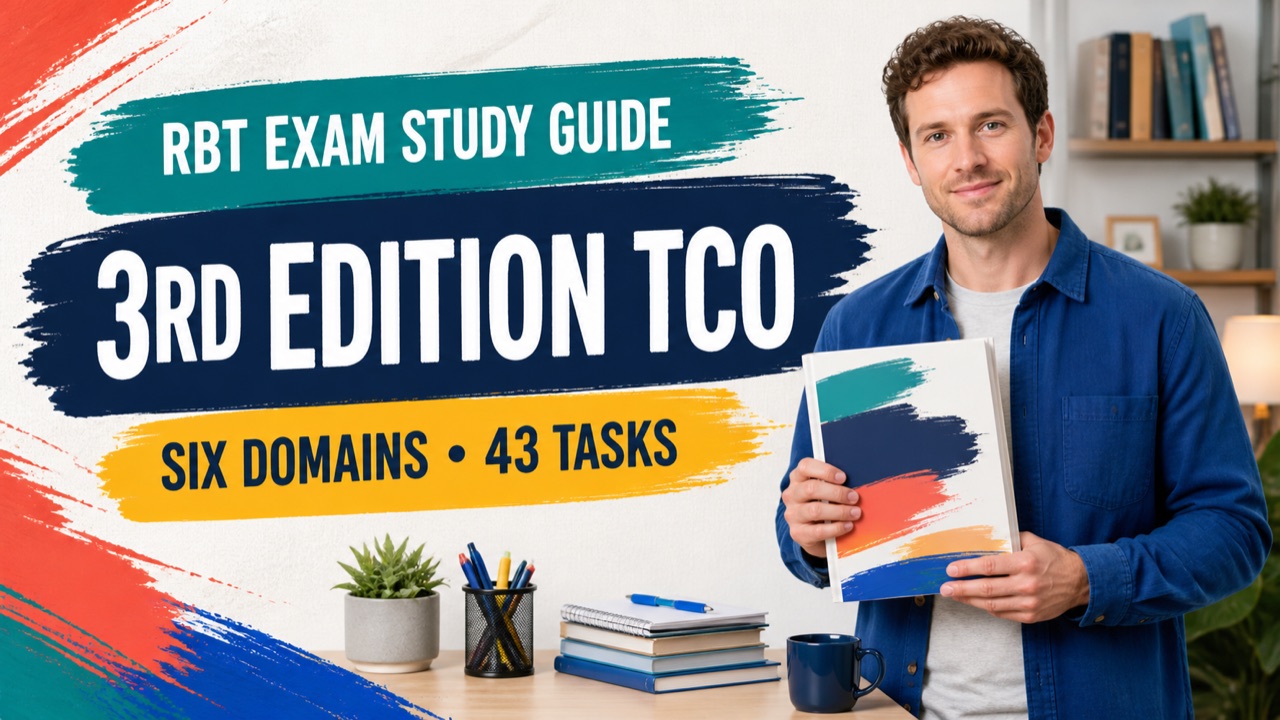
An RBT exam study guide is most useful when it tells you what to learn, how to recognize it in a scenario, and what to do when the question tests a role boundary. A long list of definitions can feel productive while leaving the hardest decisions unpracticed. The better approach is to use the current RBT Test Content Outline as a map, then build a study routine around tasks, examples, contrasts, and review evidence.
Table of Contents
- What an RBT exam study guide should organize
- Map an RBT exam study guide to the current TCO
- Build an RBT exam study guide by domain
- Turn an RBT exam study guide into daily blocks
- Review an RBT exam study guide with contrasts
- Audit your RBT exam study guide before test day
- Common RBT exam study guide mistakes
- A two-pass RBT exam study guide plan
- Frequently Asked Questions
- References
This guide is aligned with the Behavior Analyst Certification Board’s RBT Test Content Outline, 3rd edition. The TCO describes 43 tasks across six domains, with 75 scored questions and 10 unscored pilot questions described for the examination. Independent study materials may use different counts, formats, or scoring. These are not official, recalled, leaked, or BACB-endorsed questions, and a study plan cannot guarantee a passing result.
Use the article as a framework: map the content, schedule the work, test application, and repair the distinctions that keep returning in your error log.
What an RBT exam study guide should organize
A complete study guide should organize four layers rather than one pile of terms.
- Content layer: the current TCO domains and tasks that define the scope.
- Decision layer: the observable clue, measurement, procedure, or ethics boundary that changes the best answer.
- Practice layer: new scenarios that require you to apply the rule instead of repeat a memorized sentence.
- Correction layer: an error log that records what you missed, why you missed it, and what you will do differently next time.
This structure also helps you evaluate online resources. A flashcard deck may support recall. A video may model a distinction. A practice set may reveal an application gap. None of those formats is automatically a complete study guide. The question is whether they connect to the current TCO and lead to a specific next action.
Map an RBT exam study guide to the current TCO
The TCO’s six-domain structure gives your study guide a stable spine. The current distribution for the 75 scored questions is:
| Domain | Scored share | Study focus |
|---|---|---|
| A. Data Collection and Graphing | 13 / 17% | Observable descriptions, measurement systems, data collection, calculations, graphing, and trend reading. |
| B. Behavior Assessment | 8 / 11% | Preference assessments, skill assessments, functional-assessment participation, and following the assigned procedure. |
| C. Behavior Acquisition | 19 / 25% | Teaching arrangements, reinforcement, prompting and fading, shaping, chaining, discrimination, maintenance, and generalization. |
| D. Behavior Reduction | 14 / 19% | Functions, antecedent strategies, differential reinforcement, extinction, punishment, crisis procedures, and safety. |
| E. Documentation and Reporting | 10 / 13% | Objective notes, timely reporting, data irregularities, confidentiality, and supervisor communication. |
| F. Ethics | 11 / 15% | Competence, supervision, professional boundaries, public statements, gifts, cultural humility, and protecting client information. |
The TCO includes 43 tasks across these six domains. A practical study guide can use the task ranges as checkpoints without pretending that an independent quiz reproduces the official examination. The TCO’s 75 scored questions and 10 unscored pilot questions should also remain distinct in your notes; a resource provider’s item count does not change the official content map.
Build an RBT exam study guide by domain
For each domain, write one page with the same five fields. Consistency makes weak areas easier to compare.
- Core terms: define only the terms you need to make the next decision.
- Observable clue: write what the stem would show, count, time, or record.
- Procedure boundary: note what must be followed as written and when supervisor direction matters.
- Common contrast: name the pair you confuse, such as count versus rate or acquisition versus maintenance.
- Fresh example: create a new scenario with different names, numbers, or settings.
For Domain A, a page might contrast count, duration, rate, latency, and percentage, then ask which unit the stem requests. For Domain C, it might contrast prompting and fading, maintenance and generalization, or a teaching step and a reinforcement decision. For Domain F, it might pair a tempting but impermissible action with the correct boundary: protect confidentiality, stay within competence, and seek supervision when needed.
The point is not to make six attractive pages. The point is to make six usable decision maps. If a page contains only a definition, it is not finished until you can apply the term to a short case.
Turn an RBT exam study guide into daily blocks
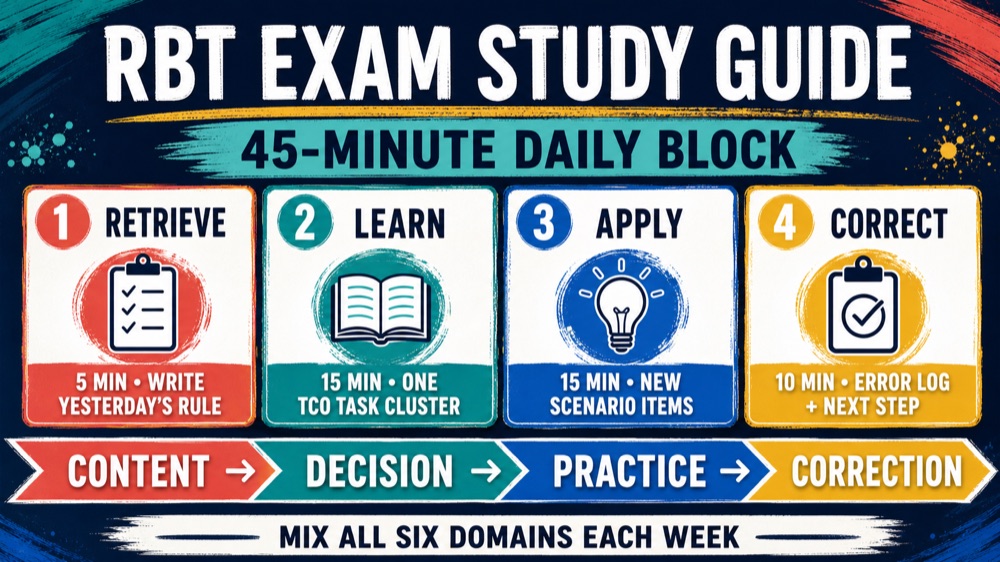
A study guide becomes actionable when each session has a small output. Try a 45-minute block:
- Five minutes: retrieve. Without notes, write the rule from yesterday and one distinction it protects.
- Fifteen minutes: learn. Read one TCO task cluster or review one concept page. Keep the scope narrow.
- Fifteen minutes: apply. Answer a few new scenario items. Mark confidence before checking explanations.
- Ten minutes: correct. Add missed or low-confidence items to the error log with the decisive clue and corrected rule.
Rotate the domains across the week. Give extra blocks to a cluster that produces repeated errors, not just to the domain with the largest percentage. A smaller domain can still contain a high-impact role or ethics boundary. At the end of each week, use a mixed set so you practice switching between measurement, acquisition, documentation, and ethics rather than recognizing a domain from its heading.
If you have less time, keep the sequence and shorten each block. If you have more time, add a second application block with new scenarios. Do not replace application with rereading; the exam-style decision is the part that needs evidence.
Review an RBT exam study guide with contrasts
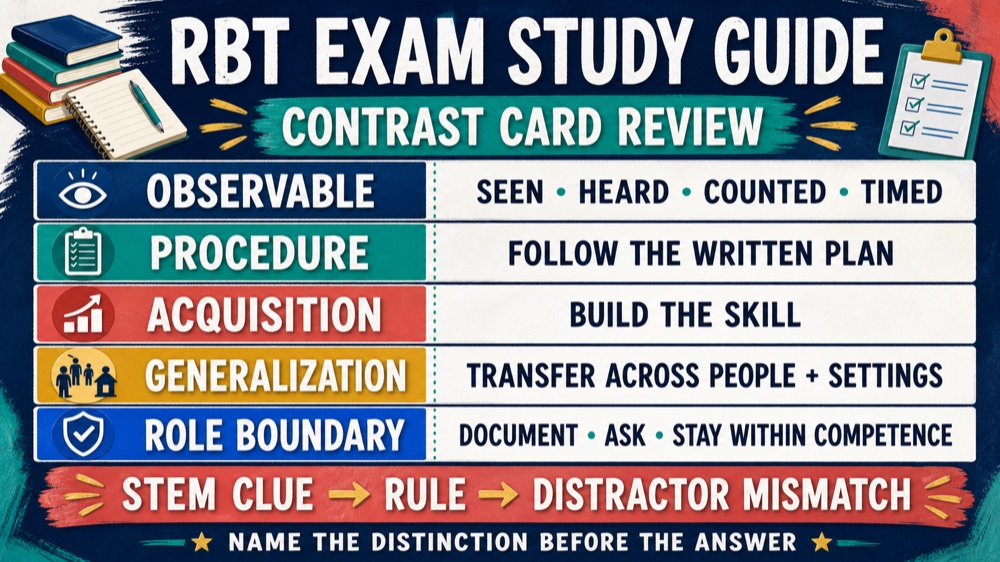
Many questions become easier when you compare the best answer with the strongest wrong answer. Use a contrast card with three lines: “The stem shows…,” “The rule requires…,” and “The distractor fails because…”.
Observable description versus interpretation
Record what was seen, heard, counted, timed, or recorded separately from a hypothesis about why it happened. A hypothesis may be important for assessment and supervision, but it is not automatically a data statement.
Following a plan versus inventing an intervention
If the scenario gives a written teaching or behavior-reduction procedure, select the option that follows it. A more complicated intervention is not automatically better. If the plan is unclear or the situation falls outside demonstrated competence, documentation and supervisor direction matter.
Acquisition versus maintenance and generalization
Ask whether the learner is still building the skill, demonstrating it after teaching, or using it across people, settings, or materials. The same target can require different evidence at each stage.
Count versus rate
If a learner makes six responses in 30 minutes, count is six responses; rate incorporates the time unit and is 0.2 responses per minute. The answer follows the requested measurement, not the number that looks most familiar.
Documentation versus private problem-solving
When data are unusual, a caregiver reports a concern, or a safety procedure is triggered, the RBT should not conceal the event or improvise outside the plan. Accurate reporting and timely direction protect the client and the integrity of the record.
Audit your RBT exam study guide before test day
Before you call the guide complete, run a short audit:
- Does it name the RBT Test Content Outline, 3rd edition?
- Does it include all six domains and the 43-task scope?
- Does it distinguish 75 scored questions from 10 unscored pilot questions?
- Does every domain have a decision rule, a contrast, and a fresh example?
- Does the practice section use independent, newly written scenarios rather than claims about official or recalled items?
- Does the error log show what you changed after a miss?
- Does the plan include documentation, supervision, ethics, and competence boundaries rather than only technical procedures?
If the answer to one of these is no, repair the guide before adding more resources. More pages do not automatically solve a missing decision rule.
Common RBT exam study guide mistakes
- Using an old topic map without checking the edition. Current terms and emphasis should be verified against the 3rd-edition TCO.
- Studying by percentage only. The distribution helps prioritize, but a small domain may contain a decision you cannot safely guess.
- Collecting resources without outputs. Each session should produce a definition, contrast, scenario explanation, or repaired error.
- Memorizing answer letters. New wording should not break a rule you genuinely understand.
- Ignoring role boundaries. An RBT study guide must include following written procedures, competence, supervision, documentation, and confidentiality.
- Treating a practice score as a guarantee. A score is evidence for the next study action, not an official result.
A two-pass RBT exam study guide plan
In Pass One, build coverage. Touch all six domains, write one contrast per domain, and complete enough application items to identify repeated errors. In Pass Two, build transfer. Mix the domains, change the setting and numbers, and explain why the strongest distractor fails. Keep the official TCO open as the map, but make your examples original and independent.
For additional preparation, compare the site’s RBT exam-prep materials, use section practice for a targeted domain, and return to the free RBT mock exam for mixed rehearsal. Use the official RBT Test Content Outline, the RBT Handbook, and the RBT Ethics Code as source boundaries. These resources support preparation but do not turn independent content into official BACB material.
Bottom line: the best RBT exam study guide is a decision system. It maps the current TCO, gives you a small daily task, and makes each error produce a clearer rule and a new example.
Ready to practice the RBT concepts you just reviewed?
Try an independent, original RBT practice resource with exam-style questions, scoring, and answer explanations.
References
- Behavior Analyst Certification Board. RBT Test Content Outline, 3rd edition.
- Behavior Analyst Certification Board. RBT Handbook.
- Behavior Analyst Certification Board. RBT Ethics Code.