

An RBT study guide works best when it helps you make decisions in short behavior-analytic scenarios, not when it becomes a long glossary that you reread without checking your reasoning. Start with the current blueprint, identify the task behind each concept, and then practice the smallest observable step you need to improve.
Table of Contents
- What an RBT study guide should do
- Map the current 3rd-edition TCO before studying
- Turn the six domains into daily study blocks
- Practice concept contrasts with fresh scenarios
- Use an RBT study guide to review errors
- Build an RBT study guide review routine that you can repeat
- Common mistakes when using exam-prep resources
- Frequently Asked Questions
- References
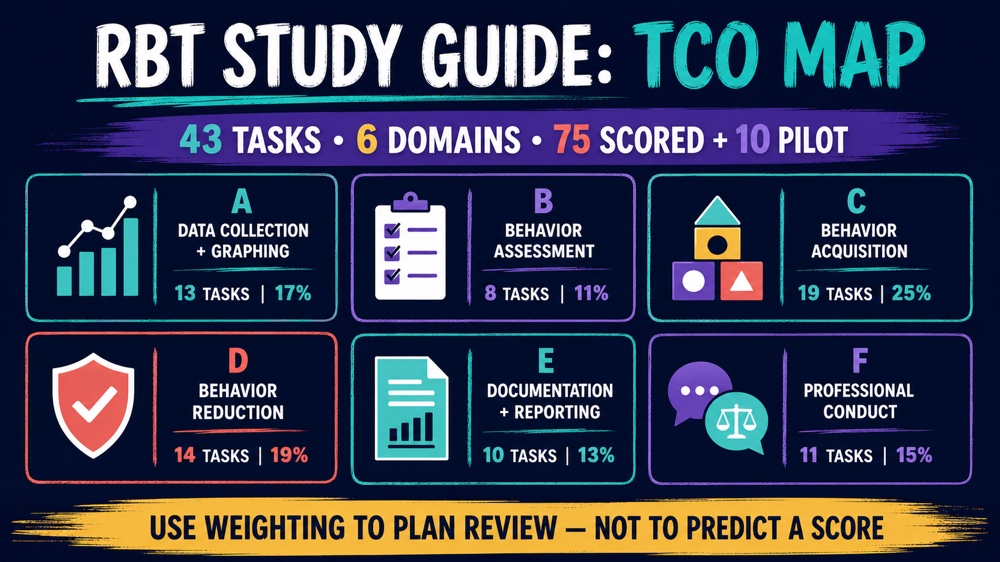
The BACB RBT Test Content Outline, 3rd edition, describes 43 tasks across six domains. Its examination blueprint includes 75 scored questions and 10 unscored pilot questions. The outline is the authority for the examination content map; it is not a public bank of test questions. The examples in this guide are independently written for study. They are not official, recalled, leaked, or BACB-endorsed questions. This guide cannot guarantee a passing result, replace the current BACB materials, or substitute for required training, supervision, or professional direction.
Use this guide as a working plan: map the domains, rehearse contrasts, record why an answer is stronger, and revisit the exact error instead of collecting another generic resource.
What an RBT study guide should do
A useful study guide should answer four questions for every topic:
- What is the term? State the definition in plain language without adding a claim that the source does not make.
- What would I observe? Translate the term into something a technician could see, hear, count, time, or document.
- Which procedure or measurement fits? Explain why the option matches the target and the written instruction.
- What is my role boundary? Identify when to follow the plan, document an observation, ask for supervisor direction, or respond to a safety concern.
For example, knowing that duration is a measurement of how long a behavior lasts is only the first layer. A scenario may ask you to select duration rather than count because the target is defined by its length. Your study response should name the observable target, the unit, and the reason the unit fits. That is more useful than memorizing a single answer letter.
Good preparation also separates current official material from independent teaching language. Read the TCO, RBT Handbook, and RBT Ethics Code for their own requirements. Then use a study guide to organize practice. If a commercial page says its questions are real, recalled, or guaranteed to predict your result, treat that as a boundary warning rather than as evidence of authority.
Map the current 3rd-edition TCO before studying
The six domains are not six equally sized chapters. The current TCO gives each area a task count and percentage weighting:
| Domain | Task count | Percentage | Study emphasis |
|---|---|---|---|
| A. Data Collection and Graphing | 13 | 17% | Units, recording systems, graphs, trends, and data quality. |
| B. Behavior Assessment | 8 | 11% | Assessment purpose, preference or skill procedures, and role boundaries. |
| C. Behavior Acquisition | 19 | 25% | Teaching procedures, prompts, reinforcement, shaping, chaining, and generalization. |
| D. Behavior Reduction | 14 | 19% | Plan fidelity, function-informed procedures, differential reinforcement, extinction, and safety. |
| E. Documentation and Reporting | 10 | 13% | Objective notes, communication, changes, and protecting client information. |
| F. Professional Conduct and Scope of Practice | 11 | 15% | Ethics, competence, supervision, boundaries, and professional communication. |
The counts total 75? No. The six domain task counts total 75 scored questions only in the examination blueprint, while the TCO itself describes 43 tasks. The distinction matters: a task count is not a promise that a specific task will appear as a fixed number of questions. The outline also includes 10 unscored pilot questions. Use the percentages to allocate review time, not to predict an individual score.
Make a one-page TCO map with three columns: task label, what competent performance would look like, and the most recent evidence that you can apply it. A blank evidence cell is a study priority. A definition copied into the cell is not enough; write a short scenario, a data unit, a procedure step, or a documentation sentence.
Turn the six domains into daily study blocks
A practical routine should reflect the TCO weighting while still revisiting smaller domains. The following is an independent planning example, not a BACB requirement:
- Ten minutes: retrieve. Without looking at notes, write the definition, target, or decision rule for three items.
- Twenty minutes: apply. Work through two fresh scenarios. State what is observable, which procedure is written, and what the RBT should do next.
- Fifteen minutes: correct. Compare your reasoning with the explanation and record the first decision point where you went off track.
- Ten minutes: communicate. Say an objective note, a supervisor question, or a one-sentence rationale aloud.
- Five minutes: schedule. Choose the exact item to repeat tomorrow and put it on the calendar.
On a five-day cycle, give the longest blocks to C and D, alternate A with E, and keep B and F in every week. A simple pattern might be Monday A plus C, Tuesday D plus F, Wednesday C plus E, Thursday A plus B, and Friday mixed retrieval with the week’s corrections. The pattern is a way to distribute practice; it is not an official exam schedule.
For each block, choose one narrow target. “Study behavior acquisition” is too broad for a 20-minute session. “Compare most-to-least prompting with a written prompt sequence and identify the reinforcement step” is specific enough to rehearse. Specific targets also make it easier to notice improvement.
Practice concept contrasts with fresh scenarios
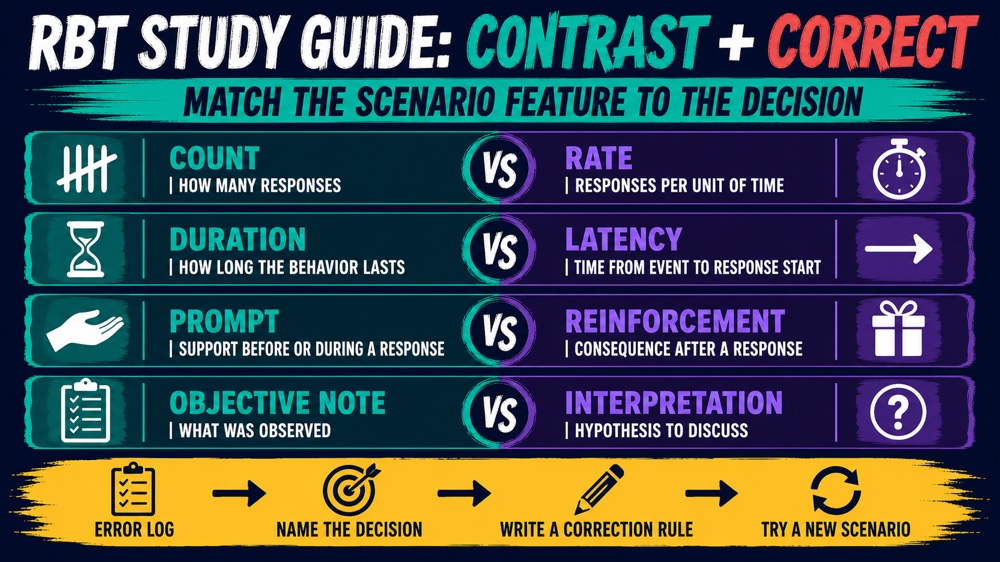
Many missed items are not caused by never seeing a definition. They happen because two familiar concepts are applied to the wrong feature of the scenario. Build contrast pairs and ask what changes the answer:
- Count versus rate: count records how many responses occurred; rate relates responses to a unit of time. If two sessions have different lengths, rate may allow a more comparable description when the procedure calls for it.
- Duration versus latency: duration is how long the behavior lasts; latency is the time between an event or instruction and the start of the response. Do not choose duration just because the behavior feels “long.”
- Preference assessment versus skill assessment: preference procedures help identify items or activities a learner may choose; skill procedures evaluate what the learner can do under specified conditions. Follow the assigned procedure and do not improvise a new assessment.
- Prompt versus reinforcement: a prompt changes the assistance provided before or during a response; reinforcement follows a response and changes its future likelihood. A preferred item is not automatically reinforcement until its effect is demonstrated in context.
- Differential reinforcement versus extinction: differential reinforcement arranges reinforcement for a defined alternative, incompatible, or other response pattern; extinction means withholding the reinforcer that previously followed a behavior, when that procedure is part of the approved plan. Do not infer a behavior function or change a plan from a single observation.
- Objective note versus interpretation: “left the table for 40 seconds after the instruction” reports observable information; “was defiant because the task was too hard” adds an interpretation that may require assessment and clinical direction.
Imagine a scenario in which a learner answers correctly after a verbal model, and the item asks what to record. The strongest response depends on the written target: you may need to record the prompt level, the correct response, the consequence, or all specified fields. The study skill is matching the answer to the procedure, not selecting the most technical-sounding phrase.
Keep your scenarios independent and new. Recalled or leaked questions do not provide a safe study foundation, and they can blur the difference between memorizing a pattern and demonstrating competence.
Use an RBT study guide to review errors
An error log is where a study guide becomes useful. Do not write only “wrong.” Classify the error by the decision that failed:
| Error type | What to record | Next repetition |
|---|---|---|
| Definition | The term I could not state accurately. | Write a plain-language definition and one observable example. |
| Discrimination | The two concepts I confused. | Create a contrast pair and underline the scenario feature that changes the answer. |
| Procedure | The step I skipped, reordered, or invented. | Read the written sequence, rehearse one clean repetition, and ask for direction if unclear. |
| Measurement | The unit or recording system I mismatched. | Name the target and unit before recording two new examples. |
| Scope and ethics | The moment I started making a clinical decision outside my role. | Practice an objective note and a concise request for supervisor guidance. |
For each error, write a one-sentence correction rule. “When the question asks how long, check duration; when it asks the delay before starting, check latency” is a usable rule. Then test the rule on a new scenario with different names, settings, and numbers. If you can only recognize the original question, the correction is not finished.
Review the log after 24 hours, again after several days, and once at the end of the week. Keep errors that recur visible. A recurring mistake is not a reason to add five resources; it is a signal to reduce the target and practice the decision aloud.
Build an RBT study guide review routine that you can repeat
At the start of the week, choose two high-weight domains and two maintenance domains. At the end of each study block, save one piece of evidence: a completed data example, a correctly ordered procedure, an objective note, or an explanation of a role boundary. At the end of the week, complete a mixed set without looking at the domain labels. This checks whether you can identify the underlying task rather than simply follow a chapter heading.
A useful weekly review has three passes:
- Map pass: compare your notes with the current TCO and mark missing tasks or outdated language.
- Application pass: answer fresh scenarios and explain why the distractors do not fit the observable facts or written plan.
- Boundary pass: practice reporting changes, protecting confidentiality, and asking for supervision when a situation exceeds your training or instructions.
Use the current RBT Handbook for certification-process instructions and the RBT Ethics Code for professional expectations. If an official source changes, update your notes instead of preserving an old summary because it is familiar. The product pages and practice resources on this site can support repetition, but they remain independent educational materials.
Common mistakes when using exam-prep resources
- Reading without retrieval: recognition feels fluent, but recall reveals what you can produce without a prompt.
- Giving every domain equal time: a balanced week is useful; identical minutes for every domain ignore the TCO weighting.
- Chasing wording instead of decisions: memorize the observable distinction and procedure step before polishing terminology.
- Using old-edition material without a label: keep the 3rd-edition TCO as the current map and identify legacy notes before relying on them.
- Confusing a study example with an official item: independent practice must be labeled honestly and should never claim to be recalled or endorsed.
- Ignoring scope: an RBT study session should strengthen implementation, documentation, communication, and escalation—not encourage independent treatment design.
Before you finish a session, ask: What did I observe? Which procedure or unit fit? What would I document? When would I ask the supervisor? Those four questions keep review connected to competent practice.
Bottom line: the strongest RBT study guide is not the longest page. It is the one that turns the 3rd-edition TCO into observable practice, makes concept contrasts explicit, and gives every error a scheduled next repetition.
Ready to practice the RBT concepts you just reviewed?
Try an independent, original RBT practice resource with exam-style questions, scoring, and answer explanations.
References
- Behavior Analyst Certification Board. RBT Test Content Outline, 3rd edition.
- Behavior Analyst Certification Board. RBT Handbook.
- Behavior Analyst Certification Board. RBT Ethics Code.