

BACB RBT ethics code study is most useful when it helps you make a safe decision in a real work situation. Ethics is not only a list of words to memorize. It affects how an RBT protects dignity, handles private information, accepts supervision, documents services, recognizes limits of competence, and responds when something is unclear.
Table of Contents
- How to study the bacb rbt ethics code
- Dignity, choice, and respectful service
- Confidentiality and information sharing
- Competence and supervision
- Objective documentation and reporting
- Professional boundaries
- Original study scenario: an ethics decision
- How ethics appears in RBT exam study
- Common ethics mistakes
- Daily ethics checklist
- Frequently Asked Questions
- References
Quick answer: Use the current official ethics materials and RBT Handbook as the controlling sources. In a scenario, identify the person’s rights, follow the written procedure, protect confidentiality, communicate with the responsible supervisor, and avoid acting beyond your training or authority.
Study boundary: This independent guide explains concepts with original examples. It is not an official code, legal advice, or an official answer key. The questions and scenarios are not official, recalled, leaked, or BACB-endorsed, and no article can guarantee certification or an examination result.
Continue your review with RBT practice questions that reinforce measurement, prompting, supervision, and ethics.
How to study the bacb rbt ethics code
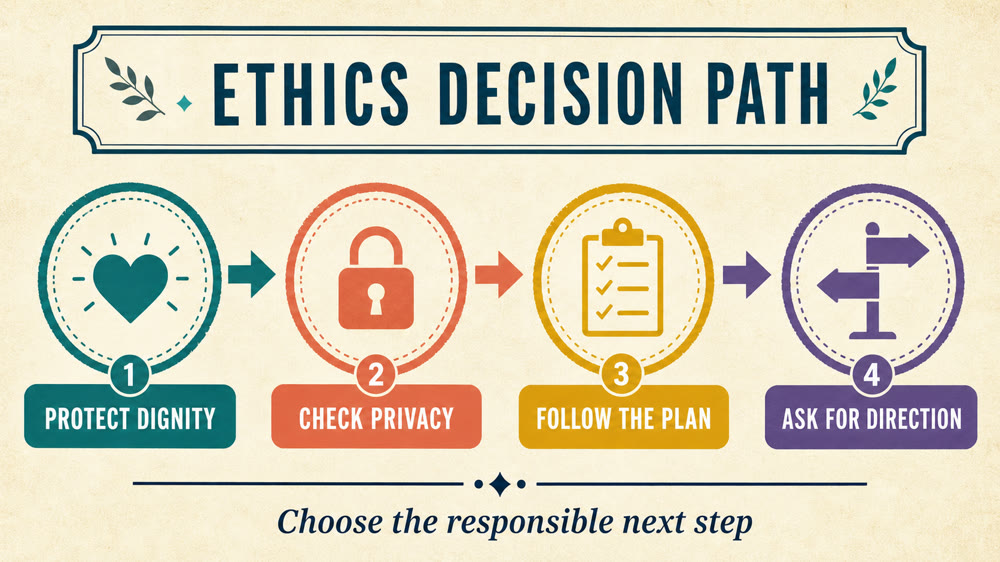
An ethics code gives professionals a framework for behavior that protects clients, families, colleagues, and the integrity of services. It helps an RBT decide what to do when convenience conflicts with privacy, when a request exceeds training, or when accurate reporting feels uncomfortable. Ethical practice means taking the next responsible step, not simply choosing the fastest step.
When reviewing bacb rbt ethics code questions, look for the answer that preserves dignity, uses the appropriate chain of communication, and stays grounded in observable facts. Be cautious with answers that promise outcomes, disclose unnecessary details, or make an independent clinical change without authorization.
Dignity, choice, and respectful service
Respectful services use person-first decision-making and avoid unnecessary embarrassment, coercion, or public discussion of private behavior. An RBT should use neutral language, explain or offer choices when the procedure allows, and follow safety directions without treating the learner as a problem to be controlled.
An original example: a learner is asked to choose between two approved materials, but the technician prefers a third item that is easier to carry. The technician should follow the written options and ask the supervisor if the plan needs revision. Convenience alone is not a reason to remove a meaningful choice.
Confidentiality and information sharing
Private information should be shared only with people who are authorized and only through approved channels. A technician should not discuss a learner’s diagnosis, behavior, schedule, or family circumstances in a public place or personal social-media account. Even a well-intentioned story can identify someone when details are combined.
- Use the approved record system rather than a personal notes app.
- Check the recipient before sending a message.
- Share only the information needed for the service or report.
- Keep paper records, screens, and devices protected.
- Ask a supervisor or workplace privacy contact when unsure.
Competence and supervision
Ethical practice requires an RBT to work within demonstrated competence and receive ongoing supervision. Completing a course or reading a definition does not automatically mean that a technician can safely implement every procedure. Training, observation, rehearsal, feedback, and documented direction help the team decide what work is appropriate.
If a supervisor asks an RBT to implement a procedure that the RBT has not been trained to perform, the RBT should communicate the limitation and request instruction. Quietly guessing may create a safety risk and unreliable data. Asking for help is a professional action, not a failure.
Objective documentation and reporting
Ethical documentation describes what occurred, what procedure was implemented, what was measured, and what relevant concern was communicated. It avoids changing an inconvenient fact to make a session look successful. If an error occurred, report it through the required process so the team can decide how to protect the learner and handle the data.
Compare “the learner left the table twice after the instruction” with “the learner was defiant.” The first statement is observable and can be connected to a measurement rule. The second is a broad interpretation. Good notes make later supervision and decision-making more accurate.
Professional boundaries
Boundaries protect both the client and the technician. An RBT should maintain appropriate communication, avoid conflicts of interest, decline gifts or relationships when workplace policy or ethical guidance makes them inappropriate, and keep the service relationship focused on the learner’s goals. When a family asks for a personal favor, the technician can respond respectfully and seek supervisor direction.
Role boundaries also apply to treatment decisions. An RBT may notice a pattern or offer an objective observation, but should not diagnose, rewrite a behavior plan, promise a result, or represent personal opinion as the team’s clinical decision.
Original study scenario: an ethics decision
Suppose a caregiver asks the RBT to send a video of a session to a private group so relatives can see progress. The RBT should not simply upload the video because the request sounds supportive. The technician should follow the organization’s consent and privacy process, consult the responsible supervisor, and use only an approved method if sharing is authorized.
The reasoning is transferable: identify the private information, check authorization, use the approved process, document the communication, and ask for direction. That sequence is more reliable than relying on a personal feeling about whether the request is harmless.
How ethics appears in RBT exam study
The current RBT Test Content Outline, 3rd edition, includes 43 tasks across six domains, with Ethics as one domain and Documentation and Reporting as another. The current examination includes 75 scored questions and 10 unscored pilot questions. Practice should focus on reasoning from the written scenario; it should never claim to reveal live questions or a secure answer key.
For each practice item, underline the privacy, competence, supervision, or reporting issue. Then identify the action that protects the person, follows the plan, and uses the correct communication channel.
Common ethics mistakes
- Confusing kindness with permission: Good intentions do not replace consent or policy.
- Using private details as casual conversation: Keep information in approved channels.
- Hiding an error: Accurate reporting supports safe correction.
- Working beyond competence: Ask for training and supervision.
- Making an independent plan change: Report observations and seek direction.
- Assuming an online summary is the code: Verify current official publications.
Daily ethics checklist
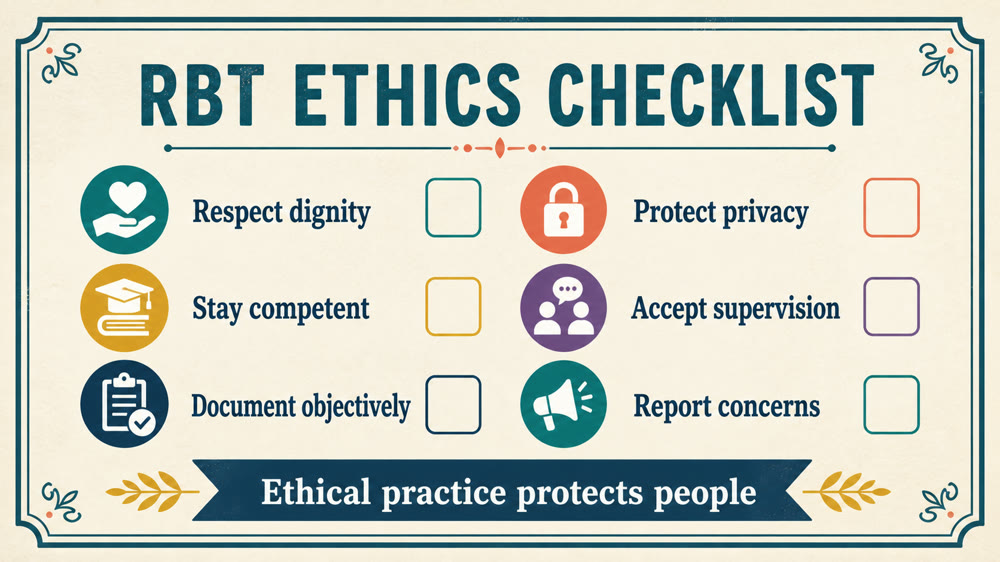
- Did I protect dignity and offer appropriate choices?
- Did I use the written procedure and stay within training?
- Did I protect private information and use approved systems?
- Did I document observations rather than unsupported conclusions?
- Did I report errors, safety concerns, or conflicts promptly?
- Did I ask the responsible supervisor when direction was unclear?
- Did I keep the service relationship professional?
Practice ethical reasoning
Review original scenarios about privacy, documentation, supervision, and professional boundaries.
Try the RBT practice resource →
Frequently Asked Questions
What should I study in the bacb rbt ethics code
Study dignity, privacy, competence, supervision, objective documentation, professional boundaries, and the correct way to report concerns. Verify details in current official materials.
What if I am not trained for a requested procedure?
Tell the responsible supervisor that you need direction or training. Do not guess or implement an unfamiliar procedure independently.
Can an RBT share a client story online without a name?
Do not assume that removing a name makes sharing safe. Follow the approved privacy and consent process and seek direction.
Are these official BACB ethics answers?
No. They are independent explanations and original study scenarios, not official, recalled, leaked, or endorsed content.
References
- Behavior Analyst Certification Board: Registered Behavior Technician Handbook, updated June 2026.
- Behavior Analyst Certification Board: RBT Test Content Outline (3rd ed.).
- Behavior Analyst Certification Board: RBT resources.
- RBT Training: independent RBT practice questions.