An RBT practice exam 85 questions free search usually reflects a practical need: you want a full-length set, you want to know what the score means, and you do not want to pay before you can evaluate the resource. The important first step is to understand what the number 85 does—and does not—tell you.
Table of Contents
- What an RBT practice exam 85 questions free set can and cannot tell you
- Separate the official blueprint from an independent 85-item set
- Before taking an RBT practice exam 85 questions free, check the blueprint
- Take the full set for pacing, not for a guaranteed score
- Use an RBT practice exam 85 questions free score as a starting point
- Review five domain decisions after the test
- Common mistakes with 85-question practice exams
- Frequently Asked Questions
- References
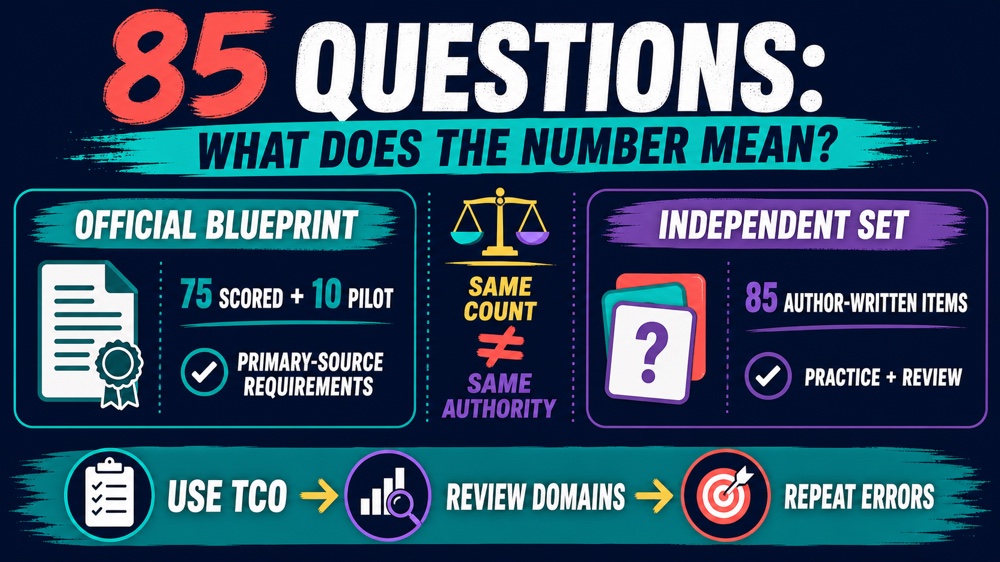
The BACB RBT Test Content Outline, 3rd edition, describes 43 tasks across six domains. The examination blueprint includes 75 scored questions and 10 unscored pilot questions. That official structure can total 85 questions, but a third-party 85-question practice set is still an independent study resource. It does not become an official form because the question count matches. Examples in this article are newly written for education. They are not official, recalled, leaked, or BACB-endorsed questions. No independent practice exam can guarantee a passing result or replace required training, supervision, current BACB materials, or professional direction.
Use the distinction as a study advantage: take a full set to practice pacing, then review the underlying task, domain, measurement, procedure, and role boundary behind every answer.
What an RBT practice exam 85 questions free set can and cannot tell you
A full-length independent set can provide useful evidence about how you reason under a defined set of conditions. It can show whether you can:
- Identify the controlling fact. Notice the behavior definition, time unit, prompt detail, consequence, documentation request, or ethical boundary that changes the best answer.
- Apply a concept in context. Move beyond a definition and select the measurement or procedure that fits the scenario.
- Sustain attention. Practice reading and deciding across a longer sequence rather than only solving isolated flashcards.
- Explain uncertainty. Record which items were guesses, even when the selected answer happened to match the key.
It cannot prove that you will receive the same content, difficulty, wording, or result on the official examination. It cannot establish practical performance with a client, data reliability across sessions, safe implementation, or professional judgment under supervision. Treat the score as local evidence from one independent set, not as a certification decision.
For example, a person may score well on a question about rate but still need practice entering the correct unit on a data sheet. A useful review asks what observable behavior would demonstrate the concept, not simply whether the answer letter was correct.
Separate the official blueprint from an independent 85-item set
Use this comparison before you interpret a full-length practice score:
| Feature | Official examination blueprint | Independent 85-item practice set |
|---|---|---|
| Authority | Defined by current BACB materials for the examination. | Written and maintained by the third-party resource owner. |
| Question count | 75 scored questions plus 10 unscored pilot questions. | 85 items chosen by the author; count alone does not establish equivalence. |
| Purpose | Certification examination under the applicable process. | Practice pacing, application, recall, and error review. |
| Score meaning | Interpreted under the official examination process. | A local result that helps plan study; it is not an official score or pass/fail decision. |
| Content boundary | Use the current TCO and official instructions. | Questions should be independent and honestly labeled, not presented as real or recalled items. |
The distinction protects both accuracy and the learner. A page can truthfully say that its free test has 85 questions while still needing to say that it is independent. Conversely, a page that uses “official,” “real exam,” or “guaranteed pass” language without primary-source support deserves caution.
Keep the word “pilot” in your notes. Unscored pilot questions are part of the official blueprint, but they are not a signal that you can identify which questions are unscored while taking an independent test. Do not build a strategy around guessing which items count.
Before taking an RBT practice exam 85 questions free, check the blueprint
Prepare a coverage note before you press start. The current TCO domains and examination shares are:
| Domain | Scored share | Review question |
|---|---|---|
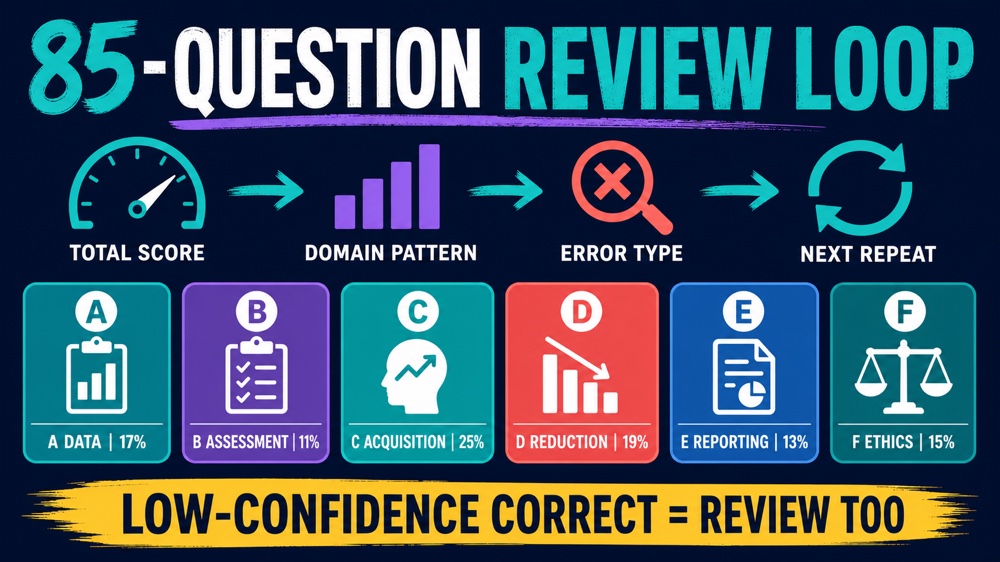
| A. Data Collection and Graphing | 13 / 17% | Can I match the target to the correct measurement, unit, graph, or trend description? |
| B. Behavior Assessment | 8 / 11% | Can I follow the assigned preference, skill, or assessment procedure within my role? |
| C. Behavior Acquisition | 19 / 25% | Can I identify the teaching step, prompt, reinforcement, fading, or generalization opportunity? |
| D. Behavior Reduction | 14 / 19% | Can I implement the written plan, recognize safety needs, and avoid inventing an intervention? |
| E. Documentation and Reporting | 10 / 13% | Can I report observable information, changes, irregularities, and confidentiality concerns? |
| F. Ethics | 11 / 15% | Can I recognize competence, supervision, boundary, privacy, and professional communication issues? |
The TCO task counts total 43, while the blueprint numbers describe 75 scored and 10 unscored pilot questions. The percentages help you distribute review time, not predict which exact tasks or questions will appear. If a practice set claims to represent all six areas, check whether its explanations actually identify the domain or task behind the item.
Write down three targets before the test: one high-weight domain, one lower-weight maintenance domain, and one recurring error from your previous attempt. That gives the result a purpose beyond “I hope the percentage is higher.”
Take the full set for pacing, not for a guaranteed score
Use a full 85-item set in a quiet block when you want to observe pacing. Read each stem, mark the controlling fact, choose an answer, and flag low-confidence decisions. Avoid opening a reference after every item because that turns the session into an untimed lookup exercise. You can do a separate open-book learning pass later.
When you finish, save four numbers:
- Total correct: the local result from this set.
- Low-confidence correct: answers that matched but were guesses.
- Missed by domain: where the errors clustered.
- Missed by decision type: measurement, discrimination, procedure fidelity, calculation, documentation, or scope and ethics.
Do not translate these numbers into an official passing percentage. A third-party answer key may have different wording, item quality, or difficulty. If a question is ambiguous, record the ambiguity and compare the explanation with the current source instead of forcing a confident conclusion.
Use an RBT practice exam 85 questions free score as a starting point
The score is the beginning of the review, not the end. Use a four-step correction loop:
- Locate: identify the exact item and the fact you overlooked.
- Label: classify the error as definition, discrimination, measurement, procedure, calculation, documentation, or ethics/scope.
- Repair: write a one-sentence rule and one new example with changed numbers or setting.
- Delay: repeat the new example after a day and again later in the week.
Keep low-confidence correct answers in the same log. A correct guess can represent a fragile skill. Your table might say: “A.6; confused count with rate; correction: name the requested time unit before calculating; repeat Wednesday.” That note is more actionable than “review data collection again.”
Use the TCO weights to allocate time: give C and D the largest blocks, use A and E for concrete data and documentation practice, and keep B and F in every weekly cycle. This is an independent study plan, not a promise about your official result.
Review five domain decisions after the test
The following examples are newly written and are not official, recalled, leaked, or BACB-endorsed questions. Answer each before reading the rationale:
- A, measurement: The behavior occurs 12 times in 30 minutes and the procedure asks for responses per hour. The matching calculation is 24 per hour. The decision is driven by the requested unit, not by the fact that count is easier to report.
- B, assessment: A supervisor assigns a preference procedure. The RBT follows the sequence, records choices, and reports questions. The RBT does not independently redesign the assessment or infer a treatment function from the result.
- C, acquisition: A plan specifies a verbal model before an independent response. Record the required prompt information and follow the written sequence; do not replace the procedure with a different prompt hierarchy without direction.
- D, reduction: A safety concern appears and the plan does not describe the next step. Follow the setting’s safety instructions and contact the supervisor or designated professional; do not invent a consequence because the practice item feels incomplete.
- E and F, documentation and ethics: A learner leaves the table for 40 seconds after an instruction. An objective note reports the observable action and timing; it should not assign motive or disclose unnecessary private information.
The value of these examples is the explanation. If your answer is correct for the wrong reason, record that as a low-confidence correction. If a distractor sounds plausible, write the scenario feature that rules it out.
Common mistakes with 85-question practice exams
- Assuming matching counts means matching authority: 85 independent items are not automatically an official examination form.
- Calling pilot questions “easy” or identifiable: the official blueprint does not turn unscored status into a visible test-taking clue.
- Reporting one total without domain detail: a total hides whether the error was a calculation, procedure, or ethics decision.
- Taking repeated versions without delayed review: familiarity with the page can look like learning.
- Ignoring source dates: compare third-party explanations with the current 3rd-edition TCO and official instructions.
- Trusting guaranteed-pass language: no independent practice resource can guarantee a certification outcome.
- Practicing only recall: fresh scenarios should change the numbers, setting, or wording so you test the concept.
Before your next attempt, choose one correction rule and one delayed repeat. If you cannot explain why the correct option fits the observable facts and written plan, keep studying that decision rather than simply increasing the number of questions.
Bottom line: an 85-question free RBT practice exam can be a useful full-length rehearsal when you know what it represents. Use the official 75-scored plus 10-pilot blueprint as a boundary, treat the third-party set as independent, and convert every score pattern into a specific next practice.
Ready to practice the RBT concepts you just reviewed?
Try an independent, original RBT practice resource with exam-style questions, scoring, and answer explanations.
References
- Behavior Analyst Certification Board. RBT Test Content Outline, 3rd edition.
- Behavior Analyst Certification Board. RBT Handbook.
- Behavior Analyst Certification Board. RBT Ethics Code.