

Registered behavior technician certification is a BACB credential with eligibility, training, competency, application, examination, supervision, ethics, and maintenance requirements. A study page can make the path easier to understand, but it cannot approve an application, administer the examination, complete an assessment for you, or issue the credential.
Table of Contents
- What registered behavior technician certification means
- Who controls registered behavior technician certification requirements
- Registered behavior technician certification eligibility checklist
- Build a registered behavior technician certification document timeline
- Complete the application and examination sequence
- Prepare for the exam with the current TCO
- Maintain the credential after certification
- Common certification-process mistakes
- Frequently Asked Questions
- References
This guide is based on the BACB RBT Handbook updated June 2026, the current RBT Initial Competency Assessment packet, the RBT Test Content Outline, 3rd edition, and the RBT Ethics Code. The Handbook says requirements can be revised and that applicants must meet the requirements in place when they apply and test under the edition in effect when they schedule the examination. Check the current BACB page and your portal before acting on any date, document, fee, or jurisdiction detail.
RBT Training is an independent exam-preparation and study-material site. It is not a BACB certification program, is not affiliated with the BACB, and is not endorsed by the BACB. Nothing here guarantees certification or a passing examination result.
What registered behavior technician certification means
The BACB describes an RBT as a paraprofessional certified in behavior analysis who assists with behavior-analytic services under the direction and close supervision of an RBT Supervisor and/or RBT Requirements Coordinator. Certification signals that an applicant has met a defined set of requirements; it does not authorize independent clinical practice or replace supervision.
That distinction matters when comparing course pages. A provider may offer a 40-hour training course, practice questions, or a study guide. Those products may support preparation, but the BACB controls the certification application, official assessment forms, examination process, ethics requirements, and certification status. A provider cannot confer BACB certification merely by issuing a course-completion certificate.
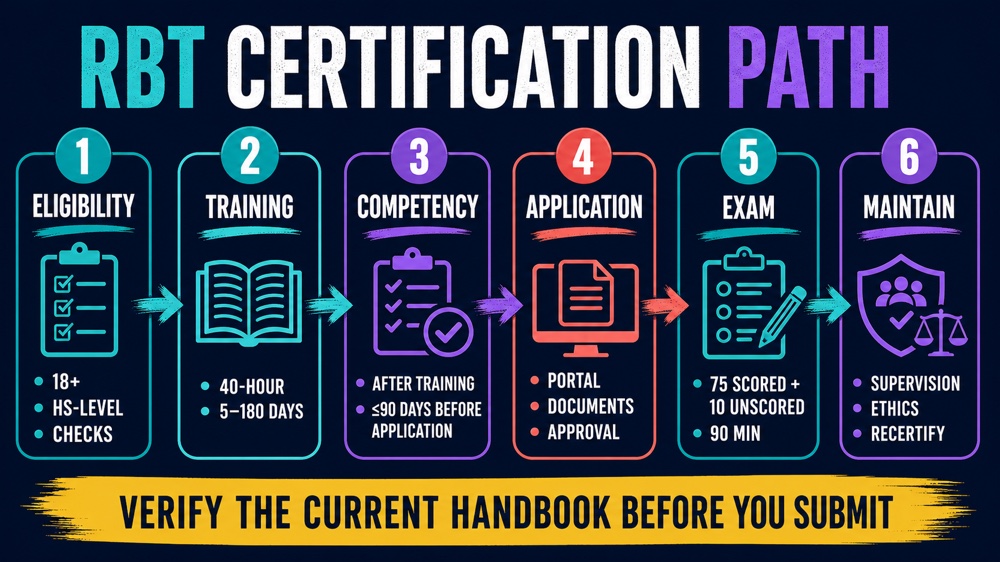
Think of the path as four connected gates:
- Eligibility: meet the age, education, background, registry, and jurisdiction requirements.
- Preparation and demonstration: complete the applicable training and show competent performance in the current assessment packet.
- Application and examination: create the portal account, submit the required documents, receive an application determination, schedule, and pass the RBT examination.
- Maintenance: follow supervision, ethics, reporting, and recertification requirements after certification.
Missing one gate can delay the next. A high practice-test score does not replace an incomplete assessment packet, and a training certificate does not replace the application or examination.
Who controls registered behavior technician certification requirements
The BACB is the primary source for current RBT requirements. Use the RBT Handbook for the process, the official competency packets for assessment forms, the current TCO for examination scope, and the Ethics Code for professional expectations. University and commercial pages can explain a process in friendly language, but they are not substitutes for the documents that control the application.
The June 2026 Handbook also warns that new versions may be published quarterly. If you are planning to apply in a future year, do not copy a checklist from an old blog post and assume its dates still apply. Confirm:
- the current Handbook version and update date;
- the current 40-hour training outline;
- the current Initial Competency Assessment packet;
- the examination edition in effect when you will schedule;
- the BACB jurisdiction and portal instructions that apply to your residence.
When a training site says “certification training,” read the wording carefully. It may mean preparation for the training requirement, not a certification issued by the site. RBT Training provides independent study support and does not represent that completion of its materials creates, renews, or guarantees BACB certification.
Registered behavior technician certification eligibility checklist
The current Handbook lists requirements that must be met before applying. Use this checklist as an orientation, then verify the exact current instructions:
| Requirement | Current Handbook orientation | Evidence or boundary |
|---|---|---|
| Age | At least 18 years old when submitting the application. | An attesting certificant confirms the requirement within the stated timing window. |
| Education | At least a high school-level education or equivalent. | Keep the document or information your application process requires. |
| Checks | Pass a criminal background check and an abuse registry check. | The Handbook describes a 180-day timing window before paying for the application; state and organization rules may add requirements. |
| Training | Complete a 40-hour training that meets the current 2026 requirements, in no less than 5 days and no more than 180 days. | Upload the provider’s certificate and confirm the course follows the current outline. |
| Initial competency | After the 40-hour training and no more than 90 days before submitting the application, demonstrate the current task items with an assessor. | Use the current official packet and an eligible assessor; do not substitute a quiz score. |
| Jurisdiction and attestation | Meet the BACB jurisdiction rules and provide required attestations. | The attesting or assessing person must meet the relationship restrictions in the current documents. |
For example, completing a 40-hour course in January does not mean you can use any future assessment form indefinitely. The application timing, training requirements, assessment version, and document windows must line up with the current Handbook. If a date or relationship requirement is unclear, ask the BACB or the responsible professional rather than guessing.
Build a registered behavior technician certification document timeline
Make a document timeline before you pay an application fee. Start with the dates that can expire:
- Training start and end: record both dates and verify that the duration meets the current 2026 requirements.
- Background and abuse registry checks: record completion dates and compare them with the Handbook’s application-payment window.
- Competency assessment: schedule it after the required training and within the current application window. Confirm the exact packet version and assessor eligibility.
- Attestation: make sure the form is completed and signed by an eligible attesting certificant within the stated window.
- Portal and application: use your legal name consistently, upload readable documents, and note the application active period.
- Examination authorization: after approval, follow the BACB instructions for scheduling and the deadline shown in your portal.
Use one folder with subfolders for “current source,” “training,” “checks,” “assessment,” and “application.” Keep the official blank packet separate from your completed copy. Do not email sensitive documents casually or store portal credentials in a shared workplace account.
The Handbook says an application is active for a limited period and that documents must be submitted again for a new application when applicable. The exact rule can change, so the timeline is a reminder to check the live Handbook and portal, not a replacement for them.
Complete the application and examination sequence
The current process is not simply “take a course, then book a test.” The Handbook’s sequence includes:
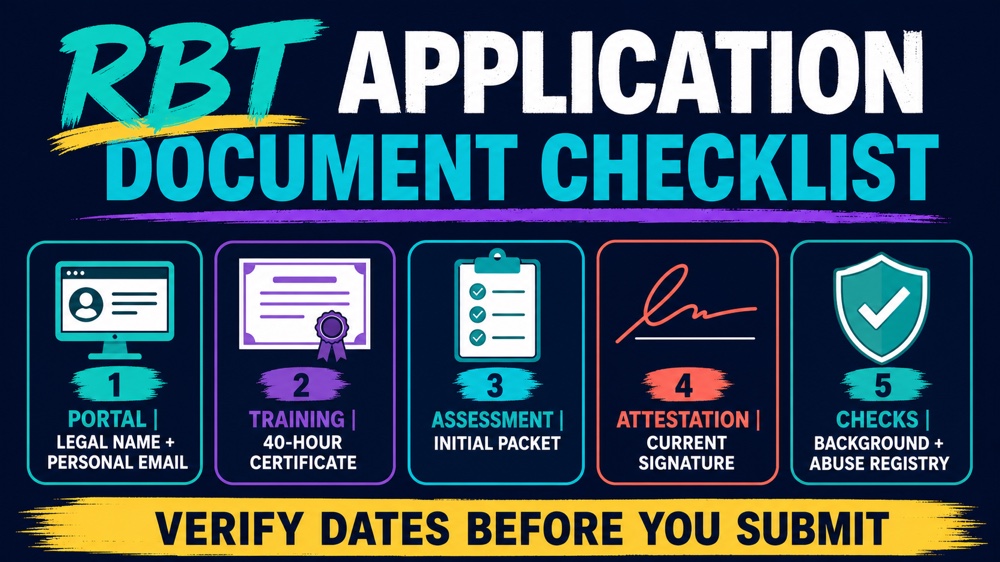
- Create one BACB Portal account. Use your legal name as it appears on government identification, a personal email address, and your current residence information. Do not create multiple accounts or share your credentials.
- Complete the required documents. The current Handbook identifies the attestation form, 40-hour training certificate, and completed Initial Competency Assessment as application documents.
- Submit the certification application. Enter accurate information, upload readable files, and respond truthfully to required disclosure questions.
- Pay and wait for the application determination. The BACB processes applications and communicates approval or action items through the portal and email. Use the current fee table rather than an old screenshot.
- Schedule the examination after approval. Follow the instructions provided for the examination appointment and the deadline in your portal.
- Take the current examination. The Handbook states that candidates test under the current TCO edition in effect when they schedule, subject to its current policies.
Do not schedule based only on a course provider’s calendar. Your application determination, authorization period, identity information, accommodations process, and testing instructions come from the BACB and the designated examination vendor.
Prepare for the exam with the current TCO
The current examination outline describes 75 scored questions and 10 unscored questions, four answer options per question, and 90 minutes. It maps 43 tasks across six content areas: A Data Collection and Graphing, B Behavior Assessment, C Behavior Acquisition, D Behavior Reduction, E Documentation and Reporting, and F Ethics. The Handbook states that all questions are equally weighted and the examination result is based on overall performance, not a separate pass decision in each content area.
Use the TCO as a map, not as a leaked question list. Organize review around observable decisions: choose a measurement unit, follow an assessment or teaching procedure, implement the written behavior-reduction plan, write objective documentation, and recognize ethics or supervision boundaries. Then use independent practice to test application.
The BACB recommends reviewing the TCO and materials from the 40-hour training and Competency Assessment. It does not endorse specific study guides or preparation materials, and the purchase of study materials does not guarantee a passing result. That is why this site’s materials must remain clearly labeled as independent.
For each missed item, write the TCO task, the observable fact, the procedure that fits, and the role boundary. If you cannot explain the decision without the answer options, schedule a smaller practice repetition instead of simply increasing the question count.
Maintain the credential after certification
Certification is not the end of the process. The Handbook describes ongoing supervision, ethics and self-reporting responsibilities, and recertification requirements. The exact maintenance cycle and professional-development requirements depend on the current rules and implementation dates, so verify the live Handbook rather than relying on a generic “renew every year” or “renew every two years” statement.
In practice, keep a maintenance folder for supervision records, required professional development, reporting questions, and recertification deadlines. Continue to work within competence and follow the directions of the responsible supervisor or requirements coordinator. If your role, address, employment, or professional situation changes, update the BACB portal and review the applicable policy.
An exam-prep website can help you rehearse concepts and organize study. It cannot supervise your services, attest to your eligibility, perform your competency assessment, or decide whether a disclosure affects your application.
Common certification-process mistakes
- Using an old checklist: compare every date and document with the current Handbook.
- Confusing training completion with certification: a course certificate is one requirement, not the credential.
- Scheduling before application approval: follow the approval and authorization instructions in the portal.
- Submitting inconsistent names: make the portal, identification, certificates, and assessment documents match the current instructions.
- Using an ineligible assessor or attesting person: check relationship and employment restrictions before the appointment.
- Treating a study score as an official result: independent practice cannot establish certification eligibility or guarantee the examination outcome.
- Assuming a provider is BACB-affiliated: look for a clear statement of the provider’s actual role and verify claims against BACB primary sources.
Before submitting anything, ask four questions: Is this the current document? Is the date inside the required window? Is the person signing or assessing eligible? Does the information match my portal identity? If any answer is uncertain, pause and verify through the official channel.
Bottom line: registered behavior technician certification is a BACB-controlled credential with several gates. Use the current Handbook for process requirements, the official packet for competency, the TCO for examination scope, and independent study materials only as preparation support.
Ready to practice the RBT concepts you just reviewed?
Try an independent, original RBT practice resource with exam-style questions, scoring, and answer explanations.
References
- Behavior Analyst Certification Board. RBT Test Content Outline, 3rd edition.
- Behavior Analyst Certification Board. RBT Handbook.
- Behavior Analyst Certification Board. RBT Ethics Code.