

RBT test questions are easier to use when you stop treating them as vocabulary flashcards and start reading them as small decision problems. First identify the observable facts, then locate the written instruction, select the role-appropriate action, and explain why the strongest distractor does not fit.
Table of Contents
- What RBT test questions should test
- Map RBT test questions to the current TCO
- Read an RBT test question in four passes
- Separate the best answer from a possible answer
- Original RBT test question examples
- Review RBT test questions by distractor and error
- Practice documentation and ethics questions
- Common mistakes with RBT test questions
- Frequently Asked Questions
- References
The current BACB RBT Test Content Outline, 3rd edition, maps 43 tasks across six domains. The current examination blueprint describes 75 scored questions and 10 unscored pilot questions. The examples on this page are newly written for study. They are not official, recalled, leaked, or BACB-endorsed questions. An independent question page can support preparation, but it cannot guarantee certification or a passing result, replace required training and supervision, or provide access to official examination content.
Use the method below for a single question, a short practice set, or a larger review session. The goal is to make each answer explainable and transferable when the setting, timing, behavior, or written plan changes.
What RBT test questions should test
A useful independent question asks you to apply a concept to a short situation. It may require you to:
- Identify the target: distinguish an observable response from a broad label or inferred motive.
- Choose the measurement: match the unit to the behavior, procedure, and time frame.
- Follow the plan: select the step that is written instead of introducing a new intervention.
- Recognize a role boundary: implement, document, communicate, and ask for direction when the information is insufficient.
- Use professional judgment within scope: protect confidentiality, safety, and accurate reporting.
A definition can be correct and still be the wrong answer if it does not address the fact the stem emphasizes. If the question gives a time interval and asks for responses per hour, count alone does not answer it. If the written plan specifies a prompt sequence, an answer that invents another sequence is not improved by sounding more clinical.
Before checking the key, say what evidence in the stem controlled your choice. If you cannot name that evidence, mark the item low-confidence even if the letter happens to be correct.
Map RBT test questions to the current TCO
Use the current TCO to label what a question is asking. The six domains and blueprint shares are:
| Domain | Tasks / share | Question signals |
|---|---|---|
| A. Data Collection and Graphing | 13 / 17% | Definitions, measurement systems, calculations, graphing, trends, and data quality. |
| B. Behavior Assessment | 8 / 11% | Preference or skill assessment purpose, assigned steps, and role boundaries. |
| C. Behavior Acquisition | 19 / 25% | Prompts, fading, reinforcement, shaping, chaining, maintenance, and generalization. |
| D. Behavior Reduction | 14 / 19% | Written plans, function-informed procedures, safety, differential reinforcement, and fidelity. |
| E. Documentation and Reporting | 10 / 13% | Objective notes, timely communication, data irregularities, and confidentiality. |
| F. Ethics | 11 / 15% | Competence, supervision, boundaries, public statements, privacy, and reporting. |
The 43 tasks define the scope map. The 75 scored and 10 unscored pilot questions describe the current examination blueprint. Do not assume that a third-party set with the same number of items is an official form, and do not use a practice score to infer certification status.
When you miss a question, record both the topic and the decision type. “Prompting” is a topic; “selected a new prompt instead of following the written hierarchy” is an error that can be corrected.
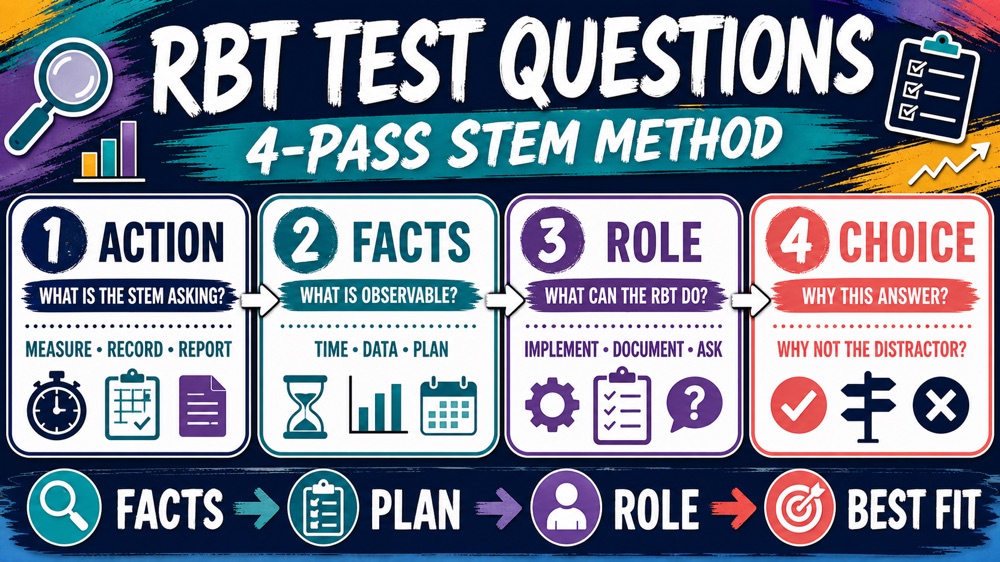
Read an RBT test question in four passes
Use four passes so you do not let a technical-sounding distractor control the answer:
- Pass 1 — find the action word: is the stem asking you to measure, record, implement, report, ask, or identify?
- Pass 2 — underline the facts: note the behavior, timing, plan instruction, prompt, consequence, or privacy issue that is directly stated.
- Pass 3 — check the role: decide whether the option stays within implementation, documentation, communication, and supervision boundaries.
- Pass 4 — compare the two strongest options: choose the one supported by the exact facts and explain what makes the other less appropriate.
For a timed block, avoid researching between every item. Record your confidence and finish the first pass. During review, use the TCO and primary sources to correct the rule. This protects the difference between answering under conditions and studying after the attempt.
Separate the best answer from a possible answer
Multiple-choice questions often include options that could be reasonable in another situation. The best answer is the one that fits the current facts, written procedure, and role. Ask:
- Does this option answer the action requested by the stem?
- Does it use only information provided rather than assuming a function or motive?
- Does it follow the written plan rather than change the plan?
- Does it protect safety, confidentiality, and accurate documentation?
- Would an RBT implement it, document it, or ask a supervisor instead?
Eliminate answers that are too broad, too independent, or based on a label instead of an observation. Then state the controlling fact in one sentence. If the controlling fact is missing, the correct next action may be to seek direction—not to guess.
For example, if a stem gives a 30-minute observation and asks for responses per hour, write the time unit before choosing the calculation. That one visible step is stronger evidence of understanding than recognizing the word “rate” in a definition list.
Original RBT test question examples
The following examples are newly written practice prompts, not official or recalled questions. Answer before reading the rationale.
- Rate versus count: A behavior occurs 12 times during a 30-minute observation. The procedure asks for responses per hour. The matching result is 24 responses per hour because the requested unit includes time. Count alone is not the requested measure.
- Objective documentation: A learner leaves the table for 40 seconds after an instruction. An objective note records the action, duration, and relevant context. It does not state that the learner was “defiant” or assign an unobserved motive.
- Prompt fidelity: A teaching plan specifies a verbal model before an independent response. The RBT follows that step and records the prompt information. The RBT does not replace the procedure with a new hierarchy without direction.
- Assessment role: A supervisor assigns a preference procedure. The RBT prepares materials, follows the sequence, records choices, and reports questions. The RBT does not convert the activity into an independent functional assessment.
- Safety and escalation: A behavior-reduction plan does not say what to do when a safety concern appears. The RBT follows the available safety instruction and contacts the supervisor or designated professional rather than inventing a consequence.
- Confidentiality: A family asks the RBT to post a recognizable client photo with a success story. The RBT follows privacy and organization requirements and asks the supervisor before sharing anything.
Notice the pattern: each rationale points to observable facts, the written procedure, and a role boundary. That is the part to transfer to a new question.
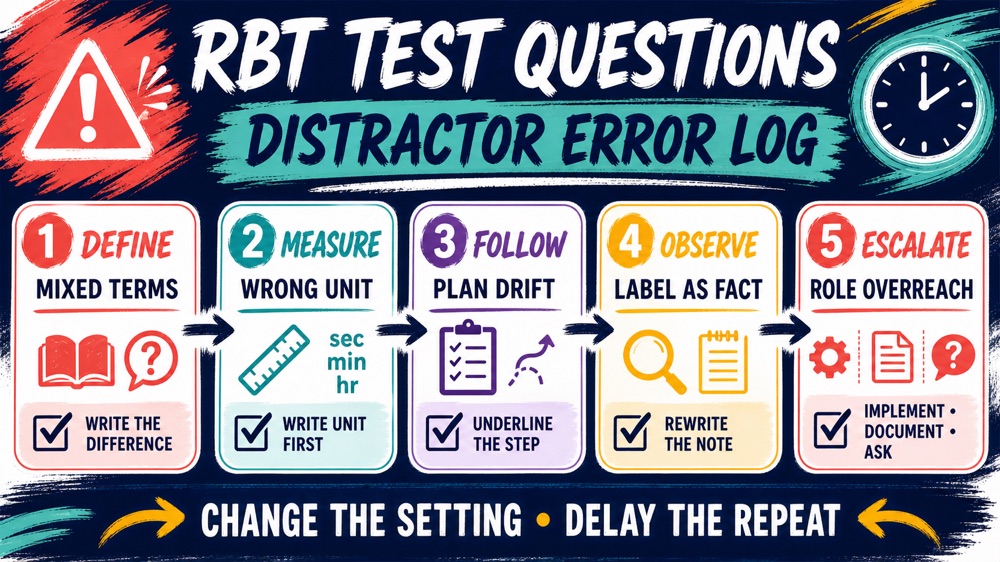
Review RBT test questions by distractor and error
Do not write only “wrong.” Record the decision that failed:
| Error | What happened | Correction rule |
|---|---|---|
| Definition confusion | I mixed two terms. | Write the separating feature and one new example. |
| Measurement mismatch | I ignored the unit or time frame. | Write the requested unit before calculating. |
| Plan drift | I chose a plausible step that was not written. | Underline the exact procedure and follow its sequence. |
| Interpretation | I treated a label or motive as an observation. | Rewrite the stem using only what was seen, heard, counted, or timed. |
| Role overreach | I selected an independent treatment change. | State what to implement, document, and escalate. |
Review low-confidence correct answers too. They can show fragile learning. After writing the correction rule, change the setting, numbers, prompt, or behavior and solve a new version. A delayed repeat is more informative than immediately clicking the same answer again.
Practice documentation and ethics questions
Put documentation and ethics into every practice session rather than saving them for the end. Ask whether the answer:
- uses objective, observable language;
- reports data, changes, and concerns accurately and on time;
- protects client information and avoids casual public disclosure;
- stays within current competence and supervision;
- distinguishes independent study support from BACB certification or endorsement.
These questions often contain a tempting option that sounds helpful but skips the reporting or supervision step. When the plan or information is incomplete, the correct response is often to follow the stated safety direction and ask the appropriate professional—not to improvise.
Common mistakes with RBT test questions
- Memorizing answer letters: changed wording exposes a rule that was never learned.
- Choosing the most technical option: jargon does not replace evidence from the stem.
- Ignoring the action word: a “report” question is not answered by describing a new intervention.
- Confusing practice with official content: independent questions are not automatically official, real, recalled, leaked, or BACB-endorsed.
- Relying on an old edition: check the current TCO, Handbook, training, and competency materials.
- Skipping the error log: taking more questions without correcting the decision creates volume, not necessarily learning.
Bottom line: strong RBT test questions practice is a loop: identify the fact, map the task, follow the plan, choose the role-appropriate action, explain the distractor, and repeat the rule in a changed scenario.
Ready to practice the RBT concepts you just reviewed?
Try an independent, original RBT practice resource with exam-style questions, scoring, and answer explanations.
References
- Behavior Analyst Certification Board. RBT Test Content Outline, 3rd edition.
- Behavior Analyst Certification Board. RBT Handbook.
- Behavior Analyst Certification Board. RBT Ethics Code.