

RBT practice questions become more useful when the set is designed around decisions, not just a large number of answer boxes. Choose a current TCO task, read a short scenario, identify the observable fact, select the role-appropriate procedure, and explain the distractor. Then change the scenario and repeat the rule later.
Table of Contents
- What good RBT practice questions do
- Choose RBT practice questions from the current TCO
- Build three types of RBT practice questions
- Sequence a balanced question set
- Review RBT practice questions with a rationale
- Use original scenarios to test transfer
- Make a seven-day RBT practice question rotation
- Common problems with RBT practice questions
- Frequently Asked Questions
- References
The current BACB RBT Test Content Outline, 3rd edition, maps 43 tasks across six domains. The current examination blueprint describes 75 scored questions and 10 unscored pilot questions. Independent practice questions can be shorter, longer, or organized differently. The examples in this article are newly written for study and are not official, recalled, leaked, or BACB-endorsed questions. Practice can support review, but it cannot guarantee certification or a passing result, replace training and supervision, or create access to official examination content.
Use the framework below to choose a balanced set, focus a weak domain, review answers, and build a delayed correction cycle. A good set tells you what to study next rather than only telling you how many letters matched.
What good RBT practice questions do
A useful independent item should make one decision visible. It may ask you to:
- Define the observable target: separate the behavior from a label, motive, or diagnosis.
- Match the measurement: choose count, rate, duration, latency, interval recording, or another system because the scenario requires it.
- Follow the written plan: select the prompt, teaching, reinforcement, or reduction step actually described.
- Stay within role: implement, collect data, document, communicate, and ask rather than independently redesigning treatment.
- Explain the distractor: point to the fact that makes the tempting option less appropriate.
A question that tests only whether you can repeat a definition has a place in early review, but it is not enough for a mixed practice set. For example, knowing that rate includes time does not tell you whether to calculate responses per hour until the stem gives the observation period and requested unit.
Use a quality note for each item: domain, task, decision type, answer rationale, distractor rationale, confidence, and repeat date. This turns a question set into a study record.
Choose RBT practice questions from the current TCO
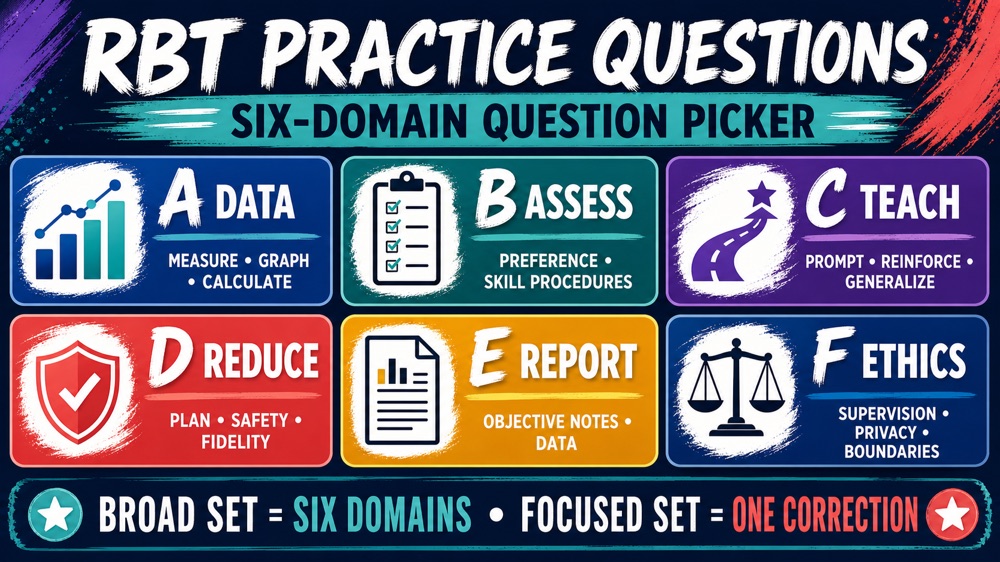
Start with the current TCO rather than a random list. Its six domains and blueprint shares are:
| Domain | Tasks / share | Question mix |
|---|---|---|
| A. Data Collection and Graphing | 13 / 17% | Observable definitions, measurement, calculations, graphing, trends, and data quality. |
| B. Behavior Assessment | 8 / 11% | Preference or skill assessment purpose, assigned procedures, and role boundaries. |
| C. Behavior Acquisition | 19 / 25% | Prompts, fading, reinforcement, shaping, chaining, maintenance, and generalization. |
| D. Behavior Reduction | 14 / 19% | Written plans, antecedent strategies, differential reinforcement, safety, and fidelity. |
| E. Documentation and Reporting | 10 / 13% | Objective notes, timely reporting, data irregularities, confidentiality, and communication. |
| F. Ethics | 11 / 15% | Competence, supervision, boundaries, privacy, public statements, and reporting. |
The percentages help plan coverage; they do not predict the order or wording of individual items. The 43 tasks are the scope map, while the 75 scored and 10 unscored pilot questions describe the examination blueprint. Do not call a third-party set official because it uses a familiar number.
When your goal is a broad check, sample all six domains. When your goal is correction, choose one domain and two or three task decisions. Label the purpose before you start so a narrow set does not get mistaken for a complete readiness measure.
Build three types of RBT practice questions
Use three levels in a study rotation:
- Recognition items: identify a term, measurement, or ethical boundary from a clear description. These are useful for new material.
- Discrimination items: compare two close options, such as count versus rate or duration versus latency. These reveal whether you notice the controlling feature.
- Application items: follow a written procedure in a changed scenario, select the role-appropriate action, or document what happened. These test transfer.
Move from recognition to discrimination and application as the concept becomes familiar. If you miss a discrimination item, do not respond by memorizing another list. Write the feature that separates the options and create a new example where that feature changes.
Keep the scenario short enough that one decision controls the answer. Add complexity only when the learner can explain the first decision without relying on answer choices.
Sequence a balanced question set
A 20-item independent set can be arranged as a study sample:
- four items from A and E using data or documentation;
- three items from C and D using written teaching or reduction plans;
- two items from B and F using assessment, supervision, privacy, or boundaries;
- the remaining items mixed across the domains to test switching.
This is a study design, not an official exam form. You can also create a focused set of five A.6-style measurement decisions or three F-domain boundary decisions. Name the scope at the top of the worksheet and record what the set cannot tell you.
Sequence easy recognition items first only when they help you warm up. A useful mixed block should eventually require you to switch from calculating data to following a teaching plan, then to documenting an event. Switching reveals whether you learned a rule or merely recognized a repeated visual pattern.
Review RBT practice questions with a rationale
Review every missed or uncertain item in five lines:
- Fact: what was directly observable or explicitly written?
- Task: which current TCO domain or task best fits?
- Action: what should the RBT do, record, or report?
- Distractor: why is the strongest alternative less appropriate under these facts?
- Repeat: what changed scenario will you solve later?
For example, if a question asks for responses per hour after a 30-minute observation, write “requested unit: per hour” before performing the calculation. If the answer is wrong because you reported count alone, the correction is a measurement-unit rule, not a general instruction to study more data collection.
Track low-confidence correct answers. They may show a rule that is not stable. Use a confidence scale such as high, medium, or low, and compare it with accuracy after the review.

Use original scenarios to test transfer
Original scenarios should change the surface features while preserving the decision rule. Change one variable at a time:
- change the setting but keep the measurement unit;
- change the behavior but keep the prompting sequence;
- change the timing and ask whether the calculation changes;
- change the missing information and ask whether to implement or escalate;
- change the documentation wording and remove labels or inferred motives.
Do not reproduce remembered exam content. Do not describe an independent example as real, official, recalled, leaked, or BACB-endorsed. The learning goal is the discrimination, not access to a protected item.
A good answer explanation names the fact, plan, role, and next step. It does not need to sound like a clinical report; it needs to be accurate, observable, and within scope.
Make a seven-day RBT practice question rotation
- Day 1: map the current TCO and rate confidence by domain.
- Day 2: use recognition and discrimination questions for A and E.
- Day 3: use application questions for C and D.
- Day 4: practice B and F with assessment, supervision, privacy, and role examples.
- Day 5: take a mixed set and tag errors by type.
- Day 6: create changed scenarios for the two largest error groups.
- Day 7: delay the repeat, compare confidence with accuracy, and plan the next rotation.
End each day with one visible output: a calculation, corrected note, procedure sequence, ethics explanation, or new scenario. If the output is only the number of questions completed, the next study decision is still unclear.
Common problems with RBT practice questions
- Volume without correction: more items do not repair an error that is never named.
- One-domain overconfidence: a strong score in a focused set does not show broad coverage.
- Answer-letter memory: changed options expose rules that were not transferred.
- Unclear source status: independent questions should not be presented as official, recalled, leaked, or endorsed.
- Role overreach: a practice answer should not make the RBT independently change a plan.
- Ignoring uncertainty: low-confidence correct answers belong in the correction log.
Bottom line: strong RBT practice questions are selected from the current TCO, balanced across domains, reviewed by decision and distractor, and repeated in changed scenarios.
Ready to practice the RBT concepts you just reviewed?
Try an independent, original RBT practice resource with exam-style questions, scoring, and answer explanations.
References
- Behavior Analyst Certification Board. RBT Test Content Outline, 3rd edition.
- Behavior Analyst Certification Board. RBT Handbook.
- Behavior Analyst Certification Board. RBT Ethics Code.