

RBT competency assessment practice can help you rehearse the decisions that appear in supervised behavior-analytic work: identify what is observable, follow the written procedure, record accurately, and ask for direction when the facts do not support an independent change. It is a preparation activity, not the official competency assessment.
Table of Contents
- What RBT competency assessment practice can measure
- Practice versus the official competency assessment
- Map practice to the current TCO
- Build a supervised study block
- Read each scenario by action and role
- Original practice decisions
- Review errors with a competency log
- Prepare for the official assessment
- Common RBT competency assessment practice mistakes
- Frequently Asked Questions
- References
The current BACB RBT Test Content Outline, 3rd edition, maps 43 tasks across six domains. The current examination blueprint describes 75 scored questions and 10 unscored pilot questions. Those exam facts are useful for broad study planning, but they do not turn an independent practice set into BACB material. The examples in this guide are newly written for study and are not official, recalled, leaked, or BACB-endorsed questions. RBT Training is an independent study-material site, not a BACB certification program, and practice cannot guarantee certification, assessment completion, or a passing result.
An initial competency assessment is a separate professional checkpoint. Use the current BACB Handbook and the current RBT Initial Competency Assessment Packet for the applicable process, documentation, and assessor requirements. This guide helps you prepare your reasoning; it does not conduct an assessment or replace direct observation by an eligible assessor.
What RBT competency assessment practice can measure
An independent practice set can give you local study evidence about whether you can:
- separate an observable response from a label, diagnosis, or assumed motive;
- choose a measurement system that matches the target and time frame;
- follow the sequence, prompt, reinforcement, or safety step written in a plan;
- write an objective note and report a concern through the appropriate channel;
- identify when the next action is implementation, documentation, communication, or escalation.
That evidence is useful because competency is more than remembering a definition. A learner may recognize the word “duration” and still select count when a scenario asks how long a response lasts. A learner may know that reinforcement matters and still change a planned consequence without direction. Practice should expose those decision points so the next supervised conversation is specific.
Practice cannot establish clinical competence by itself. It does not replace required training, direct observation, supervision, the official assessment packet, an assessor’s judgment, or the BACB application and examination process. Treat the result as a study signal: it identifies what to rehearse, not what status you hold.
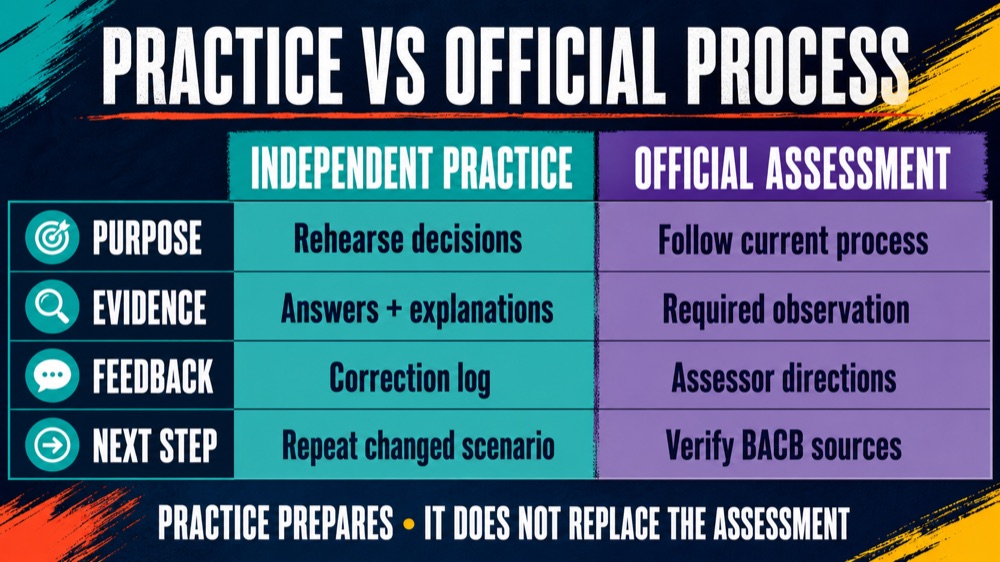
Practice versus the official competency assessment
| Question | Independent practice | Official assessment boundary |
|---|---|---|
| Who controls it? | A learner or study provider chooses the set and feedback. | Use the current BACB requirements and applicable assessor process. |
| What does it show? | Performance on newly written scenarios at one point in study. | Whether the applicable competency procedures are demonstrated under the required process. |
| What evidence is used? | Answers, explanations, confidence marks, and a correction log. | Follow the current official packet, required documentation, and direct observation expectations. |
| What happens after uncertainty? | Pause, record the question, and ask a supervisor or instructor. | Follow the assessor’s directions; do not invent a step or treat practice feedback as approval. |
The distinction protects both accuracy and ethics. A practice website should not imply that a quiz is an official competency assessment, that a score is an eligibility decision, or that its questions came from a secure examination or assessment form.
Map practice to the current TCO
The TCO is an exam-content map, not a substitute for the competency-assessment packet. It is still useful for making a practice block broad enough to include the work an RBT may need to recognize under supervision.
| Domain | Tasks / share | Practice emphasis |
|---|---|---|
| A. Data Collection and Graphing | 13 / 17% | Define, measure, calculate, graph, and describe observable data. |
| B. Behavior Assessment | 8 / 11% | Follow assigned assessment procedures and report observations. |
| C. Behavior Acquisition | 19 / 25% | Implement teaching steps, prompts, reinforcement, maintenance, and generalization. |
| D. Behavior Reduction | 14 / 19% | Follow the plan, protect safety, and maintain treatment fidelity. |
| E. Documentation and Reporting | 10 / 13% | Write objective notes and communicate concerns accurately. |
| F. Ethics | 11 / 15% | Protect competence, supervision, privacy, boundaries, and client dignity. |
The counts above describe the current RBT examination blueprint: 43 tasks across six domains. The 75 scored questions and 10 unscored pilot questions describe the examination format, not the number of items a third-party practice resource must contain. Use the map to label your study set honestly and then verify current details through the BACB source documents.
Build a supervised study block
Use a short cycle that makes every answer explainable:
- Choose one target: measurement, assessment procedure, teaching, reduction, documentation, or ethics.
- Read the source: review the relevant TCO language, written treatment plan, training note, or supervisor instruction.
- Answer without searching: mark high, medium, or low confidence before checking feedback.
- Explain the decision: name the observable fact, written procedure, and role boundary that support the answer.
- Ask one good question: bring uncertainty to the supervisor instead of resolving a missing step by guessing.
- Repeat with a change: alter the setting, time frame, learner response, or data while keeping the same decision rule.
A timer can help with pacing, but it should not crowd out correction. During early learning, a smaller set with a complete explanation is often more informative than a long set whose answer letters are never reviewed. Keep personal study records separate from protected client information.
Read each scenario by action and role
Use this five-part reading routine:
- Target: what response or skill is actually being described?
- Fact: what was directly observed, counted, timed, or written?
- Procedure: what plan, prompt, criterion, or safety direction is already stated?
- Role: should the RBT implement, record, report, or request direction?
- Evidence: which option can be supported without inventing a motive or a new intervention?
Distractors often sound professional while quietly changing the facts. Watch for an answer that substitutes a diagnosis for an observable definition, changes a prompt sequence, promises a consequence not in the plan, hides a safety concern, or shares information outside the appropriate channel. A confident tone is not evidence that the option fits the scenario.
Original practice decisions
These examples are newly written for independent study. They are not official, recalled, leaked, or BACB-endorsed questions:
- Measurement: a learner leaves a chair for 35 seconds during a 20-minute session. Record the observable event and the requested measurement, rather than writing “noncompliant” as if it were data.
- Assessment: a supervisor assigns a preference procedure with a written sequence. Prepare the materials, follow the sequence, record the choices, and report anything that makes the procedure unclear.
- Teaching: the plan says to present an instruction, wait, and then use the specified prompt if needed. Do not replace the sequence with a favorite prompt just because it feels faster.
- Reduction: a behavior plan includes a response procedure but no direction for a new safety risk. Pause the unsupported improvisation, follow available safety instructions, and contact the responsible professional.
- Documentation: a caregiver asks you to leave out a difficult event from the session note. Record objectively and communicate the request through the appropriate supervisory channel.
- Ethics: a friend asks for a recognizable client story for social media. Protect privacy and do not share identifying information simply because the request seems complimentary.
For each example, change one detail and solve again. If the answer changes, write down which fact changed. This is transfer practice: it checks whether you learned a decision rule rather than memorized a phrase.
Review errors with a competency log
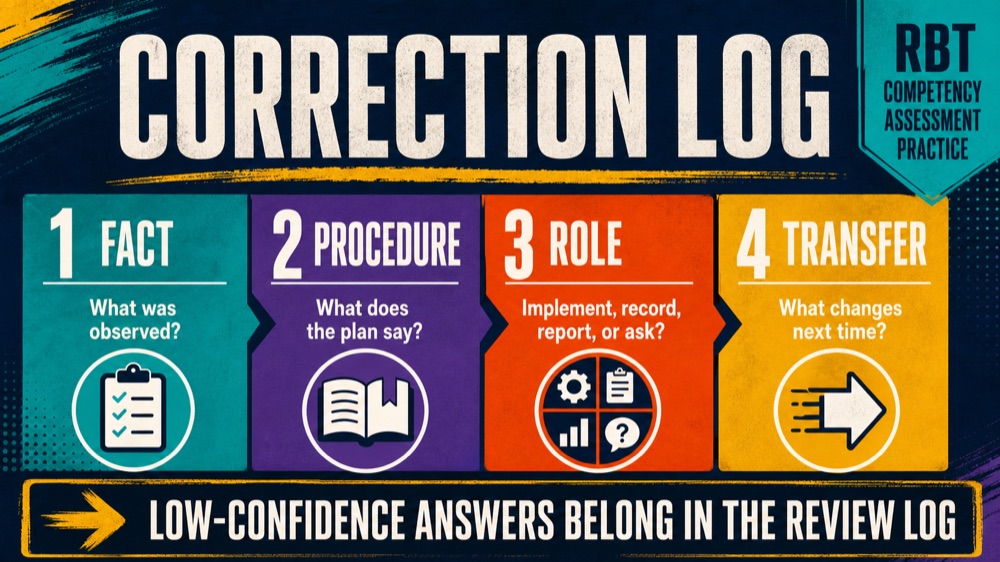
Use a six-column correction log:
| Column | Write | Example |
|---|---|---|
| Scenario fact | Only what was observed or stated. | “Instruction, 5-second wait, no response.” |
| Decision point | What had to be selected? | “Use the planned prompt.” |
| Chosen answer | What did you select? | “Immediate physical prompt.” |
| Correction | Why does the stronger option fit? | “The written sequence specifies the next prompt.” |
| Role boundary | What must be implemented or escalated? | “Ask before changing the hierarchy.” |
| Transfer item | What will change next time? | “New instruction and new setting.” |
Review low-confidence correct answers as well as misses. A correct letter supported by a weak explanation is not a stable skill yet. After a delay, close the answer key and solve a changed scenario. Bring recurring uncertainty to supervision instead of turning a practice explanation into a new clinical rule.
Prepare for the official assessment
Before scheduling or completing an initial competency assessment, verify the current BACB Handbook and the applicable official packet. The Handbook describes the assessment as part of the RBT credentialing pathway after the required 40-hour training and states that it must be completed within the applicable timing window before the application. Requirements can change, so do not rely on a study blog for current eligibility, forms, deadlines, or assessor qualifications.
Use your practice log to prepare questions for the assessor or supervisor:
- Which procedure or task should I rehearse next?
- What observable evidence will show that I followed the written step?
- Which materials, safety directions, and documentation are required?
- What should I do if a plan is incomplete or a new risk appears?
- Which current BACB document controls this requirement?
Do not upload private client records into a public practice system. Keep the official assessment process with the responsible assessor and use independent practice only for preparation.
Common RBT competency assessment practice mistakes
- Confusing two processes: an independent quiz is not the official competency assessment.
- Calling study content official: original questions should be labeled honestly.
- Using a score as a status decision: one practice result cannot establish competence or certification.
- Overlooking role boundaries: follow the plan and ask before changing a procedure.
- Recording labels instead of behavior: describe what happened, not an inferred motive.
- Skipping transfer: repeat in a changed scenario after a delay.
Bottom line: effective RBT competency assessment practice makes observable decisions, written procedures, documentation, supervision, and ethics easier to explain. It prepares you to ask better questions; it does not replace the current official assessment process.
Ready to practice the RBT concepts you just reviewed?
Try an independent, original RBT practice resource with exam-style questions, scoring, and answer explanations.
References
- Behavior Analyst Certification Board. RBT Test Content Outline, 3rd edition.
- Behavior Analyst Certification Board. RBT Handbook.
- Behavior Analyst Certification Board. RBT Ethics Code.