
BACB ethics code 2026 is a current-year search phrase, but it should not be read as proof that the RBT code was replaced by a new 2026 edition. The BACB’s ethics resources identify the RBT Ethics Code (2.0) as the code for RBT applicants and certificants. Candidates should check the official ethics page, the current code, and the RBT Handbook for updates rather than trusting an undated summary.
Table of Contents
- What bacb ethics code 2026 means for an RBT
- Use the official source hierarchy
- General responsibilities and competence
- Confidentiality, technology, and public statements
- Supervision and communication of concerns
- A bacb ethics code 2026 scenario
- Reporting, remediation, and nonretaliation habits
- Ethics and cultural humility
- Common mistakes when studying the BACB ethics code
- How to study bacb ethics code 2026 without keyword stuffing
- BACB ethics code 2026 review checklist
- Frequently Asked Questions
- References
Quick answer: Treat bacb ethics code 2026 as a current-source study topic. Define the term, follow the written procedure, practice an original scenario, and keep the RBT’s supervision boundary visible.
Study boundary: This independent guide is educational content. It is not a BACB policy, certification decision, legal opinion, answer key, or guarantee of examination success. Examples are original and are not official, recalled, leaked, or BACB-endorsed questions.
Current exam context: The current BACB RBT Test Content Outline describes 43 tasks across six domains; the examination includes 75 scored questions and 10 unscored pilot questions in a 90-minute testing period. Verify the current handbook and outline before relying on a time-sensitive detail.
What bacb ethics code 2026 means for an RBT
The BACB publishes ethics requirements for applicants and certificants. For RBTs, the relevant source is the RBT Ethics Code (2.0), which applies to behavior-technician activities across settings and communication modalities. The phrase BACB ethics code 2026 is useful for finding current study material, but the year in a search query does not automatically create a new code or change the standards.
Ethics questions are not only about dramatic misconduct. They often test ordinary decisions: protecting confidentiality, working within competence, communicating concerns, maintaining supervision, using accurate public statements, and responding when a written plan is unclear. The RBT’s safest answer usually starts with observable facts and the applicable reporting or supervision pathway.
Use the official source hierarchy
Start with the BACB ethics resources page and the RBT Ethics Code (2.0). Use the RBT Handbook for certification, supervision, and administrative requirements. Use the current Test Content Outline to map ethics topics to examination preparation. A course summary or social post may help you locate a topic, but it should not replace the primary source when a rule, reporting channel, or transition detail matters.
- Record the document title, version or update date, and official URL.
- Read the standard that matches the role and situation rather than a code for a different credential.
- Translate the standard into an observable action for the scenario.
- Identify whether the next step is supervision, documentation, correction, or reporting.
- Recheck time-sensitive information before relying on an old study note.
General responsibilities and competence
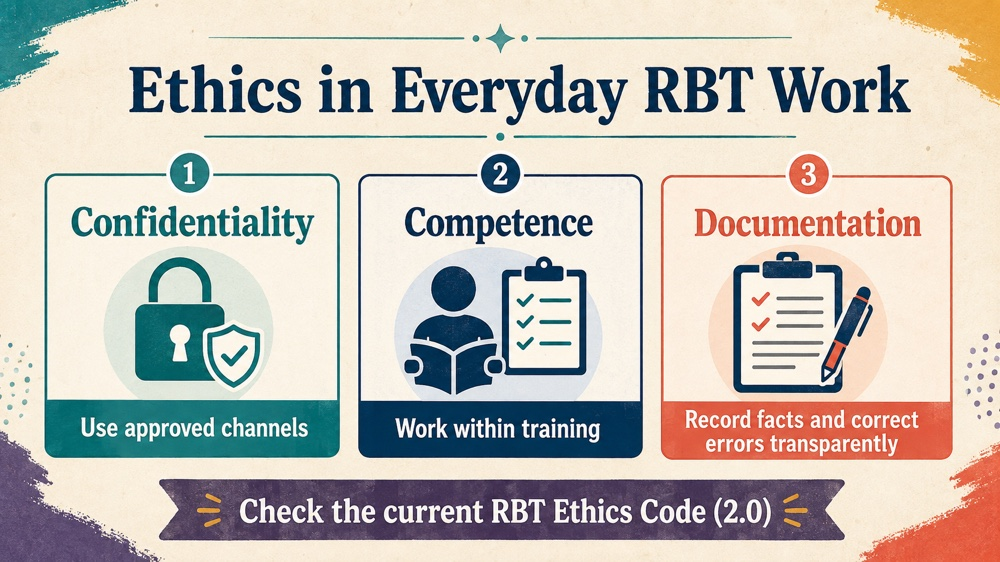
An RBT should provide services only within demonstrated competence and the assigned role. Competence includes completing required training, accepting feedback, following the written procedure, and communicating when a task exceeds current skill. It does not mean an RBT must know every answer immediately. Ethical practice can look like pausing, checking the plan, asking the supervisor, and documenting what occurred.
A candidate may see an answer that sounds independent and confident, such as changing a target, diagnosing a function, or promising a family a result. Those answers can be attractive because they appear proactive. The better answer respects role boundaries: implement the assigned procedure, protect safety, describe the observable issue, and obtain direction for a clinical change.
Confidentiality, technology, and public statements
Confidentiality applies to conversations, paper records, electronic systems, photos, text messages, video calls, and social posts. Do not share identifying client details for a joke, a study example, or a request for advice. Use only approved channels and the minimum information needed for the professional purpose. A blurred screenshot can still reveal identity through context, names, or dates.
Public statements create another common ethics question. An RBT should describe credentials accurately and avoid implying that a training provider, employer, or study site is BACB-endorsed when it is not. Do not promise a clinical outcome, claim an RBT can practice independently, or represent a pending application as an active certification. Accuracy is an ethical behavior, not just a marketing preference.
Supervision and communication of concerns
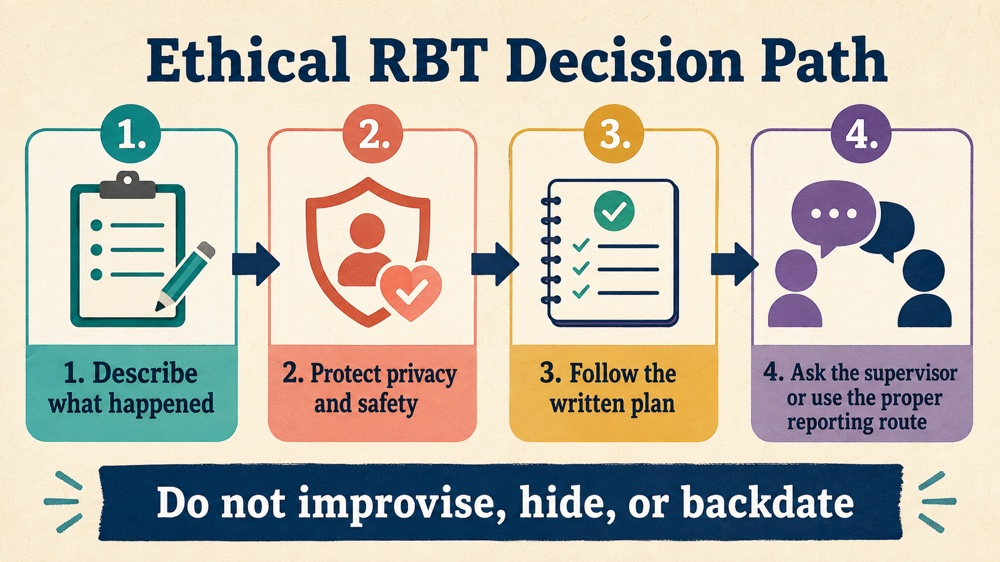
Supervision gives the RBT a route for training, observation, feedback, and escalation. If a data sheet is incomplete, a procedure is unclear, a safety concern occurs, or a family asks for a change beyond the RBT’s role, communicate through the responsible supervisor and the approved workplace process. Preserve the original facts and do not backfill a record to make the session appear smooth.
Ethical communication is specific. Instead of saying “the learner was noncompliant,” describe the instruction, materials, response, prompts, and consequence that were observed. Instead of hiding a missed step, state what happened, what was recorded, and what direction is needed. This supports both consumer protection and accurate clinical decision-making.
A bacb ethics code 2026 scenario
An RBT is asked by a relative to post a video of a client making progress. The request sounds celebratory, but the RBT should not upload the video to a personal account. The RBT should follow the organization’s privacy and consent process, consult the supervising team, and use only an approved communication pathway if a public story is ethically and legally authorized.
In a second scenario, an RBT notices that the written prompt hierarchy is not clear and a caregiver asks the RBT to try a new technique immediately. The ethical response is to protect safety, follow the trained procedure if possible, document the uncertainty, and ask the responsible supervisor. The RBT should not improvise a clinical intervention for convenience or approval.
Reporting, remediation, and nonretaliation habits
When a concern may involve an ethics requirement, the first step is to use the appropriate supervisory and organizational process when that is safe and applicable. The RBT Ethics Code and BACB procedures describe routes for addressing concerns; the exact response depends on the facts. Keep records factual, preserve relevant evidence, and avoid public accusations while a concern is being reviewed.
A correction can be ethical when it is prompt and transparent. If an RBT enters the wrong data point, the RBT should follow the approved correction process and notify the appropriate person rather than silently deleting the error. If a required supervision record is incomplete, the RBT should report the gap and seek direction rather than inventing a signature or date. Integrity is shown in the repair, not in pretending an error never happened.
Ethics and cultural humility
Ethical service includes respectful, culturally responsive communication. An RBT should avoid treating a preference, communication style, family practice, or disability-related behavior as a defect simply because it is unfamiliar. Ask the supervising team for culturally responsive guidance, use the learner’s and family’s communication needs, and distinguish a safety or skill concern from a personal preference of the provider.
For exam practice, look for answers that preserve dignity while still following the behavior plan. The ethical choice is not always the most permissive or the most restrictive. It is the choice that is authorized, necessary, respectful, observable, and consistent with the current code and supervision process. When the scenario lacks information, the answer may be to gather information and consult the responsible professional.
Common mistakes when studying the BACB ethics code
- Searching for a supposed 2026 code and ignoring the current RBT Ethics Code (2.0).
- Using standards for BCBA or BCaBA practice to answer an RBT role question.
- Treating confidentiality as only a social-media issue rather than an everyday duty.
- Confusing reporting an observable concern with making an unsupported accusation.
- Backdating a signature, deleting an error, or hiding a missed supervision record.
- Changing a clinical procedure because a caregiver, colleague, or candidate thinks it will help.
- Describing independent study content as official BACB material or endorsement.
How to study bacb ethics code 2026 without keyword stuffing
Build a source-linked study table with four columns: standard or topic, observable situation, RBT action, and escalation route. Use the exact search phrase once as a label, then focus on the decision. Write original scenarios about privacy, competence, supervision, documentation, public statements, boundaries, cultural humility, and reporting. Explain why an attractive alternative would exceed the role or omit a required communication step.
Review the date of each source check. Ethics documents can be updated, and a current-year search phrase may bring back an older PDF. Use the official document title and link in your notes. This approach improves recall while keeping the article and study process honest: clarity and primary sources are more useful than repeating a keyword in every sentence.
BACB ethics code 2026 review checklist
- Can I identify the current RBT Ethics Code (2.0) and official BACB ethics resources?
- Can I distinguish an RBT’s supervised role from independent clinical or certification decisions?
- Can I protect private information across paper, digital, video, and public channels?
- Can I describe an observed concern without turning a hypothesis into a fact?
- Can I correct a record transparently and report a supervision or safety concern?
- Can I recognize when a family request requires consultation rather than improvisation?
- Can I describe independent study material accurately without claiming BACB endorsement?
Use the checklist as a review tool, then return to the official code for the exact language that applies to your role and situation. This page explains concepts for study; it does not replace the BACB code, a supervisor’s direction, legal advice, or an official ethics decision.
Practice the concept
Review bacb ethics code 2026 with original RBT scenarios, current-source reminders, and clear role boundaries.
Review the RBT study resource →
Frequently Asked Questions
Is there a new BACB ethics code specifically called the 2026 code?
The current BACB ethics resources identify the RBT Ethics Code (2.0) for RBT applicants and certificants. Check the official ethics page for updates; a current-year search phrase is not itself a new code version.
Does the RBT Ethics Code apply outside a clinic?
The code applies to RBT behavior-technician activities across settings and communication modalities. Review the current code for its scope and standards.
What should an RBT do when a procedure is unclear?
Follow the trained procedure when safe, describe and document the observable issue, and ask the responsible supervisor for direction before making a clinical change.
Are the scenarios official BACB questions?
No. They are original study scenarios and are not official, recalled, leaked, or BACB-endorsed questions.
References
- Behavior Analyst Certification Board: Registered Behavior Technician Handbook, updated June 2026.
- Behavior Analyst Certification Board: RBT Test Content Outline (3rd ed.).
- Behavior Analyst Certification Board: RBT resources.
- Behavior Analyst Certification Board: ethics resources.
- Behavior Analyst Certification Board: RBT Ethics Code (2.0).