
BACB ethics hotline is a search phrase for help with an ethics concern, but candidates should not assume there is one universal phone line for every situation. The current BACB ethics resources describe ethics standards and enforcement procedures. An RBT should first protect safety and privacy, use the responsible supervision and organizational process when appropriate, and consult the official BACB reporting instructions for matters that require board involvement.
Table of Contents
- What the BACB ethics hotline search is really asking
- First protect safety and preserve facts
- Use supervision before escalating when safe
- The difference between advice and a formal report
- A BACB ethics hotline scenario
- Confidentiality when seeking ethics help
- Documentation and remediation
- Current ethics study context
- Mistakes to avoid with BACB ethics hotline searches
- BACB ethics hotline review checklist
- Frequently Asked Questions
- References
Quick answer: Treat bacb ethics hotline as a current-source RBT study topic. Identify the actor and decision owner, follow the written procedure, record observable facts, and keep the supervision boundary visible.
Study boundary: This independent guide is educational content. It is not a BACB policy, certification decision, legal opinion, answer key, or guarantee of examination success. Examples are original and are not official, recalled, leaked, or BACB-endorsed questions.
Current exam context: The current BACB RBT Test Content Outline describes 43 tasks across six domains; the examination includes 75 scored questions and 10 unscored pilot questions in a 90-minute testing period. Verify the current handbook and outline before relying on a time-sensitive detail.
What the BACB ethics hotline search is really asking
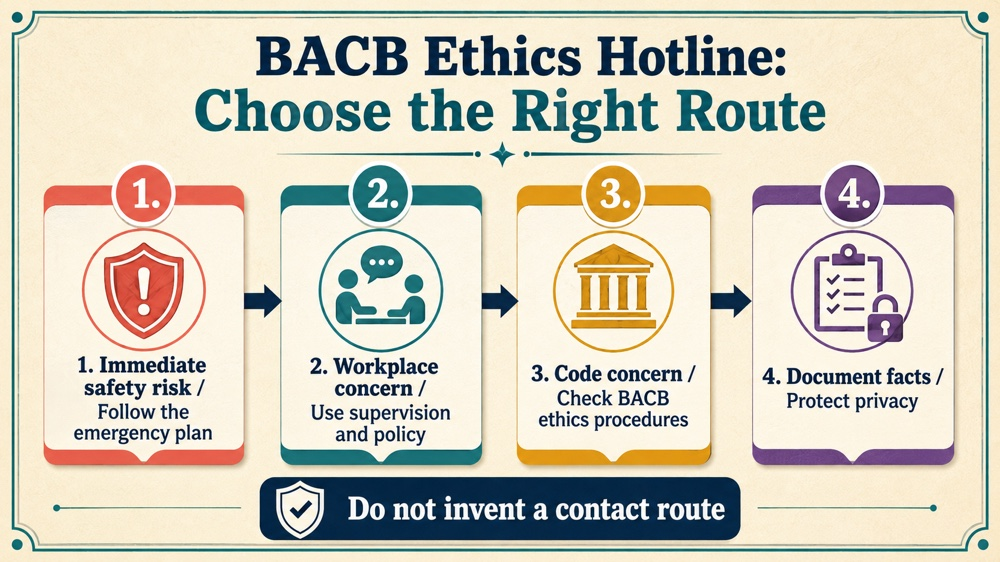
A person searching for an ethics hotline may be asking where to get advice, where to report a concern, or how to handle an urgent safety issue. Those are different needs. A client emergency requires the trained emergency or crisis procedure. A workplace question may require the supervisor or employer process. A possible certification-code concern may require the official BACB ethics channel and procedures.
Do not invent a phone number, promise confidentiality beyond the channel’s terms, or post a client’s details in a public forum while looking for help. Start with the current BACB ethics resources and the RBT Ethics Code (2.0). The correct route depends on the facts, role, urgency, and applicable process.
First protect safety and preserve facts
When an immediate safety risk exists, follow the trained emergency or crisis plan and obtain urgent help through the appropriate local or organizational route. After the situation is safe, record what was observed, when it occurred, who was present, what actions were taken, and who was notified. Do not turn the first report into a public accusation or a clinical diagnosis.
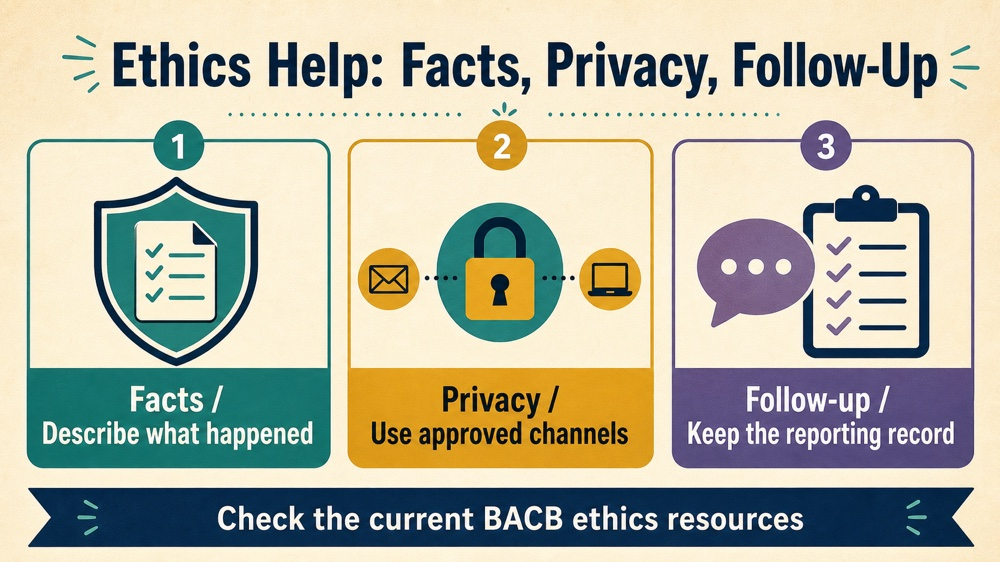
For a nonurgent concern, preserve the original message, note, or data record according to policy. Use neutral descriptions and distinguish what you saw from what someone told you. A clear factual record allows the supervisor, employer, or BACB to decide which process applies without forcing the RBT to make a legal conclusion.
Use supervision before escalating when safe
The RBT Ethics Code and the RBT Handbook connect the technician’s work to supervision. If an instruction is unclear, a record is incomplete, or a boundary concern arises, discuss it with the responsible supervisor or other authorized professional when doing so is safe and appropriate. Ask what to document and whether a formal report is required.
Supervision is not a reason to hide a concern. If the supervisor is involved in the concern, unavailable, or the matter is not resolved through the applicable route, use the organization’s escalation process and the official BACB instructions. A study answer should name the next authorized route rather than saying only ‘tell someone.’
The difference between advice and a formal report
Advice helps a person understand what a rule or process may require. A formal report starts a defined review or enforcement process and may require specific information and consent. An RBT should read the current instructions before submitting a report and should not label a disagreement as an ethics violation without identifying the observable conduct and applicable standard.
A report should be truthful, specific, and made through the designated channel. Keep copies of what was submitted and follow any instructions about communication. Do not retaliate, threaten, or ask coworkers to coordinate a story. If the issue concerns a client, protect client privacy while providing the information the authorized reviewer needs.
A BACB ethics hotline scenario
An RBT sees a public post that includes a recognizable client photo and claims the post was approved by a colleague. The RBT should not share the post widely or add identifying comments. The RBT should preserve the relevant evidence securely, follow the organization’s privacy and supervision process, and review the current BACB reporting instructions if the concern falls within the code or certification process.
A different scenario involves a learner’s immediate medical emergency. The RBT should follow the trained emergency plan and contact the appropriate urgent service, not wait for an ethics inquiry. The phrase hotline does not replace an emergency route. Matching the response to the urgency is a key exam and workplace skill.
Confidentiality when seeking ethics help
An ethics question should contain only the information needed for the authorized recipient to understand the concern. Remove unnecessary names, photos, addresses, and clinical details. Use approved work systems, not personal social accounts or group chats. Even if a message is deleted later, screenshots, forwarding, or contextual clues may continue to expose private information.
If a report requires identifying information, provide it through the official secure channel and follow the instructions. Do not promise a family or coworker that a report will remain anonymous unless the responsible process says so. Honest communication about limits is part of ethical practice.
Documentation and remediation
Ethical work includes correcting errors. If an RBT enters the wrong data point, the RBT should use the approved correction process, notify the appropriate person, and preserve an accurate record of the change. If supervision was missed, report the gap rather than backdating a signature. If a privacy disclosure occurred, follow the reporting and remediation procedure promptly.
A remediation step is not the same as erasing the event. The goal is to reduce harm, restore accurate information, and prevent recurrence. In study questions, choose the answer that is transparent, timely, and connected to the responsible process. Avoid answers that hide, minimize, retaliate, or create a new record that falsely looks complete.
Current ethics study context
The BACB’s ethics resources identify the RBT Ethics Code (2.0) as the code for RBT applicants and certificants and provide code-enforcement procedures. The current examination also includes an Ethics domain. Study the standards with original scenarios about competence, confidentiality, supervision, documentation, public statements, relationships, and reporting. Always verify the current official page before relying on a contact route or form.
The current RBT outline describes 43 tasks across six domains, and the examination includes 75 scored questions and 10 unscored pilot questions in 90 minutes. Those numbers provide context but do not decide a reporting question. The facts of the scenario and the applicable current source control.
Mistakes to avoid with BACB ethics hotline searches
- Using an unverified phone number or outdated reporting page.
- Treating a public post or coworker opinion as a formal ethics finding.
- Sharing identifying client information while asking for advice.
- Skipping an urgent safety procedure because the question contains the word ethics.
- Failing to use supervision or the designated escalation route when safe.
- Backdating, deleting, or rewriting records instead of correcting them transparently.
- Threatening retaliation or promising an outcome that the reporting process cannot guarantee.
BACB ethics hotline review checklist
- Can I separate emergency response, supervision, workplace escalation, and BACB reporting?
- Can I describe an observable concern without making an unsupported accusation?
- Can I preserve evidence and protect privacy?
- Can I find the current BACB ethics resources rather than relying on a search snippet?
- Can I correct documentation honestly and report a gap promptly?
- Can I identify when a supervisor is unavailable or involved and use the next authorized route?
- Can I explain that independent study content is not a BACB decision or reporting service?
The phrase hotline is only a starting point. Ethical action is a sequence: protect people, preserve facts, use the right channel, and follow the current instructions. When the situation is unclear, ask an authorized professional instead of guessing.
Practice the concept
Review bacb ethics hotline with original RBT scenarios, current-source reminders, and clear role boundaries.
Try the RBT practice resource →
Frequently Asked Questions
Is there one BACB ethics hotline for every concern?
Do not assume that one route fits every situation. Use the current BACB ethics resources and procedures, plus the appropriate emergency, supervision, or organizational route for the facts and urgency.
Should an RBT report an immediate safety emergency to the BACB first?
No. Follow the trained emergency or crisis procedure and obtain urgent help first. After safety is addressed, document and use the appropriate reporting process.
What information should an ethics report contain?
Use the current official instructions. Reports should be truthful and specific, while protecting privacy and providing only the information the authorized reviewer needs.
Is this page a BACB reporting service?
No. It is independent educational content and does not make ethics findings or replace the BACB’s official reporting instructions.
References
- Behavior Analyst Certification Board: Registered Behavior Technician Handbook, updated June 2026.
- Behavior Analyst Certification Board: RBT Test Content Outline (3rd ed.).
- Behavior Analyst Certification Board: RBT resources.
- Behavior Analyst Certification Board: ethics resources.
- Behavior Analyst Certification Board: RBT Ethics Code (2.0).