
RBT competency assessment practice test resources can help you rehearse observable, role-appropriate decisions during RBT preparation. They should not be confused with the official initial competency assessment. A practice page can provide original scenarios, answer explanations, and a study log; it cannot perform a direct assessment, sign an official form, approve a BACB application, or issue certification.
Table of Contents
- What an RBT competency assessment practice test can do
- RBT competency assessment practice test vs. the official assessment
- Learn the official assessment boundary
- Map practice to the six TCO domains
- Prepare evidence, not just answers
- Original RBT competency practice decisions
- Build a correction log
- Use practice to ask better supervision questions
- Check the current official documents
- Common RBT competency assessment practice test mistakes
- Frequently Asked Questions
- References
The distinction matters because “practice test” and “competency assessment” are often placed next to each other. The current BACB materials control the official process. This article is an independent study guide built around the RBT Test Content Outline, 3rd edition, and current public BACB documents. It is not a BACB page, not a certification program, and not a substitute for the current assessment packet or Handbook.
RBT Training is not affiliated with, operated by, or endorsed by the Behavior Analyst Certification Board (BACB). The examples below are newly written for study. They are not official, recalled, leaked, or BACB-endorsed questions, and no practice score can guarantee assessment completion, certification, or a passing result.
What an RBT competency assessment practice test can do
An RBT competency assessment practice test is most useful when it rehearses decisions rather than asking you to memorize answer letters. Before reading an explanation, identify the observable response, the written procedure, the measurement or teaching step involved, and the action that fits the RBT role. Then explain what evidence would support your choice.
- It can rehearse: selecting a measurement, following a prompt sequence, recording objective information, recognizing a plan boundary, and choosing when to report or ask.
- It can reveal: whether an error came from reading the facts, confusing a measurement unit, skipping a written step, or exceeding the assigned role.
- It cannot replace: direct observation, performance feedback, the current initial competency assessment packet, an eligible assessor, or any BACB application requirement.
For example, an independent question may describe an instruction, a prompt, and a learner response. You can practice identifying which step was implemented and what should be recorded. That exercise builds preparation skill. It does not create the direct evidence or assessor decision required by the official competency process.
A good practice resource also tells you what to do after a miss. Write a correction rule, locate the source you need to reread, and create a changed scenario. A percentage alone does not tell you whether the problem was measurement, procedure fidelity, documentation, ethics, or reading.
RBT competency assessment practice test vs. the official assessment
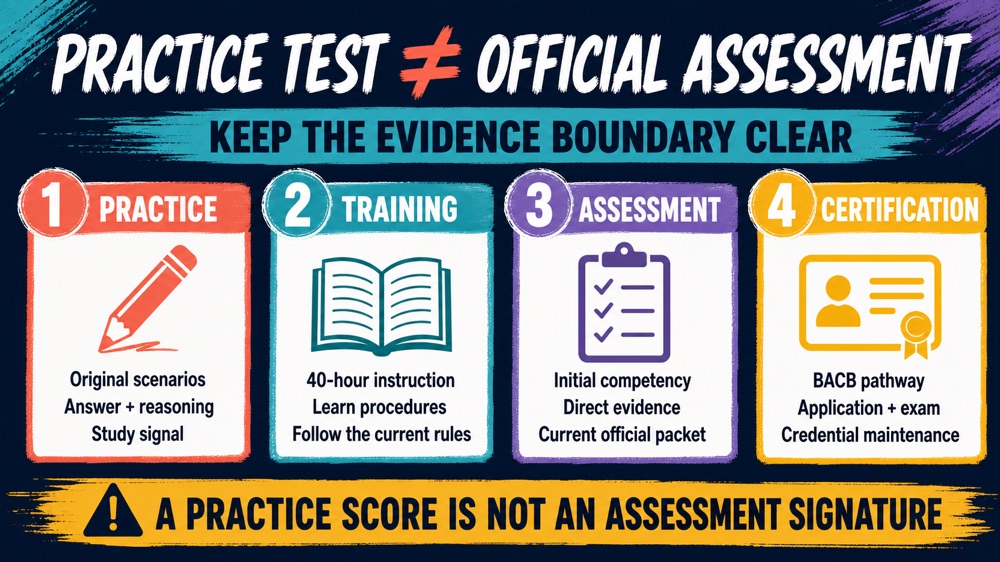
The phrase RBT competency assessment practice test describes an independent rehearsal tool. The official initial competency assessment is a separate BACB pathway step that evaluates demonstrated competency through the applicable current process. Do not use the names interchangeably in a course description, application checklist, or study note.
| Feature | Independent practice test | Official initial competency assessment |
|---|---|---|
| Purpose | Rehearse decisions and identify study gaps. | Evaluate required competency through the current official process. |
| Format | Original questions, scenarios, checklists, or explanations chosen by the provider. | Current BACB materials and the applicable assessment process. |
| Evidence | A learner’s selected answer and reasoning. | Direct competency evidence and the required assessor documentation. |
| Authority | Independent study content; not a BACB decision. | Part of the official RBT application pathway. |
| Result | A study signal for what to review next. | Documentation used within the current eligibility/application process. |
This boundary should appear wherever a provider uses the word “assessment.” A practice score is not an assessment signature. A completion badge is not certification. A study checklist is not permission to skip the current official packet.
Learn the official assessment boundary
The current BACB RBT Handbook describes the initial competency assessment as a step after the required training and within the applicable timing window before application. The current official packet controls the tasks, evidence, signatures, and instructions that apply to that assessment. Verify the live documents before acting because requirements, forms, and dates can change.
Use a four-question boundary check:
- Who controls this step? If it affects eligibility, the official assessment, application approval, examination authorization, or credential maintenance, start with the BACB source.
- What evidence is required? A multiple-choice answer may show study reasoning, but it is not the same evidence as demonstrating a skill or procedure.
- Who is allowed to sign or evaluate? Do not ask an unqualified person or a website to substitute for the current eligible assessor process.
- What should happen if the direction is unclear? Pause, preserve safety, and use the appropriate supervisor or official channel instead of inventing a procedure.
Do not upload identifiable client information to a public practice tool. Practice examples should use fictional, non-identifying facts. In real services, implement the written plan, protect privacy, document objectively, and ask the responsible professional when a new event falls outside the available direction.
Map practice to the six TCO domains
The current RBT Test Content Outline, 3rd edition, lists 43 tasks across six domains. The examination blueprint describes 75 scored questions and 10 unscored pilot questions. Those public facts help a learner organize study, but an independent RBT competency assessment practice test should not claim to reproduce the official assessment or examination.
| Domain | Current task count / share | Practice decision to rehearse |
|---|---|---|
| A. Data Collection and Graphing | 13 / 17% | Define what is observable, choose the matching measurement, and record it as written. |
| B. Behavior Assessment | 8 / 11% | Follow an assigned assessment procedure and separate observation from interpretation. |
| C. Behavior Acquisition | 19 / 25% | Follow teaching, prompting, reinforcement, maintenance, and generalization steps. |
| D. Behavior Reduction | 14 / 19% | Implement the written plan, protect safety, and report concerns without improvising. |
| E. Documentation and Reporting | 10 / 13% | Write objective notes and communicate information through the right channel. |
| F. Ethics | 11 / 15% | Protect privacy, competence, dignity, supervision, and professional boundaries. |
Use the counts as an official blueprint reference, not as a promise about how many questions an independent practice set must contain. A practical review cycle is to solve one scenario from each domain, explain the decision, and then compare the explanation with the relevant TCO task and current source.
When a resource says “BACB aligned,” ask what that means. Alignment should be specific: current TCO version, clear domain mapping, original content, source links, and a visible boundary between preparation and the official pathway. A logo, color scheme, or score does not establish endorsement.
Prepare evidence, not just answers
To use an RBT competency assessment practice test well, answer each item in two layers. First select the best option from the facts supplied. Then write the evidence or action that would matter in real work. This second layer prevents memorized vocabulary from replacing performance reasoning.
- Fact: underline what was observed, counted, timed, stated, or written.
- Target: name the response, skill, or procedure without adding a motive.
- Plan: find the instruction, prompt hierarchy, criterion, assessment sequence, or safety direction already provided.
- Role: decide whether the RBT should implement, record, report, or ask for direction.
- Evidence: state what you would document or demonstrate, without claiming that a quiz proves competency.
Suppose a scenario says a learner takes four seconds to begin a response after an instruction. If the question asks about the delay between the instruction and the response, latency is the relevant measurement concept. The explanation should still state the start event, end event, operational definition, and recording rule. A label without those facts is fragile.
Suppose another item describes a supervisor-assigned preference procedure but leaves one step unclear. The strongest role-appropriate answer is usually to follow the written procedure that is clear, preserve the record, and ask the supervisor about the ambiguity. Adding a new procedure because it sounds efficient is not evidence of competence.
Original RBT competency practice decisions
The following examples are newly written study decisions. They are not official, recalled, leaked, or BACB-endorsed questions:
- Data collection: the plan defines a response and asks for the number of occurrences during a session. Identify the response exactly as defined, count only qualifying events, and record the session context.
- Assessment: a responsible professional assigns a preference procedure with a stated order. Prepare materials, follow the order, record the choices, and report any missing instruction.
- Acquisition: a teaching plan specifies an instruction, a wait, and a prompt if needed. Follow that sequence and record the learner’s response; do not replace the hierarchy with a personal favorite.
- Reduction: a new safety concern appears and the available plan does not say how to respond. Follow current safety direction and contact the responsible professional rather than creating an intervention.
- Documentation: a caregiver uses a broad label to describe an event. Separate the caregiver report from what was directly observed and document what still needs verification.
- Ethics: someone requests a recognizable client story for social media. Protect confidentiality and use the legitimate supervisory channel for any necessary case discussion.
After each item, change one fact: the setting, time frame, prompt, response definition, or role. Solve it again without checking the first answer. If the answer changes, write down exactly which fact changed the decision. That transfer step is more valuable than repeating the same wording.
Build a correction log
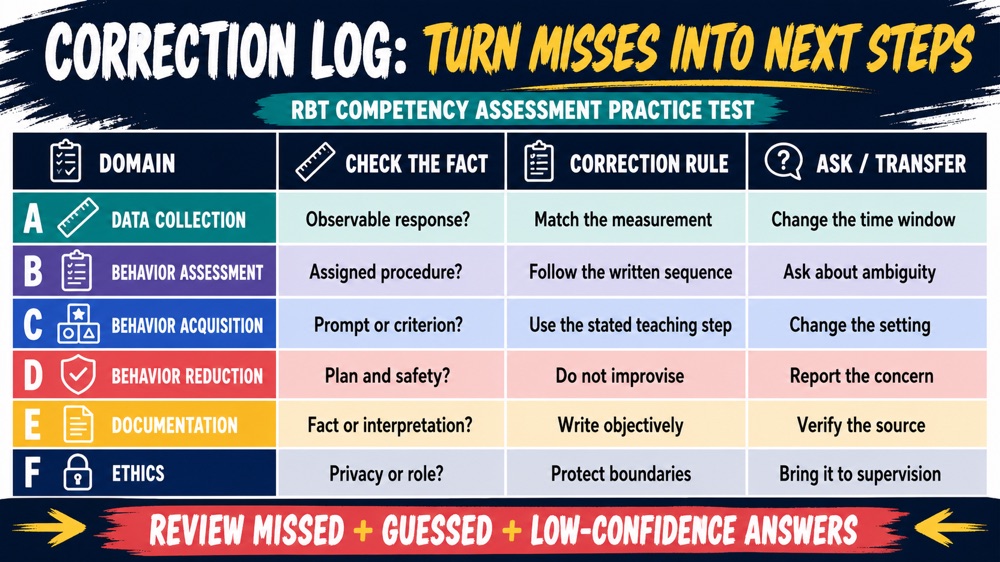
A correction log makes practice results actionable. Record missed, guessed, and low-confidence correct answers, because all three can signal an unstable decision. Use fields such as:
| Field | What to write | Example |
|---|---|---|
| Observable fact | Only what the scenario states or shows. | “Instruction, five-second wait, no response.” |
| TCO domain | The main decision area. | “C. Behavior Acquisition.” |
| Chosen answer | Your selection and confidence. | “Prompt immediately; low confidence.” |
| Correction rule | Why the stronger option fits the facts. | “Use the next step written in the hierarchy.” |
| Role boundary | What to implement, record, report, or ask. | “Ask before changing the hierarchy.” |
| Transfer item | What will change when you solve it again. | “New setting and new instruction.” |
Sort the log by error pattern rather than by question number. Common groups include measurement unit, prompt sequence, plan fidelity, objective language, privacy, and next-best-step reasoning. Start with the largest group, then bring unresolved procedure questions to supervision. Do not use the log to claim that you have completed the official assessment.
Use practice to ask better supervision questions
The best result of an RBT competency assessment practice test is often a better question for the person responsible for supervision or training. Bring a concise example and ask:
- Which observable feature tells me to use latency rather than duration here?
- Which step of this prompt or reinforcement procedure is written in the plan?
- What data system and note format should I use for this program?
- What safety direction applies if the plan is silent about a new event?
- Which current BACB source controls the requirement I am trying to verify?
- What would direct competency evidence look like for this assigned procedure?
Keep the study question separate from identifiable client information. A supervisor can correct a decision rule without receiving unnecessary names, dates of birth, addresses, or recognizable stories. If a practice explanation conflicts with the written plan or current official source, stop and verify rather than forcing the explanation to fit.
Check the current official documents
Before training, completing an assessment, applying, or scheduling an examination, check the current BACB RBT page and Handbook. The current Handbook describes eligibility, the 40-hour training requirement, the initial competency assessment, application documents, examination process, and maintenance expectations. The current official assessment packet controls the assessment form and evidence. The TCO controls the current task scope.
The current exam blueprint describes six domains, 43 tasks, 75 scored questions, and 10 unscored pilot questions. These facts are useful for planning a study map, but they do not turn an independent practice test into an official exam or competency assessment. Requirements and documents may be updated, so preserve the access date and recheck before acting.
A trustworthy independent resource should make four things easy to find: its current source list, its version boundary, its original-content disclaimer, and its correction method. Avoid any page that sells “real,” “recalled,” or “leaked” questions, implies BACB endorsement without evidence, or promises certification from a practice score.
Common RBT competency assessment practice test mistakes
- Confusing practice with assessment: a quiz answer is not direct competency evidence or an official signature.
- Memorizing answer letters: change one fact and solve the decision again.
- Ignoring the written plan: implement assigned direction and ask before changing it.
- Using labels instead of observations: define the response and events before choosing a measurement.
- Skipping low-confidence correct answers: review uncertainty as well as incorrect answers.
- Sharing private information: keep practice examples fictional and study notes non-identifying.
- Trusting old requirements: check the current BACB Handbook, TCO, and official assessment packet.
Bottom line: an RBT competency assessment practice test can organize rehearsal, but it cannot replace the official initial competency assessment. Use original scenarios to practice observable decisions, use the current TCO and BACB documents for scope, and turn every uncertain answer into a correction rule or supervision question.
Ready to practice the RBT concepts you just reviewed?
Try an independent, original RBT practice resource with exam-style questions, scoring, and answer explanations.
References
- Behavior Analyst Certification Board. RBT Test Content Outline, 3rd edition.
- Behavior Analyst Certification Board. RBT Handbook.
- Behavior Analyst Certification Board. RBT Ethics Code.