
RBT ethics code 2026 is a time-sensitive study phrase, so the first step is to confirm the current official document, title, version, update date, and application. Ethics study should not rely on an image, social post, or summary that omits the source. An RBT must protect clients, work within competence, follow supervision, protect privacy, communicate accurately, and report concerns through the appropriate route. The ethics code does not turn an RBT into an independent diagnostician or treatment designer. This independent guide uses the keyword rbt ethics code 2026 to organize practical study questions and role boundaries. It is not a legal opinion, BACB policy quotation, official answer key, or guarantee of examination success. Examples are original and are not official, recalled, leaked, or BACB-endorsed questions.
Table of Contents
- RBT ethics code 2026: verify the current source
- Work within competence and assignment
- RBT ethics code 2026: protect privacy
- Follow supervision and communicate accurately
- Respect dignity and choice
- Respond to concerns through the right route
- Use ethical reasoning in exam scenarios
- Avoid ethics-study mistakes
- RBT ethics code 2026 checklist
- Frequently Asked Questions
- References
Continue your RBT study with RBT exam study materials and original practice resources.
Quick answer: Treat rbt ethics code 2026 as a current-source RBT study topic. Identify the exact action, source, data rule, and supervision boundary before deciding.
Study boundary: This independent guide is educational content. It is not a BACB policy, certification decision, legal opinion, answer key, or guarantee of examination success. Examples are original and are not official, recalled, leaked, or BACB-endorsed questions.
Current exam context: The current BACB RBT Test Content Outline describes 43 tasks across six domains; the examination includes 75 scored questions and 10 unscored pilot questions in a 90-minute testing period. Verify the current handbook and outline before relying on a time-sensitive detail.
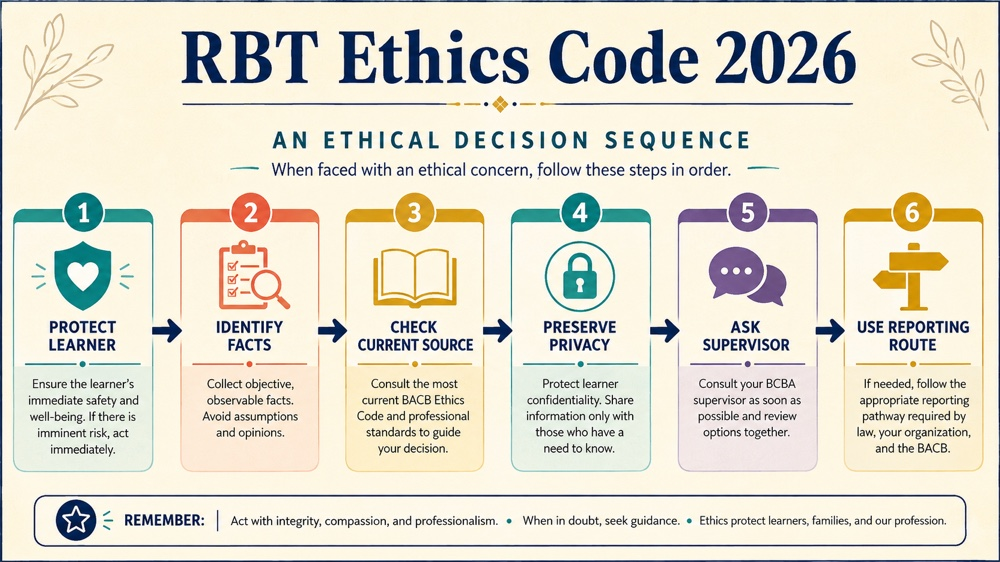
For a current-year ethics topic, write the source beside every study note. Distinguish a direct requirement from an application example, and distinguish an employer procedure from the professional code. When an ethical concern appears, protect the learner first, preserve relevant facts, avoid public disclosure, and use the reporting or supervision route required by the situation. Do not investigate beyond your authority or promise a particular outcome. If two instructions conflict, document the conflict and ask the responsible professional or designated reporting channel for clarification. A current-source habit is part of ethical competence because it prevents outdated summaries from guiding present conduct. Record the date you checked the source and revisit notes when official materials change.
RBT ethics code 2026: verify the current source
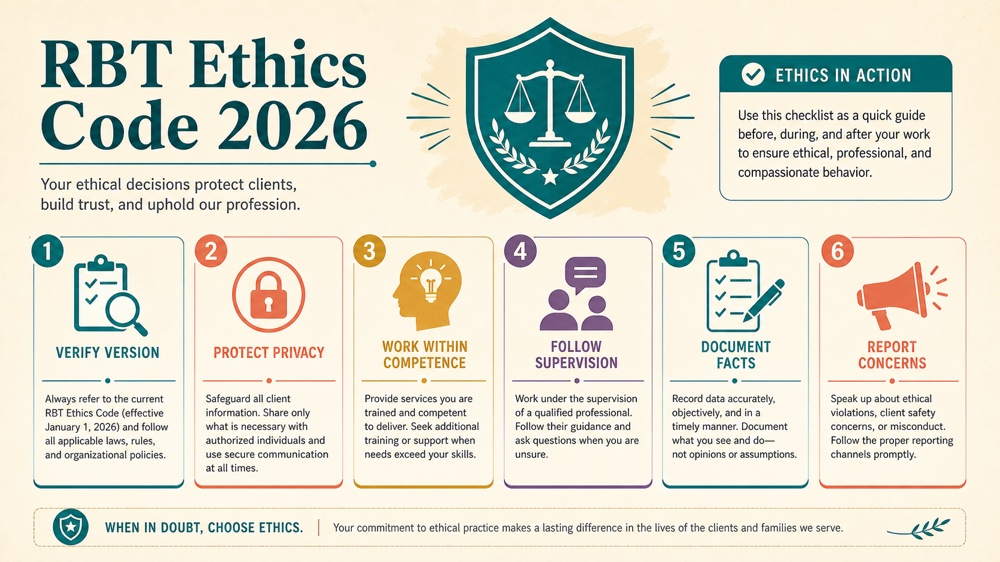
Record the official document, version, update date, and relevant section before relying on a rule. Current-year language can be confused with older summaries, so keep the source visible in study notes.
Work within competence and assignment
Know the training and supervision required for the task. Do not present a credential, course, or previous experience as universal permission. Report when a task exceeds demonstrated competence or the written assignment is unclear.
RBT ethics code 2026: protect privacy
Use minimum necessary information, approved systems, secure records, and respectful communication. Do not post identifying details, copy protected assessment materials, or move client data into an unapproved study tool.
Follow supervision and communicate accurately
Bring focused questions, report errors and deviations, and separate observation from interpretation. Do not conceal a problem because you fear an uncomfortable conversation. Accurate communication supports client protection and professional review.
Respect dignity and choice
Use individualized communication supports, reasonable processing time, and procedures that do not shame or threaten. Report barriers, distress, inaccessible materials, or conflicts between a routine and the learner’s needs.
Respond to concerns through the right route
Identify immediate safety issues, preserve relevant facts, and follow the organization’s reporting process. Avoid gossip, public accusations, or independent investigation outside your role. Ask which channel is appropriate when uncertain.
Use ethical reasoning in exam scenarios
Name the client risk, the factual observation, the applicable current source, the role boundary, and the next supervised action. Reject options that hide data, expose privacy, retaliate, or make unsupported promises.
Avoid ethics-study mistakes
- Relying on an outdated code summary.
- Treating social media as the official source.
- Sharing client details while asking for advice.
- Hiding errors or supervision concerns.
- Working outside training or competence.
- Making promises about outcomes or certification.
- Calling original scenarios official examination questions.
RBT ethics code 2026 checklist
- What current official source supports the rule?
- What client dignity, privacy, or safety issue is present?
- What is the RBT trained and assigned to do?
- What fact must be documented objectively?
- Which supervisor or reporting route applies?
- What information must remain confidential?
- What action protects the learner while clarification is obtained?
Use rbt ethics code 2026 as a current-source ethics and role-boundary study topic. RBT Training is independent educational content and is not affiliated with or endorsed by BACB.
Practice the concept
Review rbt ethics code 2026 with original RBT scenarios, current-source reminders, and clear role boundaries.
Review the RBT study resource →
Frequently Asked Questions
Where should I verify RBT ethics code 2026 information?
Use the current official BACB ethics materials and compare them with the handbook, employer policy, and supervisor direction.
What should an RBT do after an ethical concern?
Protect the learner, document objective facts, preserve privacy, and use the appropriate supervision or reporting route.
Does an ethics code authorize independent clinical decisions?
No. Ethical obligations and role boundaries still require appropriate training, assignment, supervision, and qualified decision-makers.
Are these official exam questions?
No. They are original educational scenarios and are not official, recalled, leaked, or BACB-endorsed.
References
- Behavior Analyst Certification Board: Registered Behavior Technician Handbook, updated June 2026.
- Behavior Analyst Certification Board: RBT Test Content Outline (3rd ed.).
- Behavior Analyst Certification Board: RBT resources.
- Behavior Analyst Certification Board: ethics resources.
- Behavior Analyst Certification Board: RBT Ethics Code (2.0).