RBT mock exam 2026 searches are usually asking for two things at once: a practice experience that feels current and a clear way to decide what to review next. A year in a title is not, by itself, proof that the official examination blueprint changed. Use the year as a prompt to check the primary sources, then use an independent mock to rehearse decisions, pacing, and correction.
Table of Contents
- What RBT mock exam 2026 practice should measure
- What the 2026 label does and does not mean
- Compare RBT mock exam 2026 formats
- Map review to the six TCO domains
- Understand the official exam frame
- Use original study decisions
- Build a 2026 correction log
- Verify sources before you trust a year label
- Turn mock results into supervision questions
- Common RBT mock exam 2026 mistakes
- Frequently Asked Questions
- References
This guide is for independent exam preparation. The current BACB Handbook, the RBT Test Content Outline, 3rd edition, and the applicable competency-assessment materials control the credentialing pathway. A third-party mock cannot perform an initial competency assessment, approve an application, reproduce the secure examination, or issue certification.
RBT Training is not affiliated with, operated by, or endorsed by the Behavior Analyst Certification Board (BACB). All examples below are newly written for study. They are not official, recalled, leaked, or BACB-endorsed questions. A practice score cannot guarantee a passing result, an assessment decision, or certification.
What RBT mock exam 2026 practice should measure
A useful RBT mock exam 2026 resource should make you apply a decision rule to a new situation. It should not reward recognition of a repeated phrase while leaving the underlying procedure unclear. For each item, identify the observable facts, the written instruction, the decision that fits the RBT role, and the evidence you would record or report.
- Observe: separate what the scenario states, shows, counts, or times from an interpretation.
- Locate the procedure: identify the current plan, assigned assessment step, teaching procedure, or safety direction.
- Choose the next action: implement, record, report, or ask for direction rather than improvising a new plan.
- Explain the distractor: name the unsupported assumption, plan change, privacy problem, or scope error in the weaker option.
- Transfer: solve a changed example after you review the answer.
For example, if a stem describes how long a response lasts, the important reasoning is not the label attached to the behavior. Define the beginning and ending events, then match the measurement to the observable interval. If a teaching plan specifies a prompt hierarchy, follow the written sequence instead of prompting early because the learner appears uncertain.
Current-looking design, a large question count, or a high score does not prove that a resource is aligned. Check the edition, source links, explanations, originality statement, and independent-content boundary before you make it part of your study routine.
What the 2026 label does and does not mean
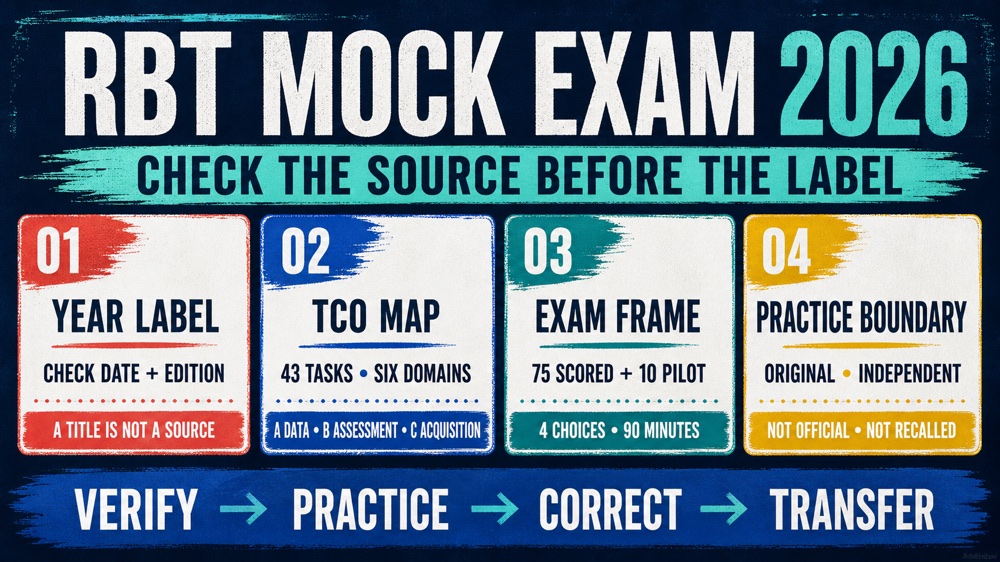
The “2026” part of an RBT mock exam 2026 title is a freshness signal to investigate, not an official credentialing rule. A publisher can update its examples or page title without changing the BACB examination. Conversely, an official document can change while an old practice page remains online.
| Claim you see | What to check | Safe study interpretation |
|---|---|---|
| “Updated for 2026” | Which BACB document, date, and edition are cited? | Use it only after comparing the cited primary source. |
| “85 questions” | Does the page explain whether the set is independent practice? | Treat the count as a format choice, not a promise to reproduce the secure exam. |
| “Exam 3.0” | Does the claim match the current TCO and Handbook? | Prefer the official document over a slogan or badge. |
| “Real” or “recalled” items | Does the page disclose an originality and security boundary? | Do not use leaked or recalled material. |
A current-year study plan therefore has two tracks. First, verify the current official requirements and test-content source. Second, use independent questions to practice the decisions represented in that source. Keeping those tracks separate prevents a marketing year from becoming a false promise about the exam.
Compare RBT mock exam 2026 formats
Choose a format based on the problem you are trying to solve. A learning set and a timed set should not be judged by the same metric.
| Format | Best purpose | Evidence to keep |
|---|---|---|
| Topic quiz | Repair one rule, such as duration, prompting, or objective notes. | Rule, example, and one changed fact. |
| Scenario set | Practice selecting an action when several options sound plausible. | Observable fact, written step, role boundary, confidence. |
| Timed block | Rehearse pacing after you understand the content. | Time, guessed items, skipped items, and review pattern. |
| Broad mock | Sample all six domains and locate the largest correction cluster. | Domain map, error type, and next study block. |
| Review-only pass | Turn a prior attempt into transfer practice. | Why the distractor failed and what changes in a new scenario. |
Start with untimed learning if you cannot explain your answers. Add a timed block when you can retrieve the decision rule without searching. Return to scenario practice when your score rises only because the wording is familiar. The goal is stable reasoning, not a decorative percentage.
Map review to the six TCO domains
The current RBT Test Content Outline, 3rd edition, lists 43 tasks across six domains. The domain shares below describe the official blueprint; they are not a requirement that every independent mock use the same item allocation.
| Domain | Tasks / share | Correction question |
|---|---|---|
| A. Data Collection and Graphing | 13 / 17% | What is directly observable, and which measurement or graph fits? |
| B. Behavior Assessment | 8 / 11% | Which assigned assessment step and observation rule apply? |
| C. Behavior Acquisition | 19 / 25% | Which teaching, prompting, reinforcement, maintenance, or generalization step is written? |
| D. Behavior Reduction | 14 / 19% | What does the plan require, and when should the concern be reported? |
| E. Documentation and Reporting | 10 / 13% | What can be documented objectively and communicated through the right channel? |
| F. Ethics | 11 / 15% | Which privacy, competence, supervision, dignity, or boundary rule matters? |
A correction log should show both the domain and the decision pattern. “Missed C” is less useful than “selected a prompt that was not in the written hierarchy.” “Missed F” is less useful than “treated a recognizable client story as public information.” This level of detail tells you what to practice next.
Understand the official exam frame
The current public exam description in the BACB Handbook refers to 75 scored questions and 10 unscored pilot questions, with four answer choices, a 90-minute time limit, and content represented by the six-domain TCO. A third-party 85-question practice set can be a convenient rehearsal format, but it cannot identify pilot items or reproduce the secure form, item order, scoring treatment, or official result.
| Practice fact | What it can tell you | What it cannot tell you |
|---|---|---|
| 85-item mock completed in 90 minutes | How your attention and pacing felt under that resource’s rules. | Your official score or the identity of pilot items. |
| Correct answer with low confidence | That the decision is unstable and needs review. | That the concept is mastered. |
| One weak domain | Where to schedule source review and new examples. | That the official result is determined by one domain. |
Use the official numbers as orientation, not as a reason to copy the examination. The safest practice material explains its limits and teaches the reasoning behind an answer.
Use original study decisions
These newly written examples demonstrate the kind of reasoning to rehearse. They are not official, recalled, leaked, or BACB-endorsed questions:
- Data collection: the observer needs to record how long a response continues. Identify onset and offset, then choose duration rather than frequency.
- Assessment: the written preference procedure lists materials and an order. Follow that procedure, record the response, and ask about a missing instruction instead of adding one.
- Acquisition: the teaching plan specifies a wait before a prompt. Honor the wait and the hierarchy; do not change the procedure because the learner looks hesitant.
- Behavior reduction: a new safety event is outside the current plan. Follow existing safety direction and contact the responsible professional rather than inventing a consequence.
- Documentation: a draft note says the learner was “noncompliant.” Replace the label with observable actions, context, and the response that occurred.
- Ethics: someone asks for a recognizable client story in a public post. Protect confidentiality and use an approved professional channel for case discussion.
After each item, change one feature: the setting, response definition, prompt, time period, or communication channel. If the answer changes, write the fact that caused the change. If it does not, state why the same rule still applies.
Build a 2026 correction log
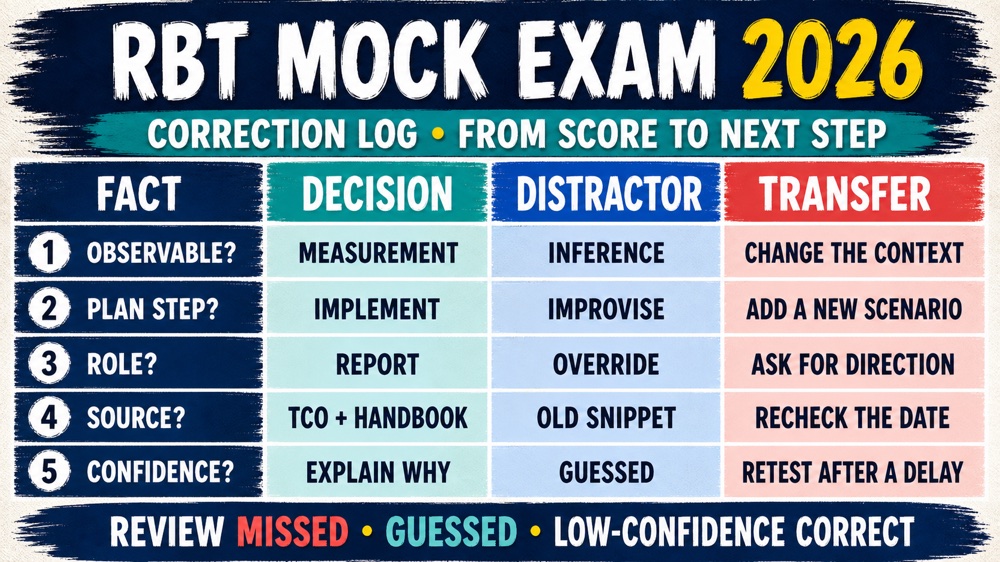
Use the same correction fields for every RBT mock exam 2026 attempt:
- Source and date: identify the resource version and the day you used it.
- Observable fact: record only what the item directly states, shows, counts, or times.
- Selected decision: write your answer and confidence before reading the explanation.
- Distractor error: note the inference, plan change, role error, or privacy problem in the weaker choice.
- Correction rule: state why the stronger choice fits the evidence and written direction.
- Transfer change: create a new example with one changed feature.
Review wrong, guessed, and low-confidence correct answers. Sort them by pattern: measurement, assessment procedure, prompting, reinforcement, behavior reduction, documentation, privacy, or next-best-step reasoning. Schedule the largest pattern first. Do not put identifying client information in a study log; fictional scenarios are sufficient.
Verify sources before you trust a year label
Before you rely on a current-year claim, open the official BACB RBT page and compare the linked Handbook, TCO, and applicable competency-assessment packet. The Handbook describes the pathway and examination frame. The TCO describes task scope and domain weighting. The official assessment packet controls the assessment form and evidence. The RBT Ethics Code frames professional conduct.
Save the source date in your notes. If a third-party page says “updated for 2026” but does not identify a primary source, treat the update as unverified. Search snippets, user-created flashcards, and old videos may remain visible after the official materials change. A current label should lead you to a source check, not replace one.
Also check whether the page uses “real,” “recalled,” “leaked,” or “official” language. Independent preparation should use original examples and state its limits clearly.
Turn mock results into supervision questions
A mock result is most useful when it improves the next question you ask a supervisor. Bring a short, non-identifying example and ask:
- Which observable feature tells me to use frequency, duration, or latency?
- Which prompt, reinforcement, maintenance, or generalization step is written in the current plan?
- What should I document when a caregiver report differs from direct observation?
- What safety direction applies when a new event is outside the plan?
- Which current BACB source controls the requirement I am checking?
Do not use a high mock score to decide that you can change a procedure, work outside supervision, or represent yourself as certified. The purpose of practice is to make uncertainty visible and discussable.
Common RBT mock exam 2026 mistakes
- Trusting the year label: verify the cited primary source and edition.
- Calling a mock official: independent content cannot reproduce the secure exam or issue a BACB result.
- Using only timed attempts: learn the decision rule before measuring pacing.
- Ignoring guessed answers: low-confidence correct answers still need correction.
- Studying a single domain: map the review to all six current TCO domains.
- Changing a written plan: implement assigned direction and ask before improvising.
- Sharing private information: keep study examples fictional and non-identifying.
Bottom line: use an RBT mock exam 2026 resource as a current-source check plus a structured practice loop. Compare formats, map corrections to the six TCO domains, record why distractors fail, and keep every practice score separate from official assessment, examination, certification, and supervision decisions.
Ready to practice the RBT concepts you just reviewed?
Try an independent, original RBT practice resource with exam-style questions, scoring, and answer explanations.
References
- Behavior Analyst Certification Board. RBT Test Content Outline, 3rd edition.
- Behavior Analyst Certification Board. RBT Handbook.
- Behavior Analyst Certification Board. RBT Ethics Code.