

RBT test prep works best when it changes how you make decisions, not only how many definitions you can repeat. A practical plan starts with the current primary sources, maps study time to the six TCO domains, and uses original scenarios to rehearse what an RBT should implement, document, report, or ask about.
Table of Contents
- What RBT test prep should measure
- Start RBT test prep with primary sources
- Build a six-domain RBT test prep map
- Choose the right practice format
- Learn the official exam frame
- Use original scenarios, not recalled items
- Use a three-pass study session
- Keep a correction log
- Bring uncertainty to supervision
- Common RBT test prep mistakes
- Frequently Asked Questions
- References
This is independent exam preparation. The current BACB Handbook, the RBT Test Content Outline, 3rd edition, and the applicable competency-assessment materials control the credentialing pathway. An independent study page cannot perform an initial competency assessment, approve an application, reproduce the secure examination, or issue certification.
RBT Training is not affiliated with, operated by, or endorsed by the Behavior Analyst Certification Board (BACB). All examples below are newly written for study. They are not official, recalled, leaked, or BACB-endorsed questions, and no practice score can guarantee a passing result or certification.
What RBT test prep should measure
Good RBT test prep makes you apply a procedure to a short situation. Before choosing an answer, identify four things:
- Observable fact: what the scenario directly states, shows, counts, or times.
- Written direction: the current plan, assigned assessment procedure, teaching step, safety instruction, or reporting route.
- Role-appropriate action: whether the RBT should implement, record, report, or request direction.
- Reason the distractor fails: an unsupported inference, plan change, privacy problem, or competence error.
For example, if a scenario asks how long a response lasts, identify onset and offset before selecting duration. If a written teaching plan includes a prompt hierarchy, follow the stated order rather than prompting early because the learner looks hesitant. If a new safety event is outside the plan, follow existing safety direction and contact the responsible professional instead of inventing a consequence.
A high number of flashcard recalls can coexist with weak transfer. Add a changed setting, response definition, time period, or communication route after every explanation. If your choice changes, write down the fact that caused the change.
Start RBT test prep with primary sources
Do not begin a study calendar with an undated question bank. First create a source card for the current BACB materials:
| Source | What it controls | Study use |
|---|---|---|
| RBT Test Content Outline, 3rd edition | Task scope, six domains, and blueprint shares. | Build your coverage map and label each correction. |
| Current RBT Handbook | Pathway requirements, application timing, and exam frame. | Separate credentialing facts from study advice. |
| Initial competency assessment packet | Assessment form, evidence, and evaluator boundary. | Do not confuse a mock score with an assessment result. |
| RBT Ethics Code | Professional conduct, privacy, competence, and boundaries. | Review the role-safe next action in scenarios. |
Record each document title, edition or update date, URL, and the date you checked it. A practice page can remain online after a primary source changes. When a study resource says “updated,” verify which document it actually used.
Use third-party resources for rehearsal and explanation, not as a substitute for the primary sources. Avoid pages that describe questions as real, recalled, leaked, or endorsed. Secure examination content should not be reproduced in an independent study article.
Build a six-domain RBT test prep map
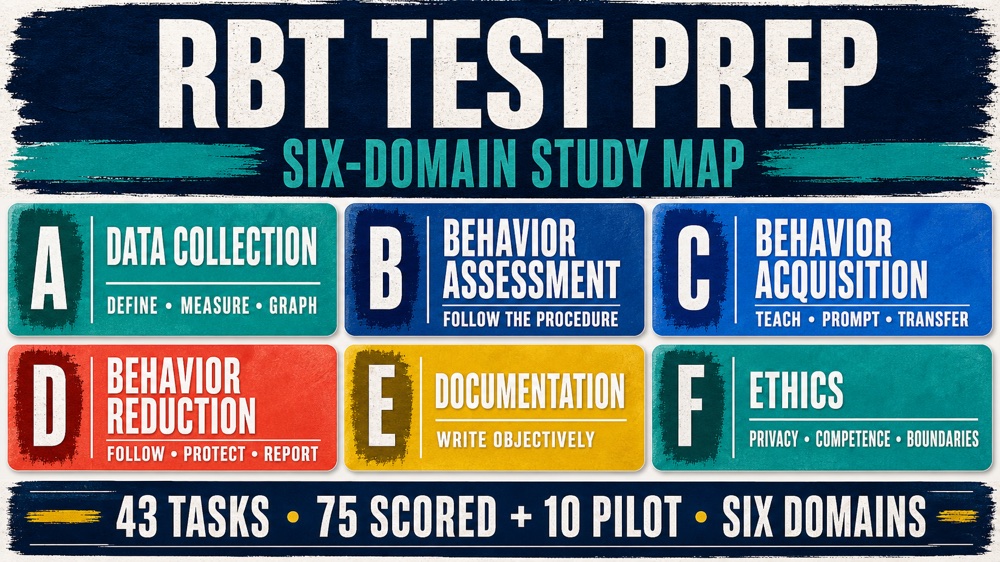
The current TCO lists 43 tasks across six domains. Use the official shares to prevent a convenient question bank from becoming your entire syllabus.
| Domain | Tasks / share | Study target |
|---|---|---|
| A. Data Collection and Graphing | 13 / 17% | Define observable responses and match frequency, duration, latency, rate, interval, or graphing decisions. |
| B. Behavior Assessment | 8 / 11% | Follow assigned assessment procedures and distinguish observation from interpretation. |
| C. Behavior Acquisition | 19 / 25% | Implement teaching, prompting, reinforcement, maintenance, and generalization steps as written. |
| D. Behavior Reduction | 14 / 19% | Follow the plan, protect safety, and report concerns without creating an intervention. |
| E. Documentation and Reporting | 10 / 13% | Write objective notes, protect information, and communicate through the appropriate channel. |
| F. Ethics | 11 / 15% | Apply privacy, competence, supervision, dignity, and professional-boundary decisions. |
The exact task names and the wording of your plan matter more than a homemade percentage chart. Use the table to schedule coverage, then return to the official TCO when you need the actual task description. Label each practice item with one primary domain and one decision pattern.
Choose the right practice format
Different formats solve different problems. Decide what you are measuring before you start.
| Format | Use it when | Record |
|---|---|---|
| Definition or topic quiz | A single rule is unclear. | Rule, example, and a changed example. |
| Scenario set | Several options sound technically plausible. | Fact, procedure, role, and confidence. |
| Timed block | You can explain decisions and want to rehearse pacing. | Time, guesses, skipped items, and review pattern. |
| Broad mock | You need a domain-level diagnosis. | Domain distribution and correction priorities. |
| Review pass | You need transfer, not another score. | Why the distractor failed and what changes next. |
Start untimed when your explanations are incomplete. Add timed work after the decision rules are retrievable. A timed score can show attention and pacing under one resource’s rules; it is not a standardized official result.
Learn the official exam frame
The current BACB Handbook describes an examination with 75 scored questions and 10 unscored pilot questions, four answer choices, and a 90-minute time limit. The TCO describes the current six-domain content map. An independent practice set may use a different number of items or a convenient 85-question format, but it cannot identify pilot items or reproduce the secure form, order, scoring treatment, or official result.
| Practice observation | Reasonable conclusion | Overreach to avoid |
|---|---|---|
| Completed a full timed set | You rehearsed pacing under that resource’s rules. | You know your official score. |
| Correct but guessed | The decision is unstable and needs review. | The concept is mastered. |
| One weak domain | Schedule source review and new examples there. | The official outcome is decided by that one domain. |
Use official numbers to orient your plan, not to imitate secure content. A trustworthy independent resource makes its limits clear and explains why an answer fits the observable evidence and written direction.
Use original scenarios, not recalled items
The following are newly written study decisions. They are not official, recalled, leaked, or BACB-endorsed questions:
- Measurement: an observer needs to record how long a response continues. Identify onset and offset, then match the measure to the interval.
- Assessment: an assigned preference procedure lists materials and an order. Follow the order, record selections, and ask about a missing instruction.
- Acquisition: the teaching plan says to wait before a prompt. Follow the wait and hierarchy rather than adding a prompt.
- Reduction: a new event is not covered by the current plan. Follow safety direction and contact the responsible professional rather than creating a consequence.
- Documentation: a note says the learner was “noncompliant.” Replace the label with observable actions, context, and what happened next.
- Ethics: someone requests a recognizable client story for a public post. Protect confidentiality and use an approved professional channel.
After answering, change one feature and solve again. A good explanation should survive a new setting without turning into a new procedure. If it does not, identify the missing rule and ask about it in supervision.
Use a three-pass study session
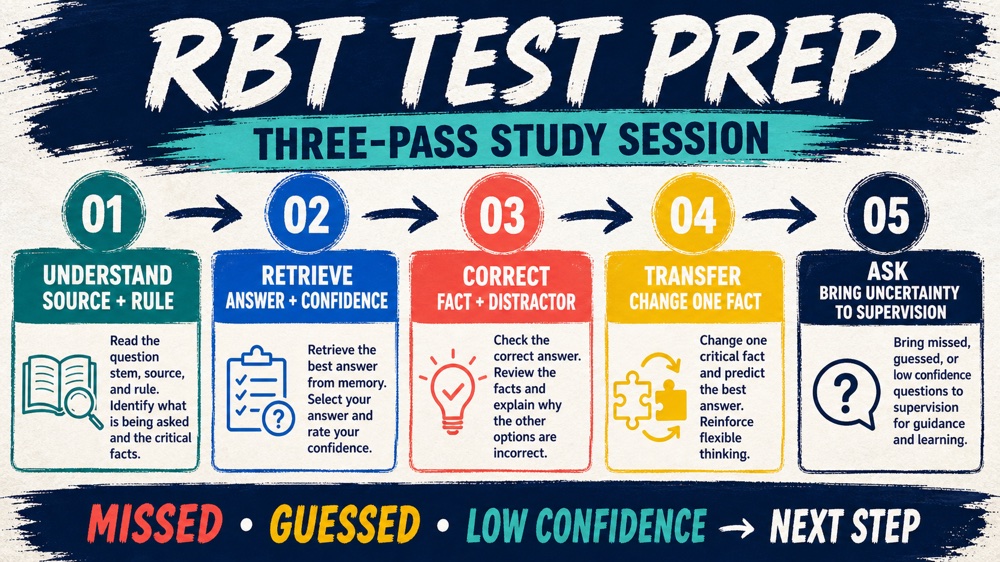
A compact session can be more useful than a long, unstructured question binge:
- Understand: read the source or explanation, underline the observable fact, and name the controlling procedure.
- Retrieve: answer without notes, mark confidence, and choose implement, record, report, or ask.
- Transfer: change the setting, prompt, response definition, or time period and solve after a short delay.
For a 60-minute block, reserve 10 minutes for source review, 25 minutes for scenarios, 15 minutes for correction, and 10 minutes for transfer. Adjust the times to your schedule; the sequence matters more than the exact clock. Do not mix the score from an open-note learning pass with the score from a timed pass.
At the end, choose one next action: reread a task, solve three new scenarios, make a supervision question, or schedule a timed block. “Study more” is not a correction plan.
Keep a correction log
Record more than right and wrong. For every missed, guessed, or low-confidence correct answer, write:
- Source and date: which resource and version you used.
- Observable fact: what is directly stated, shown, counted, or timed.
- Decision: what you selected and how confident you were.
- Distractor: the inference, unsupported plan change, role error, or privacy problem in the weaker option.
- Correction rule: one sentence explaining why the stronger action fits.
- Transfer: one changed scenario you will solve next.
Sort the log by pattern rather than question number: measurement, assessment procedure, prompting, reinforcement, behavior reduction, documentation, privacy, or next-best-step reasoning. Never place identifying client details in a study file. Fictional facts are enough to rehearse the decision.
Bring uncertainty to supervision
RBT test prep should improve the questions you bring to supervision. Use a short, non-identifying example:
- Which observable feature tells me to use frequency, duration, or latency?
- Which prompt or reinforcement step is written in the current plan?
- What should I document when a caregiver report differs from direct observation?
- What safety direction applies when an event is outside the plan?
- Which current BACB source controls the requirement I am checking?
A mock score can reveal where you need clarification; it cannot authorize you to change a procedure, work outside supervision, or represent yourself as certified. Keep study practice and service decisions in their proper boundaries.
Common RBT test prep mistakes
- Using an undated source: record the edition and check the current primary documents.
- Studying only definitions: add new scenarios that require a role-appropriate action.
- Taking only timed mocks: learn the rule before measuring pacing.
- Ignoring guessed answers: low-confidence correct answers still need correction.
- Ignoring domain balance: map study to all six TCO domains and 43 tasks.
- Changing a written plan: implement assigned direction and ask before improvising.
- Trusting recalled or official-sounding claims: use original independent materials and verify sources.
- Sharing private information: keep study examples fictional and non-identifying.
Bottom line: effective RBT test prep is a source-checked loop: learn the current task map, practice original decisions, correct the reasoning, and transfer it to a new scenario. Keep every practice score separate from official assessment, examination, certification, and supervision decisions.
Ready to practice the RBT concepts you just reviewed?
Try an independent, original RBT practice resource with exam-style questions, scoring, and answer explanations.
References
- Behavior Analyst Certification Board. RBT Test Content Outline, 3rd edition.
- Behavior Analyst Certification Board. RBT Handbook.
- Behavior Analyst Certification Board. RBT Ethics Code.