

RBT ethics principles are not abstract words reserved for an exam. They guide how an RBT protects clients, follows a plan, communicates honestly, uses supervision, and responds when a situation feels unsafe or unclear.
Table of Contents
- RBT ethics principles: quick answer
- The four core principles
- How the RBT Ethics Code is organized
- Benefit others
- Compassion, dignity, and respect
- Integrity and truthful work
- Competence and supervision
- A practical ethics decision path
- Documentation and reporting
- Common mistakes
- Frequently asked questions
- Official source note
Four core principles, daily decisions, role boundaries, confidentiality, competence, and ethical escalation
RBT Ethics Principles: A Practical Guide to Ethical Work
RBT ethics principles are not abstract words reserved for an exam. They guide how an RBT protects clients, follows a plan, communicates honestly, uses supervision, handles private information, and responds when a situation feels unsafe or unclear. This guide translates the BACB RBT Ethics Code (2.0) into a practical decision framework without replacing the current Code, workplace policy, or supervisor direction.
RBT ethics principles: quick answer
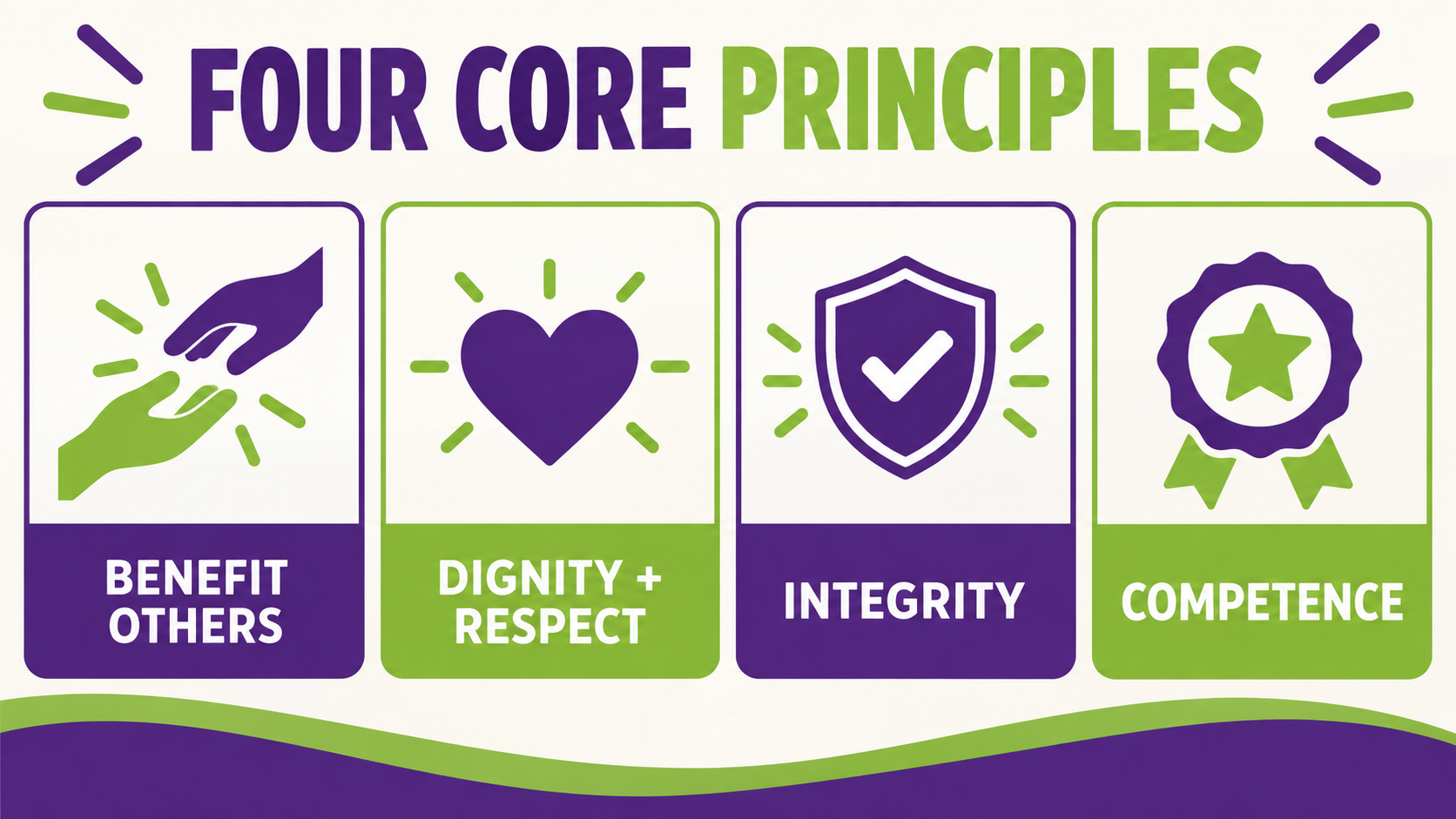
The BACB RBT Ethics Code (2.0) identifies four core principles: RBTs benefit others; treat others with compassion, dignity, and respect; behave with integrity; and ensure their own competence. The Code applies to RBT behavior-technician activities across settings and communication modalities. It works alongside applicable law, employer requirements, supervisor direction, and other relevant rules.
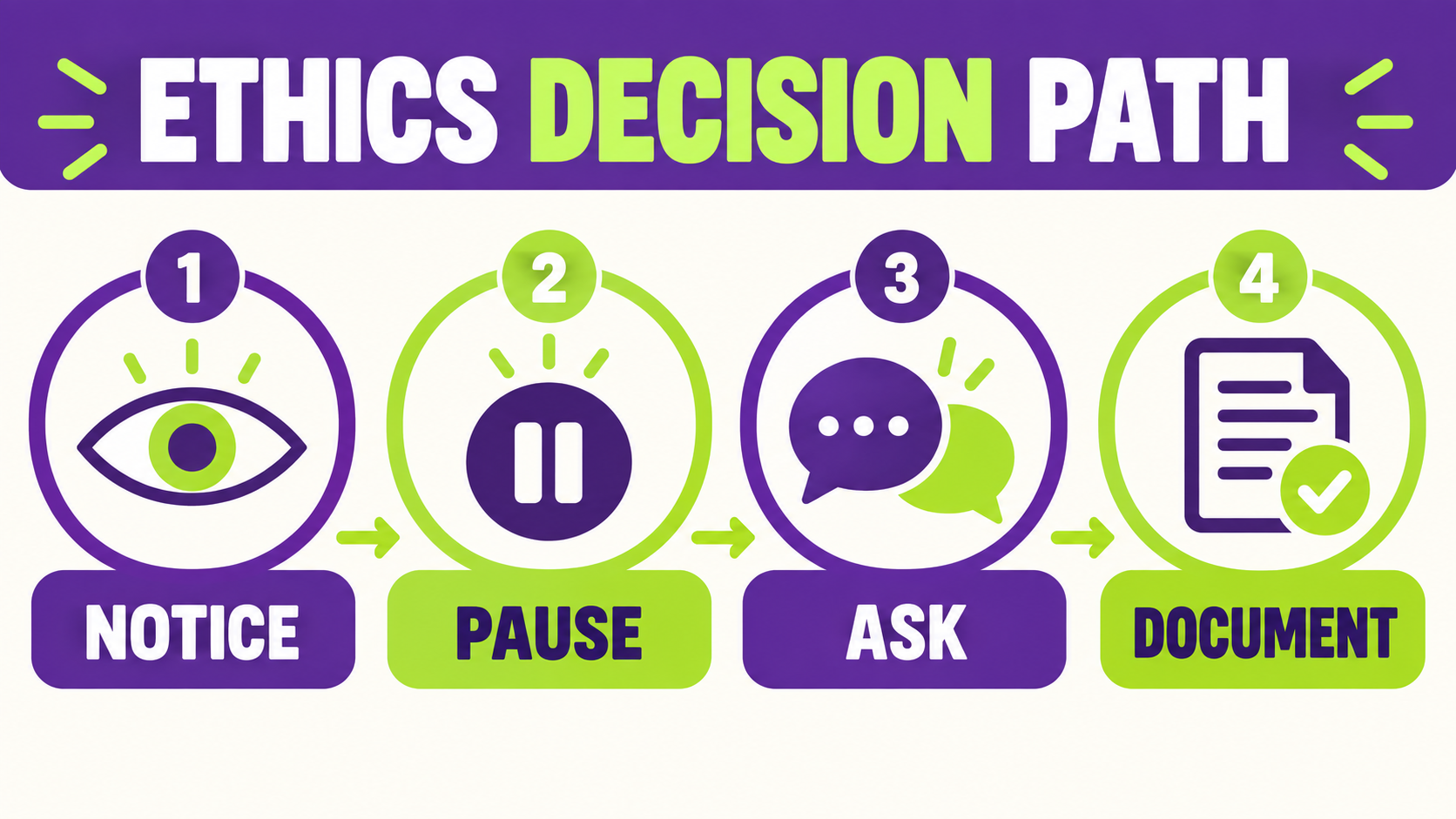
When a situation is uncertain, the ethical response is usually not to improvise privately. Protect the client, pause an unfamiliar or unsafe action when possible, ask the supervisor or another appropriate workplace contact, follow the required procedure, and document the actions taken. The exact route depends on the facts and the current Code.
The four core principles
The four principles are a high-level compass, not a substitute for the 29 standards in the Code. They help an RBT notice what is at stake before selecting a specific action.
| Principle | What it asks in practice |
|---|---|
| Benefit others | Put client welfare, rights, safety, and meaningful service ahead of convenience, personal gain, or avoiding an uncomfortable conversation. |
| Compassion, dignity, and respect | Use humane, inclusive, culturally responsive interactions and avoid unnecessary humiliation, discrimination, or coercive shortcuts. |
| Integrity | Be accurate, honest, accountable, and transparent about data, credentials, commitments, mistakes, and conflicts. |
| Competence | Work within a clearly defined role, obtain training and supervision, and speak up when a task exceeds current ability. |
A decision can look efficient and still fail one of these tests. For example, copying a previous session note may save time, but it undermines integrity and can harm the client if the record is inaccurate. Trying an unfamiliar intervention because a challenging moment is stressful may seem helpful, but it conflicts with competence, supervision, and client protection.
How the RBT Ethics Code is organized
The Code is divided into three sections. Section 1 covers general responsibilities, including honesty, professional conduct, defined role, accurate qualifications, cultural responsiveness, discrimination, conflicts, gifts, and relationships. Section 2 covers responsibilities while providing behavior-technician services, including client welfare, accurate implementation, documentation, questions, safety, privacy, and confidentiality. Section 3 covers responsibilities to the BACB and BACB-required supervisor, including supervision, audits, accurate communications, self-reporting, intellectual property, required actions, and keeping account information current.
This structure helps with routing. A concern about an intervention may involve Section 2 and the supervisor. A credential or self-report issue may involve Section 3 and the BACB. A multiple relationship may involve Section 1 and the supervisor, employer, or another appropriate entity. Do not assume that every concern is solved by one person or one form.
The RBT Ethics Code 2.0 went into effect January 1, 2022 and replaces the 2018 Code. Check the current version and revision information before relying on a remembered rule. The BACB states that lack of awareness or misunderstanding is not an excuse for failing to comply.
Benefit others
Benefiting others begins with the client’s best interest and legal rights. An RBT follows the authorized plan, implements behavior-technician services accurately, and takes necessary action when a client’s rights are violated or there is a risk of harm. The correct action may include contacting the supervisor, following an organization’s safety or mandated-reporting procedure, documenting the event, or contacting another appropriate authority when required.
Benefit is not the same as making a client comply at any cost. A short-term result does not justify an unauthorized intervention, avoidable distress, false data, or a public correction that damages dignity. Ask whether the action supports meaningful skill development, safety, and the client’s rights within the plan.
When a stakeholder asks for something that may be outside the plan, listen respectfully and route the request. An RBT can describe what was observed, explain what the current procedure allows, and ask the supervisor for direction. The RBT should not promise a clinical, educational, or legal outcome just to keep the conversation comfortable.
Compassion, dignity, and respect
Respect shows up in ordinary details: using the person’s preferred communication when known, protecting privacy, offering choices when the plan permits, avoiding ridicule, and speaking about the client as a person rather than a problem. The Code also requires equitable and inclusive conduct and prohibits harassment or discrimination on protected or other legally prohibited bases.
Cultural responsiveness is an active responsibility. An RBT works with the supervisor to evaluate personal biases and obtain needed training. This does not mean guessing what a family values or treating a cultural difference as a behavior deficit. It means noticing assumptions, asking respectful questions through the appropriate channel, and adapting authorized support under supervision.
Respect also applies to coworkers, caregivers, supervisors, and stakeholders. Do not use a private frustration as permission to shame a colleague, disclose confidential details, or create a hostile environment. If a relationship or communication pattern creates risk for the client, document the concern and use the appropriate reporting route.
Integrity and truthful work
Integrity means the record and the conversation match what happened. Record actual data, identify reports as reports, disclose relevant errors, and correct inaccurate information promptly through the approved process. Do not exaggerate progress, hide a missed opportunity, alter a time, or imply that a supervisor approved a step when that approval was not given.
Integrity includes accurate representation of qualifications. Use current credentials and do not present an RBT certification as permission to diagnose, practice independently, or perform a task outside the defined role. If a client, family, employer, or online audience misunderstands the role, clarify it or ask the supervisor how to respond.
Boundaries are also part of integrity. The Code addresses multiple relationships, gifts, and romantic or sexual relationships because mixed roles can create conflicts of interest and risk of harm. Follow the specific standards and any stricter employer policy. When a boundary concern develops, inform the appropriate supervisor or entity rather than trying to manage it secretly.
Competence and supervision
An RBT provides services only after the supervisor confirms demonstrated competence and continues to evaluate competence with the supervisor. If asked to use an unfamiliar intervention, serve an unfamiliar population, or perform a task beyond training, inform the supervisor or another appropriate workplace contact immediately and document the communication.
Competence is not a permanent label. A person may be competent with one procedure, population, setting, or level of risk and need training for another. New materials, a changed behavior plan, a crisis procedure, a communication device, or a new environment can all require clarification. Seeking help early is a competence behavior, not an admission of failure.
Supervision is part of the safeguard. Follow directions, attend required contacts, receive feedback professionally, and report irregular data or implementation problems. If the supervisor is unavailable or part of the concern, use the employer’s chain of command or the other appropriate route described in the Code and policy.
A practical ethics decision path
Use this four-step path as a prompt for thinking, not as a replacement for the current Code:
- Notice: identify the observable event, the possible client risk, the relevant standard or policy, and what information is missing.
- Pause: do not begin an unfamiliar, unsafe, unauthorized, or misleading action. Follow the emergency or safety procedure first when immediate risk exists.
- Ask: contact the supervisor and other designated workplace resources. State the facts, the action already taken, and the decision you need. Protect confidentiality while seeking help.
- Document: record dates, people involved, actions, communication, outcome, and any required follow-up in the approved system. Preserve supporting material.
When the concern cannot be resolved with the supervisor, the Code says the RBT reports it to the appropriate authority. If it involves an unresolved violation of the RBT Ethics Code or the Ethics Code for Behavior Analysts, reporting to the BACB may be required. Use the current BACB code-enforcement and self-reporting instructions; do not assume that an online discussion or a coworker’s opinion is enough.
Documentation and reporting
Ethical documentation is factual, timely, and stored in the approved location. Include what occurred, when, where, who was involved in the professional sense, what was directly observed, what was reported by another person, what action you took, whom you contacted, and what happened next. Keep confidential information to what is necessary for the job-related communication.
Save relevant documentation when the Code requires it. If you submitted inaccurate or false information to the BACB, supervisor, or employer, contact the applicable party promptly to correct the issue and determine whether self-reporting is required. If you are required to self-report an event, the Code identifies a 30-day timeframe for specified events, including when the RBT becomes aware of the event.
Do not post identifying client information on social media or websites. Do not forward private records to personal accounts for convenience. Use the employer’s privacy, retention, and incident-reporting systems, and ask before sharing information with someone whose authorization is unclear.
Common mistakes
- Reducing ethics to kindness: compassion matters, but accurate data, competence, privacy, and reporting duties matter too.
- Waiting for certainty: an RBT can raise a concern based on observable facts without proving a violation first.
- Keeping a secret to protect the team: hiding an error or risk can harm the client and undermine integrity.
- Using a remembered rule: check the current Code, employer policy, and applicable law.
- Solving a role problem alone: use supervision and the appropriate escalation path.
Frequently asked questions
What are the four RBT ethics principles?
They are benefiting others; treating others with compassion, dignity, and respect; behaving with integrity; and ensuring one’s own competence.
Are the principles the same as the ethics standards?
No. The principles are the foundation of the Code. The Code also contains specific standards that describe required or prohibited conduct and should be read directly when a situation is uncertain.
What should an RBT do when a supervisor gives an unclear instruction?
Ask for clarification before implementing an unfamiliar or potentially unsafe action. State what you understand, what is unclear, and what decision you need. Document the communication through the approved process.
Can an RBT report an ethics concern without accusing someone?
Yes. Start with observable facts, the possible risk, the policy or standard involved if known, and the steps already taken. The responsible authority determines whether a violation occurred.
Official source note
This educational guide was checked against the BACB RBT Ethics Code (2.0) and the BACB Ethics Codes page, retrieved September 28, 2026. Employer, state, legal, licensure, and workplace requirements may add requirements or differ in implementation.
Role boundary: This article is general education, not individualized legal, ethics, clinical, or employment advice. Follow the current Code, applicable law, employer policy, supervisor direction, and required reporting process.
Ready to practice the RBT concepts you just reviewed?
Try an independent, original RBT practice resource with exam-style questions, scoring, and answer explanations.
References
- Behavior Analyst Certification Board. RBT Test Content Outline, 3rd edition.
- Behavior Analyst Certification Board. RBT Handbook.
- Behavior Analyst Certification Board. RBT Ethics Code.