

Benefit others RBT ethics is a practical decision filter: protect the client’s welfare and rights, reduce avoidable harm, work within competence, and ask for direction when the safest next step is unclear.
Table of Contents
- Benefit others RBT ethics: what it means
- Use the principle as a decision filter
- Protect welfare and rights
- Balance progress with dignity and choice
- Stay within competence and supervision
- Use data and communication honestly
- Include culture, context, and responsiveness
- When to pause and escalate
- Common misunderstandings
- Frequently asked questions
- References
RBT ETHICS GUIDE · CLIENT WELFARE AND RIGHTS
Benefit Others RBT Ethics: Apply the Principle in Practice
Turn a broad ethics principle into daily decisions about safety, dignity, competence, communication, and supervision.
Benefit others RBT ethics is a practical decision filter: protect the client’s welfare and rights, reduce avoidable harm, work within competence, and ask for direction when the safest next step is unclear. It is one of the core principles described in the RBT Ethics Code (2.0), alongside compassion, dignity and respect, integrity, and competence.
The principle is not a promise that every session will be easy or that every client will immediately prefer the planned activity. It asks the RBT to examine whether the service is being delivered safely, respectfully, competently, and honestly. This article is educational and cannot decide whether a particular situation is an ethics violation, legal problem, medical issue, or emergency.
Benefit others RBT ethics: what it means
In everyday language, benefiting others means acting to maximize benefit and avoid harm. In RBT work, that idea becomes concrete through the client’s welfare and rights. The RBT follows the current plan, uses demonstrated skills, protects confidential information, communicates concerns, documents accurately, and works with the supervisor when a decision exceeds the RBT’s role.
Benefiting the client does not mean doing whatever produces the fastest visible compliance. A short-term reduction in a behavior may not be a benefit if it depends on humiliation, unsafe practice, ignoring communication, or using a procedure that the RBT has not been trained to implement. Ask whether the action supports meaningful participation, safety, learning, and dignity over time.
Use the principle as a decision filter
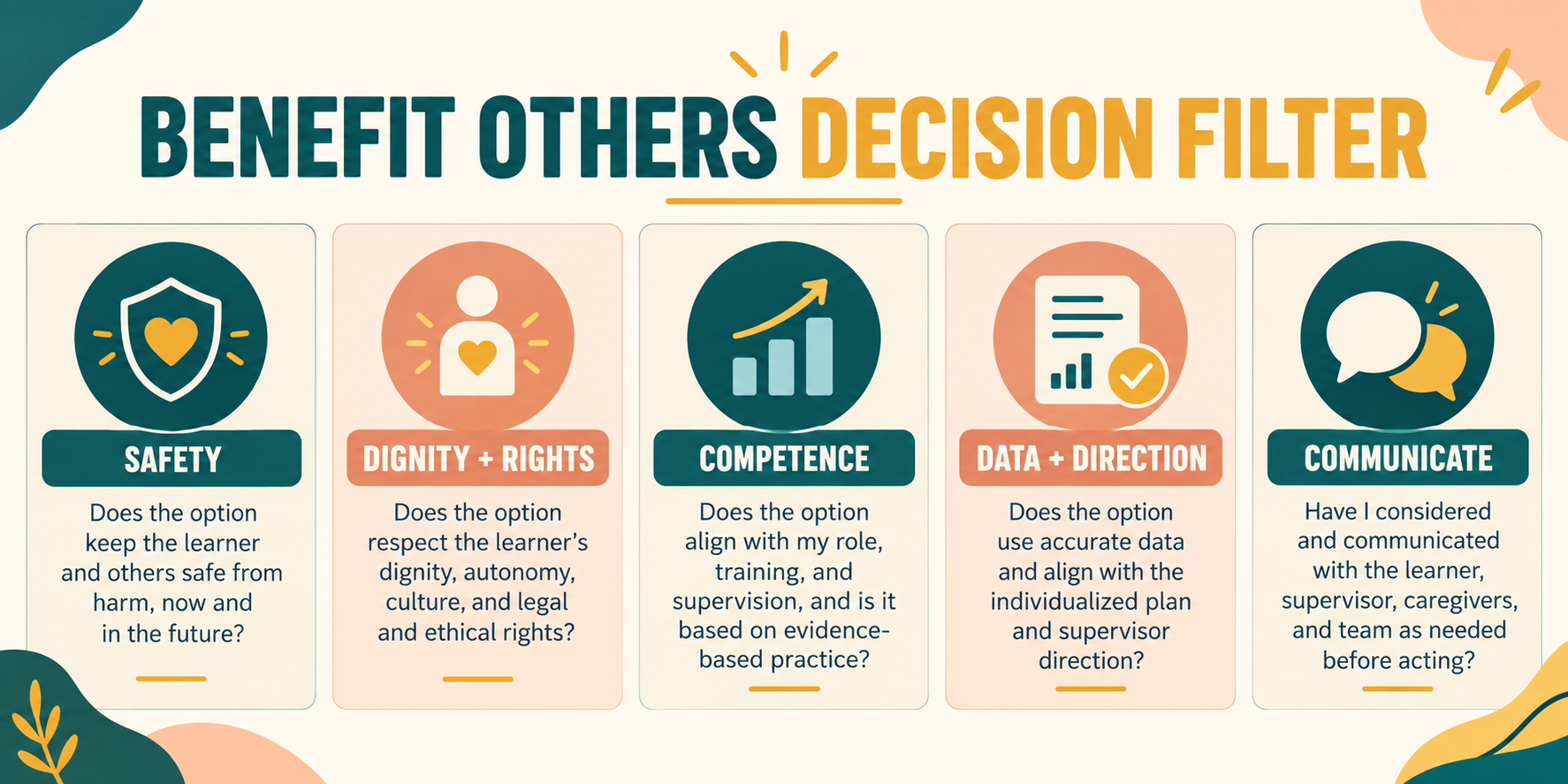
When a situation feels ethically uncertain, ask five questions:
- Safety: Is anyone at immediate risk, and what approved safety procedure applies?
- Rights and dignity: Does the response preserve respectful treatment, privacy, communication, and meaningful choice?
- Competence: Have I been trained and observed as competent for this procedure?
- Evidence and direction: What does the current plan, data, and supervisor instruction say?
- Communication: Who needs to know, what should I document, and what must I escalate?
The answers may point to a simple implementation step, a supervisor question, a safety response, or a report through another authorized route. The filter is not a license to invent a clinical solution. It helps the RBT notice when continuing automatically may create more risk than pausing for direction.
Protect welfare and rights
Start with immediate welfare. Follow the setting’s safety or crisis procedure, protect the person from imminent harm, and notify the responsible supervisor or emergency contact as required. A routine ethics discussion cannot replace emergency support, medical care, safeguarding procedures, or legal reporting duties that apply to a situation.
In non-emergency situations, benefit-others reasoning still requires attention to risk. A new illness, medication change, unsafe equipment, environmental hazard, or significant schedule change may affect service. Record observable facts and communicate the concern promptly. Do not hide a problem because the data sheet is nearly complete or because raising it feels inconvenient.
Welfare also includes the right to services delivered with care and respect. Use the learner’s communication, follow the authorized plan, and avoid treating distress as a reason to disregard the person. If the current procedure produces a concern, ask the supervisor to review it rather than quietly changing it.
Balance progress with dignity and choice
Behavior change goals should not erase the person. Use neutral language, protect privacy, and avoid public charts, jokes, threats, or comments that make a learner the subject of group attention. When the plan allows choices, present them clearly and honor a reasonable selection. When a learner communicates refusal, pain, fear, or a need for a break, treat that information as clinically relevant.
Benefit others does not mean removing every challenge. Teaching often involves effort, waiting, practice, and correction. The ethical question is whether the challenge is authorized, understandable, proportionate, and delivered with support. If the learner cannot access the task or the response seems to increase risk, communicate the observation and seek direction.
Stay within competence and supervision
The BACB describes RBTs as paraprofessionals who assist with behavior-analytic services under the direction and close supervision of an RBT Supervisor and/or RBT Requirements Coordinator. Competence is part of benefiting others. An RBT who guesses through a complex procedure may intend to help while creating inaccurate data or unsafe service.
Before implementing, confirm that you understand the target definition, materials, prompts, reinforcement, data system, and safety steps. If the plan is unclear, ask. If the learner’s response does not match the defined options, record the observation and contact the supervisor. If a teacher, caregiver, or coworker asks for a new intervention, separate the request from the clinical decision and route it through the authorized process.
Use data and communication honestly
Benefit-others reasoning depends on accurate information. Record what occurred, not what you wish had occurred. Use the assigned measurement rule, distinguish missing data from zero, and note variables that may affect progress. A polished but inaccurate note can harm the learner because the team may make its next decision on a false picture.
Communicate concerns in a timely, respectful way. Use observable examples and identify the question you need answered. “The transition took three minutes longer after the schedule changed, and the learner requested a break twice; should we review the transition procedure?” gives the supervisor useful information. “The program is not working” does not explain what needs attention.
Protect confidentiality while communicating. Use authorized systems, share only necessary information, and avoid public or personal channels for identifiable client details. Benefiting the client includes protecting information that could expose the learner or family to harm.
Include culture, context, and responsiveness
The benefit-others principle is not a reason to impose the technician’s idea of a good life. Preferences, communication styles, family routines, disability identity, language, culture, and community context can affect what a respectful and useful service looks like. Work with the supervisor and authorized stakeholders to understand context and identify your own assumptions.
Cultural responsiveness does not mean abandoning data or allowing unsafe practice. It means asking better questions: Is the target socially meaningful? Is the communication method accessible? Does the plan treat a difference as a problem without considering context? What does the learner or family communicate about the goal? Bring those questions to the team instead of making an independent redesign.
When to pause and escalate
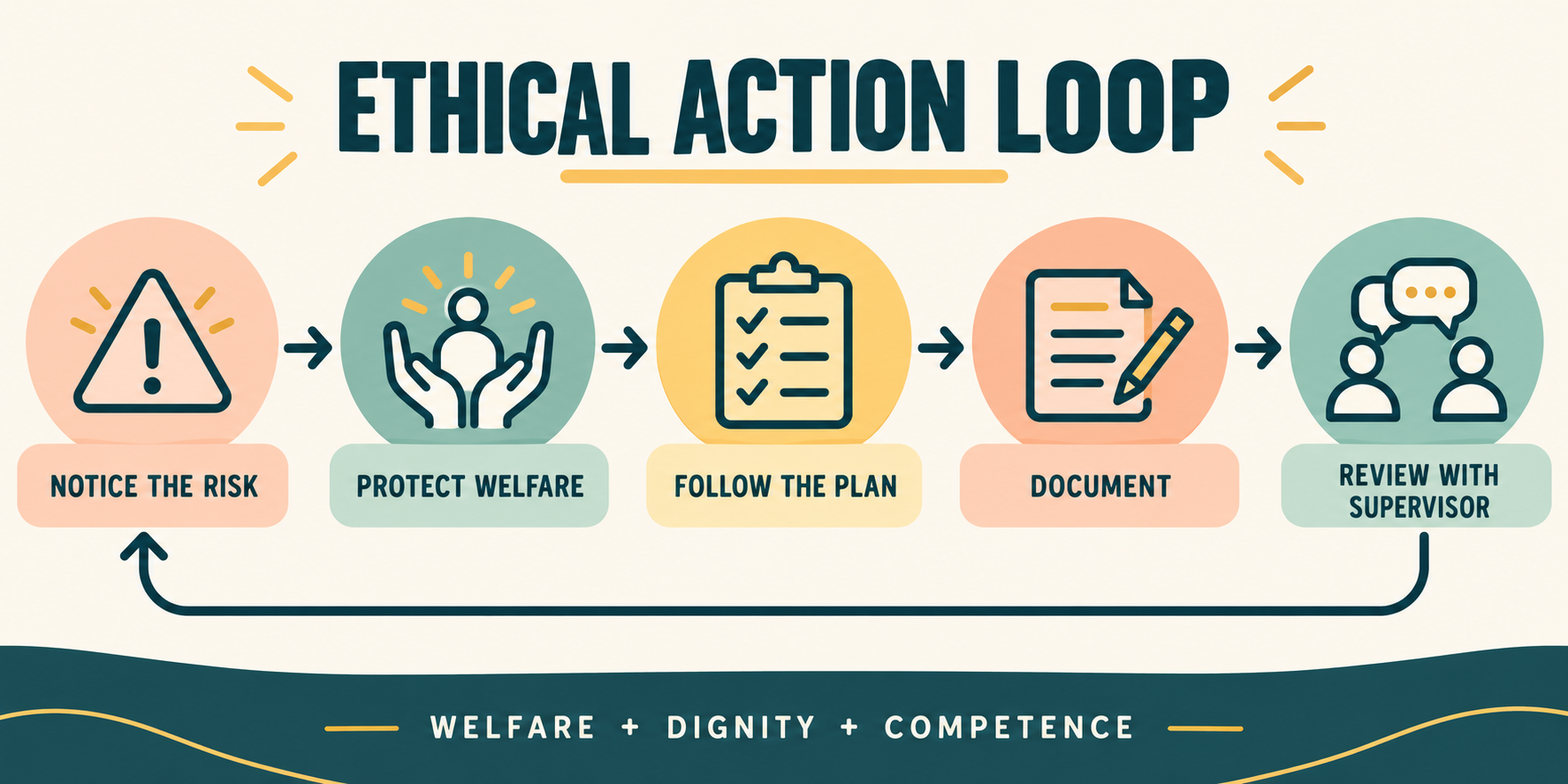
Pause and seek direction when a situation involves immediate safety risk, a procedure outside your training, conflicting instructions, possible confidentiality loss, inaccurate records, suspected unethical conduct, or a change that may affect client progress. Follow the applicable emergency or workplace route first when necessary, then document the action and communicate with the supervisor.
For suspected ethics concerns, use the current RBT Ethics Code and reporting instructions. The code describes bringing concerns to a supervisor when possible, documenting actions and dates, and using the appropriate authority when the matter cannot be resolved. The correct route depends on the facts; this article is not an ethics ruling.
Common misunderstandings
- “Benefit” means make the client happy: ethical service can include teaching effort while protecting dignity and safety.
- Good intentions are enough: competence, supervision, data, and authorized procedures matter too.
- The RBT should solve every problem alone: timely supervision is part of safe service.
- Fast compliance proves benefit: examine communication, skill growth, risk, choice, and longer-term outcomes.
- Client welfare means ignoring the plan: raise concerns and obtain direction rather than improvising.
- Ethics principles replace specific standards: use the complete current code and applicable workplace requirements.
Frequently asked questions
Does benefit others mean an RBT should never say no?
No. A professional may need to maintain a safety boundary, follow a plan, or delay an unsafe request. The important question is whether the response is respectful, within role, and directed toward welfare. Ask the supervisor when the boundary is unclear.
Can this principle justify changing a treatment plan?
No. It can signal that the current plan or implementation needs review, but the RBT should communicate the observation and seek authorized clinical direction. Independent changes can create risk and unreliable data.
What if the learner refuses the activity?
Follow the current plan and safety procedure, observe and document the communication, and contact the supervisor if the response is outside the defined procedure or suggests a concern. Do not shame, threaten, or invent a consequence.
Is benefit others a guarantee that the intervention will work?
No. It is an ethical principle for evaluating how services are delivered and how concerns are handled. Data review and supervision are still needed to determine whether a procedure should continue or change.
In practice, benefiting others means making welfare visible in small decisions: protect safety, respect communication, use competent procedures, document honestly, protect privacy, and ask for help before uncertainty becomes harm. That is how a broad RBT ethics principle becomes a reliable professional habit.
Ready to practice the RBT concepts you just reviewed?
Try an independent, original RBT practice resource with exam-style questions, scoring, and answer explanations.
References
- Behavior Analyst Certification Board. RBT Test Content Outline, 3rd edition.
- Behavior Analyst Certification Board. RBT Handbook.
- Behavior Analyst Certification Board. RBT Ethics Code.