
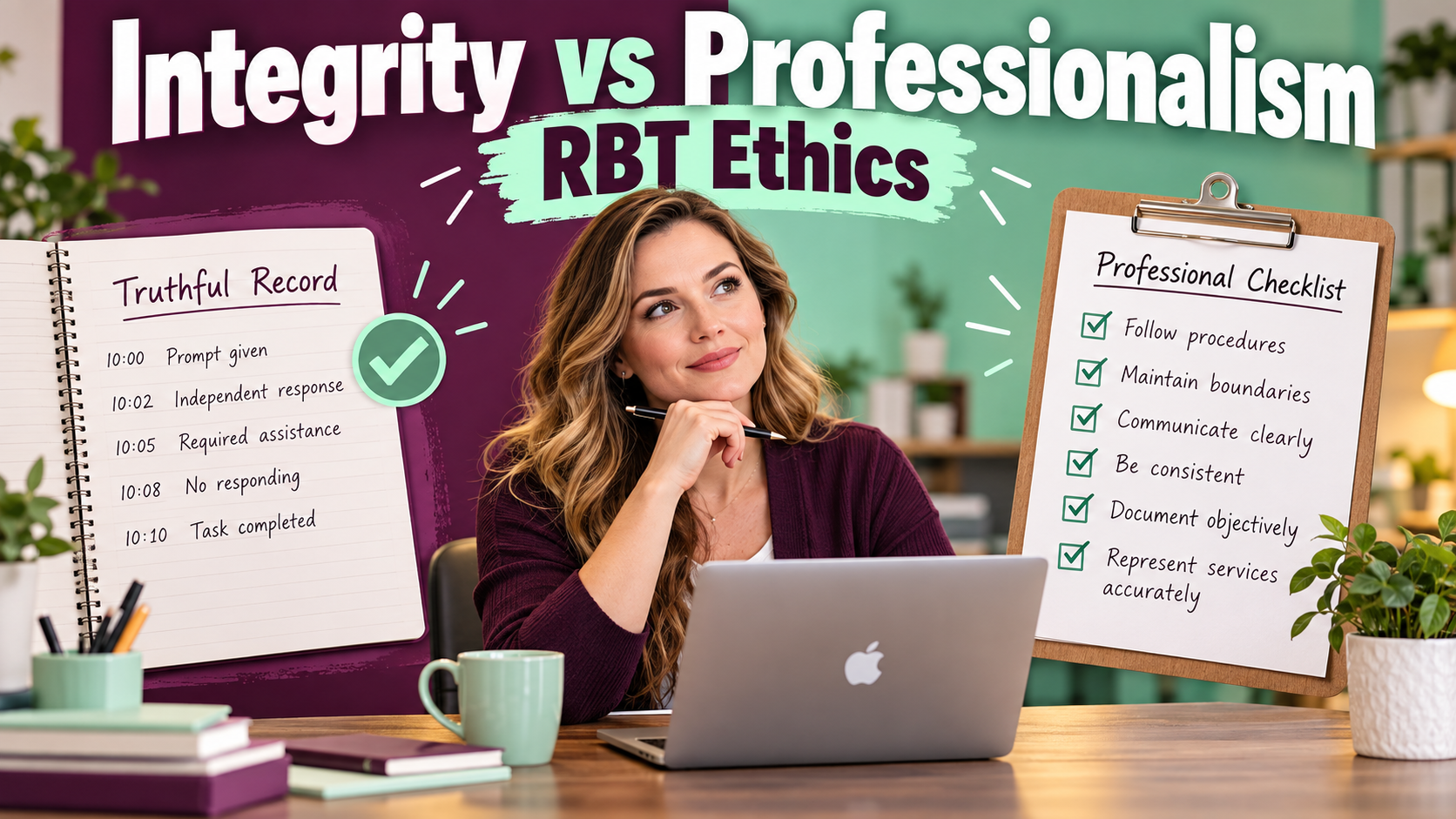
Integrity vs professionalism RBT ethics is a useful distinction: integrity asks whether an RBT is truthful and accountable, while professionalism asks whether the RBT performs the role responsibly and respectfully.
Table of Contents
- Integrity vs professionalism RBT ethics: the difference
- What integrity asks
- What professionalism asks
- Where the two principles overlap
- Apply the distinction to records and data
- Apply it to role boundaries and competence
- Apply it to communication and feedback
- Everyday comparison scenarios
- Frequently asked questions
- Sources and scope note
RBT ETHICS GUIDE · COMPARISON AND DAILY PRACTICE
Integrity vs Professionalism RBT Ethics: Know the Difference
Separate truthfulness and accountability from role conduct and follow-through, then use both to improve service quality.
Integrity vs professionalism RBT ethics is a useful distinction: integrity asks whether an RBT is truthful and accountable, while professionalism asks whether the RBT performs the role responsibly and respectfully. They overlap, but they are not interchangeable.
For example, an RBT may be friendly and punctual but still lack integrity if the person knowingly reports data that were not collected. Another RBT may be honest about a missed task but still need to improve professionalism by communicating earlier and following the workplace correction process. This article is educational, not an ethics ruling, legal opinion, or individualized treatment direction.
Integrity vs professionalism RBT ethics: the difference
Use two short questions:
- Integrity: Is my account truthful, accurate, and accountable? Am I willing to correct what is wrong?
- Professionalism: Am I carrying out my role with appropriate conduct, preparation, boundaries, competence, and follow-through?
Integrity is about the trustworthiness of the person’s choices and representations. Professionalism is about the quality and reliability of the person’s participation in the work. A good RBT needs both. Neither term gives permission to ignore the current behavior plan, confidentiality requirements, supervisor direction, or applicable law.
What integrity asks
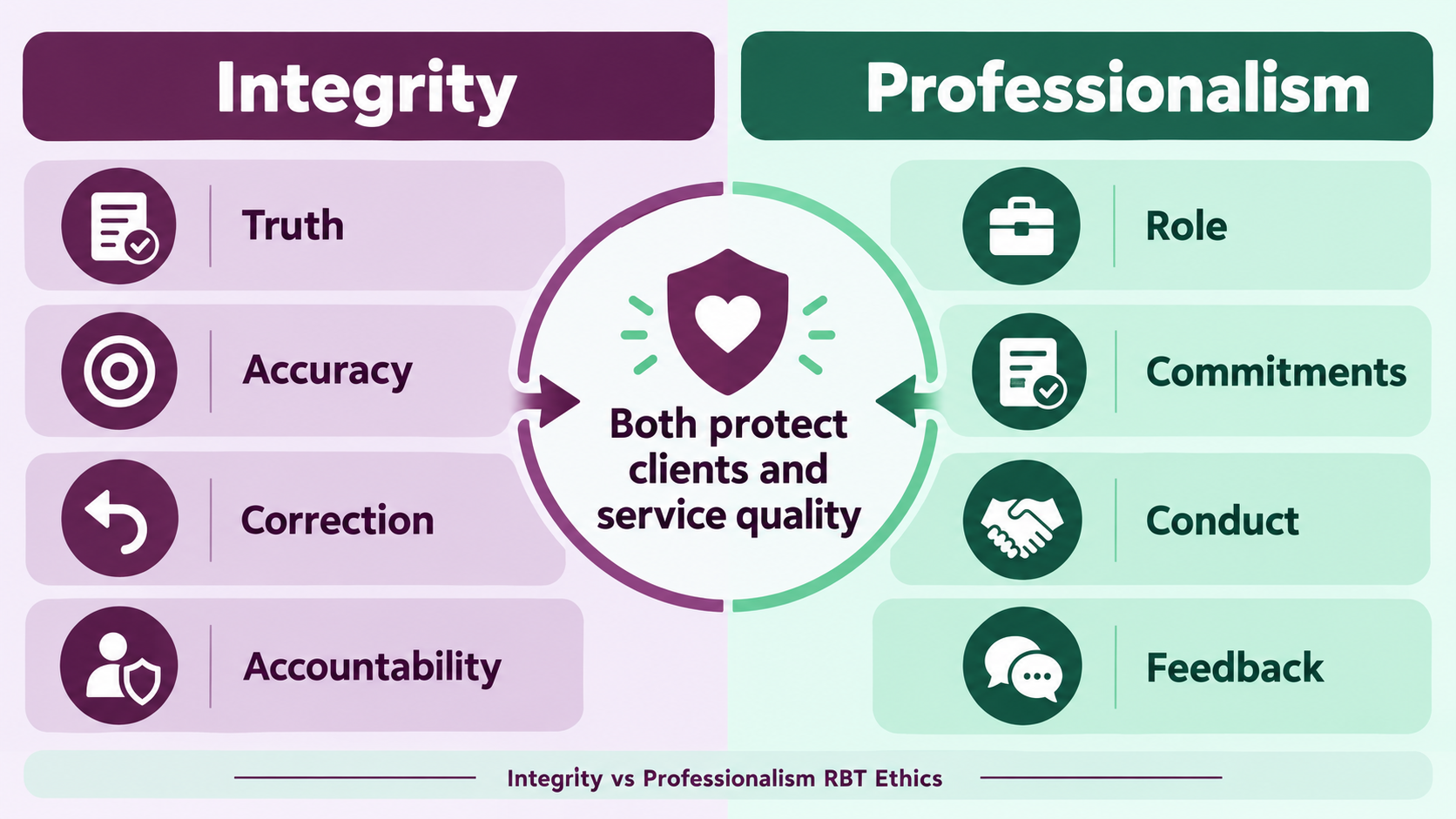
Integrity is the “can I trust this account?” question. The RBT Ethics Code connects it to honesty, truthful behavior, professional accountability, accurate communications, accurate documentation, and correcting inaccurate information. It also includes not making false, misleading, or exaggerated statements about qualifications or behavior-technician services.
In daily work, integrity means saying what you actually observed, identifying what you did not observe, and not turning uncertainty into a confident claim. It means refusing to sign for a service you did not provide, not estimating a missing data point, and telling the supervisor when a commitment or procedure could not be completed as planned.
Integrity does not mean sharing every private detail with every person. A truthful report still follows confidentiality rules and uses the appropriate channel. The goal is accurate, necessary communication—not uncontrolled disclosure.
What professionalism asks
Professionalism is the “am I participating responsibly in this role?” question. The code describes professional conduct, accountability for actions, follow-through on commitments, close supervision, competence, confidentiality, and improvement after feedback. The RBT must show those expectations in behavior, not only in a résumé or job interview.
Professional conduct can include arriving prepared, using respectful language, protecting a learner’s privacy, maintaining appropriate relationships, following the assigned procedure, asking for training before unfamiliar work, and communicating early when a commitment may not be met. It also includes accepting feedback without hiding a problem or retaliating against the person who raised it.
Professionalism is not a demand for perfection or a particular personality. A quiet RBT can be professional, and an outgoing RBT can be unprofessional. The relevant question is whether the conduct supports safe, competent, respectful, and reliable service.
Where the two principles overlap
Integrity and professionalism meet at client protection and service quality. Accurate records are both an integrity issue and a professional responsibility. A truthful conversation with a supervisor is both honest and professionally appropriate. Staying within competence protects the client and shows accountability for the role.
The overlap can be summarized this way:
- Integrity without professionalism: An RBT may admit an error but repeatedly fail to prepare, communicate, or follow through.
- Professional appearance without integrity: An RBT may look organized while hiding inaccurate data or overstating qualifications.
- Both together: The RBT gives an accurate account, follows the authorized process, communicates limits, and completes the required correction.
Apply the distinction to records and data
Imagine a session ends before the planned measurement opportunities are complete. Integrity asks whether the note accurately states what occurred and avoids invented values. Professionalism asks whether the RBT uses the correct form, informs the supervisor when the limitation matters, and follows the workplace deadline.
If an entry is wrong, integrity means acknowledging and correcting it rather than silently changing history. Professionalism means using the approved amendment, addendum, audit-trail, or supervisor-review process. Because procedures vary, ask the record owner before editing if the route is unclear.
Billing records require the same care. Do not represent reserved time as delivered service without checking the applicable policy. If attendance, cancellation, or timekeeping is confusing, preserve the facts and contact the supervisor, employer, or billing contact who owns the question.
Apply it to role boundaries and competence
Integrity asks whether the RBT is honest about training and scope. Professionalism asks whether the RBT acts on that information responsibly. If an RBT has not demonstrated competence with an unfamiliar intervention, an honest answer is necessary but not sufficient. The professional next step is to pause, request training or direction, and avoid providing the service until authorized and competent.
The same distinction applies when a caregiver, teacher, or coworker asks the RBT to change a goal or procedure. Integrity means not pretending to have authority that belongs to the supervisor or treatment team. Professionalism means responding respectfully, following the current plan within role, and bringing the request to supervision for review.
Apply it to communication and feedback
An integrity-focused message is factual: what happened, when, what was observed, and what remains uncertain. A professional message is also timely, respectful, secure, and directed to the person who can act. Avoid public complaints, sarcasm, gossip, or broad messages that expose unnecessary client information.
Feedback creates another useful test. Integrity means not misrepresenting whether feedback was received or whether a task was completed. Professionalism means listening, asking clarifying questions, practicing the revised skill, and following up. If feedback seems inconsistent with the written plan or creates a safety concern, raise that specific question through supervision.
Everyday comparison scenarios
Late arrival. Integrity means recording the actual service time and not asking someone else to cover the gap in the record. Professionalism means notifying the appropriate person promptly and using the attendance or scheduling procedure.
Missing data. Integrity means not guessing. Professionalism means marking the limitation correctly, telling the supervisor if interpretation is affected, and reviewing how to prevent the same gap.
Unclear request. Integrity means stating that you do not understand or are not trained. Professionalism means asking for clarification, staying within the current plan, and documenting the direction when required.
Possible privacy mistake. Integrity means describing what information was sent or viewed without minimizing it. Professionalism means stopping further disclosure, using the secure reporting route, and following instructions for correction or retention.
Supervisor feedback. Integrity means representing your response honestly. Professionalism means implementing the agreed improvement and asking for another observation or practice opportunity when needed.
Frequently asked questions
Is integrity more important than professionalism?
They serve different functions and should work together. Truthful records cannot replace competent, respectful conduct, and polished conduct cannot excuse inaccurate or misleading records.
Can an RBT be professional while admitting a mistake?
Yes. Promptly acknowledging a mistake, protecting the client, using the approved correction process, and following supervisor direction can demonstrate both integrity and professionalism.
Does professionalism mean never questioning a supervisor?
No. A professional RBT can raise a factual concern respectfully, especially when safety, competence, privacy, or a written requirement is unclear. The RBT should use the appropriate supervision or escalation route rather than changing the plan independently.
How can I remember the difference?
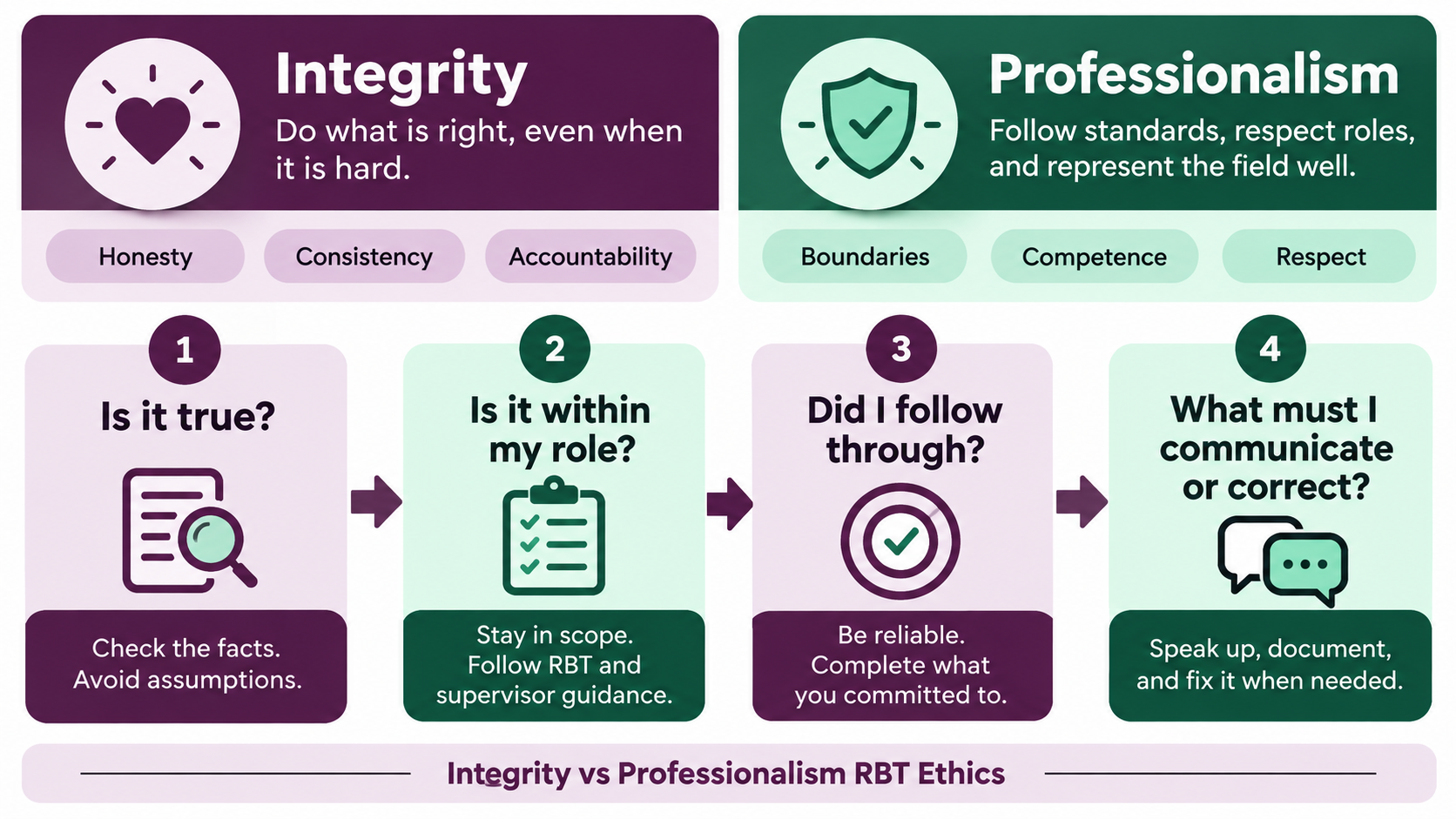
Ask four questions: Is it true? Is it within my role? Did I follow through? What must I communicate or correct? The first and fourth emphasize integrity; the middle questions connect both principles to professional practice.
Sources and scope note
This guide is based on the BACB RBT Ethics Code (2.0), the BACB Registered Behavior Technician Handbook, and BACB ethics information. Requirements can change, and employer, payer, school, state, and legal rules may add obligations. Check current sources and ask the appropriate supervisor or authority about your situation.
Ready to practice the RBT concepts you just reviewed?
Try an independent, original RBT practice resource with exam-style questions, scoring, and answer explanations.
References
- Behavior Analyst Certification Board. RBT Test Content Outline, 3rd edition.
- Behavior Analyst Certification Board. RBT Handbook.
- Behavior Analyst Certification Board. RBT Ethics Code.