
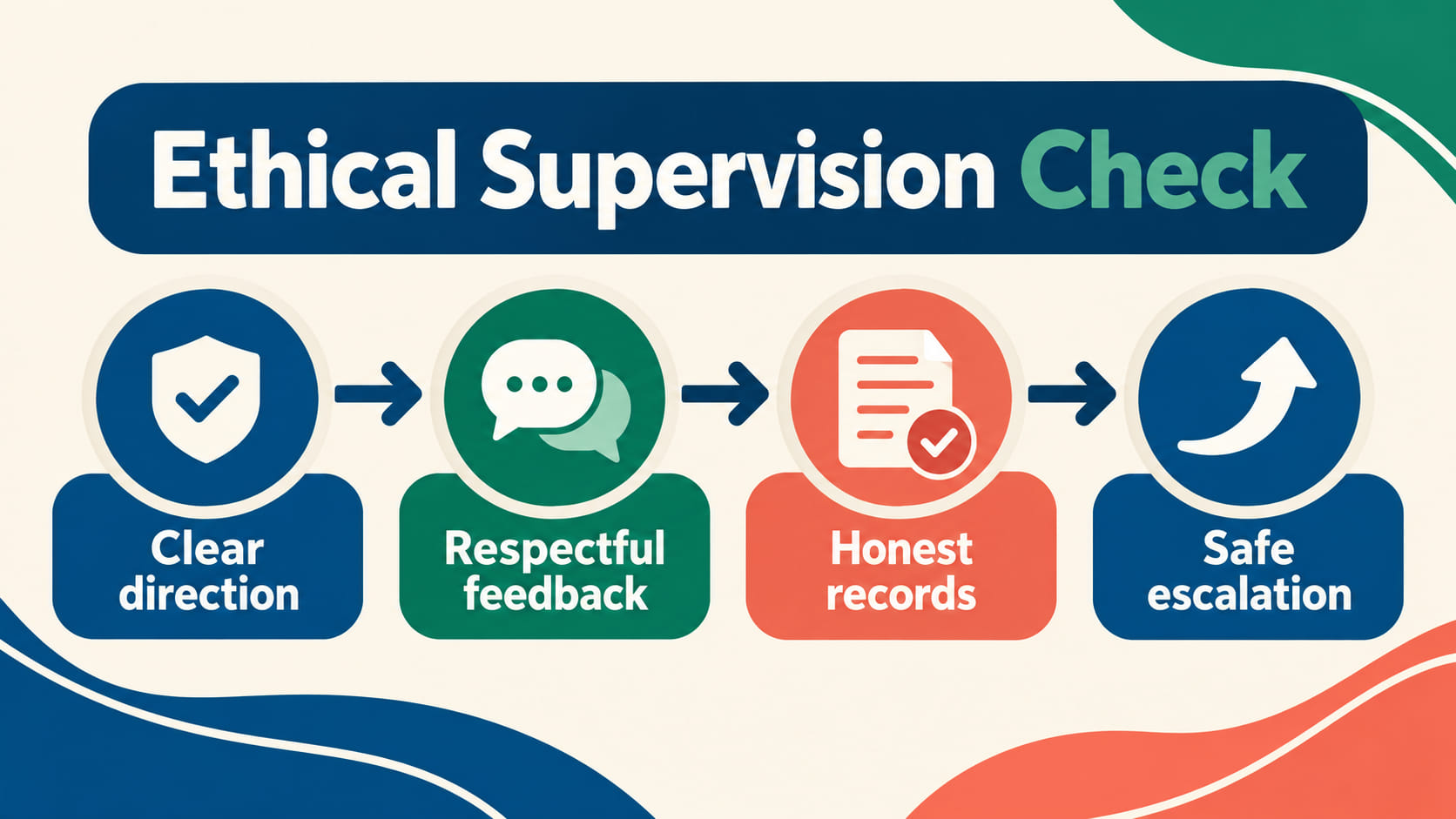
Supervision requirements RBT ethics questions are about more than scheduling a meeting. Ethical supervision connects clear direction, respectful feedback, honest records, privacy, competence, and a safe escalation route so an RBT can perform assigned services without guessing or hiding a concern.
Table of Contents
- Supervision requirements RBT ethics: the short answer
- Make direction clear and role-appropriate
- Use respectful, useful feedback
- Keep honest and reviewable records
- Protect privacy during supervision
- Escalate without retaliation or concealment
- Ethical supervision checklist
- Frequently asked questions
RBT supervision ethics, direction, feedback, records, and escalation
Supervision Requirements RBT Ethics: Safe, Honest, Respectful
Connect the supervision process to privacy, competence, accurate records, and clear role boundaries.
Supervision requirements RBT ethics questions are about more than scheduling a meeting. Ethical supervision connects clear direction, respectful feedback, honest records, privacy, competence, and a safe escalation route so an RBT can perform assigned services without guessing or hiding a concern.
The RBT Ethics Code (2.0), current RBT Handbook, supervisor relationship, written program, employer policy, payer rules, and applicable law all matter. This article explains the connection for education. It is not the complete Ethics Code, an official supervision checklist, legal advice, or individualized supervision direction.
Supervision requirements RBT ethics: the short answer
Ethical supervision should make five things possible:
- The RBT knows the current program, definition, procedure, data rule, and safety instruction.
- The RBT can practice and demonstrate the task at the required competence level.
- The supervisor can observe performance and give specific, respectful feedback.
- The service, supervision, communication, and correction records remain accurate.
- The RBT can ask questions and report risk, privacy, scope, or compliance concerns without hiding facts.
These are not five extra forms. They are ethical qualities of a supervision system. The current official materials determine the actual forms, frequency, retention, and documentation requirements.
Make direction clear and role-appropriate
Direction should identify what the RBT is expected to implement, what to measure, what to document, and when to ask. It should also show the boundary between implementation and clinical decision-making. An RBT can follow an assigned procedure; the RBT should not independently diagnose, redesign treatment, change mastery criteria, or select a new assessment because the situation is inconvenient.
Ethical direction avoids both extremes: a vague “do your best” instruction and a request that pushes the RBT outside competence or scope. Before the session, check the program version, response definition, data sheet, materials, safety steps, privacy route, and escalation contact.
If a direction is unclear, ask for the missing fact rather than guessing: “Which version of the program should I use, and what should I record if the required material is unavailable?” A focused question reduces risk and makes the next step reviewable.
Use respectful, useful feedback
Feedback should address observable performance, not personal worth. “You started the timer at the defined onset but missed the stop point; repeat the practice with the checklist” tells the RBT what happened and what to do next. “You are careless” creates shame without a usable correction.
Feedback should be connected to the current program and training. If the supervisor wants an RBT to implement a new procedure, the RBT should receive the required explanation, practice, observation, and direction rather than being evaluated for a skill that was never taught.
Respect works in both directions. An RBT can report that the material, timing, setting, or data system made the procedure impossible to implement as written. Reporting a barrier is not an ethics violation; concealing the barrier or inventing data creates a more serious problem.
Keep honest and reviewable records
Supervision ethics includes the records created around supervision: service dates and times, supervision dates and duration, format, direct observation, supervisor identity, feedback, required forms, and follow-up. Use the current approved system and the fields required by the Handbook and organization.
Do not backdate a supervision entry, silently overwrite a signed session note, delete a missing-data record, or ask another person to make a false correction. When an error is found, preserve the history and use the approved amendment or edit process. A factual record of a barrier is more ethical than an invented record that appears perfect.
Keep records relevant and objective. Do not use supervision documentation to expose unnecessary family details, photographs, private conversations, or identifying information. If a discrepancy appears between records, report it and let the responsible person determine the permitted correction route.
Protect privacy during supervision
Supervision often involves examples, screenshots, videos, notes, and data graphs. Use the approved platform and share the minimum necessary information with authorized recipients. Do not put a real client record into a personal presentation, public slide, class group, or social-media post.
A request from a supervisor does not automatically approve every technology route. If the requested channel is unclear, confirm the approved method. Check recipients and attachments before sending, and keep draft screenshots or downloads in the approved location.
Training examples should be fictional and de-identified from the start. Removing a name does not guarantee privacy when dates, locations, family details, images, and unusual events remain recognizable.
Escalate without retaliation or concealment
An ethical supervision system gives the RBT a route to report a safety concern, privacy exposure, missing supervision, inaccurate record, out-of-scope request, or conflict of interest. The first route may be the supervisor, coordinator, employer contact, or designated reporting system. Use the current organization procedure and any urgent route that applies.
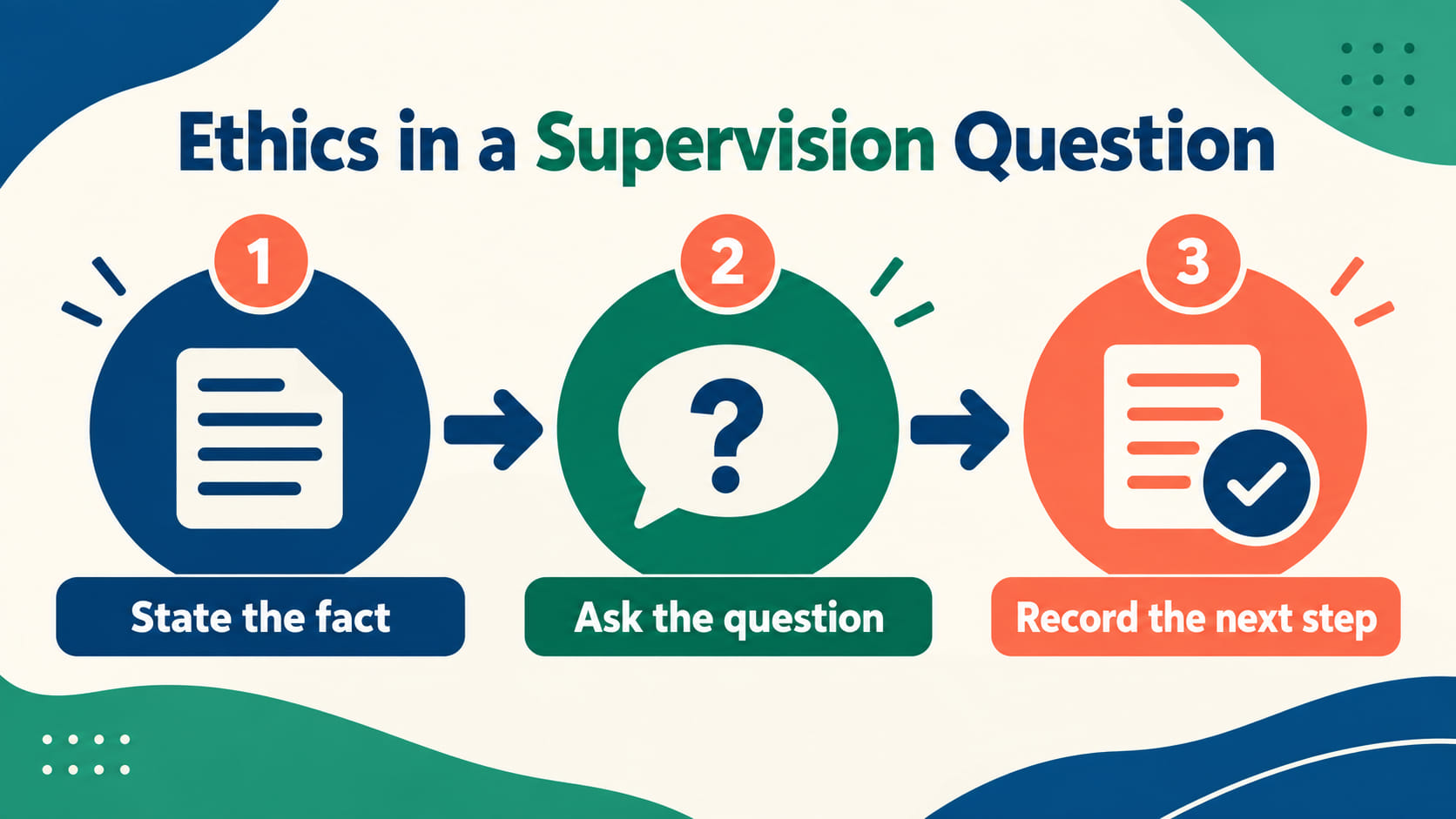
Escalation should be factual rather than accusatory. State what happened, what part of the program or record is affected, what immediate action was taken, and what decision or support is needed. Do not retaliate against a person who asks a good-faith question, and do not conceal a concern to avoid conflict.
If the concern remains unresolved, follow the next official or organizational route. If there is immediate risk of harm, use the urgent safety or reporting procedure first. This article cannot replace those procedures.
Ethical supervision checklist
- The current program, supervision arrangement, and role expectations are clear.
- Training and observation support the specific task and context.
- Feedback describes observable performance and a usable next step.
- Service, supervision, data, and correction records are accurate and traceable.
- Information is shared only through an approved route with an authorized recipient.
- The RBT can ask about scope, competence, safety, privacy, or unclear direction.
- Concerns are escalated through the correct process without concealment or retaliation.
- Examples and training materials do not expose identifying client information.
Frequently asked questions
What makes supervision ethical?
Ethical supervision is clear, role-appropriate, respectful, observable, accurately documented, privacy-protective, and open to good-faith questions and escalation.
Can an RBT question a supervisor’s direction?
Yes. Asking for clarification about safety, scope, competence, privacy, data, or a conflicting instruction is part of responsible practice. Use a respectful, factual route.
Can supervision records be corrected?
Use the approved correction or amendment process. Do not backdate, silently overwrite, delete, or conceal the original history.
Does this article replace the RBT Ethics Code?
No. Review the complete current RBT Ethics Code and the current RBT Handbook, then follow the supervisor, employer, and applicable requirements.
Role reminder: This article is educational content, not the complete RBT Ethics Code, an official supervision checklist, legal advice, or individualized supervision direction. Follow the current code, Handbook, supervisor, employer, and applicable requirements.
Official starting points: the RBT Ethics Code (2.0), the RBT Handbook, and BACB supervision and training resources.
Ready to practice the RBT concepts you just reviewed?
Try an independent, original RBT practice resource with exam-style questions, scoring, and answer explanations.
References
- Behavior Analyst Certification Board. RBT Test Content Outline, 3rd edition.
- Behavior Analyst Certification Board. RBT Handbook.
- Behavior Analyst Certification Board. RBT Ethics Code.