

Professional credentials RBT ethics begins with accurate status, truthful role language, and clear limits on what an RBT is authorized to claim.
Table of Contents
- What professional credentials RBT ethics means
- Verify the credential before representing it
- Describe the RBT role accurately
- Limit claims about authority and outcomes
- Update profiles and materials
- Safe and risky credential examples
- When to ask for direction
- Common representation mistakes
- Frequently asked questions
- References
RBT ETHICS · PROFESSIONAL REPRESENTATION
Professional Credentials RBT Ethics: Accurate, Honest Representation
Verify your status, describe your role truthfully, avoid inflated claims, and keep professional profiles current.
Professional credentials RBT ethics concerns how an RBT represents training, certification status, role, experience, and professional services. The basic standard is simple: use accurate language, verify current status, and do not imply authority or qualifications you do not hold.
A credential is not only a line on a résumé. It can appear in an email signature, staff directory, social profile, business card, online advertisement, presentation, intake conversation, or public statement. Each setting still calls for truthful representation. If an employer has an approved title or template, follow that process and ask before making a personal variation.
The current credential record and applicable organization rules control. This guide offers a practical review framework; it does not determine an individual’s legal title, employment classification, scope, or eligibility.
What professional credentials RBT ethics means
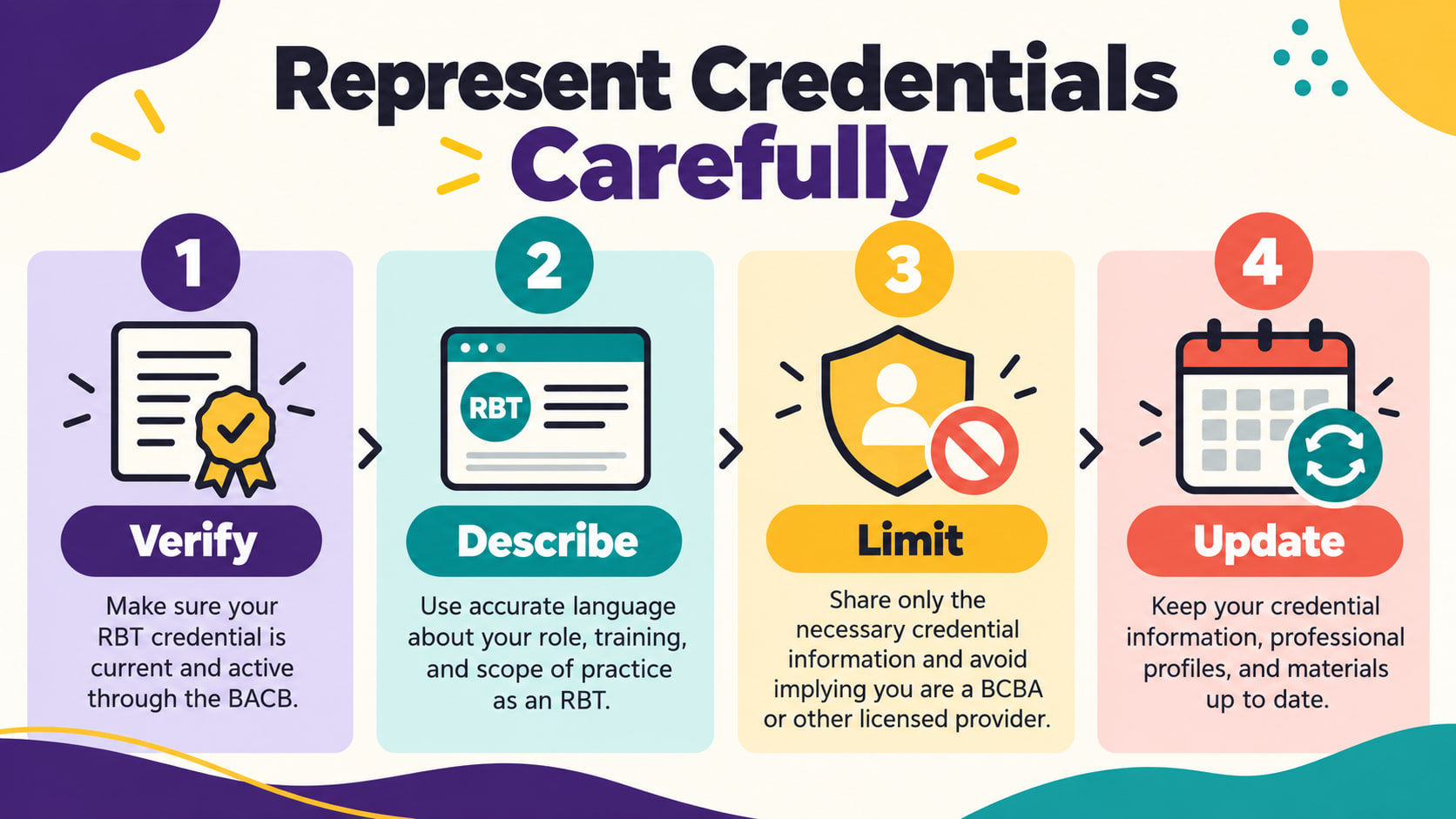
Ethical representation has four parts: verify the credential, describe the role, limit the claim, and update the information. These steps reduce confusion for families, coworkers, referral sources, and members of the public who may not know the difference between an RBT and another professional role.
Accurate language can still communicate competence. You do not need to exaggerate a title to explain what you do. A precise description of implementing assigned behavior-analytic services under supervision is clearer and safer than a broad statement that suggests independent clinical authority.
Verify the credential before representing it
Check the applicable official record or employer-provided verification process before stating that a credential is active, current, renewed, or in good standing. Do not rely only on an old screenshot, a résumé copied from a previous job, or someone else’s assumption.
Verification also includes the name attached to the credential, the effective period, and any status language that must be used exactly. If a renewal, inactive status, supervision change, or administrative issue affects the record, pause before publishing a claim. Ask the designated contact how the status should be described.
Describe the RBT role accurately
Use the actual credential title and explain the work in role-appropriate language. An RBT may describe implementation, data collection, communication, and participation in supervision when those statements match the assigned work. Avoid replacing “RBT” with a higher or more general title that could mislead a reader.
Be careful with words such as “expert,” “specialist,” “therapist,” “clinician,” or “analyst.” Some words may have a specific professional or legal meaning in a setting. When an employer or regulator provides approved wording, use it. When a public profile is unclear, ask for review rather than selecting the most flattering label.
Limit claims about authority and outcomes
A credential does not authorize every activity associated with a field. An RBT should not represent that they independently diagnose, conduct an assessment, design a treatment plan, determine a functional relation, supervise another provider, or make a clinical decision reserved for an authorized professional.
Outcome claims require particular care. Saying that a team is working on a stated skill is different from promising that a service will produce a specific result. Do not use one success story, a testimonial, or a personal impression as proof of a guaranteed outcome. Keep claims tied to what you are authorized to report and what the available information supports.
Update profiles and materials
Review public and internal materials after a credential change, employer change, role change, renewal, or supervision change. Check your résumé, email signature, social profile, staff page, speaker biography, course introduction, and any template that lists your qualifications.
Remove outdated statements through the approved process. If an old page is controlled by another person or platform, request the correction and document the request when policy requires it. Do not create a second inaccurate explanation to compensate for a first one.
Keep evidence for your own review when appropriate: the date you checked a status, the source used, and the wording approved for the specific setting. Do not keep unnecessary copies of protected records. A short credential checklist can help you notice when a profile, handout, or signature block needs attention before it is shared.
Safe and risky credential examples
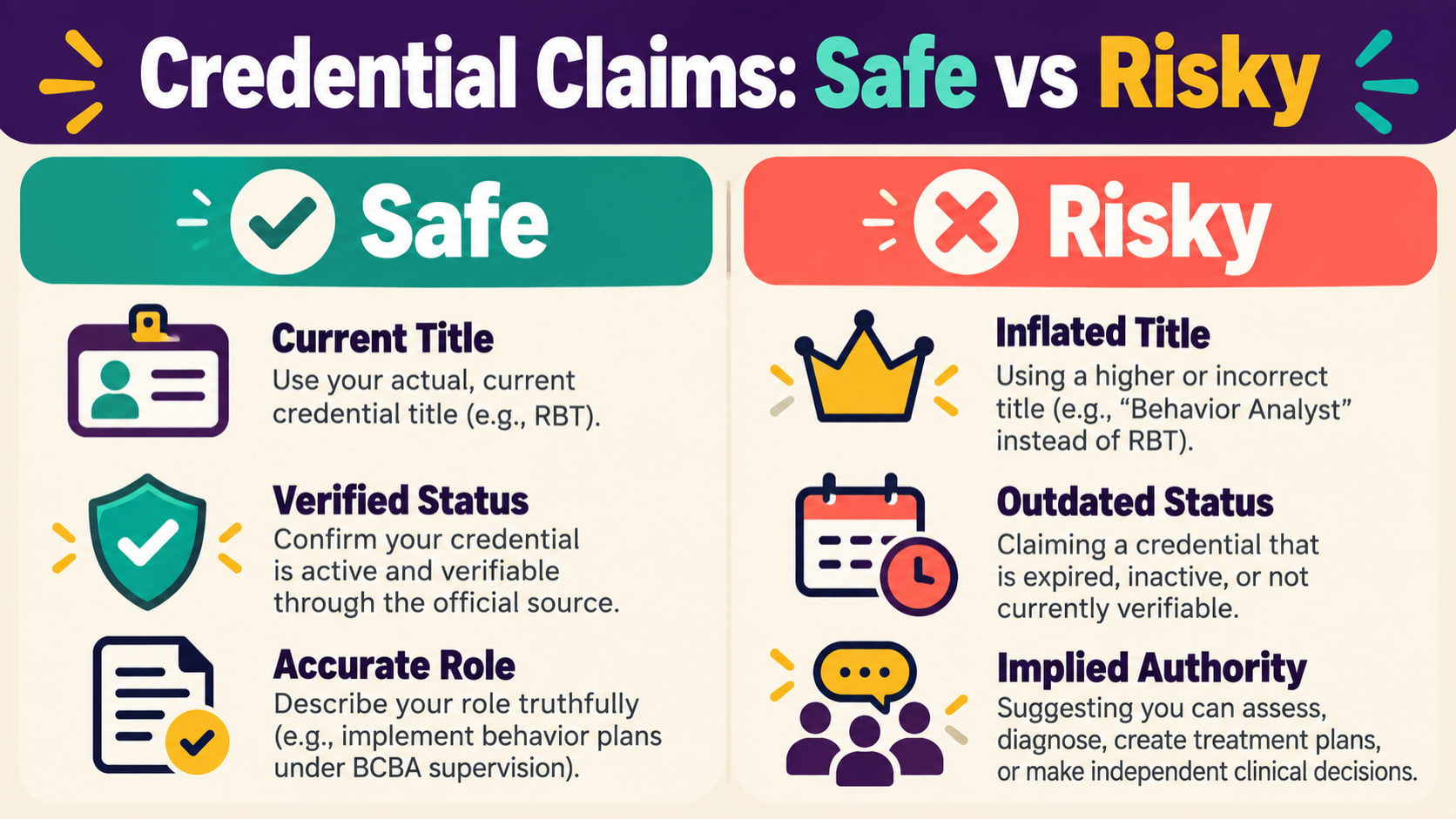
Safer: “I am an RBT who implements assigned behavior-analytic services under supervision and records session information according to the current procedure.” This describes the role without claiming independent authority.
Riskier: “I am a behavior analyst who creates treatment plans and guarantees progress.” This combines an inaccurate title with claims about authority and outcomes that may not be supported.
Safer: “My current RBT status can be verified through the applicable official record.” This points readers toward verification.
Riskier: “I am permanently certified,” especially when the status has not been checked or may change. A credential is not represented accurately merely because it was once valid.
When to ask for direction
Ask before publishing when a title is ambiguous, a credential status is changing, an employer requests wording that seems inaccurate, a public statement could be read as clinical advice, or a profile includes another person’s protected information. Bring the exact sentence, where it will appear, and the source you checked.
If the concern involves misrepresentation, retaliation, discrimination, privacy, or a request to falsify a credential, use the organization’s escalation route and any applicable official process. Seeking direction is not an admission of incompetence; it is a way to keep the representation accurate and role-safe.
Common representation mistakes
- Inflating the title: a familiar but inaccurate title is used to sound more senior.
- Ignoring status changes: an old credential statement remains online.
- Borrowing authority: an RBT speaks as if they were the supervisor or another licensed professional.
- Overpromising outcomes: a personal result becomes a guarantee for others.
- Using vague experience claims: years, populations, or skills are stated without a reliable basis.
- Copying a template blindly: a profile contains someone else’s title, status, or identifying information.
Frequently asked questions
Can an RBT call themselves a therapist?
Use the title and wording approved for your setting. If “therapist” could imply a qualification or authority you do not hold, use the accurate RBT title and ask for direction.
Should an RBT list the BACB in a profile?
Follow current official and organizational rules for describing certification and verification. Do not imply that an employer, course, or personal service is endorsed by the BACB unless that relationship is officially authorized.
What if my old résumé has an inaccurate title?
Correct it through the appropriate process and use the accurate title going forward. If it has already been submitted or published, ask the responsible person how to update the record.
Can an RBT describe positive work results?
Use accurate, supported, privacy-protective language and avoid guarantees. Do not disclose client information or present a personal observation as an independently verified outcome.
Source note: Review current BACB materials, credential records, organizational policy, assigned role, and supervisor direction for your setting. This article is educational and does not provide individualized legal, clinical, employment, or credentialing advice.
Ready to practice the RBT concepts you just reviewed?
Try an independent, original RBT practice resource with exam-style questions, scoring, and answer explanations.
References
- Behavior Analyst Certification Board. RBT Test Content Outline, 3rd edition.
- Behavior Analyst Certification Board. RBT Handbook.
- Behavior Analyst Certification Board. RBT Ethics Code.