
RBT ethics code 2.0 study is not just a vocabulary exercise. The useful question is what an RBT should do when a client-safety concern, a boundary request, an unfamiliar procedure, a privacy risk, or an inaccurate record appears at work. A strong review method connects the situation to the current standard, keeps the RBT within a defined role, and makes the next safe action visible.
Table of Contents
- What the RBT ethics code 2.0 covers
- Learn the four core principles
- Map the three sections and 29 standards
- Use a role-safe ethics decision loop
- Study general responsibilities
- Study service-delivery responsibilities
- Study BACB and supervisor responsibilities
- Practice original RBT ethics code 2.0 scenarios
- Build an ethics correction log
- Use a seven-day ethics study plan
- Frequently Asked Questions
- References
The BACB RBT Ethics Code (2.0) applies to RBT applicants and certificants in their behavior-technician activities across settings and communication modalities. The current document describes four core principles and 29 standards in three sections. It is the authority for ethical requirements; this article is an independent study guide, not legal advice, a supervisor, or a replacement for the official code.
For exam context, the current BACB RBT Test Content Outline, 3rd edition, organizes 43 tasks across six domains. The examination context includes 75 scored questions and 10 unscored pilot questions, with four answer options and a 90-minute time condition. Ethics reasoning is concentrated in Domain F, but ethical decisions also appear in measurement, assessment, acquisition, reduction, documentation, and supervision scenarios.
RBT Training is not a BACB certification program and is not affiliated with or endorsed by the BACB, Pearson VUE, or the independent resources reviewed here. All examples below are newly written for independent study; they are not official, recalled, leaked, or BACB-endorsed questions. No article, practice score, course, or answer key can guarantee certification or a passing result.
What the RBT ethics code 2.0 covers
The RBT Ethics Code (2.0) is a professional-conduct document for behavior-technician activities. It does not give an RBT independent authority to diagnose, select a treatment plan, change a client goal, or answer a clinical question outside the defined supervision structure. The code states that RBTs practice under the direction and close supervision of an RBT Supervisor and/or RBT Requirements Coordinator, who are responsible for the work RBTs perform.
The code has a wider reach than “be nice to clients.” Its standards address truthful conduct, competence, cultural responsiveness, discrimination, personal conditions that may affect service delivery, multiple relationships, gifts, romantic or sexual relationships, client rights, mandated reporting, plan fidelity, unfamiliar interventions, restrictive procedures, privacy, social media, supervision records, BACB communications, examination security, self-reporting, intellectual property, notices from the BACB, and accurate account information.
| Study question | What to identify | Common trap |
|---|---|---|
| Who is responsible? | The RBT’s defined action, the supervisor’s direction, and the client’s rights. | Assuming an RBT can independently redesign services. |
| What is the immediate risk? | Harm, privacy loss, inaccurate documentation, boundary conflict, or competence gap. | Starting with a favorite intervention before protecting the client. |
| What is the next step? | Follow the plan when authorized, ask the supervisor, document, or report through the proper channel. | Keeping a serious concern informal or solving it privately. |
| What source controls? | The current code, BACB requirements, law, employer policy, and supervisor direction as applicable. | Treating a quiz explanation or social-media post as the authority. |
For example: a caregiver may ask an RBT to add a new target because it seems important. The compassionate response is not to dismiss the caregiver. It is to acknowledge the concern, avoid making an independent clinical change, and bring the request to the supervisor through the established process.
Learn the four core principles
The code introduction identifies four principles that support ethical reasoning:
- Benefit others: protect client welfare and act when rights or safety are at risk.
- Treat others with compassion, dignity, and respect: avoid discrimination, harassment, demeaning language, and careless assumptions.
- Behave with integrity: be truthful in records, communication, credentials, billing-related documentation, and BACB interactions.
- Ensure your own competence: recognize limits, obtain training and supervision, and do not present unfamiliar services as if they were within competence.
These principles are not four choices that replace a standard. They are a first-pass lens for an ambiguous stem. If one option protects the client, preserves dignity, tells the truth, and seeks appropriate support, it deserves closer attention. Then verify the exact rule and the facts provided.
Map the three sections and 29 standards
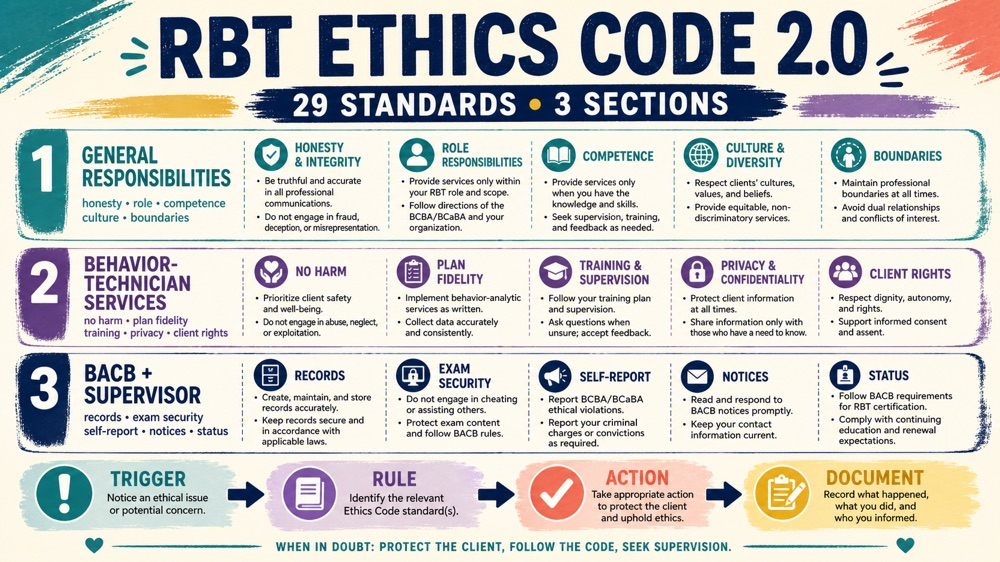
The 2026 RBT Handbook describes 29 standards across three sections. Memorize the map first, then attach examples to it:
| Section | Standards | High-yield pattern |
|---|---|---|
| 1. General Responsibilities | 1.01–1.12 | Honesty, accountability, defined role, competence, cultural responsiveness, discrimination, personal challenges, multiple relationships, gifts, and romantic or sexual boundaries. |
| 2. Responsibilities in Providing Behavior-Technician Services | 2.01–2.10 | No harm, supervisor direction, documentation, training, restrictive procedures, client rights, confidentiality, social media, and necessary job-related communication. |
| 3. Responsibilities to the BACB and BACB-Required Supervisor | 3.01–3.07 | Compliance, accurate communication, exam security, self-reporting, intellectual property, responding to BACB actions, and account/status updates. |
Do not turn the numbers into isolated flashcards. Pair each number with a trigger, a role-safe action, and a documentation expectation. For instance, “unfamiliar intervention” should cue training before service, supervisor consultation, and no improvisation—not simply the phrase “competence.”
Use a role-safe ethics decision loop
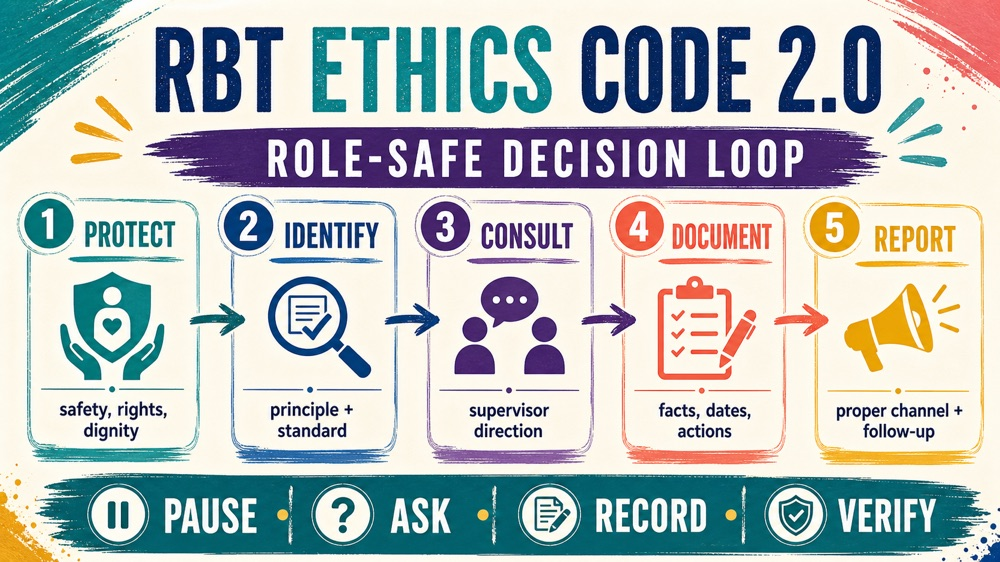
When a practice item presents an ethical dilemma, use this six-step loop:
- Protect: identify immediate danger, rights violations, or risk of harm. Follow the safety plan and required reporting pathway.
- Pause the unsupported decision: do not invent a clinical change, use an unfamiliar procedure, share information casually, or continue a task that exceeds competence.
- Identify: name the likely principle and the relevant standard family. Separate what the stem actually says from what you are assuming.
- Consult: bring questions to the BACB-required supervisor or another appropriate workplace authority. The RBT is not expected to interpret a difficult code question in isolation.
- Document: record observable facts, dates, people involved, actions taken, and outcome in the required system. Do not write a judgmental label as if it were data.
- Report and verify: if the issue is unresolved or reportable, use the appropriate authority and check the applicable deadline. Follow up rather than assuming that a verbal handoff solved the issue.
The correct exam answer is often not the most dramatic option. It is the one that protects the client while respecting the RBT’s role and the supervisor’s responsibility. “I will fix the plan myself” can sound decisive but is usually a scope problem. “I will ignore it” can sound calm but may fail a safety, privacy, or reporting obligation.
Study general responsibilities
Section 1 is easiest to remember as truth, role, competence, respect, boundaries:
- Truth and accountability: do not lead others toward fraudulent, illegal, or unethical behavior; follow through on commitments or work with the supervisor when a commitment cannot be met.
- Defined role: provide services within a clearly defined role under close, ongoing supervision. Do not misrepresent credentials or exaggerate what an RBT service can do.
- Competence: services follow supervisor confirmation of competence. If a request exceeds certification or competence, inform the supervisor or appropriate workplace authority and document it.
- Cultural responsiveness: work with the supervisor to evaluate biases and obtain needed training. Respect differences in identity, disability, culture, language, and background.
- Boundaries: avoid multiple relationships that create conflicts or risk harm. Apply the code’s gift, romantic, and sexual-relationship boundaries carefully, and follow stricter employer policies when they exist.
A small detail can control the answer. A gift is not evaluated only by whether the family is kind; the code sets a monetary boundary and explains the conflict-of-interest risk. A relationship is not safe merely because both people feel comfortable; the relevant professional role, timing, and risk of harm matter.
Study service-delivery responsibilities
Section 2 connects ethics to what happens during services. RBTs do no harm, work in the client’s best interest, follow supervisor direction, implement accurately, and complete required documentation. Questions commonly test whether an RBT will preserve plan fidelity while responding to a real situation.
- Unfamiliar procedures: obtain proper training before using an unfamiliar intervention or working with an unfamiliar client population.
- Restrictive or punishment-based procedures: use them only when included in a documented behavior-change plan and after the supervisor verifies competence.
- Client rights and safety: report suspected rights violations or risk of harm to the supervisor, follow organization policy, document actions, and contact other relevant authorities when required.
- Privacy: protect confidential information under BACB requirements, law, and employer policy. Do not share identifying client information on social media or websites.
- Necessary communication: discuss confidential information under supervisor direction unless a valid legal reason applies, and share only information necessary for job-related communication.
Imagine a coworker suggests a physical procedure that is not in the written plan. The ethical answer is not to copy the coworker’s confidence. The RBT should not implement an unauthorized procedure, should protect the client, contact the supervisor, follow policy, and document the concern. The exact emergency action depends on the safety plan and law, so a study article cannot replace workplace direction.
Study BACB and supervisor responsibilities
Section 3 is often missed because learners study only client-facing boundaries. It covers responsibilities to the BACB and BACB-required supervisor:
- comply with supervision, supervision documentation, audits, and other BACB requirements;
- communicate honestly and correct inaccurate or false information or documents;
- do not cheat, help others cheat, or collect, use, or distribute unauthorized examination materials;
- know the events that must be self-reported and report qualifying events within 30 days of the event or awareness, as applicable;
- do not misuse BACB or employer intellectual property;
- share a BACB notice or required action with the supervisor immediately and collaborate on a response; and
- check the BACB account regularly and report a certification-status change to the supervisor within 24 hours of becoming aware of it, then follow the applicable practice and title requirements.
These are not administrative details separate from ethics. A false record can affect client care, billing, certification, and trust. Examination security also matters: a page advertising recalled or leaked questions is not a legitimate shortcut. Treat secure content as protected, use original practice, and verify current rules from the BACB.
Practice original RBT ethics code 2.0 scenarios
The examples below are newly written for this article. For each one, select the role-safe action, name the nearest distractor, and state what fact would change the answer.
- Scope and competence: A caregiver asks the RBT to add a new communication target tonight. Best action: acknowledge the concern, do not independently change the program, and bring it to the supervisor. Nearest distractor: add the target because it seems helpful. The answer changes only when the supervisor authorizes and documents the change.
- Privacy: A colleague wants to post a recognizable session photo to celebrate progress. Best action: do not share identifying client information on social media or a website; follow the privacy policy and supervisor direction. Nearest distractor: post it after removing the client’s first name. A face or context can still identify the client.
- Documentation: The RBT realizes yesterday’s data were entered under the wrong date. Best action: preserve the correction trail, notify the required person, and correct the record according to policy. Nearest distractor: silently overwrite the entry so the graph looks clean. Integrity includes accurate records and transparent correction.
- Boundary and gifts: A family offers a high-value gift after a difficult month. Best action: do not accept it casually; consult the supervisor and follow the code and employer policy. Nearest distractor: accept it because it is private gratitude. The amount, pattern, role, and conflict risk matter.
- Safety: An RBT notices a possible rights violation and is told not to document it. Best action: protect the client, follow the safety and reporting pathway, document observable actions, and consult the supervisor or appropriate authority. Nearest distractor: keep quiet to preserve team harmony.
- Examination integrity: A website offers “real RBT exam questions” copied from a test center. Best action: do not obtain or distribute the material; use independent original practice and official BACB sources. Nearest distractor: download it but promise not to share. Unauthorized collection is still a problem.
- Cross-domain example: A data question asks the RBT to change the measurement definition because the current numbers look low. Best action: record according to the written definition and ask the supervisor about any revision. Nearest distractor: choose a more flattering measure. Ethical integrity applies even when the item appears to belong to Domain A.
- Status change: An RBT notices that the BACB account shows an unexpected status change. Best action: report the change to the supervisor within the applicable timeframe and follow BACB requirements before representing oneself as active. Nearest distractor: continue billing until someone calls.
Build an ethics correction log
Do not measure ethics preparation by how many standard numbers you can recite. Use a correction log that captures the decision process:
| Column | Record |
|---|---|
| Scenario trigger | One neutral sentence describing the observable facts and request. |
| Risk and principle | Client safety, dignity, integrity, competence, privacy, or boundary risk. |
| Standard family | General responsibilities, service delivery, or BACB/supervisor responsibilities. |
| Role-safe action | Implement the plan, pause, ask, document, report, or protect—whichever the facts support. |
| Nearest distractor | The tempting action and the exact rule or fact that makes it weaker. |
| Changed fact | One condition that would change the answer, such as a written plan or immediate danger. |
| Source check | Official code, Handbook, employer policy, law, or supervisor clarification. |
Review low-confidence correct answers too. A lucky choice may hide a misunderstanding about when to consult, what to document, or who has authority. If a practice explanation conflicts with the official code, keep the conflict visible and verify it before memorizing anything.
Use a seven-day ethics study plan
- Day 1: read the official introduction, highlight the four principles, and write the three-section/29-standard map.
- Day 2: study General Responsibilities with contrasts for competence, culture, discrimination, multiple relationships, gifts, and romantic boundaries.
- Day 3: study service delivery, privacy, social media, unfamiliar procedures, restrictive procedures, and client safety.
- Day 4: study BACB and supervisor responsibilities, including accurate records, exam security, self-reporting, notices, and status changes.
- Day 5: complete a short mixed ethics set; record confidence, standard family, and the nearest distractor.
- Day 6: create changed-fact versions for missed or low-confidence items and ask the supervisor about real workplace ambiguity.
- Day 7: retest with fresh wording, then verify any rule that still feels like a slogan rather than a decision.
Keep the outcome claim modest. A higher practice score shows performance under one resource and condition; it does not prove eligibility, ethical competence in a workplace, certification, or a future examination result. No independent resource can guarantee certification or a passing result.
Bottom line: study the RBT ethics code 2.0 as a decision system. Start with client protection and dignity, identify the actual standard family, respect the supervisor-defined role, document accurately, and report through the correct channel. Then use original scenarios and changed facts to test whether you can apply the rule rather than merely recognize its number.
Ready to review RBT ethics scenarios?
Practice original situations, read the reasoning behind each answer, and use the correction loop to choose what to review next.
Try Free RBT Mock Exams →
Frequently Asked Questions
What is the rbt ethics code 2.0?
It is the BACB ethics code that applies to RBT applicants and certificants in their behavior-technician activities. It includes four core principles and 29 standards across three sections. Use the current BACB document as the authority.
How many sections are in the RBT Ethics Code (2.0)?
The code has three standards sections: General Responsibilities; Responsibilities in Providing Behavior-Technician Services; and Responsibilities to the BACB and BACB-Required Supervisor. The 2026 RBT Handbook describes 29 standards across those sections.
Can an RBT change a behavior plan independently?
An RBT should work within the clearly defined role and close supervision structure. Questions or requests that would change a program should be brought to the supervisor rather than solved independently.
What should an RBT do with a privacy concern?
Protect identifying information, follow the law and employer policy, consult the supervisor, document observable actions, and use the appropriate reporting pathway when client rights or safety may be at risk.
Are RBT ethics practice questions official BACB questions?
Independent practice questions should be original study content. Do not treat online questions as official, recalled, leaked, or secure BACB examination material, and verify official facts with the BACB.
Can RBT ethics study materials guarantee a passing score?
No. A study resource can organize review and provide practice, but no independent article, course, question bank, or score can guarantee certification or a passing result.
References
- Behavior Analyst Certification Board. RBT Ethics Code (2.0).
- Behavior Analyst Certification Board. Ethics Codes and Code-Enforcement Procedures.
- Behavior Analyst Certification Board. RBT Handbook.
- Behavior Analyst Certification Board. RBT Test Content Outline, 3rd edition.
- Behavior Analyst Certification Board. RBT certification resources.
- RBT Hub professional conduct study page. Reviewed for competitor research; not an endorsement.
- RBTPracticeExame ethics quiz. Reviewed for competitor research; not an endorsement.
- MockZoo professional-conduct practice. Reviewed for competitor research; not an endorsement.