
The phrase according to the BACB if there is an ethical complaint requires careful source checking because the correct response depends on the current policy, the role of the person involved, the immediate safety risk, the facts available, and the reporting route. An RBT should not investigate beyond authority, retaliate, gossip, destroy records, promise an outcome, or treat a social-media summary as the official process. The practical first steps are to protect the learner, preserve objective information, maintain privacy, notify the appropriate supervisor or designated channel, and follow current official instructions. This independent guide is educational content, not legal advice, a formal BACB determination, or a substitute for current policy. Verify official materials and local procedures before acting.
Table of Contents
- According to the BACB if there is an ethical complaint: identify the source
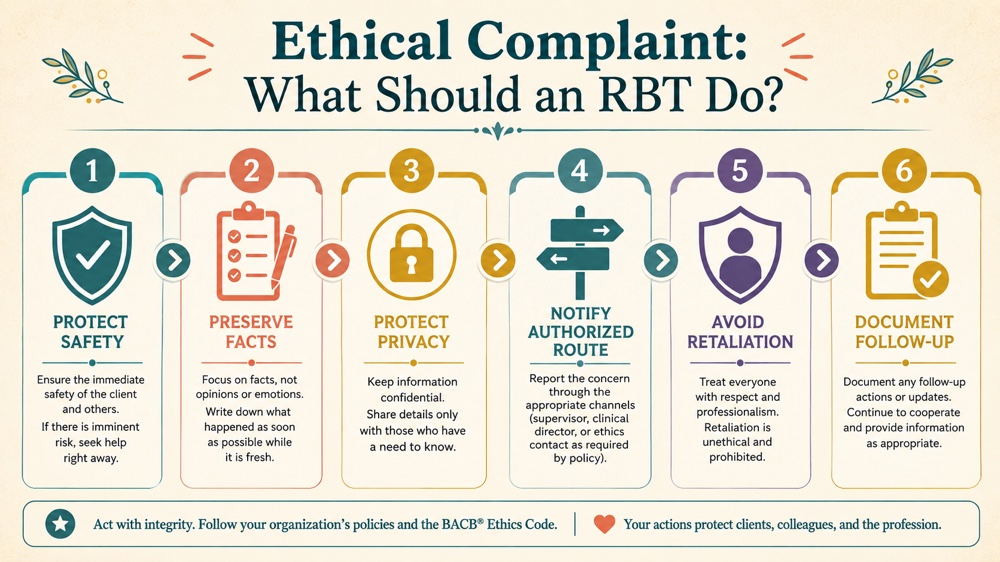
- Protect immediate safety first
- According to the BACB if there is an ethical complaint: preserve facts
- Use the appropriate reporting route
- Protect confidentiality and nonretaliation
- Stay within role and competence
- Document follow-up responsibly
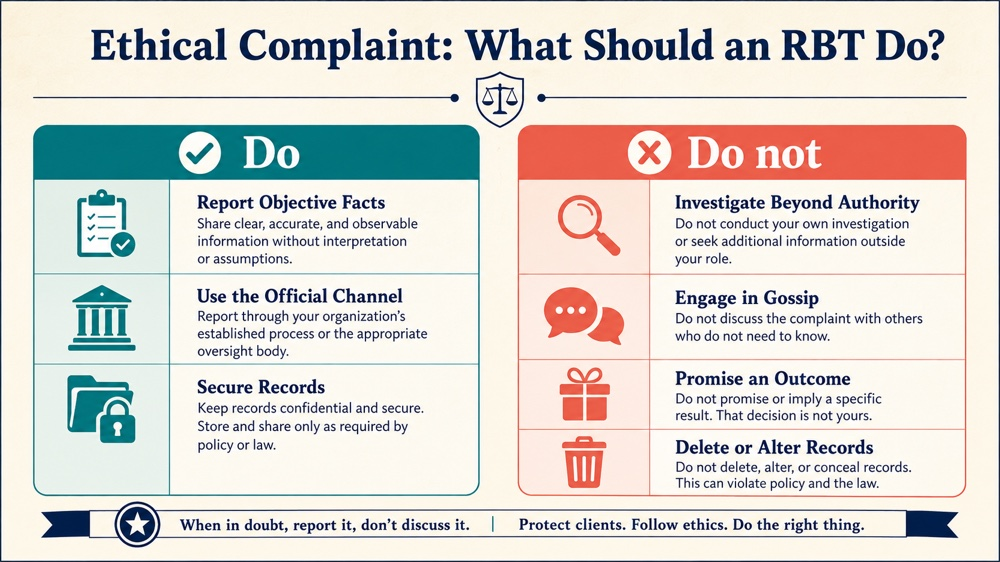
- Avoid complaint-response mistakes
- According to the BACB if there is an ethical complaint checklist
- Frequently Asked Questions
- References
Continue your RBT study with RBT exam study materials and original practice resources.
Quick answer: Treat according to the bacb if there is an ethical complaint as a current-source RBT study topic. Identify the exact action, source, data rule, and supervision boundary before deciding.
Study boundary: This independent guide is educational content. It is not a BACB policy, certification decision, legal opinion, answer key, or guarantee of examination success. Examples are original and are not official, recalled, leaked, or BACB-endorsed questions.
Current exam context: The current BACB RBT Test Content Outline describes 43 tasks across six domains; the examination includes 75 scored questions and 10 unscored pilot questions in a 90-minute testing period. Verify the current handbook and outline before relying on a time-sensitive detail.
Complaint questions are often answered poorly when a person jumps directly to blame or to a promised result. Start by separating immediate safety from the administrative process. If there is an urgent danger, use the organization’s emergency or safeguarding route. If the concern is about conduct, document what was observed, when, where, and who was present, without adding conclusions. Keep records secure and share only with authorized people. Ask the supervisor or designated compliance contact which current channel applies, and retain confirmation of the report according to policy. Never tell a client or coworker that a complaint will definitely be substantiated, dismissed, or kept secret when you do not control that decision.
According to the BACB if there is an ethical complaint: identify the source
Find the current official BACB complaint or ethics information and distinguish it from employer policy, state law, payer rules, or an internal grievance process. Different routes can coexist and may have different requirements.
Protect immediate safety first
If a learner faces immediate risk, follow emergency, safeguarding, and supervisor procedures. Do not delay necessary protection while trying to complete a form or conduct an independent investigation.
According to the BACB if there is an ethical complaint: preserve facts
Write objective observations with dates, locations, direct actions, relevant records, and witnesses when appropriate. Separate what you saw from what you inferred, and do not alter or destroy original documentation.
Use the appropriate reporting route
Ask the supervisor, employer compliance contact, or official channel which process applies. A technician should not promise that one route will replace another or assume that a coworker’s advice is current policy.
Protect confidentiality and nonretaliation
Share only necessary information with authorized people. Do not post details, pressure witnesses, punish someone for raising a concern, or use a complaint as a public argument.
Stay within role and competence
An RBT can report observations and follow direction, but should not act as an investigator, adjudicator, attorney, or independent clinical decision-maker. Ask for clarification when the requested action exceeds role.
Document follow-up responsibly
Keep the report confirmation and relevant records according to policy. Communicate new objective information through the approved route and avoid repeated informal retelling that can spread private details.
Avoid complaint-response mistakes
- Treating a social post as official procedure.
- Investigating beyond authority.
- Promising a complaint outcome.
- Sharing identifying details publicly.
- Retaliating or pressuring another person.
- Deleting or rewriting relevant records.
- Calling original scenarios official examination questions.
According to the BACB if there is an ethical complaint checklist
- Is there an immediate safety or safeguarding risk?
- Which current official or local process applies?
- What objective facts and records must be preserved?
- Who is authorized to receive the report?
- How will privacy and nonretaliation be protected?
- What action is within the RBT’s role?
- How should follow-up and confirmation be documented?
Use according to the BACB if there is an ethical complaint as a current-source reporting and role-boundary study topic. RBT Training is independent educational content and is not affiliated with or endorsed by BACB.
Practice the concept
Review according to the bacb if there is an ethical complaint with original RBT scenarios, current-source reminders, and clear role boundaries.
Review the RBT study resource →
Frequently Asked Questions
What should an RBT do if there is an ethical complaint?
Protect immediate safety, preserve objective facts, protect privacy, notify the appropriate supervisor or designated channel, and follow the current official and local process.
Can an RBT investigate a complaint?
Do not assume that authority. Report observations and follow the process; investigation and adjudication may belong to designated professionals or agencies.
Can an RBT promise confidentiality or an outcome?
No. Share only with authorized people and explain that the responsible process determines next steps and outcomes.
Is this legal advice or an official BACB determination?
No. It is independent educational content and not legal advice, a formal determination, or an official answer key.
References
- Behavior Analyst Certification Board: Registered Behavior Technician Handbook, updated June 2026.
- Behavior Analyst Certification Board: RBT Test Content Outline (3rd ed.).
- Behavior Analyst Certification Board: RBT resources.
- Behavior Analyst Certification Board: ethics resources.
- Behavior Analyst Certification Board: RBT Ethics Code (2.0).