
BACB Ethics Code gifts guidance for RBTs centers on avoiding conflicts of interest and multiple relationships while recognizing that an occasional expression of gratitude is different from an expected financial benefit.
Table of Contents
- BACB Ethics Code gifts: the current standard
- BACB Ethics Code gifts: what the $10 threshold does and does not mean
- Context, cumulative value, and relationships
- Employer policy and supervisor consultation
- What to do when offered a gift
- Practical examples
- RBT role boundaries
- Frequently asked questions about BACB Ethics Code gifts
- References
RBT ETHICS · PROFESSIONAL BOUNDARIES
BACB Ethics Code Gifts: What RBTs Should Know
Use the current standard, employer policy, and supervision process together.
BACB Ethics Code gifts guidance for RBTs centers on avoiding conflicts of interest and multiple relationships while recognizing that an occasional expression of gratitude is different from an expected financial benefit. The current RBT Ethics Code 2.0 includes a specific gift standard, but a dollar amount is not a substitute for context, employer policy, or supervisor consultation.
This guide explains the standard in plain language. It is not a decision for a particular client, family, stakeholder, supervisor, or employer. When a real gift question arises, pause, protect the relationship, follow the stricter applicable policy, and ask the appropriate supervisor or compliance contact.
BACB Ethics Code gifts: the current standard
RBT Ethics Code 2.0 standard 1.11 states that RBTs do not give gifts to or accept gifts from clients, stakeholders, or supervisors with a monetary value of more than $10 US dollars, or the equivalent purchasing power in another currency. The standard explains that a gift may be acceptable when it functions as an occasional expression of gratitude and does not result in financial benefit to the recipient.
The same standard warns that ongoing or cumulative gifts may rise to the level of a violation when they become a regularly expected source of income or value. That matters because several small gifts can create a pattern even when no single item appears significant.
If an employer has a stricter gift-exchange policy, RBTs follow that policy. A workplace may prohibit all gifts, require disclosure, limit who may give or receive them, or set a lower threshold. Read the employer rule with the current Ethics Code.
BACB Ethics Code gifts: what the $10 threshold does and does not mean
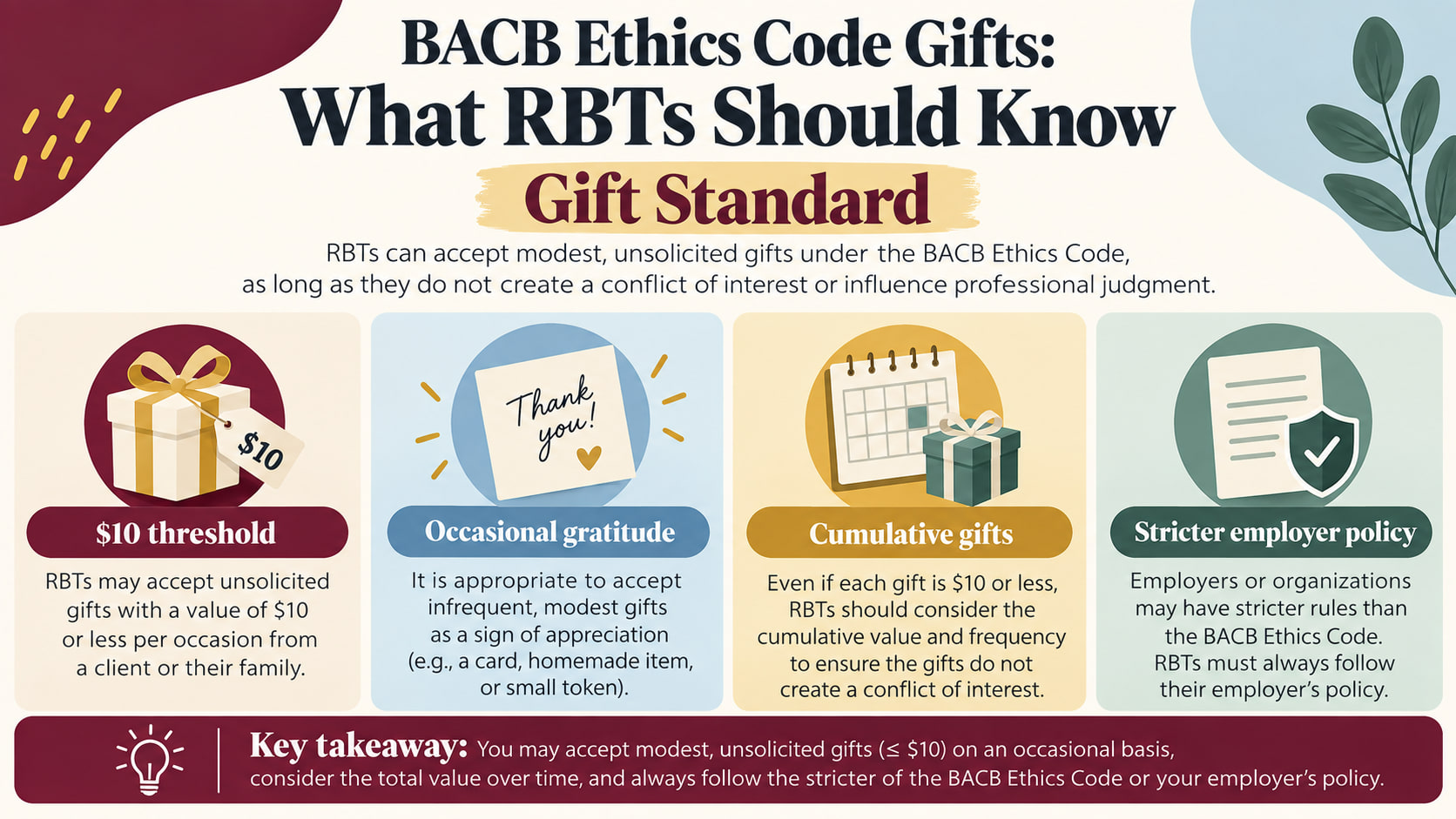
The $10 figure is a boundary in the current standard, not a permission slip for every situation under $10. A small item can still create pressure, favoritism, an expectation of special treatment, or a multiple relationship. Consider who offered it, why, how often, whether others receive the same treatment, and whether accepting it could affect professional judgment.
The rule applies to giving as well as accepting. An RBT should not purchase a personal gift for a client, stakeholder, or supervisor simply because the item is inexpensive. Ask whether the exchange is connected to the professional relationship and whether the employer has a specific procedure.
Currency conversion and value can also be unclear. When an item is homemade, bundled, discounted, shared, or offered with another benefit, do not make a convenient guess. Preserve the facts and consult the supervisor or employer policy.
Context, cumulative value, and relationships
Ethical review is broader than a receipt. A recurring snack, repeated gift card, free service, personal favor, or invitation may become an expected exchange. A “thank-you” that is offered only to one technician may change the relationship or create pressure to continue receiving it.
Consider multiple relationships. A family member may be a stakeholder as well as a neighbor, customer, friend, or community contact. A supervisor may also have authority over scheduling, evaluation, or access to opportunities. A gift can complicate those roles even when everyone has good intentions.
Protect the client’s dignity and the family’s relationship with the service. Do not shame someone for offering a gift. A neutral response can acknowledge the gratitude, explain that workplace and ethics rules apply, and offer a compliant alternative such as a general note to the organization if policy permits.
Employer policy and supervisor consultation
Check the policy before a holiday, birthday, discharge, appreciation event, or family transition creates urgency. Ask where the policy is stored, whether it requires disclosure, who approves an exception, and how the organization handles returned or shared items.
Consult early when the situation is ambiguous. Tell the supervisor the relevant facts without adding unnecessary private information: who offered the item, what it is, approximate value if known, whether it is recurring, and what the policy says. Ask for the response the organization wants documented.
Document the consultation through the approved route. Do not put client or family details in a personal messaging app, public note, or study document. If the concern involves the supervisor, use the employer’s escalation path or another appropriate entity named in the current policy.
What to do when offered a gift
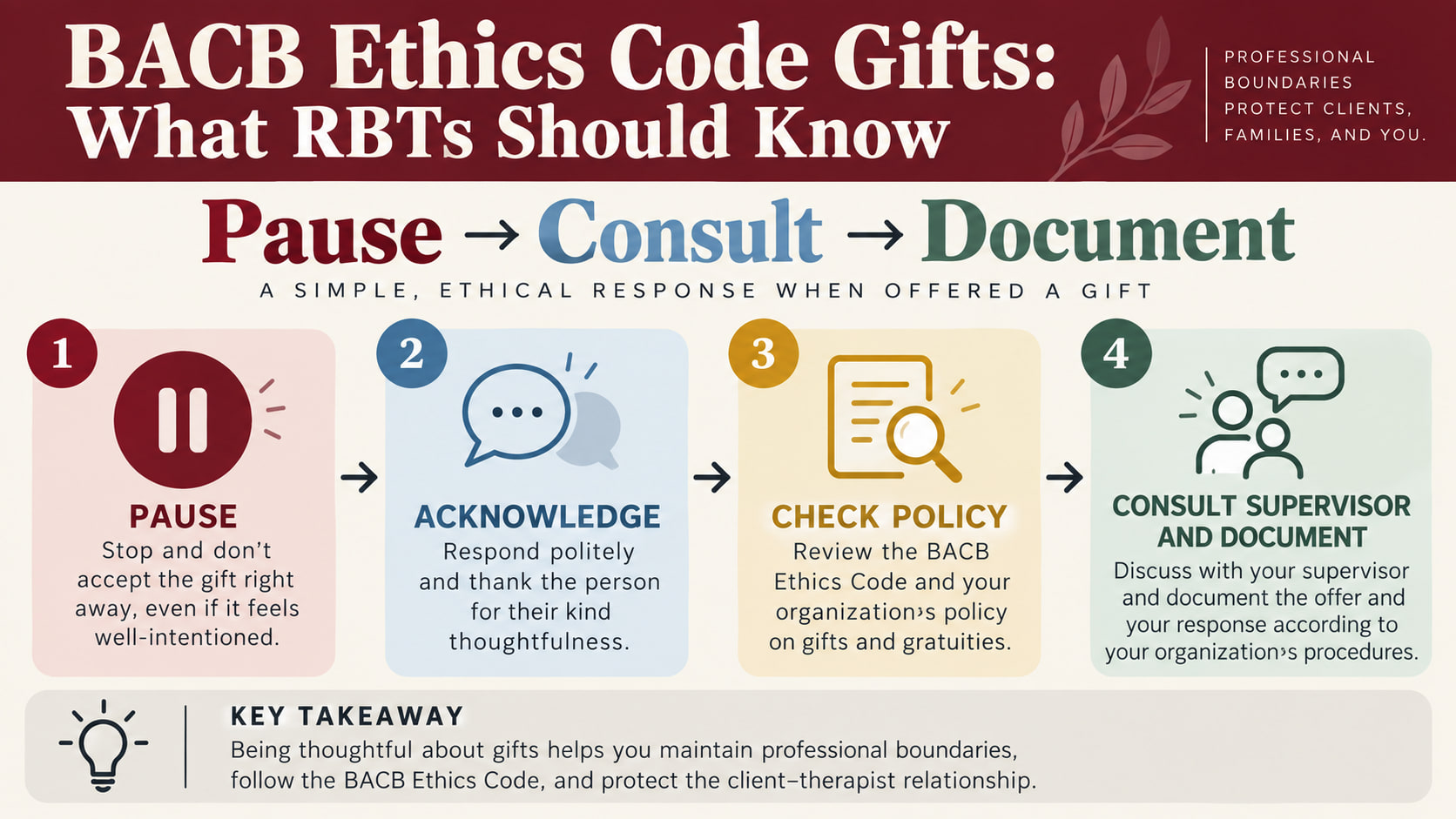
- Pause: Do not accept, promise to accept, or hide the item while deciding.
- Acknowledge: Thank the person for the thought without implying that acceptance is guaranteed.
- Check: Review the current Ethics Code, employer policy, and supervision instructions.
- Consult: Share the facts with the appropriate supervisor or compliance contact.
- Document: Record the approved response through the authorized system.
- Follow through: Return, decline, share, or handle the item exactly as directed.
A respectful script might be: “I appreciate your kindness. I need to check our professional gift policy before I can accept anything.” If the item is already handed over, keep it secure and ask what to do rather than taking it home or distributing it independently.
Practical examples
- Occasional small card: A handwritten note may be treated differently from a valuable item, but follow the employer’s policy and document questions when required.
- Repeated coffee: A small coffee offered every week can become an expected cumulative benefit. Ask the supervisor before continuing.
- Holiday gift basket: The value, contents, recipients, and workplace rule matter. Do not assume that sharing it solves the concern without approval.
- Gift from a supervisor: Even a modest gift can affect a power relationship. Check the employer rule and consult before accepting.
- Gift card: Treat a gift card as something with monetary value. Do not accept it because it is convenient or difficult to trace.
RBT role boundaries
An RBT follows the current Ethics Code, communicates concerns, protects confidentiality, and seeks required supervision. The RBT should not create a private gift policy, negotiate an exception with a family, or decide that a pattern is harmless without consultation.
Supervisors and employers provide the route for questions, documentation, and escalation. If the question cannot be resolved locally or involves a possible ethics concern, use the appropriate organizational and BACB processes rather than keeping the issue informal.
Frequently asked questions about BACB Ethics Code gifts
Can an RBT accept a gift under $10?
The standard describes an occasional expression of gratitude that does not create financial benefit, but employer policy and context still matter. A small amount is not automatic approval.
What if several small gifts add up over time?
Ongoing or cumulative gifts may become an expected source of value. Pause and consult the supervisor or employer before the pattern continues.
Does a thank-you card count as a gift?
The answer depends on the item, context, and policy. Do not assume; follow the organization’s guidance and protect privacy.
What should an RBT do if the supervisor offers a gift?
Check the employer policy and consult the appropriate route before accepting. A power relationship can make even a modest exchange significant.
Source note: Review the current RBT Ethics Code 2.0, BACB ethics information, RBT Handbook, employer policy, and supervisor guidance. This article is educational and does not provide individualized legal, clinical, employment, or credentialing advice.
Ready to practice the RBT concepts you just reviewed?
Try an independent, original RBT practice resource with exam-style questions, scoring, and answer explanations.
References
- Behavior Analyst Certification Board. RBT Test Content Outline, 3rd edition.
- Behavior Analyst Certification Board. RBT Handbook.
- Behavior Analyst Certification Board. RBT Ethics Code.