
If you are studying the BACB ethics code, start with the current RBT Ethics Code (2.0), not a recycled list of general workplace manners. The code applies to RBT applicants and certificants during behavior-technician activities across settings and communication modalities. It is a professional standard tied to client protection, supervision, competence, truthful records, privacy, and exam integrity.
Table of Contents
- BACB ethics code: what the current RBT document covers
- BACB ethics code: four core principles to remember
- General responsibilities: honesty, role clarity, competence, and boundaries
- Responsibilities while providing behavior-technician services
- Privacy, social media, and documentation: facts before explanations
- Responsibilities to the BACB and the required supervisor
- A BACB ethics code decision path for difficult questions
- Original exam-style BACB ethics code scenarios
- Map BACB ethics code review to the six current TCO domains
- BACB ethics code final review checklist
- Frequently Asked Questions
- References
The RBT Ethics Code (2.0) took effect January 1, 2022. The BACB ethics page says it applies to RBT certificants and applicants; the current PDF also explains that RBTs practice under the direction and close supervision of an RBT Supervisor and/or RBT Requirements Coordinator. Applicable laws, employer requirements, and licensure rules still matter, so an exam explanation cannot replace the current primary documents or supervisor guidance.
This guide uses the current RBT Test Content Outline, 3rd edition, as its study map. The TCO contains 43 tasks across six domains. The current exam presents 85 multiple-choice questions: 75 scored questions and 10 unscored pilot questions, with four answer choices and 90 minutes. Ethics questions are not only vocabulary questions; they test whether you can identify the observable problem, choose an in-scope response, and protect the client while using the correct reporting path.
RBT Training provides independent exam-preparation content. It is not the BACB, does not provide legal advice, does not investigate complaints, and is not affiliated with or endorsed by the BACB. The examples below are newly written for study and are not official, recalled, leaked, or BACB-endorsed questions. No course or study guide can guarantee certification or a passing result.
BACB ethics code: what the current RBT document covers
The phrase “BACB ethics code” can point to more than one document. The Ethics Code for Behavior Analysts applies to BCaBA and BCBA certificants and applicants. The RBT Ethics Code (2.0) applies to RBT applicants and certificants. This article focuses on the RBT Code. Use the document that matches the credential in the question.
The RBT Code describes responsibilities in three broad sections:
| Section | Study focus | Typical question clue |
|---|---|---|
| 1. General Responsibilities | Honesty, professionalism, defined role, competence, cultural responsiveness, and professional boundaries. | The technician exaggerates qualifications or is asked to work outside competence. |
| 2. Behavior-Technician Services | Client welfare, accurate implementation, documentation, training, safety, confidentiality, and supervisor communication. | The plan is unclear, a procedure is unfamiliar, or private information is about to be shared. |
| 3. BACB and Required Supervisor | Accurate communication, supervision, audits, exam integrity, self-reporting, and account/status responsibilities. | The technician submits an inaccurate document, sees cheating, or learns that certification status changed. |
The Code does not make an RBT an independent practitioner. It repeatedly connects ethical action to the direction of the supervisor, the RBT’s competence, applicable requirements, and the best interests of the client.
BACB ethics code: four core principles to remember
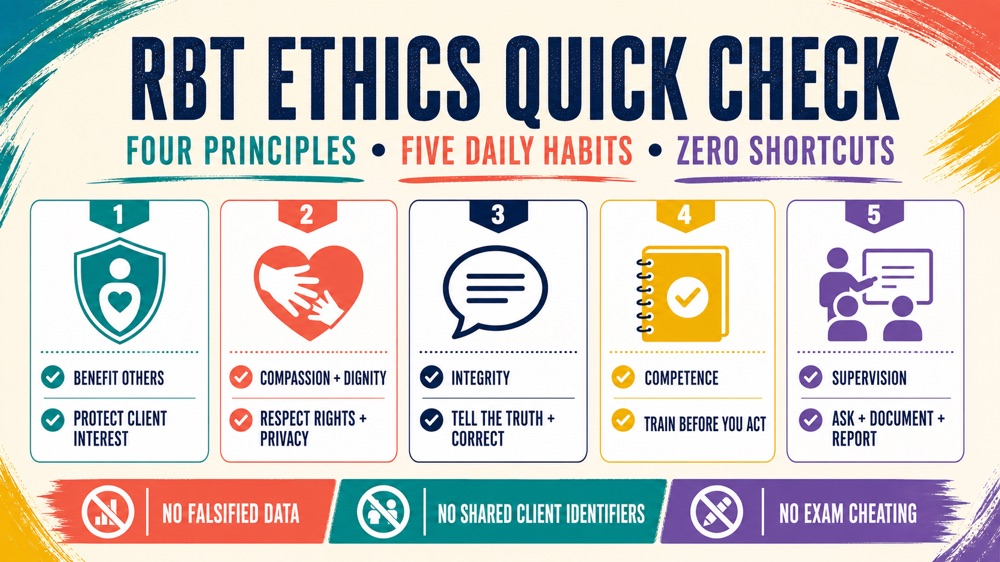
The current RBT Code introduces four principles that make the detailed standards easier to interpret:
- Benefit others: behavior-technician services should be directed toward meaningful client benefit and protection from harm.
- Treat others with compassion, dignity, and respect: protect rights, privacy, participation, and humane treatment rather than reducing a person to a target behavior.
- Behave with integrity: be accurate, truthful, accountable, and willing to correct errors.
- Ensure your own competence: accept work you can accurately perform, seek training and feedback, and notify the supervisor when a task exceeds your competence.
These principles are not four competing answer choices. They work together. For example, hiding an error may feel convenient in the moment, but it violates integrity and can prevent the team from protecting the client. The stronger response reports the error, corrects the record through the approved process, and seeks supervisor guidance.
General responsibilities: honesty, role clarity, competence, and boundaries
General responsibilities apply before, during, and after a session. An RBT must represent qualifications and behavior-technician services accurately. A résumé, intake form, social profile, or conversation should not imply a credential, degree, clinical authority, or experience that the person does not hold.
- Professional accountability: follow through on commitments, communicate early when a commitment cannot be met, and work with the supervisor toward the client’s best interest.
- Defined role: provide services under a clearly defined role and close, ongoing supervision rather than treating the credential as a license for independent practice.
- Competence: work only after competence has been demonstrated for the assigned service; seek training before unfamiliar interventions or client populations.
- Cultural responsiveness: discuss biases, diverse needs, and required training with the supervisor instead of assuming that one procedure fits every client or family.
- Multiple relationships: keep professional boundaries with clients, stakeholders, coworkers, and supervisors. A friendly request is not automatically permission to create a personal or financial relationship.
Exam distinction: “I have seen a coworker do this” is not evidence of competence or ethical permission. The answer should return to training, the written plan, supervisor direction, and the current Code.
Responsibilities while providing behavior-technician services
The service section turns principles into observable actions. The RBT follows supervisor direction, accurately implements assigned services, and completes required documentation such as client data and billing records. The RBT should improve performance after feedback instead of treating feedback as optional.
| Situation | Ethical response | Common distractor |
|---|---|---|
| Unfamiliar intervention | Pause as needed for safety, tell the supervisor, and obtain proper training before implementation. | Try it once because the caregiver is requesting it. |
| Restrictive or punishment-based procedure | Use it only when it is in a documented plan and competence has been verified by the supervisor. | Use the procedure because it worked for another client. |
| Question about the plan | Direct the question or concern to the supervisor and document according to workplace procedure. | Make a private modification and avoid reporting the uncertainty. |
| Risk of harm or rights violation | Protect the client, notify the supervisor, follow organization policy, document actions, and contact another appropriate authority when required. | Wait until the next routine supervision meeting with no safety action. |
| Client information | Use approved channels and share only the necessary information with authorized people. | Post a “success story” with identifying details removed only partly. |
Confidentiality is broader than keeping a chart in a locked cabinet. The current Code addresses records, workplace communication, social media, websites, and necessary information sharing. Removing a name does not automatically make a photo, video, written note, or distinctive story safe to post.
Privacy, social media, and documentation: facts before explanations
A reliable ethics answer separates what was observed, what was recorded, and what was inferred. For example, “Client looked toward the tablet, reached for it, and engaged in two vocal responses after the instruction” is different from “Client was manipulative and wanted to escape.” The first can be checked against the plan and data system; the second adds an unsupported interpretation.
Use the following privacy check before sending a message, writing a note, or sharing a story:
- Is the information necessary for a job-related purpose?
- Is the recipient authorized and is the channel approved?
- Does the communication follow the BACB, employer, and legal requirements that apply?
- Have I removed unnecessary identifying details rather than assuming “anonymous” is enough?
- Would I document the same information in the official record and be able to explain why it was shared?
Do not falsify, backfill, copy, or edit data to make performance appear stronger. If a mistake is discovered, tell the supervisor or the required party promptly and correct it through the approved process. Integrity is not the absence of mistakes; it is accurate communication and responsible correction.
Responsibilities to the BACB and the required supervisor
The third section is easy to overlook because it concerns administration, but it is highly testable. An RBT must comply with supervision, documentation, audit, and BACB requirements; communicate truthfully; and follow testing-center rules. The current Code specifically prohibits cheating or helping others cheat on competency assessments or RBT examinations, including unauthorized collection, use, or distribution of exam materials.
| Requirement | What to remember |
|---|---|
| Accurate submissions | If an inaccurate or false document was submitted, contact the appropriate BACB, supervisor, or employer party to correct the issue and determine next steps. |
| Self-reporting | The current Code identifies events that must be self-reported to the BACB within 30 days of the event or of becoming aware of it, including listed legal, investigation, disciplinary, or impairment events. |
| Certification status | Check the BACB account regularly; if status changes, report it to the supervisor within the current Code’s stated window and follow requirements about practice, billing, and title use. |
| Intellectual property | Do not misuse BACB titles or examination content, and do not copy proprietary employer materials without authorization. |
| Supervisor communication | Share relevant ethics concerns, documents, feedback, and uncertainty instead of concealing them. |
The exact current Code and Handbook control the dates and reporting details. If a state law, employer policy, or another authority imposes an additional duty, the RBT must follow the applicable requirement and ask the supervisor or appropriate authority how the duties interact.
A BACB ethics code decision path for difficult questions
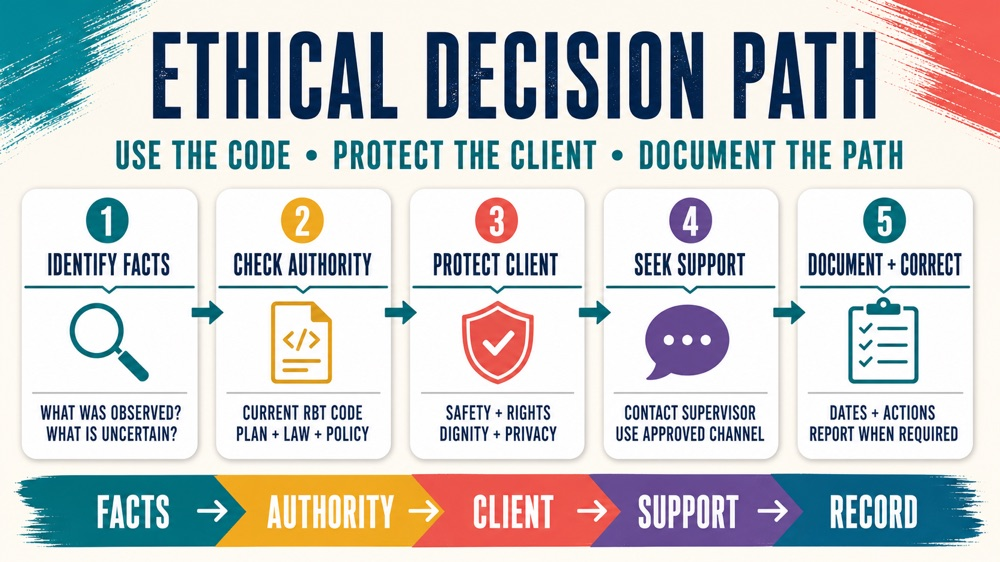
When two answer choices look “professional,” use a sequence rather than choosing the one that sounds nicest:
- Identify facts: name the observable event, who is involved, what information is known, and what remains uncertain.
- Check authority: compare the current RBT Ethics Code, written plan, supervisor direction, employer policy, and applicable law. Do not use an old summary as the final authority.
- Protect the client: address immediate safety, rights, dignity, privacy, and continuity of care.
- Seek support: contact the supervisor or another appropriate workplace authority. An RBT does not have to solve an ethical dilemma alone.
- Document and correct: record actions, dates, parties, and outcomes; correct inaccurate records or submissions through the approved channel; report further when the issue is not resolved or the Code requires it.
For example: a supervisor tells an RBT to use a procedure that the RBT has never been trained to implement. The strongest first response is to identify the competence problem, communicate it to the supervisor, and obtain proper training. Secretly trying the procedure, refusing all future services without communication, or asking a parent to decide the procedure each miss the role and reporting path.
Original exam-style BACB ethics code scenarios
Scenario 1—data error: after submitting a session note, an RBT notices that one frequency value was copied from the previous session. What is the best response?
Answer: promptly tell the supervisor or required party, correct the record through the approved process, and document the correction. Deleting the note silently or leaving it because “the total is close” fails integrity.
Scenario 2—social media: a technician posts a video of a successful teaching moment and says the client’s name was removed. The room, voice, and date remain recognizable.
Answer: do not share identifying client information on social media or a website. Follow the organization’s incident and reporting process and contact the supervisor about what has already been posted.
Scenario 3—caregiver request: a caregiver asks the RBT to change the reinforcement schedule because the current one is “too slow.”
Answer: acknowledge the concern, continue the approved plan within competence, and route the question to the supervisor. The RBT can report observations but should not independently redesign the intervention.
Scenario 4—exam materials: a friend offers a file that appears to contain recalled RBT exam items.
Answer: do not use, collect, distribute, or help others use unauthorized examination content. Follow BACB and testing rules and use original study materials instead.
Scenario 5—conflicting policy: an employer asks a technician to skip a required documentation step to speed up billing.
Answer: bring the conflict to the supervisor’s attention, document the concern and resolution, and follow the applicable law, BACB requirements, and approved documentation process. “The employer told me to” is not a complete ethical analysis.
These scenarios are newly written educational examples. They are not official, recalled, leaked, or BACB-endorsed questions. The point is to practice the sequence: facts, authority, client protection, supervisor support, documentation, and correction or reporting.
Map BACB ethics code review to the six current TCO domains
| Domain | Ethics connection | Review prompt |
|---|---|---|
| A. Data Collection and Graphing | Accurate definitions, honest measurement, and no data falsification. | What was observed, and does the record match it? |
| B. Behavior Assessment | Assigned assessment participation, competence, privacy, and supervisor direction. | Am I collecting assigned information or making an unauthorized conclusion? |
| C. Behavior Acquisition | Implement the teaching plan accurately, respectfully, and within competence. | Did I follow the procedure rather than invent a new one? |
| D. Behavior Reduction | Client welfare, safety, documented procedures, training, and escalation. | What protects the client if the plan or situation changes? |
| E. Documentation and Reporting | Truthful notes, privacy, required communication, and corrections. | Who needs the information, through which approved channel? |
| F. Ethics | Current RBT Code principles, role boundaries, supervision, competence, and professional conduct. | Which answer protects dignity and stays within the RBT role? |
Domain F is the obvious home for ethics questions, but ethical behavior is visible in every domain. A technician cannot collect valid data through dishonest notes, teach safely through an untrained procedure, or protect privacy through an unapproved communication channel.
BACB ethics code final review checklist
- Can you name the current RBT Ethics Code (2.0) and distinguish it from the BCBA/BCaBA code?
- Can you state the four core principles in plain language?
- Can you recognize when competence or training is missing?
- Can you separate observable facts from interpretations in documentation?
- Can you explain why social-media sharing can violate confidentiality?
- Can you choose a supervisor-contact, correction, or reporting step when the plan is unclear?
- Can you identify exam cheating and unauthorized content as ethics problems?
- Can you locate the current primary document before relying on a third-party summary?
Bottom line: the BACB ethics code is not a list to memorize without context. Strong RBT answers protect the client, stay within demonstrated competence, follow the written plan and supervision structure, communicate honestly, preserve privacy, and document the path taken when a problem appears.
Turn ethics vocabulary into decisions.
Use original RBT practice questions to identify the observable clue, nearest distractor, and correct supervisor or documentation step.
Try free RBT practice questions →
Frequently Asked Questions
Which ethics code applies to RBT applicants?
The RBT Ethics Code (2.0) applies to RBT applicants and certificants. The BACB also publishes a separate Ethics Code for Behavior Analysts for BCaBA and BCBA applicants and certificants.
When did the RBT Ethics Code (2.0) take effect?
The current RBT Ethics Code (2.0) took effect January 1, 2022. Always use the current BACB page or PDF because the Board can update documents and guidance.
What are the four core principles?
RBTs should benefit others; treat others with compassion, dignity, and respect; behave with integrity; and ensure their own competence.
Can an RBT solve an ethical dilemma without a supervisor?
RBTs should seek support from their supervisor and appropriate workplace individuals when interpreting or applying the Code. Immediate safety, applicable law, and client interests remain priorities.
How quickly must an RBT self-report certain events?
The current Code identifies listed events that must be self-reported to the BACB within 30 days of the event or of becoming aware of it. Check the current Code and Handbook for the event and reporting details that apply.
Are the scenarios in this BACB ethics code guide official?
No. They are newly written educational examples and are not official, recalled, leaked, or BACB-endorsed questions.
References
- Behavior Analyst Certification Board. Ethics Codes.
- Behavior Analyst Certification Board. RBT Ethics Code (2.0), updated August 2024.
- Behavior Analyst Certification Board. RBT ethics resources.
- Behavior Analyst Certification Board. RBT Test Content Outline, 3rd edition.
- RBT Practice Exam ethics study guide. Reviewed for competitor research; not an official BACB source.
- RBT Hub documentation and reporting guide. Reviewed for competitor research.
- CertifiedRBT Section F ethics guide. Reviewed for competitor research.