

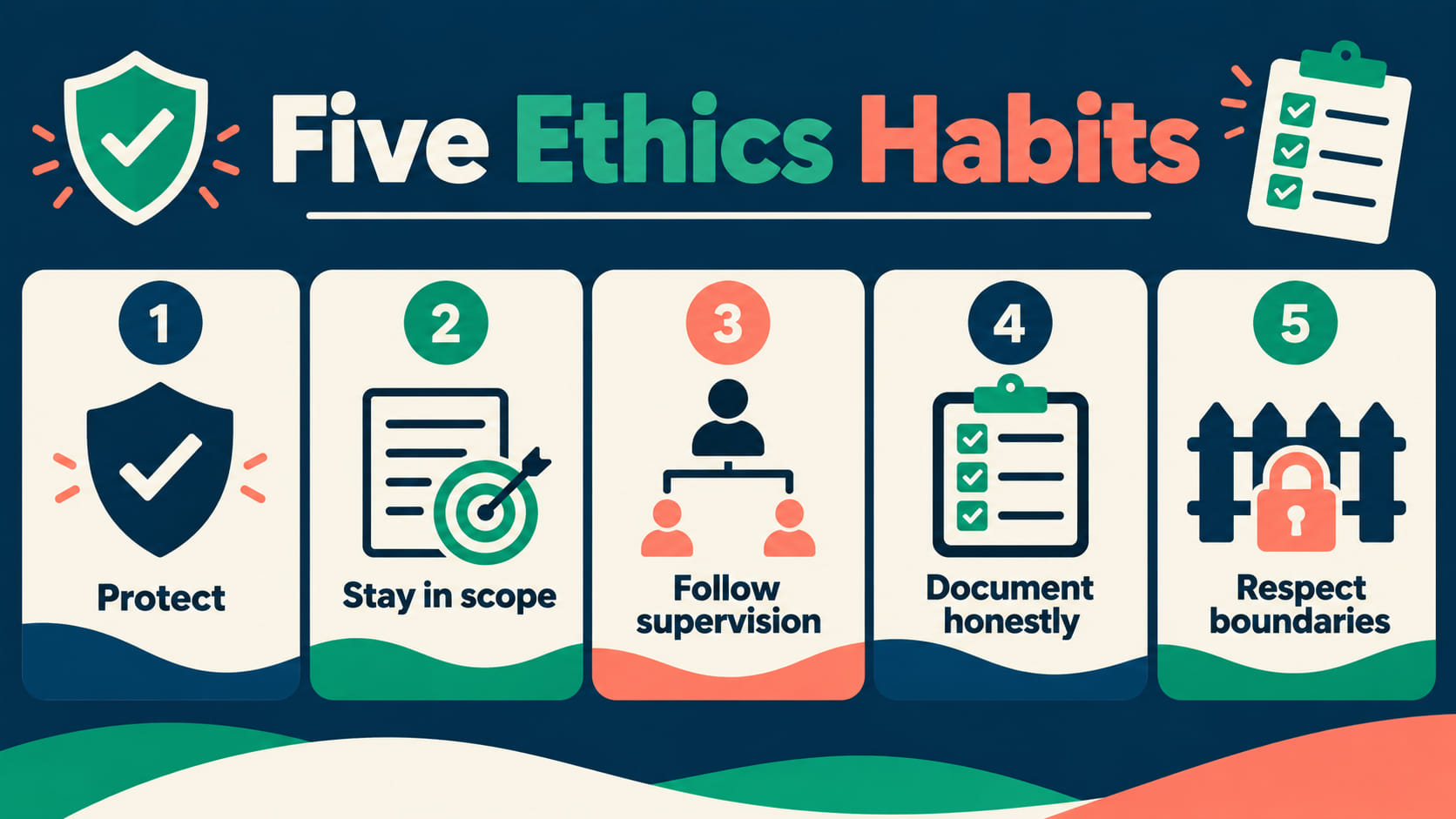
The core principles RBT ethics code readers need are practical habits: protect privacy, stay within competence and scope, follow qualified supervision, document honestly, and maintain professional boundaries. These principles guide ordinary decisions about records, requests, communication, and service delivery.
Table of Contents
- Core principles RBT ethics code: the short answer
- Protect clients, privacy, and dignity
- Stay within competence and scope
- Follow qualified supervision and direction
- Document and communicate honestly
- Maintain professional boundaries
- Know when to pause and ask
- Daily ethics checklist
- Frequently asked questions
RBT ethics, competence, supervision, records, and boundaries
Core Principles RBT Ethics Code: Five Habits for Daily Practice
Turn broad ethical responsibilities into repeatable decisions during ordinary RBT work.
The core principles RBT ethics code readers need are practical habits rather than slogans. Protect privacy and dignity. Work within competence and scope. Follow qualified supervision and the written plan. Document and communicate honestly. Maintain professional boundaries. These habits help an RBT respond to ordinary moments—an unclear request, a missing data point, a family question, or a proposed shortcut—before the moment becomes a serious problem.
The RBT Ethics Code (2.0) is the governing source, and the code should be read in the current version with the facts of the situation. Employer policy, supervisor direction, applicable law, payer rules, and emergency procedures also matter. This article is an educational map, not a replacement for the full code or individualized ethics consultation.
Core principles RBT ethics code: the short answer
When a decision feels uncertain, ask five questions:
- Does this protect the client’s rights, safety, privacy, and dignity?
- Am I competent and authorized to perform this task in this setting?
- Am I following the current supervisor direction and written program?
- Can my record and communication be reviewed as accurate and complete?
- Does this interaction preserve a professional boundary?
If the answer is unclear, pause, preserve the relevant facts, and ask the supervisor or designated contact. Ethical practice often looks like a small careful decision made before an action is taken.
Protect clients, privacy, and dignity
Protection includes more than preventing physical harm. It includes taking client rights seriously, using respectful language, handling information carefully, and reporting concerns through the correct route. An RBT should not use a client’s story, image, graph, or session detail as casual content for social media, a public presentation, or a personal teaching example.
Privacy also affects ordinary records. Use the approved system, share job-related information only with authorized recipients, and include the necessary amount of detail. A screenshot may reveal more than the field that a supervisor asked about. A “de-identified” story may still be recognizable when dates, location, family details, and unusual events are combined.
Dignity appears in the words used in a note and in the way choices are offered. Objective writing describes observable events rather than labeling a learner as lazy, manipulative, or bad. A respectful record is still precise: it can state what happened, how long it lasted, what procedure was followed, and what data were recorded.
Stay within competence and scope
Being an RBT does not mean being authorized to do every task that appears in a behavior-analytic setting. Competence depends on training, demonstrated skill, supervision, the client population, the specific procedure, and the setting. A task that looks familiar may still require additional training or direction.
Stay within the current role when recording, implementing, and communicating. Do not diagnose, independently select a function, redesign a treatment plan, change mastery criteria, promise an outcome, or provide a professional opinion outside the authority given to you. Report what you observe and ask for direction when a clinical decision is needed.
Scope questions can arise from good intentions. An RBT may notice that a material is difficult, a target seems outdated, or a family member wants advice. The ethical response is not to hide the issue or solve it alone. Record the relevant observation, use the approved communication route, and request review from the authorized supervisor.
Follow qualified supervision and direction
RBT services are delivered under the direction and supervision required by the current BACB framework and the organization. Supervision is not only a meeting on a calendar. It is the channel through which an RBT receives training, clarifies procedures, demonstrates competence, reports concerns, and receives feedback.
Follow the written program and supervisor direction as trained. If two instructions conflict, a new request appears outside the program, or the supervisor asks for a task that you do not understand, do not guess. Ask for clarification before implementing a new procedure. Keep a factual record of the question and direction when the system requires it.
Supervision does not remove the RBT’s responsibility to report a concern. If a client may be at risk, a record is inaccurate, or a practice appears inconsistent with policy, use the organization’s reporting route and any urgent procedure that applies. Silence is not the same as compliance.
Document and communicate honestly
Honest documentation includes the data collected, the procedure implemented, relevant barriers, missing information, and communication that affects service delivery. Do not invent a number because the sheet has a blank cell. Do not change a note to conceal a missed step. Use the approved correction or amendment process and notify the appropriate person when required.
Communication should be accurate, relevant, and appropriately limited. “The learner was upset” may need observable detail; “the learner cried, pushed the materials away, and left the table for 45 seconds” gives an authorized reviewer something they can evaluate. At the same time, do not add unrelated family history or private information that the record does not need.
Ethical communication also avoids promises. An RBT can explain the assigned procedure or report what occurred. The RBT should not guarantee that a behavior will stop, that a service will produce a specific outcome, or that a request is approved when the decision belongs to the supervisor, organization, payer, or another authority.
Maintain professional boundaries
Boundaries protect the service relationship. Consider gifts, favors, personal social-media connections, transportation requests, private meetings, financial arrangements, and disclosures that shift the relationship away from the professional role. A kind intention does not remove the risk of a multiple relationship or conflict of interest.
When a family offers a gift or asks for a personal favor, do not make a private exception. Follow the employer’s policy and ask the supervisor. A respectful response can acknowledge the gesture without accepting an arrangement that creates pressure, confusion, or unequal treatment.
Boundaries also apply to language and digital communication. Use the approved channel, keep messages service-related, and avoid sharing personal details that invite a separate relationship. If the relationship begins to feel difficult to define, bring the concern to supervision early.
Know when to pause and ask
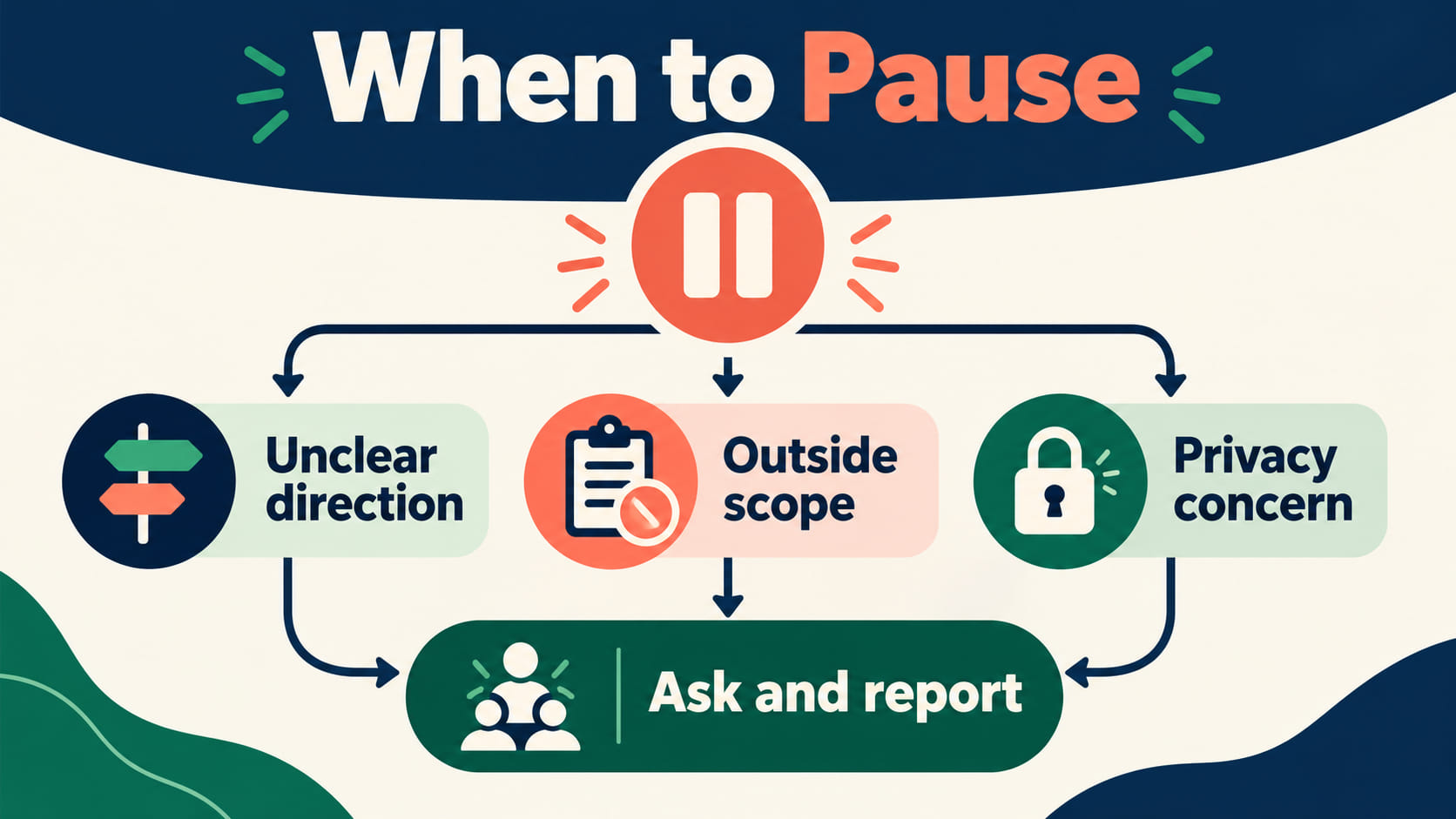
Three situations should trigger a pause:
- Unclear direction: the instruction, definition, data rule, or communication request is ambiguous.
- Outside scope: the task would require clinical judgment, training, authorization, or competence you do not have.
- Privacy concern: the recipient, route, device, or amount of client information is not clearly approved.
A good question includes the facts needed for a decision and leaves out unnecessary identifying detail: “The current plan says to record duration, but the timer was unavailable during one event. Should I mark that observation incomplete and how should I report it?” This is safer than guessing or sending a full client record through an unapproved channel.
Daily ethics checklist
- I used respectful, objective language and protected client dignity.
- I used the approved system and shared only necessary job-related information.
- I stayed within the training, competence, scope, and direction assigned to me.
- I followed the current written program and asked before making a change.
- I recorded data and barriers honestly, including relevant gaps.
- I used the approved correction, incident, and escalation processes.
- I kept gifts, favors, social media, and personal communication within policy.
- I know who to contact when a concern is urgent, unclear, or outside my role.
Frequently asked questions
What are the main RBT ethics principles?
A practical summary is to protect clients and privacy, stay competent and within scope, follow supervision, document honestly, and maintain professional boundaries. Review the complete current RBT Ethics Code for the actual requirements.
Does following a supervisor’s direction remove ethical responsibility?
No. An RBT should follow appropriate direction and also report unclear, unsafe, inaccurate, or out-of-scope requests through the correct route.
Can an RBT make a small program change during a session?
Do not make an independent treatment or criterion change simply because it seems helpful. Record the issue and seek direction from the authorized supervisor.
Where should an RBT ask an ethics question?
Start with the supervisor or designated organization contact and review the current RBT Ethics Code. If the issue involves safety, privacy, reporting, or possible misconduct, follow the organization’s escalation procedure and applicable official route.
Role reminder: This article is educational information, not the complete RBT Ethics Code, legal advice, or individualized ethics consultation. Review the current code and follow the supervisor, employer, and applicable requirements.
Official starting points: RBT Ethics Code (2.0), the BACB ethics codes page, and the RBT Handbook.
Ready to practice the RBT concepts you just reviewed?
Try an independent, original RBT practice resource with exam-style questions, scoring, and answer explanations.
References
- Behavior Analyst Certification Board. RBT Test Content Outline, 3rd edition.
- Behavior Analyst Certification Board. RBT Handbook.
- Behavior Analyst Certification Board. RBT Ethics Code.