

Dignity and respect RBT ethics means treating the learner as a person with rights, preferences, communication, and context—not as a behavior score—while implementing services within competence and supervision.
Table of Contents
- Dignity and respect RBT ethics: what it means
- Use language that preserves personhood
- Protect privacy in ordinary moments
- Make communication and choice visible
- Respect does not mean removing every demand
- Practice cultural humility and responsiveness
- Write and share data respectfully
- Use supervision when values and procedures conflict
- Common misunderstandings
- Frequently asked questions
- References
RBT ETHICS GUIDE · DIGNITY, PRIVACY, AND CHOICE
Dignity and Respect RBT Ethics: Make Care Visible
Turn a core RBT ethics principle into observable habits around language, privacy, choice, communication, and supervision.
Dignity and respect RBT ethics means treating the learner as a person with rights, preferences, communication, and context—not as a behavior score—while implementing services within competence and supervision. The RBT Ethics Code (2.0) identifies treating others with compassion, dignity, and respect as one of the principles that guides RBT conduct.
Respect is visible in small details: how an RBT talks about a learner, who can hear a session note, whether a communication attempt is noticed, how choices are offered, and how a difficult moment is handled. It is not the same as permissiveness, and it does not give an RBT permission to change a clinical plan independently. This article is educational and not an ethics ruling, legal opinion, or individualized treatment direction.
Dignity and respect RBT ethics: what it means
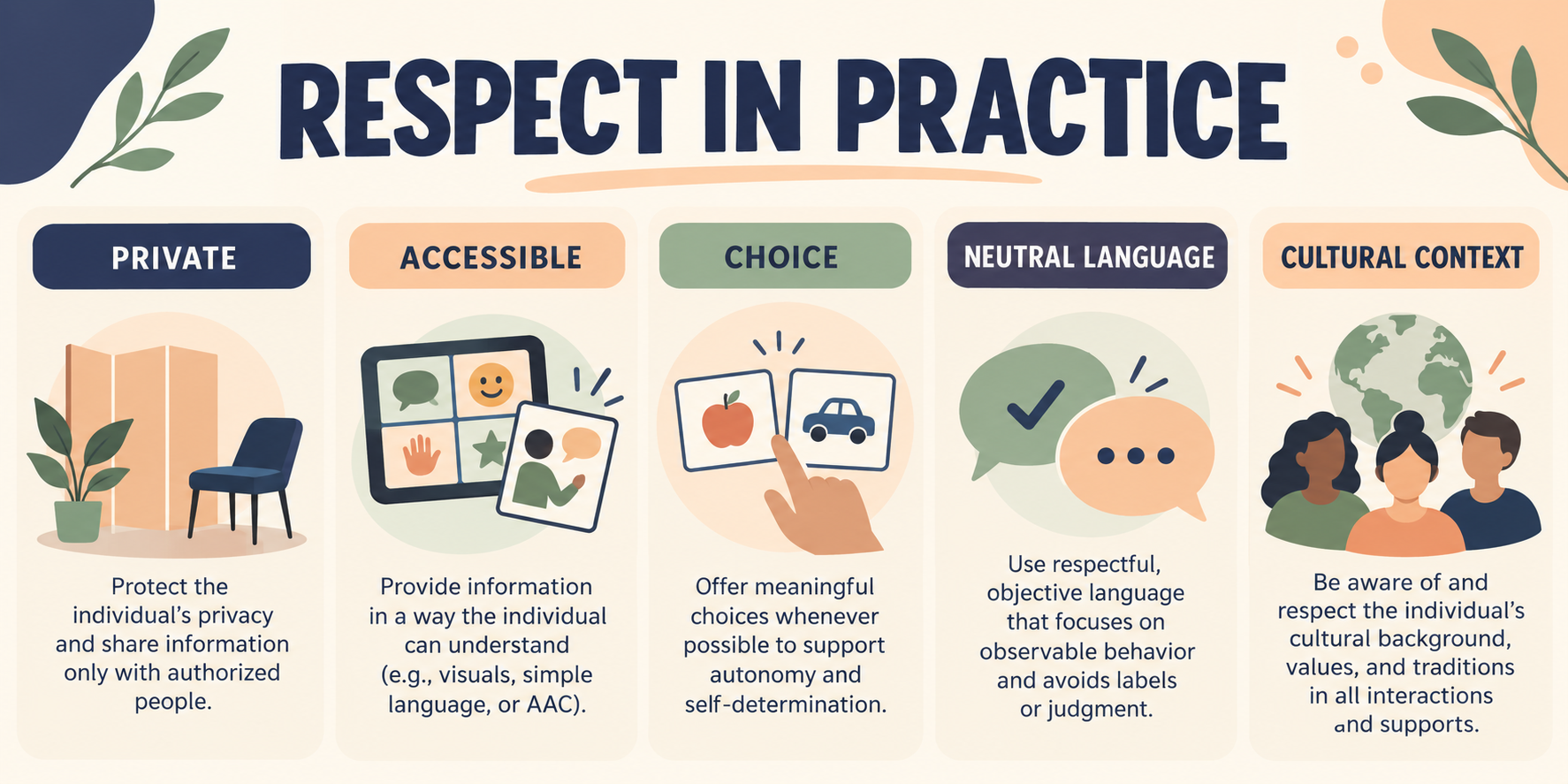
The principle asks the RBT to recognize the learner’s humanity and rights while providing behavior-technician services. That includes equitable treatment, privacy, accessible communication, respectful interaction, consideration of the learner’s context, and attention to how procedures are experienced.
Use a three-part check:
- Person: Am I describing and addressing the learner as a person rather than reducing them to a label or behavior?
- Process: Am I delivering the authorized procedure calmly, privately, and within my competence?
- Participation: Am I noticing communication, preference, refusal, assent-related signals, and relevant context?
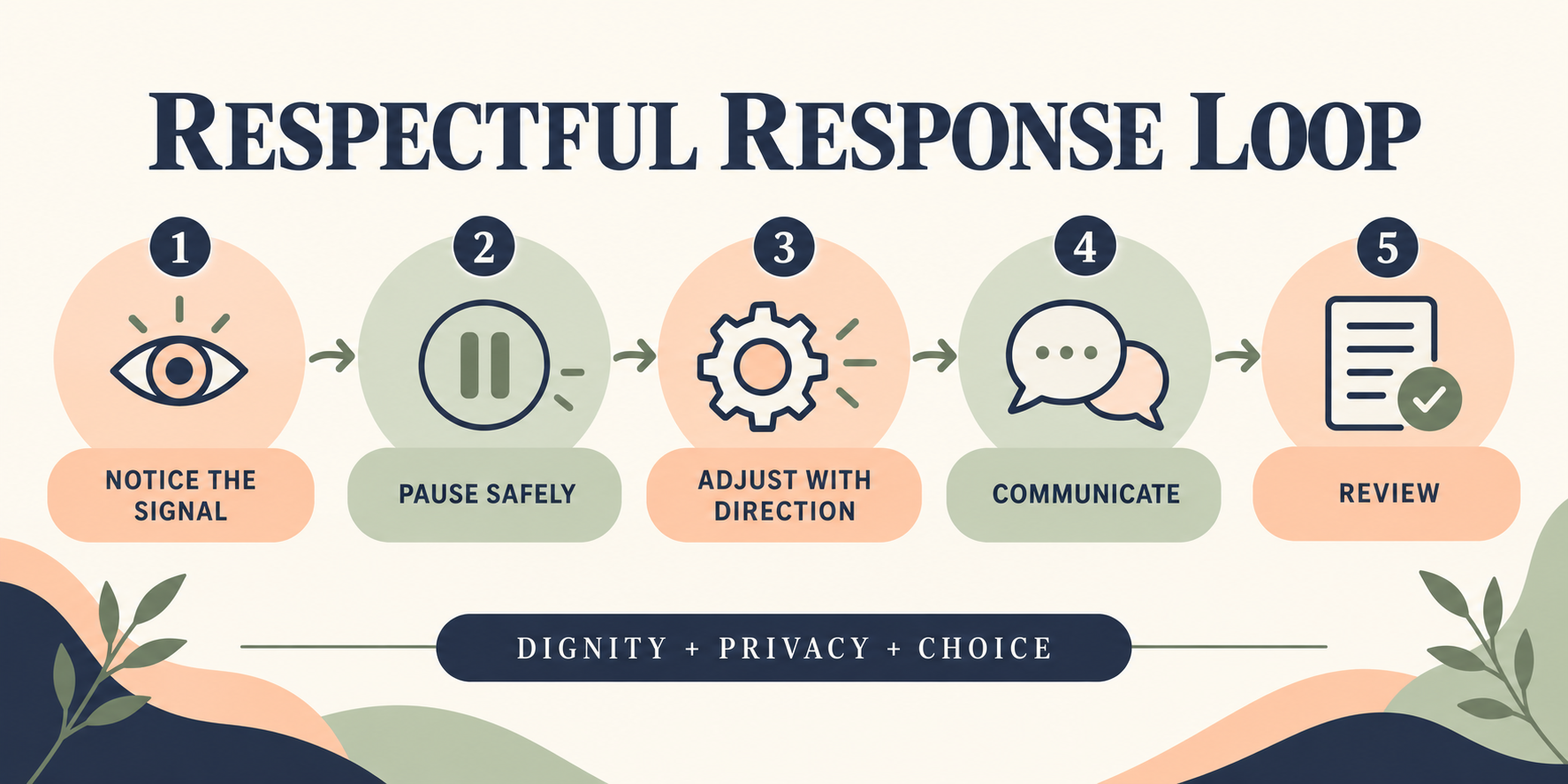
If one answer raises concern, do not hide it or improvise a new treatment. Protect immediate safety, record observable information, and bring the question to the supervisor or other authorized route.
Use language that preserves personhood
Words shape decisions. A note that says “the learner was lazy” invites blame, while a note that describes “the learner placed their head on the desk for two minutes after the instruction” gives the team something observable to review. Use neutral, specific language that separates behavior from assumptions about intention or character.
Ask the learner, family, or authorized team how the person describes themselves when that information is available and appropriate. Some people prefer identity-first language; others prefer person-first language. There is no single phrase that communicates respect for every individual. Follow the learner’s and family’s stated preference when consistent with the setting, and avoid turning a language disagreement into a public correction.
Respect also applies when talking with coworkers. Do not use a learner’s difficult moment as entertainment, gossip, or a shorthand label in a group message. Bring relevant information to the people who need it for service delivery.
Protect privacy in ordinary moments
Confidentiality is not only an electronic-record issue. A conversation in a hallway, an open laptop, a name on a whiteboard, a public token chart, or a photograph can disclose information. Use approved systems and follow workplace, school, payer, and applicable privacy procedures.
Before sharing, ask who needs the information and which details are necessary. When a supervisor needs help, use the secure route and remove unrelated identifying details from informal questions. Do not discuss a client’s progress in a public social post, even if the name is omitted but the person could still be recognized.
Make communication and choice visible
Respect requires more than asking a question and then ignoring the answer. Notice verbal and nonverbal communication, confirm that the learner can access the communication method, and offer choices in the form and timing authorized by the plan. If a learner reaches for an option, turns away, requests a break, uses a device, or communicates distress, treat the signal as information.
Choice does not require the RBT to offer every possible outcome. A clear choice between two authorized materials may be meaningful; an open-ended question during a difficult transition may be confusing. If choices do not work, document what happened and ask the supervisor whether the teaching arrangement or communication support needs review.
Assent-related signals deserve careful attention. A learner’s willingness to participate can change with pain, fatigue, fear, sensory conditions, or the way a task is presented. The RBT should follow the authorized consent, assent, safety, and clinical procedures and seek direction when signals conflict or the procedure is unclear. This article does not create a universal assent protocol.
Respect does not mean removing every demand
Teaching can involve demands, correction, waiting, practice, and persistence. Respectful service does not mean the learner never has to do something difficult. It means the task is authorized, understandable, appropriately supported, and delivered without humiliation or threats. The RBT should use the current plan, monitor safety, and communicate when the task appears beyond the learner’s current access or creates an unexpected concern.
Avoid turning a refusal into a character judgment. “The learner did not begin the task after the instruction and requested a break” is more useful than “the learner was disrespectful.” The first statement supports a clinical question; the second may escalate conflict and obscure the learner’s communication.
Practice cultural humility and responsiveness
The current RBT TCO includes ongoing cultural humility and responsiveness, including identifying personal biases. Dignity and respect require the RBT to examine whether an assumption about eye contact, volume, proximity, play, family routines, food, independence, or “appropriate” behavior reflects the learner’s needs or the adult’s preference.
Cultural responsiveness is not a checklist of stereotypes. Ask respectful questions, listen to the learner and family, consult the supervisor, and use data to understand whether a target is socially meaningful. If you notice a mismatch between the plan and the learner’s context, communicate it without making an unauthorized clinical change.
Write and share data respectfully
Accurate data protect dignity because they prevent the team from making decisions based on exaggerated or vague descriptions. Use the assigned definition and measurement system. Distinguish observation from interpretation, and describe relevant variables such as illness, schedule change, noise, staffing, or communication access.
Respectful documentation does not hide difficult information. It records the event without ridicule, sensational language, unnecessary details, or public exposure. When discussing a concern, share it with the appropriate supervisor or team member and preserve confidentiality.
Use supervision when values and procedures conflict
The BACB states that RBTs practice under the direction and close supervision of an RBT Supervisor and/or RBT Requirements Coordinator. If a procedure seems inconsistent with dignity, a coworker asks for an unapproved change, or the learner’s communication raises a safety concern, bring the observation to supervision.
A useful message is specific: “During the group activity, the learner covered their ears and moved away when the volume increased. The current plan does not say what to do for that response. I followed the safety step and paused the activity. What is the authorized next step?” This preserves the learner’s dignity, gives the supervisor facts, and avoids a private treatment redesign.
If the concern may involve an ethics violation, follow the current code and reporting instructions. Document the actions taken and relevant dates, and use the appropriate authority when the concern cannot be resolved. Do not announce a verdict in front of the learner or team.
Common misunderstandings
- Respect means no demands: teaching can include effort while remaining supported and dignified.
- One label is always respectful: ask about the learner’s and family’s communication preferences.
- Privacy means silence: relevant safety and service information still needs to reach the authorized team.
- Choice means the learner controls every procedure: offer meaningful authorized choices and seek direction when the plan needs review.
- Data must look positive: honest, objective data support better decisions and safer service.
- The RBT should fix the mismatch alone: supervision is the route for clinical changes and ethical uncertainty.
Frequently asked questions
Does dignity and respect mean I should never correct a learner?
No. Correction may be part of an authorized teaching procedure. It should be implemented within competence, without humiliation, and with attention to communication, safety, and the learner’s context.
What if a learner refuses a task?
Follow the current plan and safety procedure, observe the communication, and contact the supervisor when the response is outside the defined process or signals a concern. Do not shame, threaten, or invent a new consequence.
Can an RBT change the plan to make it more respectful?
An RBT can communicate the concern and implement immediate safety steps that are already authorized. Clinical or educational changes should come through the responsible supervisor or authorized team.
How can I show respect in a session note?
Use observable, neutral language; record the learner’s communication and relevant context; protect privacy; and avoid labels, jokes, motives, or unnecessary details that could bias the next decision.
Dignity and respect become real when the RBT protects privacy, notices communication, uses accessible language, respects context, records honestly, and asks for supervision before uncertainty becomes harm. The principle is not a decorative value statement; it is a daily standard for how services are delivered.
Ready to practice the RBT concepts you just reviewed?
Try an independent, original RBT practice resource with exam-style questions, scoring, and answer explanations.
References
- Behavior Analyst Certification Board. RBT Test Content Outline, 3rd edition.
- Behavior Analyst Certification Board. RBT Handbook.
- Behavior Analyst Certification Board. RBT Ethics Code.