
A free RBT practice exam is most useful when you use it as a decision rehearsal, not as a one-time score report. Read the scenario, identify the observable fact, choose the procedure or measurement that fits, and explain why the strongest distractor does not fit. Then schedule a small correction instead of immediately taking the same set again.
Table of Contents
- What a free RBT practice exam can show
- Check the current TCO before starting a free RBT practice exam
- Take a free RBT practice exam in two passes
- Review a free RBT practice exam by decision, not just score
- Original RBT practice exam decisions to rehearse
- Build a six-domain correction loop
- Use free RBT practice exam results for a seven-day plan
- Common free practice exam mistakes
- Frequently Asked Questions
- References
The current BACB RBT Test Content Outline, 3rd edition, maps 43 tasks across six domains. The current examination blueprint describes 75 scored questions and 10 unscored pilot questions. An independent practice resource may use a different number of questions and a different layout. The examples in this article are newly written for study; they are not official, recalled, leaked, or BACB-endorsed questions. A free resource can support preparation, but it cannot guarantee a passing result or replace required training, supervision, the current BACB materials, or professional direction.
Use the guide below to turn a free set into a repeatable study routine: check the current TCO, take a focused set, review the reasoning, classify the error, and repeat the decision in a changed scenario.
What a free RBT practice exam can show
A practice exam gives you local evidence about how you reason through the items in that set. It can help you check whether you can:
- Separate observation from interpretation. Identify what was seen, heard, counted, timed, or recorded before selecting an explanation.
- Match the requested unit. Decide whether the scenario calls for count, rate, duration, latency, interval recording, or another system.
- Follow the written procedure. Choose the prompt, reinforcement, teaching, assessment, or behavior-reduction step that the plan actually describes.
- Stay within the RBT role. Implement assigned procedures, document accurately, and ask for direction rather than independently redesigning treatment.
- Explain the distractor. State why a tempting option fails under the facts in the stem.
It cannot establish clinical competence by itself. An independent score does not replace a competency assessment, direct observation, supervision, a practical demonstration, or feedback from a qualified professional. It is also not an official certification result and does not predict that an official examination will use the same wording or question mix.
For example, a learner may remember that rate includes time but still choose count when a question asks for responses per hour. The study target is not the definition alone. The target is noticing the requested unit, performing the conversion, and reporting the result in the form the procedure requires.
Check the current TCO before starting a free RBT practice exam
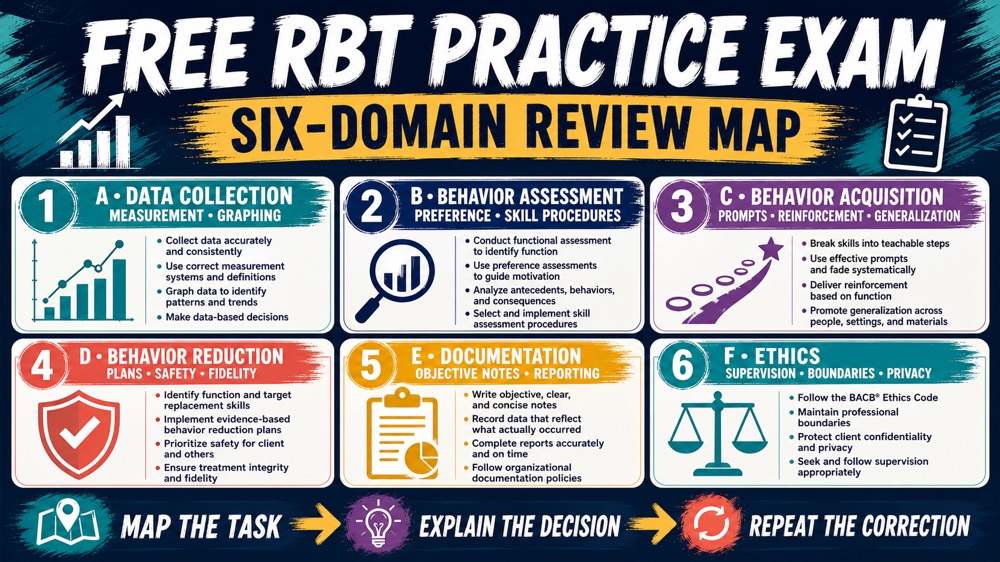
Use the current TCO as a coverage map before you judge a practice set. Its six domains and blueprint shares are:
| Domain | Tasks / share | Practice focus |
|---|---|---|
| A. Data Collection and Graphing | 13 / 17% | Observable definitions, measurement, calculations, graphing, trends, and data quality. |
| B. Behavior Assessment | 8 / 11% | Purpose of preference or skill assessment, assigned procedures, and role boundaries. |
| C. Behavior Acquisition | 19 / 25% | Teaching arrangements, prompts, fading, reinforcement, shaping, chaining, maintenance, and generalization. |
| D. Behavior Reduction | 14 / 19% | Written plans, antecedent strategies, differential reinforcement, safety, and fidelity. |
| E. Documentation and Reporting | 10 / 13% | Objective notes, timely reporting, data irregularities, confidentiality, and supervisor communication. |
| F. Ethics | 11 / 15% | Competence, supervision, boundaries, public statements, gifts, cultural humility, and client information. |
The percentages help you distribute review time; they do not reveal which individual item will appear. The 43 TCO tasks define the scope, while the 75 scored and 10 unscored pilot questions describe the current examination blueprint. Keep scope, practice length, and official examination format separate in your notes.
Before a free RBT practice exam, write a coverage note such as: “Today I am checking A.6 measurement calculations, C.5 prompting, E.1 objective documentation, and F.1 role boundaries.” A domain-specific set can be useful for correction, but it should not be labeled a complete readiness check unless it samples the whole map.
Take a free RBT practice exam in two passes
Two passes protect your reasoning from both rushing and answer-copying:
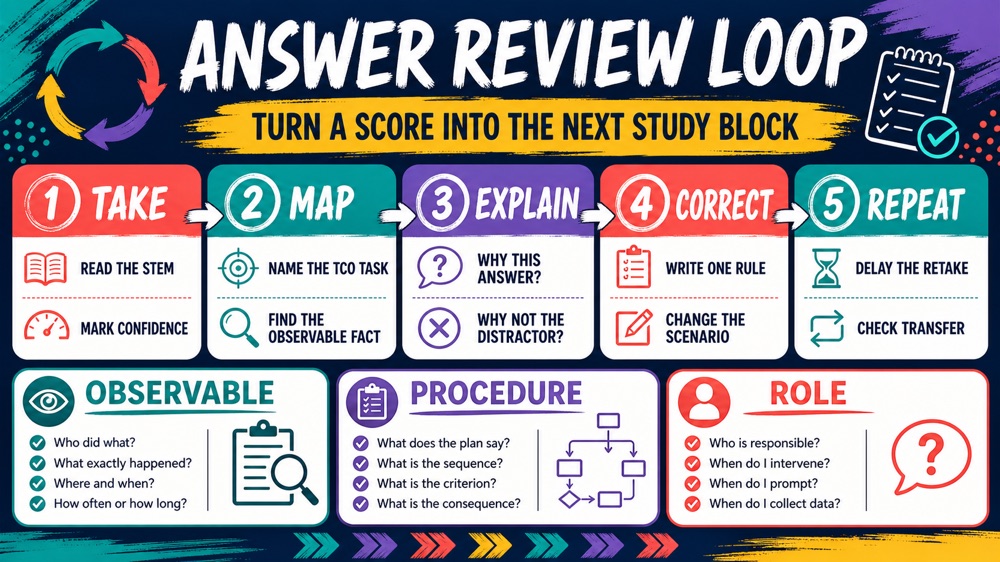
- Pass one: answer independently. Read the stem, underline the observable feature or written instruction, choose the best option, and mark confidence as high, medium, or low. Do not look up every term between items.
- Pass two: explain the choice. For every missed or low-confidence item, write the controlling fact, the TCO domain or task, and why the strongest distractor does not fit.
If a short set has 20 questions, one reasonable study block might use 25 minutes for the first pass and 35 minutes for review. That is a study suggestion, not an official time limit. For a larger set, take a brief break before accuracy drops. Timing should reveal your current process, not create a false sense of urgency.
Do not change an answer just because another option sounds more technical. Ask whether it is supported by the facts. If a plan specifies a least-to-most prompt sequence, an option that invents a different sequence is not stronger because it uses more jargon.
Review a free RBT practice exam by decision, not just score
A score tells you how many responses matched the key. A useful review explains what decision needs work. Use four columns:
| Review column | Question | Example note |
|---|---|---|
| Observable feature | What exact fact controls the answer? | “12 responses in 30 minutes; the stem asks for hourly rate.” |
| Procedure fit | Which written step or unit matches? | “Convert to rate because the requested unit is per hour.” |
| Distractor check | Why is the tempting choice wrong here? | “Count alone does not express the requested time unit.” |
| Role boundary | What should the RBT do if information is missing? | “Follow the plan and ask the supervisor instead of inventing a change.” |
Close the explanation and state the rule in your own words. Then change the names, setting, and numbers and solve a new version. If the rule works only on the original wording, you memorized the pattern rather than learning the discrimination.
Look at low-confidence correct answers as well as wrong answers. A lucky selection can conceal a gap. Record the domain, task label, confidence, error type, correction rule, and date for a delayed repeat.
Original RBT practice exam decisions to rehearse
The following prompts are newly written study examples. They are not official, recalled, leaked, or BACB-endorsed questions. Answer each before reading the rationale.
- Measurement: A behavior occurs 12 times during a 30-minute observation, and the procedure asks for responses per hour. The matching calculation is 24 responses per hour. The decision is to use the requested time unit, not to report count alone.
- Documentation: A learner leaves the table for 40 seconds after an instruction. An objective note reports the observable action and timing. It should not label the learner “defiant” or state a motive that was not observed.
- Prompting: A teaching plan specifies a verbal model before an independent response. The RBT follows that step and records the prompt information. The RBT does not replace it with a new hierarchy to appear more efficient.
- Assessment: A supervisor assigns a preference procedure. The RBT prepares the materials, follows the stated sequence, records choices, and reports questions. The RBT does not turn the activity into an independent functional assessment or change the procedure.
- Behavior reduction: A plan does not say what to do when a safety concern appears. The next action is to follow the safety instructions and contact the supervisor or designated professional according to the setting, not to improvise a new consequence.
- Ethics: A family asks the RBT to post a client success story with a recognizable photo. The RBT should follow privacy and organizational requirements and consult the supervisor rather than posting independently.
Each example follows the same reasoning: name the observable feature, match the written procedure, state the role boundary, and explain the distractor. That is more transferable than memorizing a letter.
Build a six-domain correction loop
Use a correction loop after each free RBT practice exam instead of taking unlimited attempts with no change:
- Tag the error. Choose definition, discrimination, measurement, calculation, procedure fidelity, documentation, or scope and ethics.
- Map it to the TCO. Record the domain and task that best describe the decision.
- Write one correction rule. Keep it short enough to say before the next item, such as “Record the unit named in the procedure before calculating.”
- Create a changed example. Change the behavior, setting, numbers, or prompt so you test the concept instead of recalling the page.
- Schedule a delayed repeat. Revisit the rule after one day and later in the week. Delayed success is stronger evidence than an immediate retake.
Use more weekly practice on C and D because they have larger TCO shares, revisit A and E with concrete data or notes, and keep B and F in rotation. This is a planning choice, not a promise that the official exam will distribute questions in a personally predictable way.
Use free RBT practice exam results for a seven-day plan
A score becomes more useful when it changes the next seven days:
- Day 1: take a mixed set and classify every missed or low-confidence item.
- Day 2: review the official TCO tasks connected to the largest error group.
- Day 3: solve new measurement, teaching, or reduction scenarios without the original answer choices.
- Day 4: write objective documentation and role-boundary explanations from short prompts.
- Day 5: take a smaller mixed set and compare confidence with accuracy.
- Day 6: review ethics, supervision, and confidentiality decisions; ask a qualified supervisor about real role questions.
- Day 7: repeat the highest-value corrections and update the next study block.
Do not use a free set to decide that you are “ready” from one number alone. Readiness involves current content review, required preparation, honest recognition of uncertainty, and appropriate professional guidance.
Common free practice exam mistakes
- Confusing quantity with readiness: hundreds of items do not help if the same error is never classified or corrected.
- Using an old edition without checking: label legacy notes and compare the current 3rd-edition TCO before building a schedule.
- Calling independent questions official: “free,” “real,” “recalled,” and “BACB-endorsed” are not interchangeable claims.
- Reading only the answer letter: an answer without a decision rule does not teach you how to handle a changed scenario.
- Ignoring low-confidence correct answers: uncertainty is a review signal even when the selected option happens to match.
- Changing a clinical plan in your explanation: practice should reinforce implementation, documentation, and escalation within role—not independent treatment design.
- Treating a score as a guarantee: a score is a local measure from one independent set under one set of conditions.
Before you finish, write three lines: the domain or task you practiced, the decision rule you improved, and the date of your delayed repeat. That small record makes a free resource part of a study system rather than a disposable quiz.
Bottom line: the best free RBT practice exam is not just a page that marks answers right or wrong. It connects a current TCO task to observable facts, written procedures, honest role boundaries, and a specific next repetition.
Ready to practice the RBT concepts you just reviewed?
Try an independent, original RBT practice resource with exam-style questions, scoring, and answer explanations.
References
- Behavior Analyst Certification Board. RBT Test Content Outline, 3rd edition.
- Behavior Analyst Certification Board. RBT Handbook.
- Behavior Analyst Certification Board. RBT Ethics Code.