
A free RBT practice test is most useful when you treat every item as a decision rehearsal. The goal is not to collect a high number once and move on. It is to identify what the scenario is asking, choose the measurement or procedure that fits, explain why the other options do not fit, and schedule a focused repeat.
Table of Contents
- What a free RBT practice test can measure
- Check the current TCO before you start
- Take a free RBT practice test in two passes
- Review answer rationales, not just your score
- Use a free RBT practice test as a review loop
- Five original scenario decisions to rehearse
- Common mistakes with free practice resources
- Frequently Asked Questions
- References
The current BACB RBT Test Content Outline, 3rd edition, describes 43 tasks across six domains. Its examination blueprint includes 75 scored questions and 10 unscored pilot questions. An independent practice resource may use 20, 75, 85, or another number of questions, but its length does not make it an official exam form. The practice examples in this article are newly written for education. They are not official, recalled, leaked, or BACB-endorsed questions. A free resource can support preparation, but it cannot guarantee a passing result or replace required training, supervision, the current BACB materials, or professional direction.
Use the process below to get more learning from each attempt: prepare the target, take a short set, review the reasoning, classify the error, and repeat the decision in a new scenario.
What a free RBT practice test can measure
A practice set can give you evidence about specific study behaviors, but it cannot measure everything that matters in supervised work. Use it to check whether you can:
- Read the observable facts. Separate what happened from a label, assumption, or untested explanation.
- Match the unit. Choose count, rate, duration, latency, interval recording, or another measurement because the target and procedure call for it.
- Follow the written plan. Select the prompt, reinforcement, teaching, or behavior-reduction step that is actually described.
- Recognize the RBT role. Implement assigned procedures, document accurately, and ask for direction rather than independently redesigning treatment.
- Explain a choice. Give a short rationale that uses the scenario feature, not just a memorized definition.
It cannot establish clinical competence by itself. It does not replace a competency assessment, direct observation, supervision, a practical demonstration, or feedback from a qualified professional. A score is a snapshot of performance on that set under those conditions. It is not a certification result and not a prediction that the official examination will feel identical.
For example, someone can answer a definition question about rate correctly and still record the wrong unit during a session. When reviewing practice, ask what behavior would show that the concept is usable: naming the target, selecting the unit, entering the value, and reporting uncertainty appropriately.
Check the current TCO before you start
Use the current TCO to decide whether a practice set is broad enough for your purpose. The six domains and their examination blueprint shares are:
| Domain | Scored share | What to check in practice |
|---|---|---|
| A. Data Collection and Graphing | 13 / 17% | Observable definitions, measurement systems, calculations, graphing, trends, and data quality. |
| B. Behavior Assessment | 8 / 11% | Purpose of preference or skill assessment, assigned procedures, and the RBT’s role. |
| C. Behavior Acquisition | 19 / 25% | Teaching arrangements, prompts, fading, reinforcement, shaping, chaining, maintenance, and generalization. |
| D. Behavior Reduction | 14 / 19% | Function-informed plans, antecedent strategies, differential reinforcement, extinction, safety, and fidelity. |
| E. Documentation and Reporting | 10 / 13% | Objective notes, timely reporting, data irregularities, confidentiality, and supervisor communication. |
| F. Ethics | 11 / 15% | Competence, supervision, boundaries, public statements, gifts, cultural humility, and client information. |
The percentages help you distribute review time; they do not tell you which individual item will appear. The 43 TCO tasks are the scope map, while the 75 scored and 10 unscored pilot questions describe the examination blueprint. Keep those numbers separate in your notes.
Before starting a free set, write a small coverage note: “Today I am checking A.6 measurement calculations, E.1 objective documentation, and F.1 role boundaries.” If every question comes from one domain, that may be useful for targeted practice, but do not mistake it for a complete readiness check.
Take a free RBT practice test in two passes
Use two passes so that timing does not hide your reasoning:
- Pass one: answer independently. Read the stem once, underline the observable feature or written instruction, select the best option, and mark your confidence as high, medium, or low. Do not look up every term between items.
- Pass two: explain the decision. For every missed or low-confidence item, write the feature that controlled the answer, the task or domain it represents, and why the strongest distractor does not fit.
If the set has 20 questions, a useful independent routine might be 25 minutes for the first pass and 35 minutes for review. Those times are a study suggestion, not an official limit. For a larger set, take breaks before accuracy falls. The point of a timed block is to observe your current process, not to create panic.
During the first pass, avoid changing an answer merely because another option sounds more technical. Ask whether the option is supported by the facts. If the scenario says the plan requires a least-to-most prompt sequence, an answer that invents a different sequence is not stronger because it uses more jargon.
Review answer rationales, not just your score
A score tells you how many responses matched the answer key. The rationale tells you which decision needs work. Review each item through four columns:
| Column | Question to ask | Example note |
|---|---|---|
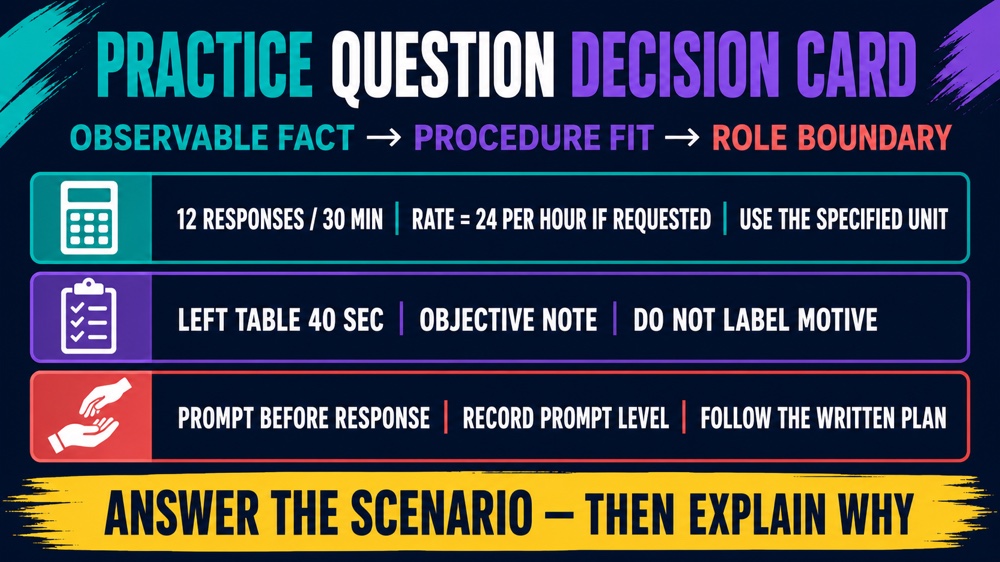
| Observable feature | What exact fact controls the answer? | “12 responses in 30 minutes; the question asks for hourly rate.” |
| Procedure fit | Which written step or measurement matches? | “Convert to rate only because the requested unit is per hour.” |
| Distractor check | Why is the tempting option wrong here? | “Count alone does not express the time unit requested.” |
| Role boundary | What would the RBT do if information is missing? | “Follow the plan and ask the supervisor rather than inventing a change.” |
Do not copy a rationale without making it your own. Close the explanation, cover the answer, and state the rule aloud. Then change the names, setting, and numbers and solve a new version. If the rule works only on the original wording, you memorized the pattern rather than learning the discrimination.
A good free practice resource should make its answer explanations and content boundaries visible. If it presents an answer without a reason, use it as a prompt source only and do your own source-grounded review with the current TCO, Handbook, and Ethics Code.
Use a free RBT practice test as a review loop
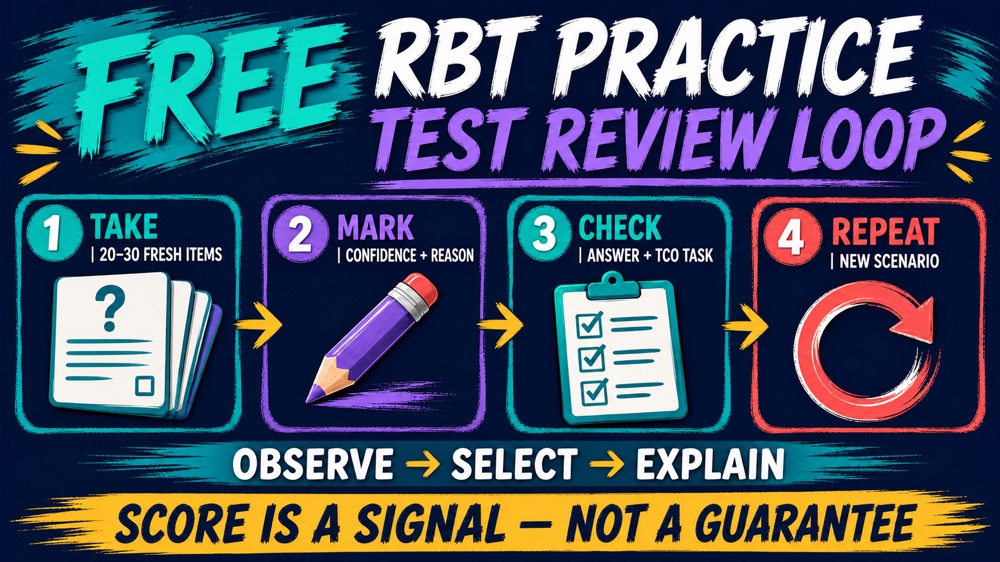
Build a four-step correction loop instead of taking unlimited attempts with no change:
- Tag the error. Use one label: definition, discrimination, measurement, procedure fidelity, calculation, documentation, or scope and ethics.
- Write the correction rule. Keep it short enough to say before the next item. Example: “Record the unit named in the procedure before calculating.”
- Make one new example. Change the behavior, setting, numbers, or prompt so you test the concept instead of recalling the page.
- Schedule a delayed repeat. Revisit the rule after one day and again later in the week. A correction that survives delay is stronger evidence than an immediate retake.
Keep a separate log for low-confidence correct answers. A lucky selection can hide a gap just as a wrong answer can reveal one. The log might include the domain, task label, confidence, error type, correction rule, and date of the next repeat.
Use the largest share of your weekly practice on C and D, revisit A and E with concrete data or notes, and keep B and F in the rotation. This follows the TCO weighting while preserving the smaller domains. It is a planning choice, not a promise that the official exam will distribute questions in a personally predictable way.
Five original scenario decisions to rehearse
The examples below are newly written practice prompts, not official or recalled questions. For each one, answer before reading the rationale.
- Measurement: A behavior occurs 12 times during a 30-minute observation, and the procedure asks for responses per hour. The matching calculation is 24 responses per hour. The key decision is to use the requested time unit, not to report count alone.
- Documentation: A learner leaves the table for 40 seconds after an instruction. An objective note reports the observable action and timing. It should not label the learner “defiant” or state a motive that was not directly observed.
- Prompting: A written teaching plan specifies a verbal model before an independent response. The RBT should follow that step and record the required prompt information. The RBT should not replace it with a new prompt hierarchy to appear more efficient.
- Assessment: A supervisor assigns a preference procedure. The RBT prepares the materials, follows the stated sequence, records the choices, and reports questions. The RBT does not turn the observation into an independent functional assessment or change the procedure.
- Behavior reduction: A plan does not say what to do when a safety concern appears. The correct next action is to follow the safety instructions and contact the supervisor or designated professional according to the setting, not to improvise a new consequence.
These examples illustrate the review habit: name the observable feature, match the written procedure, state the role boundary, and explain the distractor. They are useful for practice, but they do not reproduce the official exam or establish a passing threshold.
Common mistakes with free practice resources
- Confusing quantity with readiness: completing hundreds of items does not help if the same error is never classified or corrected.
- Using an old edition without checking: label legacy notes and compare the current 3rd-edition TCO before building a study schedule.
- Calling independent questions official: “free,” “real,” “recalled,” and “BACB-endorsed” are not interchangeable claims.
- Reading only the answer letter: an answer without a decision rule does not teach you how to handle a changed scenario.
- Ignoring low-confidence correct answers: uncertainty is a review signal even when the selected option happens to match.
- Changing a clinical plan in your explanation: practice should reinforce implementation, documentation, and escalation within role—not independent treatment design.
- Treating a score as a guarantee: a score is a local measure from one independent set under one set of conditions.
Before you finish, write three lines: the domain or task you practiced, the decision rule you improved, and the date of your delayed repeat. That small record makes a free resource part of a study system rather than a disposable quiz.
Bottom line: the best free RBT practice test is not just a page that marks answers right or wrong. It is a structured opportunity to connect a current TCO task to observable facts, written procedures, honest role boundaries, and a specific next repetition.
Ready to practice the RBT concepts you just reviewed?
Try an independent, original RBT practice resource with exam-style questions, scoring, and answer explanations.
References
- Behavior Analyst Certification Board. RBT Test Content Outline, 3rd edition.
- Behavior Analyst Certification Board. RBT Handbook.
- Behavior Analyst Certification Board. RBT Ethics Code.