

Gifts in RBT ethics are best evaluated through context rather than a shortcut such as “small means safe.” The current BACB Ethics Code, employer policy, and supervisor direction should guide the decision. An RBT should consider intent, impact, power, repetition, privacy, and the appearance of favoritism before accepting, giving, or arranging a gift.
Table of Contents
- Gifts in RBT ethics: the short answer
- The principles behind a careful decision
- Six context questions to ask
- Different gift categories need different review
- How supervision turns uncertainty into direction
- What to document and what not to share
- Mistakes that weaken the decision
- Frequently asked questions
RBT ethics, gifts, context, professional boundaries, and supervisor direction
Gifts in RBT Ethics: A Context-First Decision Framework
Learn why intent is only one part of the question, and how to review impact, power, policy, supervision, and documentation.
Gifts in RBT ethics are best evaluated through context rather than a shortcut such as “small means safe.” The current BACB Ethics Code, employer policy, and supervisor direction should guide the decision. An RBT should consider intent, impact, power, repetition, privacy, and the appearance of favoritism before accepting, giving, or arranging a gift.
This matters because a gift is not only an object. It can create an expectation, a financial connection, a private promise, or a new relationship. A family may offer something sincerely and still need to hear that the professional role has limits. A context-first approach lets the RBT be respectful without making an unauthorized exception.
Gifts in RBT ethics: the short answer
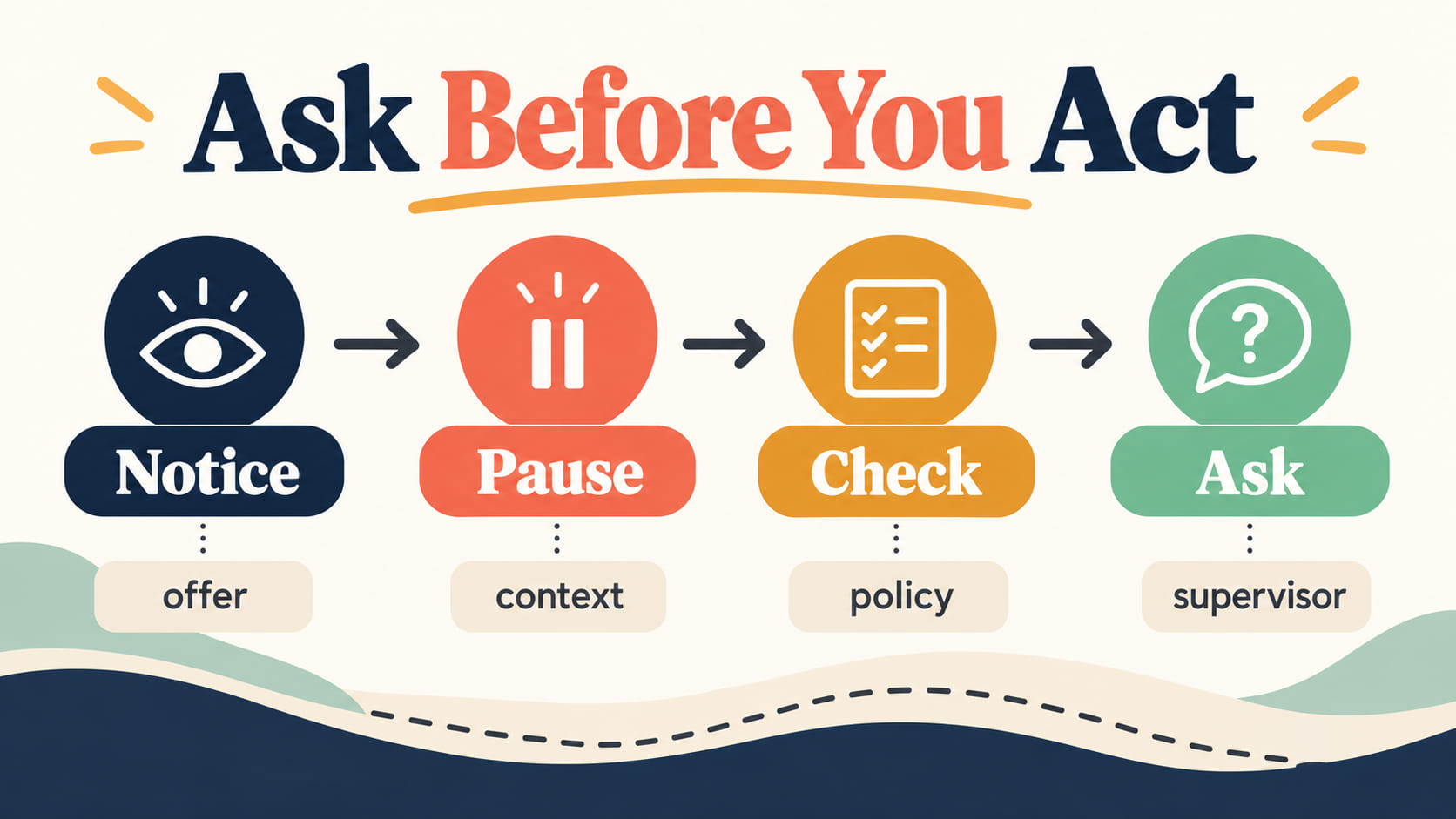
There is no reliable universal answer based only on price. Start with this sequence:
- Pause before committing. Do not say “yes,” promise to keep it, or suggest a private workaround.
- Describe the gift. Identify whether it is money, an item, food, a discount, a service, an invitation, or another benefit.
- Review the context. Consider who offered it, why, when, where, how often, and whether anything is expected in return.
- Check the governing sources. Read the current ethics guidance and the policy used by the employer or agency.
- Ask for direction. Bring the facts to the supervisor or designated workplace contact before accepting, giving, or arranging the benefit.
The goal is not to make families feel suspicious for expressing appreciation. The goal is to protect the client, the family, the RBT, and the service relationship from an avoidable conflict.
The principles behind a careful decision
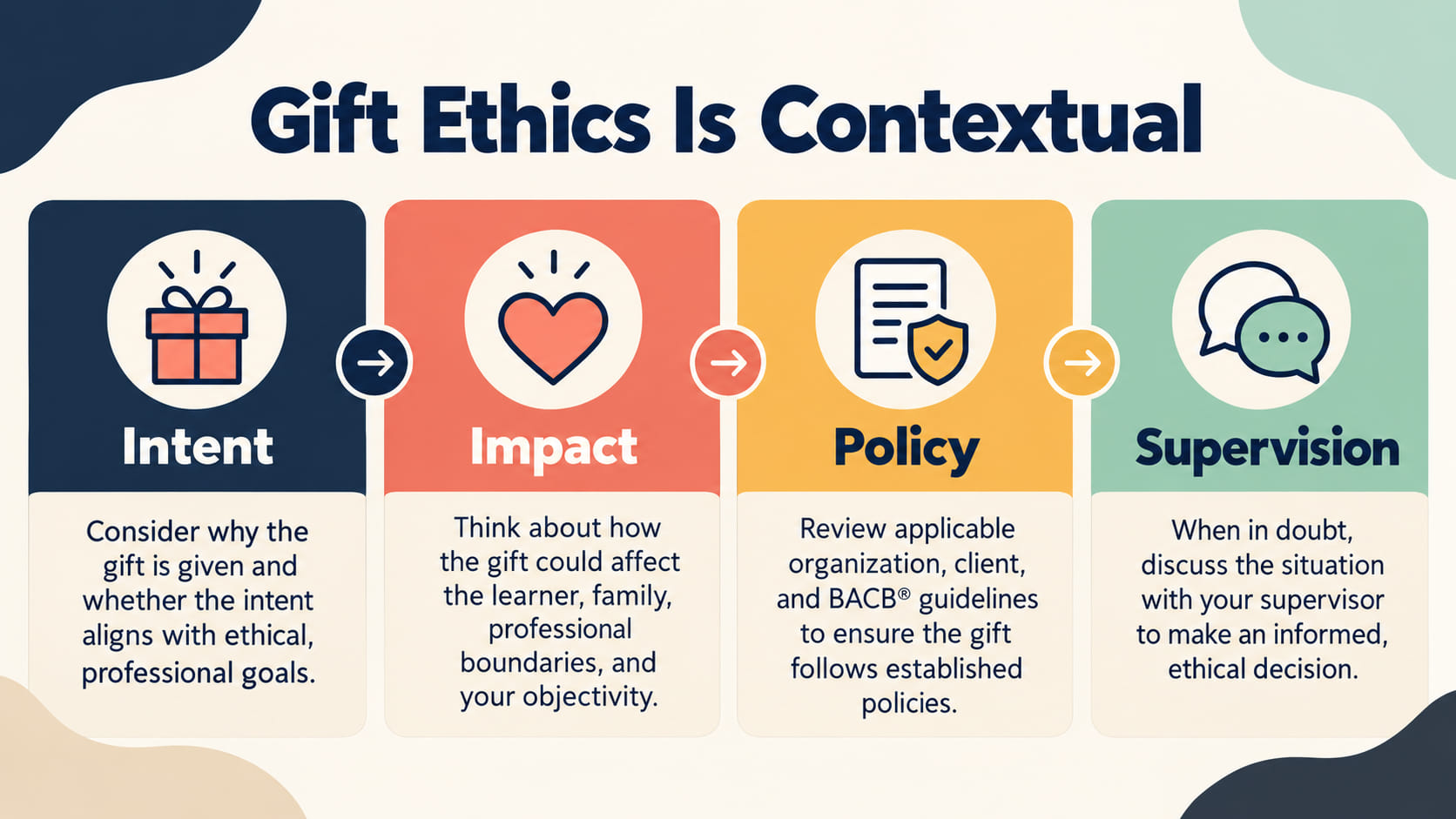
Client interests come first. The gift should not change what the client receives, how the RBT communicates, or how concerns are handled. If accepting an item could make it harder to give neutral feedback or follow an assigned plan, that is important information.
Professional boundaries need to stay visible. A gift that moves the relationship into private social contact, personal financial exchange, or special access deserves careful review. The fact that the RBT feels comfortable does not remove the power difference or the professional responsibility.
Consistency protects fairness. If one family receives a different response from another, the organization should be able to explain the difference through policy and context. A personal rule such as “I accept gifts from families I know well” is not a substitute for a workplace process.
Transparency is a useful test. Ask whether you would be comfortable describing the offer and your response to your supervisor. If the plan depends on secrecy, deletion, a second location, or “nobody needs to know,” pause and seek direction immediately.
Six context questions to ask
Use these questions to turn a vague concern into facts your supervisor can review:
- What is the relationship? Is the offer from a client, caregiver, sibling, coworker, supervisor, vendor, or another person connected to services?
- What is the purpose? Is it a general thank-you, a holiday gesture, a request for extra help, an apology, or an attempt to influence a decision?
- What is the setting? Was it offered during a session, in a public place, through a private message, or at a personal event?
- What is the pattern? Is it a one-time gesture, a repeated offer, a series of benefits, or part of an emerging personal relationship?
- What could be affected? Think about scheduling, access, data, treatment implementation, complaints, privacy, or the RBT’s judgment.
- What policy controls? Identify the current BACB guidance, employer rule, supervisor instruction, and any required approval or record.
These questions do not require the RBT to conduct a private investigation. They simply keep the request specific enough for a qualified person to provide useful direction.
Different gift categories need different review
Money and gift cards can create a direct financial relationship and may look like payment for access or special service. Ask before accepting or giving them. Never exchange money privately to avoid the normal billing or workplace process.
Food and homemade items may be offered as ordinary hospitality, but allergies, safety, repeated delivery, and the setting can matter. Do not decide that food is automatically harmless or automatically prohibited. Check the policy and supervisor direction.
Discounts, free services, and favors can create a benefit that continues beyond one interaction. A free repair, ride, lesson, or personal service may form a financial or social tie even if no cash changes hands.
Invitations and personal gifts can move contact outside the approved role. An RBT should not use a client’s private invitation, social account, or home event to create a separate relationship without clear organizational direction.
Items used during services are a separate question from a personal present. If an item is part of an assigned intervention or reinforcement plan, it should be handled according to the plan and supervision. The RBT should not turn a clinical procedure into a private gift exchange.
How supervision turns uncertainty into direction
Bring the relevant facts to supervision in a neutral way. For example: “The caregiver offered a gift card after today’s session. They said it was a thank-you and did not ask for a service change. What does our policy require, and what should I say?” That question is more useful than “Is this okay?” because it gives the supervisor enough context to explain the next step.
Follow the approved channel and ask how the decision should be communicated. The supervisor may direct the RBT to decline, return, share, redirect, or record the item. Do not widen a narrow instruction into permission for unrelated gifts. If the offer repeats or the circumstances change, ask again.
A respectful response can preserve rapport: “I appreciate the thought. I need to follow our professional policy, so I have to check before accepting anything.” If acceptance is not permitted, thank the person for the intention and explain that the boundary protects the service relationship.
What to document and what not to share
Use the organization’s approved record or supervision process. Document the facts that matter: what was offered or considered, when it happened, who was notified, what direction was given, and what action followed. Keep language neutral and avoid guessing at a family’s motives.
Do not copy a private message into an informal group chat, include unnecessary identifying information in a personal note, or post a gift online. Privacy still applies when the question feels ordinary. If you are unsure where the event belongs, ask the supervisor before creating a new record.
Mistakes that weaken the decision
- Using “small” as the entire analysis: price is only one part of context.
- Letting good intent end the review: kind intent does not remove power, impact, or policy questions.
- Making a one-person policy: an RBT should not create exceptions for familiar families, holidays, or private relationships.
- Delaying the question until after accepting: early guidance is easier than repairing a boundary later.
- Responding with shame: a professional decline can be firm and appreciative at the same time.
- Recording too much or too little: use the approved channel and capture the decision-relevant facts without unnecessary private detail.
Frequently asked questions
Does RBT ethics have one gift limit?
Do not rely on a universal dollar limit. Check the current BACB Ethics Code, employer or agency policy, and supervisor direction for the facts of the situation.
Is a gift ethical if the family expects nothing?
Expectation is important, but it is not the only factor. Consider the relationship, power, context, repeated pattern, impact, privacy, and applicable policy before deciding.
Can an RBT accept a gift in public but not at home?
Do not create that rule yourself. Setting can change the context, but the current policy and supervisor direction still control the response.
What if the supervisor is unavailable?
Use the organization’s escalation process. Until you receive direction, avoid accepting, giving, promising, or privately arranging the benefit, and communicate respectfully that you need to check policy.
Role reminder: This is educational information, not credentialing, employment, legal, tax, or clinical advice. Verify the current BACB Ethics Code and employer or agency policy, and ask a supervisor about a specific situation.
Official starting points: the BACB RBT Ethics Code, ethics codes page, RBT Handbook, and supervision and training resources.
Ready to practice the RBT concepts you just reviewed?
Try an independent, original RBT practice resource with exam-style questions, scoring, and answer explanations.
References
- Behavior Analyst Certification Board. RBT Test Content Outline, 3rd edition.
- Behavior Analyst Certification Board. RBT Handbook.
- Behavior Analyst Certification Board. RBT Ethics Code.