

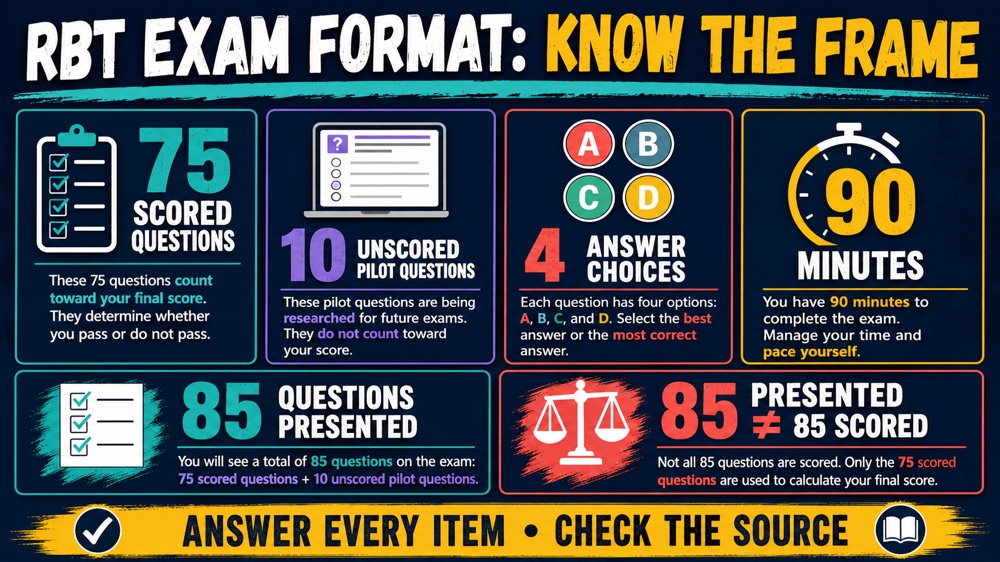
How many questions are on the RBT exam? The current BACB Handbook describes 75 scored questions and 10 unscored pilot questions, so a candidate sees 85 questions in the examination block. The 10 pilot questions are included for exam development and are not included in the scored result. You still answer every question because you cannot identify the pilot items during the exam.
Table of Contents
- How many questions are on the RBT exam: the official answer
- How many questions are on the RBT exam, and how should you study them?
- How many questions are on the RBT exam when you practice?
- What the 85-question block means for your preparation
- How the RBT question count fits the TCO
- How many questions are on the RBT exam: what practice questions can and cannot tell you
- Use the question count to plan your study
- Original RBT question decision examples
- Build a correction log for every practice set
- Avoid these RBT question-count mistakes
- Frequently Asked Questions
- References
This count is useful, but it is only the first part of preparation. You also need to know what the questions measure, how the current Test Content Outline is organized, and how to turn a missed practice item into a next study action. This page is independent RBT exam preparation. The current BACB Handbook and the RBT Test Content Outline, 3rd edition, control official credentialing and examination information.
RBT Training is not affiliated with, operated by, or endorsed by the Behavior Analyst Certification Board (BACB). The examples in this article are newly written for study. They are not official, recalled, leaked, or BACB-endorsed questions, and a practice score cannot guarantee a passing result or certification.
How many questions are on the RBT exam: the official answer
If you are asking how many questions are on the RBT exam, use this current format summary as your starting point:
| Exam-format item | Current description | Study implication |
|---|---|---|
| Scored questions | 75 | These questions contribute to the scored result. |
| Unscored pilot questions | 10 | These are included for exam development; you cannot identify them. |
| Total questions presented | 85 | Plan to work carefully through every item. |
| Answer choices | 4 per question | Read the stem and all choices before deciding. |
| Time limit | 90 minutes | Practice steady reading and decision-making, not rushing. |
The important distinction is 85 presented does not mean 85 scored. The official format also does not mean that you can skip a question that feels unusual. An item may be unfamiliar because the scenario is new, because the task is written in a different context, or because it is an unscored pilot item. Your safest response is to apply the observable facts, the written procedure, and the ethical boundary to every item.
Do not turn the count into a promise about a particular form. Secure examination content can change, and an independent practice resource cannot know which questions are scored or reproduce the current secure form.
How many questions are on the RBT exam, and how should you study them?
The answer is a useful planning frame, not a reason to chase a remembered question. Use the 85 presented items to rehearse pacing, then use the six-domain map and your correction log to decide which concept needs another application example.
How many questions are on the RBT exam when you practice?
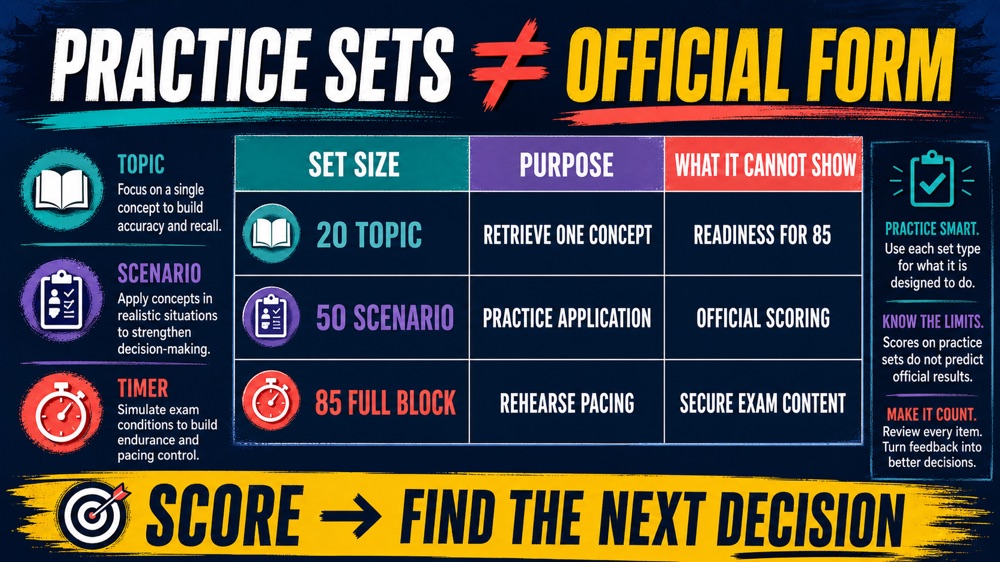
For practice, choose a set size that matches the skill you are building. A short set can sharpen retrieval, a mixed scenario set can test application, and an 85-question block can rehearse pacing. Label each set as independent practice rather than treating its count as an official exam form.
What the 85-question block means for your preparation
The count is a workload frame, not a shortcut to the answer. With 90 minutes for 85 presented questions, the simple average is a little over one minute per question. That average is not a rule for every item. A short definition may take less time than a measurement or documentation scenario. Use it as a pacing signal: read precisely, make the best plan-consistent choice, and mark a difficult item for later if the testing instructions allow it.
Because every question is presented for you to answer, practice sets should include both quick retrieval and applied reasoning. A useful set might ask you to identify a measurement system, follow a prompting sequence, record an objective note, or choose the correct supervision route. It should not train you to guess which items “look unscored.” There is no safe visual clue that identifies a pilot question.
For example, if a scenario contains a new safety event but the written plan does not address it, the practice target is not “remember a magic answer.” The target is to follow the existing safety direction, document what occurred objectively, and contact the responsible supervisor or qualified professional through the established route. That decision pattern is more durable than memorizing a number.
How the RBT question count fits the TCO
The current RBT Test Content Outline, 3rd edition, organizes 43 tasks across six domains. The domain percentages describe the blueprint emphasis; they are not a promise that you will receive a separate domain score. The current Handbook says the examination result is reported overall, so use the map to organize study rather than to predict a personal score by domain.
| Domain | Tasks / blueprint share | Question decisions to rehearse |
|---|---|---|
| A. Data Collection and Graphing | 13 / 17% | Define observable behavior, select a matching measurement, and read a graph. |
| B. Behavior Assessment | 8 / 11% | Follow an assigned assessment procedure and separate observation from interpretation. |
| C. Behavior Acquisition | 19 / 25% | Implement teaching, prompting, reinforcement, maintenance, and generalization steps. |
| D. Behavior Reduction | 14 / 19% | Follow the plan, protect safety, collect relevant data, and report changes. |
| E. Documentation and Reporting | 10 / 13% | Write objective notes, communicate through the correct route, and protect information. |
| F. Ethics | 11 / 15% | Work within competence, supervision, dignity, confidentiality, and professional boundaries. |
There are 43 tasks in the outline, not 43 questions. Several questions can reflect related skills, and the actual secure form is not a public task-by-task blueprint. Treat the six-domain table as a coverage checklist. A practice set that only tests vocabulary may have 85 items and still leave important decisions unexamined.
How many questions are on the RBT exam: what practice questions can and cannot tell you
Search results often mix full-length practice tests, short quizzes, flashcards, study guides, and community advice. Those formats can serve different purposes:
| Practice format | Useful purpose | What it cannot prove |
|---|---|---|
| 20-question topic set | Check one concept and its vocabulary. | Readiness for the full 85-question block. |
| 50-question scenario set | Rehearse application and distractor analysis. | Official scoring or the difficulty of a secure form. |
| 85-question practice block | Rehearse pacing, endurance, and correction routines. | That the questions match the examination or include pilot items. |
| Flashcards | Retrieve concise definitions and contrasts. | That you can apply the concept in a changed scenario. |
A strong explanation answers three questions: What fact in the stem is observable? Which written procedure or ethical rule controls? Why is the best choice safer or more accurate than the distractors? If a resource gives only a letter and no reasoning, add your own correction note or use another source.
Use the phrase “practice” honestly. Calling an independent item “real,” “official,” “recalled,” or “leaked” creates an academic and compliance problem. It also encourages the wrong study behavior: trying to recognize a remembered sentence rather than learning a transferable decision.
Use the question count to plan your study
Build a study cycle around the work required by the question, not around the number alone:
- Map: choose one TCO domain and identify the task or concept being practiced.
- Retrieve: close the guide and state the rule in plain language.
- Apply: solve a newly written scenario with one observable fact changed.
- Correct: explain why your choice fits and why the distractors fail.
- Transfer: solve a second scenario in a different setting or with a different response.
- Review: return to the current primary source or ask a supervisor about unresolved scope.
For a 90-minute practice block, decide your routine before starting. Put your phone away, use a quiet setting, record the time, and take a short note when you are unsure. Afterward, do not only calculate a percentage. Sort the misses and guesses by measurement, assessment, acquisition, reduction, documentation, or ethics. The category tells you what to practice next.
Use a short set on one day, a mixed set on another day, and a longer block only after you can explain your corrections. Longer is not automatically better. A 20-question set with careful feedback can teach more than an 85-question set that produces only a score.
Original RBT question decision examples
The following examples are written for this article. They are not official, recalled, leaked, or BACB-endorsed questions. Each one asks you to identify the safest next decision:
- Measurement: a learner begins a response after an instruction and stops when the response form ends. The question asks which measure captures how long it lasted. Identify the observable onset and offset before choosing duration.
- Assessment: a supervisor provides a preference-assessment sequence and a data sheet. One material is missing from the written steps. Follow the assigned procedure as written and ask the supervisor how to proceed; do not invent a replacement procedure.
- Acquisition: a teaching plan specifies a prompt hierarchy and a reinforcement condition. The learner responds independently. Record the response and follow the plan rather than adding an unnecessary prompt.
- Behavior reduction: the data show a change that may require clinical interpretation. Record the observable event and report it through the established supervision route instead of changing the intervention yourself.
- Documentation: a draft note says the learner was “defiant.” Replace the label with observable actions, the relevant context, the response, and the data required by the service plan.
- Ethics: a friend asks for a recognizable client story for a public social post. Protect confidentiality and use only an approved professional communication channel and de-identified material.
After each example, change one fact and solve it again. If the answer changes, write down why. That is the reasoning skill a question count cannot measure by itself.
Build a correction log for every practice set
Whether your practice set has 20, 50, or 85 questions, use a correction log. For every wrong, guessed, or low-confidence correct answer, record:
- Question type: measurement, assessment, acquisition, reduction, documentation, or ethics.
- Observable fact: what the stem directly states, shows, counts, or times.
- Selected action: what you chose and how confident you were.
- Decision rule: the plan, data rule, source, or ethical boundary that should control.
- Distractor error: an inference, scope change, unsupported assumption, or privacy problem.
- Transfer item: one new scenario to solve later.
Keep the examples fictional and free of identifying client information. A correction log is for learning; it is not a place to store service records. When you still cannot resolve a question, write a short supervision question and bring it to the qualified person responsible for the plan.
Avoid these RBT question-count mistakes
- Using an old count without checking the edition: compare the current Handbook and TCO before relying on a search snippet.
- Calling 85 questions all scored: keep 75 scored and 10 unscored pilot questions separate.
- Assuming pilot questions can be spotted: answer every item using the same careful process.
- Confusing 43 tasks with 43 questions: the TCO maps tasks; it does not announce a one-task/one-question exam.
- Predicting a domain score: use the domain percentages for study coverage, not a personal domain-result promise.
- Studying only by percentage: include all six domains and rehearse plan-consistent decisions.
- Treating a practice percentage as a guarantee: use the result to find the next correction, not to predict certification.
Bottom line: the current answer to “how many questions are on the RBT exam” is 85 questions presented: 75 scored and 10 unscored pilot questions, with four choices and a 90-minute limit. Use that frame to plan pacing, then study the six domains, practice original decisions, and correct your reasoning. The number tells you the size of the work; the correction process tells you what to do next.
Ready to practice the RBT concepts you just reviewed?
Try an independent, original RBT practice resource with exam-style questions, scoring, and answer explanations.
References
- Behavior Analyst Certification Board. RBT Test Content Outline, 3rd edition.
- Behavior Analyst Certification Board. RBT Handbook.
- Behavior Analyst Certification Board. RBT Ethics Code.