

Integrity RBT ethics is the daily practice of being truthful, accurate, accountable, and willing to correct problems while providing behavior-technician services under close supervision.
Table of Contents
- What integrity RBT ethics means
- Tell the truth about your work and qualifications
- Make records and data match what happened
- Correct errors without hiding the trail
- Communicate concerns through the right channel
- Follow through on commitments and limits
- Know when self-reporting may be required
- Everyday integrity scenarios
- Frequently asked questions
- Sources and scope note
RBT ETHICS GUIDE · HONESTY, ACCURACY, AND ACCOUNTABILITY
Integrity RBT Ethics: Be Accurate, Honest, and Accountable
A practical guide to truthful communication, accurate records, prompt corrections, and responsible follow-through in RBT work.
Integrity RBT ethics is the daily practice of being truthful, accurate, accountable, and willing to correct problems while providing behavior-technician services under close supervision. The RBT Ethics Code (2.0) names behaving with integrity as one of the principles that guides RBT conduct.
Integrity is more than having good intentions. It shows up in a session note, a data sheet, a billing record, a credential description, a message to a supervisor, and the way an RBT responds after discovering an error. This article is educational. It is not a legal opinion, an ethics ruling, or individualized direction about a specific event.
What integrity RBT ethics means
The word integrity can sound abstract, but the RBT Ethics Code turns it into observable responsibilities. An RBT is expected to be honest, professional, accountable for their actions, and committed to following through. When a commitment cannot be met, the RBT works with the supervisor to address the situation in the best interest of the client.
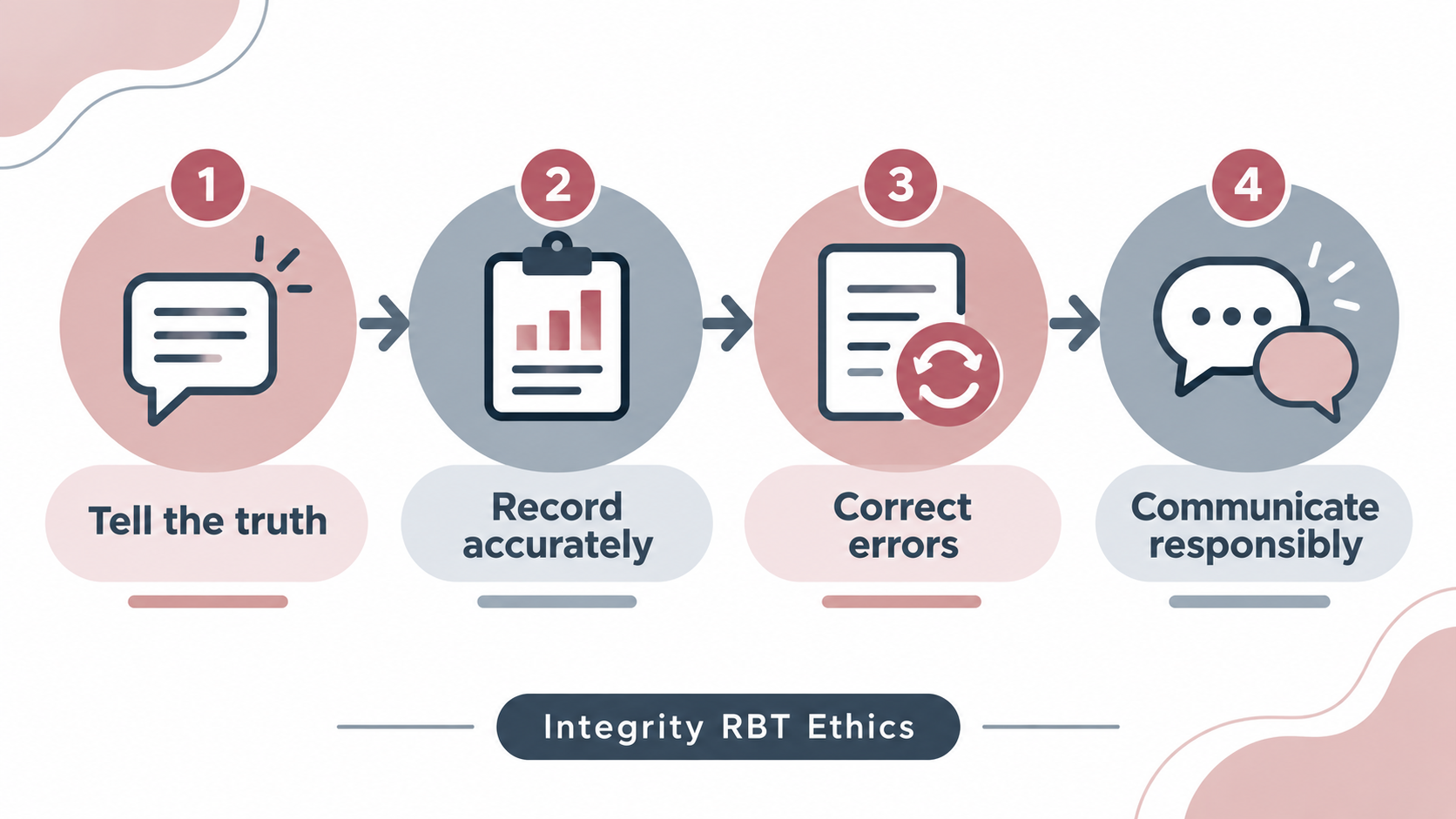
A useful integrity check has four questions:
- Truth: Does my statement accurately represent what I know, what I observed, and what I did?
- Record: Does the documentation match the assigned definitions, measurements, time, and service actually delivered?
- Route: Am I telling the person or organization that is authorized to respond?
- Follow-through: Have I corrected, documented, and revisited the issue instead of assuming it disappeared?
Integrity does not require an RBT to know every answer instantly. It requires the RBT to be honest about uncertainty and ask for direction before guessing, improvising, or presenting an unverified conclusion as fact.
Tell the truth about your work and qualifications
RBTs should describe their training, certification status, role, and experience accurately. The code prohibits knowingly making false, misleading, or exaggerated statements about qualifications or behavior-technician services. That applies to a résumé, an online profile, a staff introduction, a conversation with a caregiver, and a public post.
Do not imply that an RBT is a BCBA, a teacher, a licensed clinician, or an independent treatment designer when that is not the person’s role. Do not describe a trainee activity as a completed credential. If a certification is inactive, expired, suspended, or otherwise changed, follow the applicable reporting and practice requirements before using the title or providing services.
Truthful communication also means separating observation from interpretation. “The learner completed four of five opportunities” is different from “the learner understood the skill.” The second statement may require additional evidence and supervisor interpretation. Clear wording protects the client, the team, and the credibility of the record.
Make records and data match what happened
Integrity is visible in required documentation, including client data and billing records. Record the service that actually occurred, using the assigned measurement system and approved form. Do not invent a value because a field is blank, copy yesterday’s number forward without checking, or document a procedure that was not implemented.
When a session changes, capture the relevant variable without turning it into a dramatic story. A schedule change, illness report, unusual noise, staffing change, technology problem, or missed opportunity may matter to interpretation. The goal is not to fill a note with speculation; it is to give the authorized team an accurate account of what happened and what may affect decision-making.
Billing integrity is part of the same principle. Follow the employer, payer, and service agreement rules for time, attendance, cancellations, and corrections. An RBT should not decide that a service is billable simply because time was reserved. If a billing question appears, preserve the facts and ask the appropriate supervisor, employer, or billing contact.
Correct errors without hiding the trail
Finding an error is not the same as being dishonest. The integrity problem begins when someone knowingly hides, backdates, deletes, or misrepresents information instead of using the approved correction process. When you notice an inaccurate entry, pause and identify what is wrong, what source can verify it, and which person owns the correction.
Correction procedures vary. Some systems use an amendment, an addendum, a locked audit trail, a supervisor review, or a formal incident process. Follow the system in use; do not overwrite a record in a way that removes the history. If you are unsure, ask before editing. Keep the original information available when policy requires it and document the correction factually.
The RBT Ethics Code also addresses inaccurate or false information submitted to the BACB, supervisor, or employer. The required response depends on where the information went and what happened, but the central integrity habit is prompt contact to correct the issue and determine the appropriate next step. Do not wait because you hope the error will not be noticed.
Communicate concerns through the right channel
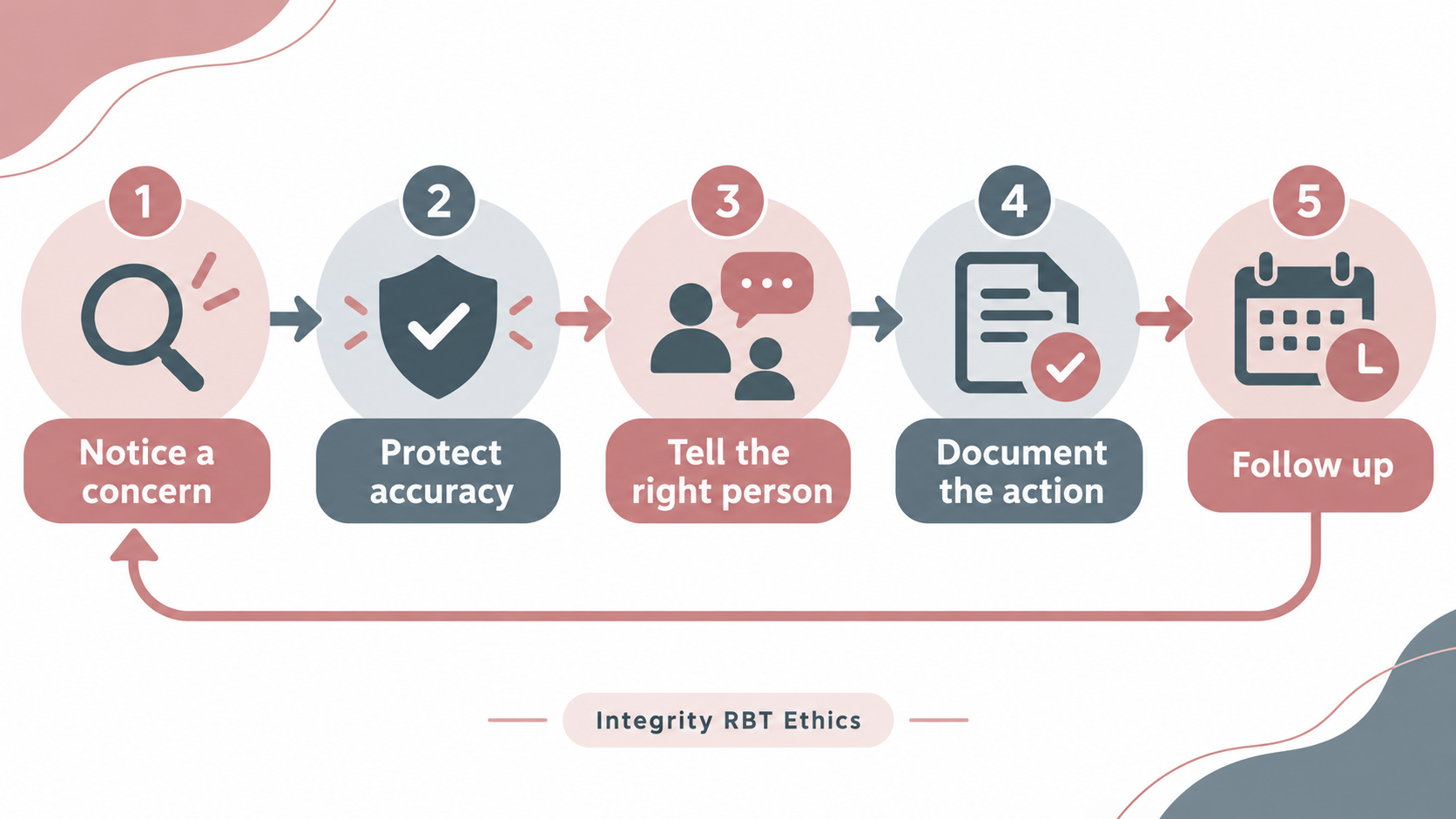
Integrity does not mean broadcasting a concern to everyone. It means giving accurate information to the person or entity that can respond, while protecting confidentiality. Start with the supervisor or the workplace route when that is appropriate. If the concern involves the supervisor, use the supervisor’s manager, requirements coordinator, human resources, compliance route, or another designated authority according to the situation.
Keep the message concrete: what happened, when it happened, what you directly observed, what action you took, and what question remains. Avoid exaggeration, insults, diagnostic labels, or conclusions you cannot support. Save relevant documentation through the approved system. If there is immediate risk of harm, follow emergency and organizational safety procedures first.
The RBT Ethics Code describes routes for unresolved ethics concerns and may require reporting to an appropriate authority. An RBT should not use a public social post as an investigation, and should not promise a coworker that a concern will remain secret when reporting duties may apply.
Follow through on commitments and limits
Accountability includes attendance, preparation, assigned documentation, supervision participation, and completing agreed tasks. If you cannot meet a commitment, communicate early. Give the supervisor enough information to protect continuity of care: what is incomplete, what has already been done, what deadline is affected, and what support or reassignment may be needed.
Integrity also requires honesty about competence. If you are asked to use an unfamiliar intervention, serve an unfamiliar client population, or perform a task outside your demonstrated competence, say so and ask for training or direction. Quietly accepting an assignment and hoping to figure it out during service can create risk. The RBT can remain helpful while still stating a real limit.
Know when self-reporting may be required
The BACB Ethics Code includes specific self-reporting responsibilities. It lists events such as legal charges and related actions, investigations naming the RBT, certain disciplinary actions, and physical or mental conditions or substance use that may impair safe service. The code states that covered events are reported to the BACB within 30 days of the event or within 30 days of becoming aware of it.
That deadline does not replace other duties. An employer, licensing board, payer, school, court, or law may have a different notice requirement. An RBT should read the current BACB requirements, contact the appropriate organization, and ask the supervisor or qualified professional for help interpreting a situation. This article cannot decide whether a particular event is reportable.
Self-reporting is not a declaration that every allegation is true. It is a structured way to disclose a covered event and let the appropriate authority evaluate it. Keep copies of submissions and related correspondence through secure, approved channels.
Everyday integrity scenarios
You forgot to collect one measure. Do not estimate it. Mark the gap according to workplace procedure, describe the limitation, and tell the supervisor if the missing value affects interpretation.
A caregiver asks you to say a service happened when it did not. Do not create a false record. Preserve the facts, respond professionally, and use the supervisor or employer route for the billing or attendance question.
You realize that a message to the supervisor contained the wrong date. Send a prompt correction that identifies the inaccurate detail. Do not rely on a vague follow-up that leaves two conflicting versions in circulation.
A coworker asks you to sign for a task you did not observe. Decline clearly and explain that your signature must represent your own work. Bring the request to the appropriate supervisor if needed.
You are unsure whether a personal event affects safe service. Do not conceal a possible impairment or make a public announcement. Contact the supervisor or appropriate professional route, follow applicable requirements, and document the action as directed.
Frequently asked questions
Is integrity RBT ethics only about avoiding lies?
No. It includes accurate records, honest credential descriptions, responsible communication, following through on commitments, recognizing limits, correcting errors, and using the correct reporting route.
Can I fix a documentation mistake by deleting the original entry?
Do not assume so. Use the approved correction or amendment process, preserve the audit trail when required, and ask the supervisor or records owner if the procedure is unclear.
What should an RBT do after discovering inaccurate information was submitted?
Act promptly: identify the affected submission, contact the relevant BACB, supervisor, or employer route, correct the information using the required process, and keep documentation of the action. The exact response depends on the destination and the facts.
Does reporting a concern mean I am accusing someone?
No. A factual report communicates an observation or concern so the authorized person can evaluate it. Use neutral language, protect confidentiality, and avoid public accusations or unsupported conclusions.
Sources and scope note
This guide is based on the BACB RBT Ethics Code (2.0), the BACB Registered Behavior Technician Handbook, and BACB ethics information. Requirements can change, and employer, payer, state, school, and legal rules may add obligations. Check the current source and ask the appropriate supervisor or authority about your situation.
Ready to practice the RBT concepts you just reviewed?
Try an independent, original RBT practice resource with exam-style questions, scoring, and answer explanations.
References
- Behavior Analyst Certification Board. RBT Test Content Outline, 3rd edition.
- Behavior Analyst Certification Board. RBT Handbook.
- Behavior Analyst Certification Board. RBT Ethics Code.