An RBT 3rd edition practice test should do more than put “3rd edition” in a title. It should show how its topics, scenarios, and explanations connect to the current RBT Test Content Outline. It should also be honest about what is independent study content and what belongs only to the official examination.
Table of Contents
- What an RBT 3rd edition practice test should prove
- Check an RBT 3rd edition practice test against the current TCO
- Read the RBT 3rd edition practice test question count correctly
- Use an RBT 3rd edition practice test by domain
- Review an RBT 3rd edition practice test answer
- Avoid RBT 3rd edition practice test version traps
- Build an RBT 3rd edition practice test retest loop
- Frequently Asked Questions
- References
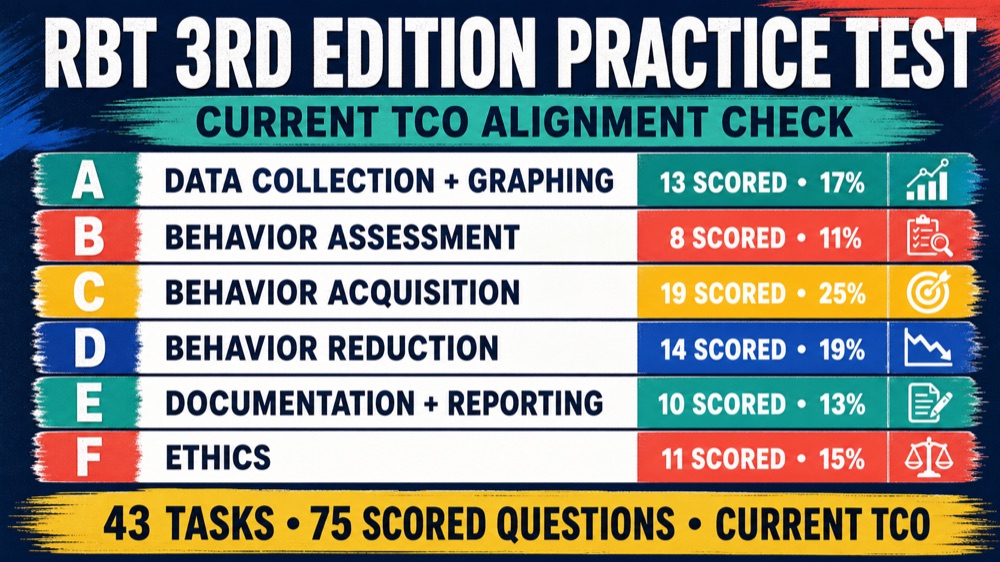
The current TCO, 3rd edition, lists 43 tasks across six domains. It describes 75 scored questions and 10 unscored pilot questions for the examination. An independent practice resource may use 10, 20, 75, or 85 items, a different timer, and a different score scale. That format choice does not change the TCO. These are not official, recalled, leaked, or BACB-endorsed questions, and a practice result cannot guarantee a passing result.
This guide helps you check edition alignment, use the six-domain map, separate the question-count language, and review an independent set by decision rule.
What an RBT 3rd edition practice test should prove
The edition label matters because a practice set can be polished and still organize its content around an outdated map. A useful 3rd-edition resource should make four things visible.
- Scope: it identifies the current TCO and shows all six domains rather than relying on a vague “task list” label.
- Application: its items require a decision about measurement, a written procedure, teaching, behavior reduction, documentation, or ethics.
- Explanation: it explains the decisive clue and why the strongest distractor fails.
- Boundary: it labels its questions as independent and does not claim access to official, recalled, leaked, or BACB-endorsed items.
When a page promises a large number of questions, ask how many are new scenarios, how many are repeated in a different order, and whether explanations use current domain language. Quantity can support practice, but it does not by itself prove version alignment.
Check an RBT 3rd edition practice test against the current TCO
Use the official TCO as your comparison sheet. An independent resource does not need to copy the document’s wording, but its coverage should make sense against this map.
| Domain | Scored share | What to verify in an independent set |
|---|---|---|
| A. Data Collection and Graphing | 13 / 17% | Observable descriptions, measurement systems, calculations, data recording, graphing, and trend interpretation. |
| B. Behavior Assessment | 8 / 11% | Preference or skill assessment participation, functional-assessment components, and following the assigned procedure. |
| C. Behavior Acquisition | 19 / 25% | Reinforcement, teaching steps, prompting and fading, shaping, chaining, discrimination, maintenance, and generalization. |
| D. Behavior Reduction | 14 / 19% | Function-informed plans, antecedent strategies, differential reinforcement, extinction, punishment, crisis procedures, and safety. |
| E. Documentation and Reporting | 10 / 13% | Objective notes, timely reporting, irregularities, confidentiality, and communication with the supervisor. |
| F. Ethics | 11 / 15% | Competence, supervision, boundaries, public statements, gifts, cultural humility, and client information. |
The TCO contains 43 tasks across these six domains. The percentages above describe the 75 scored questions, not a guarantee that a commercial or free set will reproduce the exact distribution. Use them to identify coverage gaps, not to reverse-engineer an official answer key.
Read the RBT 3rd edition practice test question count correctly
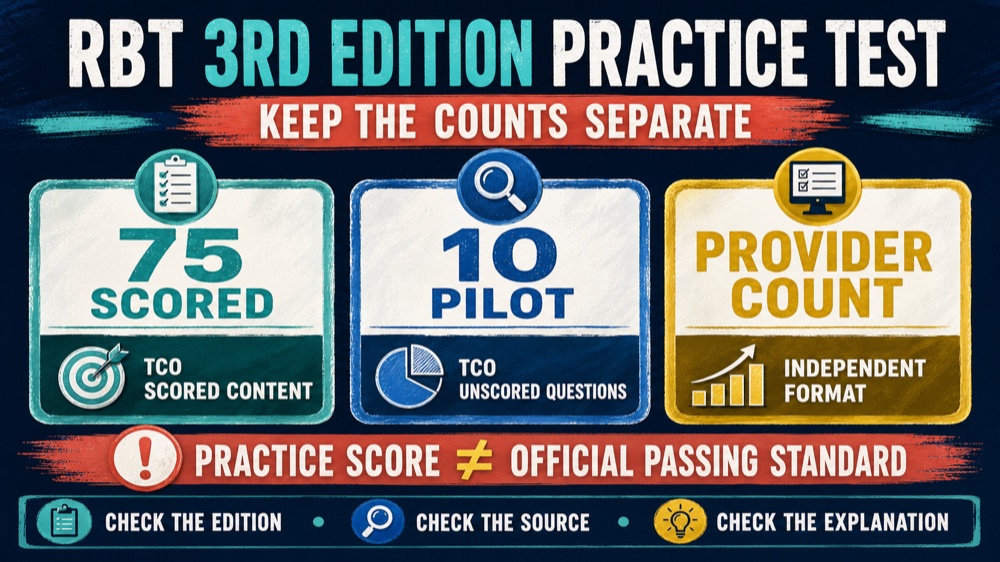
Question-count language is one of the easiest places for practice pages to become confusing. Keep three statements separate:
- Official TCO structure: 75 scored questions plus 10 unscored pilot questions are described for the examination.
- Independent practice format: a provider may offer 15, 20, 75, or 85 questions, with its own score rules.
- Study interpretation: a practice percentage shows performance on that provider’s set; it is not an official passing standard.
If a resource calls an 85-item set a “full exam,” read whether it is describing the number presented to a learner or the TCO’s scored-question distribution. If a resource offers 75 items, do not assume it has reproduced the official examination. The honest label is an independent 75-question practice set aligned to the TCO, if that alignment is actually shown.
Also check whether the page uses “3rd edition” to describe the task list, the question bank, or merely the date of an update. Those are not identical claims. A transparent page states what was updated and what its explanations are based on.
Use an RBT 3rd edition practice test by domain
Before you start, record the provider, access date, number of questions, timer, and whether the set is mixed or domain-specific. Then mark confidence for each response. A correct guess is not the same as a secure rule.
After scoring, sort misses and low-confidence answers into the six domains. For each cluster, write one decisive distinction. Examples include count versus rate, preference assessment versus skill assessment, acquisition versus maintenance, extinction versus punishment, objective documentation versus interpretation, and competence versus improvisation.
Use the TCO distribution as a broad priority guide, but do not ignore a smaller cluster because its percentage is lower. A question about confidentiality, safety, or supervisor direction can still reveal an important role boundary.
Review an RBT 3rd edition practice test answer
For each wrong or low-confidence item, review it in four passes.
Find the observable clue
Underline what was seen, heard, counted, timed, or recorded. Keep a hypothesis about function separate from the observable description. The distinction protects both measurement and documentation.
Locate the written procedure
Identify whether the stem names a teaching program, prompt sequence, reinforcement arrangement, behavior-reduction plan, assessment procedure, or crisis protocol. Select the option that follows the assigned plan. If the plan is unclear, the next step may be documentation and supervisor direction rather than a new intervention.
Name the TCO decision
Write the domain and the specific rule that controlled the answer. This keeps “I got it wrong” from becoming an unhelpful study note.
Reject the strongest distractor
Explain the mismatch in one sentence. A distractor may use the wrong unit, change the plan without authorization, hide an irregularity, disclose private information, or confuse a behavior principle with a different procedure.
Avoid RBT 3rd edition practice test version traps
- Trusting the badge instead of the map. “Updated” or “3rd edition” should be supported by visible domain and task coverage.
- Using legacy labels without checking context. If a resource groups topics differently, compare its claims with the current TCO before treating the categories as equivalent.
- Confusing 75 scored with 85 presented. Keep the official structure and provider format in separate notes.
- Calling independent items official. A BCBA-reviewed or professionally designed page is still not the BACB examination.
- Studying only by answer key. Record the observable clue, written procedure, and distractor mismatch.
- Assuming an update fixes every weakness. Recheck explanations, ethics, documentation, and role boundaries—not only question count.
Build an RBT 3rd edition practice test retest loop
Use a two-pass loop. In Pass One, take the independent set under the conditions you recorded and sort errors by domain and decision rule. In Pass Two, complete new scenarios with changed names, numbers, settings, or distractors. A retest is useful when it checks transfer, not when it repeats the same wording until the answer feels familiar.
For additional practice, compare the site’s RBT exam-prep materials, use section practice for a targeted domain, and return to the free RBT mock exam for mixed rehearsal. Use the official RBT Test Content Outline, the RBT Handbook, and the RBT Ethics Code as the source boundary. These links do not turn independent practice content into official BACB questions.
Bottom line: an RBT 3rd edition practice test is valuable when the edition claim is traceable, the six-domain coverage is visible, and every miss produces a clearer decision rule.
Ready to practice the RBT concepts you just reviewed?
Try an independent, original RBT practice resource with exam-style questions, scoring, and answer explanations.
References
- Behavior Analyst Certification Board. RBT Test Content Outline, 3rd edition.
- Behavior Analyst Certification Board. RBT Handbook.
- Behavior Analyst Certification Board. RBT Ethics Code.