
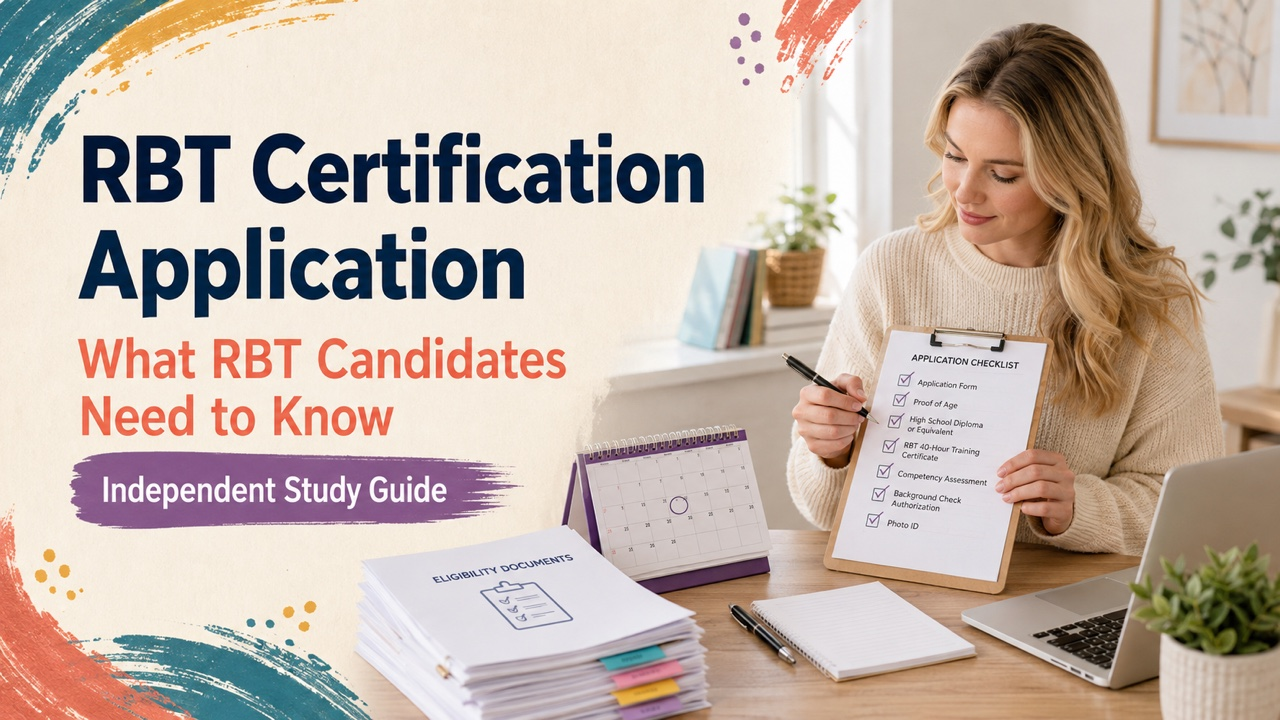
RBT certification application describes the formal request a candidate submits in the BACB pathway after preparing the required eligibility evidence. It is broader than an exam-registration form: the record connects training, competency assessment, background and education evidence, application review, examination authorization, and later maintenance. Because rules and transition instructions can change, candidates should verify every current detail in the BACB Handbook and portal.
Table of Contents
- Certification application versus examination registration
- Build an evidence packet before applying
- How to submit an RBT certification application
- Application review and correction requests
- A certification-application scenario
- After approval: examination and maintenance
- Privacy and professional records
- Common RBT certification application mistakes
- Study the pathway with decision questions
- RBT certification application checklist
- Frequently Asked Questions
- References
Quick answer: Treat rbt certification application as a current-source study topic. Define the term, follow the written procedure, practice an original scenario, and keep the RBT’s supervision boundary visible.
Study boundary: This independent guide is educational content. It is not a BACB policy, certification decision, legal opinion, answer key, or guarantee of examination success. Examples are original and are not official, recalled, leaked, or BACB-endorsed questions.
Current exam context: The current BACB RBT Test Content Outline describes 43 tasks across six domains; the examination includes 75 scored questions and 10 unscored pilot questions in a 90-minute testing period. Verify the current handbook and outline before relying on a time-sensitive detail.
Certification application versus examination registration
A certification application asks the certification board to evaluate an applicant’s eligibility for the RBT pathway. Examination registration is a later step that follows the applicable approval or authorization. Treating the two as one action can lead to premature scheduling, missing documents, or false confidence about status.
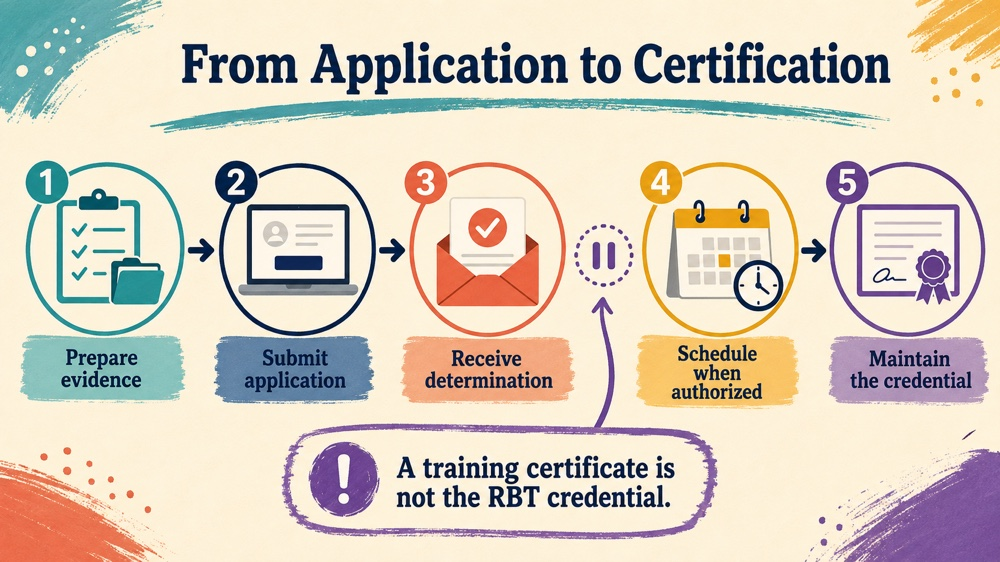
A useful timeline has five milestones: evidence completed, application submitted, determination received, examination scheduled, and certification maintained. Put the date and source beside each milestone. If a question asks what happens next, identify the last confirmed milestone rather than the outcome the candidate hopes to receive.
Build an evidence packet before applying
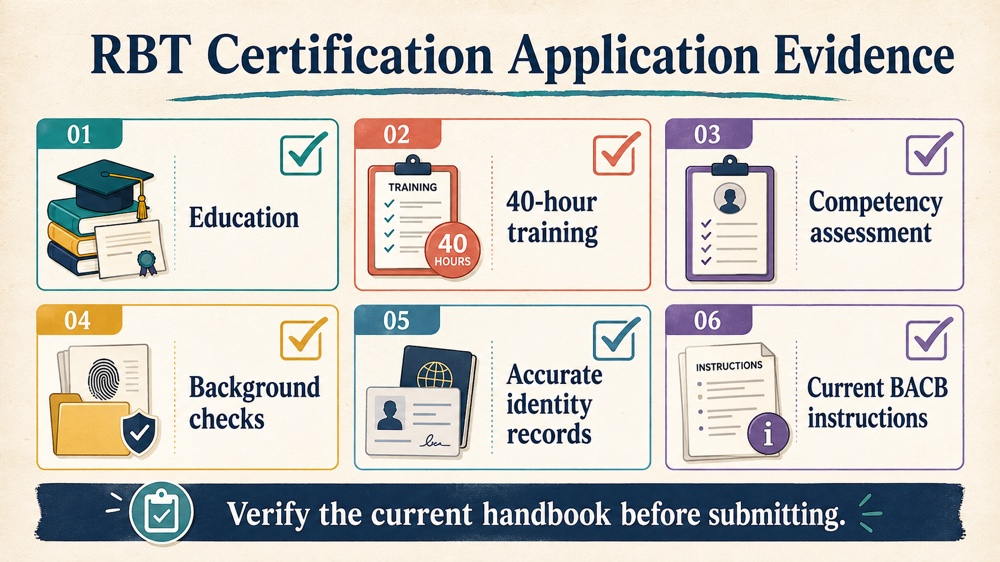
Before opening the application, gather the records that demonstrate the current eligibility requirements. Depending on the applicable pathway, this may include age and education evidence, background and abuse-registry checks, a qualifying 40-hour training certificate, an initial competency assessment, an attestation, and other information requested by the portal. The current handbook controls the exact list and timing.
- Read the current handbook and note the version date.
- Make a checklist of each document, issuer, completion date, and validity window.
- Confirm who is eligible to attest, assess, or provide the required documentation.
- Scan or save records in a secure folder using clear filenames.
- Compare names and dates before submitting, not after a correction request.
How to submit an RBT certification application
Complete the application in the BACB portal with information that matches the supporting records. Use the legal name and contact details required by the current instructions. Review each upload for readability, signatures, page completeness, and the correct document type. Submit only after the record tells a consistent story about who completed which requirement and when.
After payment or submission, save the confirmation without sharing private account details. A confirmation is evidence of receipt, not proof that every requirement has been accepted. Continue monitoring for action items. If the portal asks for a replacement file, answer the specific request and keep a dated record of the response.
Application review and correction requests
Review is easier when the candidate treats a correction request as a question about evidence. Identify the requested item, compare it with the handbook, ask the issuing organization for a corrected record when appropriate, and respond through the authorized portal channel. Do not backdate, rewrite, or crop away information that makes a record look inconsistent.
If a candidate is unsure whether a course, assessment, or background check qualifies, the responsible source should decide. A training provider can explain its certificate; an assessor can explain an assessment record; the BACB can explain certification requirements. An employer cannot replace the board’s decision with a letter of confidence.
A certification-application scenario
A candidate has completed training and believes the application is complete, but the portal shows an unresolved action item for an assessment document. The candidate should not schedule the exam or mark the requirement as complete based on memory. The candidate should read the item, verify the current rule, contact the appropriate assessor or board channel, and submit the accurate response requested.
In a second scenario, a candidate receives approval but has changed their legal name before testing. The candidate should follow the current identity-update instructions and confirm what identification will be accepted. The principle is simple: a favorable status does not remove the duty to keep the record and testing identity accurate.
After approval: examination and maintenance
Approval moves the candidate to the examination stage; it does not end the professional pathway. Follow the scheduling instructions, review identification and testing rules, and prepare with the current RBT Test Content Outline, training materials, competency-assessment materials, and original practice. After certification, maintain supervision, ethical conduct, documentation, and other requirements that apply to the certification cycle.
Keep an account-maintenance reminder for official notices and deadlines. Never assume that a prior application, a colleague’s experience, or an old handbook answers a current question. The correct habit is to check the current source and document the decision path. That habit is as valuable on the exam as it is in the workplace.
Privacy and professional records
An application contains personal information. Store it securely, use only the necessary recipients, and do not post screenshots that expose names, account numbers, addresses, or document images. The same privacy discipline applies to client information once an RBT begins service. A candidate’s desire to get quick advice does not justify disclosing someone else’s private record in a public group.
If a record is sent to the wrong place or a portal account appears compromised, follow the applicable reporting and security instructions promptly. Do not create an informal workaround that leaves the original record inaccurate. Ethical practice includes correcting errors, preserving an honest audit trail, and asking for direction when a situation affects certification or client safety.
Common RBT certification application mistakes
- Confusing the training certificate with the RBT credential.
- Using a checklist that predates the current handbook or transition rules.
- Uploading the wrong document type or an incomplete, unsigned, or unreadable file.
- Assuming that application submission means approval or examination authorization.
- Ignoring a correction request or submitting duplicate conflicting records.
- Changing a document rather than asking the issuer or BACB what is required.
- Sharing private application screenshots while asking for help online.
Study the pathway with decision questions
For each step, ask four questions: What has to be true? What evidence shows it? Who decides? What should the candidate do if it is unclear? Practice with scenarios about document timing, identity mismatches, portal statuses, corrections, and scheduling. Then explain why a tempting answer exceeds the candidate’s authority or uses an outdated source.
This method produces durable study notes. A definition of certification is useful, but a decision map shows how to act when facts are incomplete. Put the current source link beside every time-sensitive note and write the date you checked it. When the source changes, update the note instead of adding another unverified shortcut.
RBT certification application checklist
- Can I separate eligibility evidence, application submission, approval, examination, and maintenance?
- Can I identify the current handbook and portal as the controlling sources?
- Are my records complete, readable, accurate, and consistent with my testing identification?
- Can I respond to a correction request without altering an official record improperly?
- Do I know who can answer questions about training, assessment, certification, and supervision?
- Can I protect application and client information?
- Can I explain what I may do as an RBT and what requires supervision?
Keep the final checklist beside the source version date. That small habit prevents a polished but outdated application plan from becoming a costly mistake. This educational guide does not make a certification decision, and the BACB’s current instructions control.
Practice the concept
Review rbt certification application with original RBT scenarios, current-source reminders, and clear role boundaries.
Review the RBT study resource →
Frequently Asked Questions
What is an RBT certification application?
It is the formal application in the BACB pathway used to review eligibility evidence before examination authorization and certification.
Is a 40-hour course enough to become certified?
No. Training is one requirement in the pathway. Candidates must complete all applicable requirements, submit the application, receive authorization, and pass the examination.
What if the portal asks for a correction?
Read the request carefully, compare it with the current handbook, obtain accurate documentation or direction, and respond through the authorized channel.
Is RBT Training a BACB certification provider?
No. RBT Training offers independent study content and is not affiliated with or endorsed by BACB.
References
- Behavior Analyst Certification Board: Registered Behavior Technician Handbook, updated June 2026.
- Behavior Analyst Certification Board: RBT Test Content Outline (3rd ed.).
- Behavior Analyst Certification Board: RBT resources.
- Behavior Analyst Certification Board: ethics resources.
- Behavior Analyst Certification Board: RBT Ethics Code (2.0).