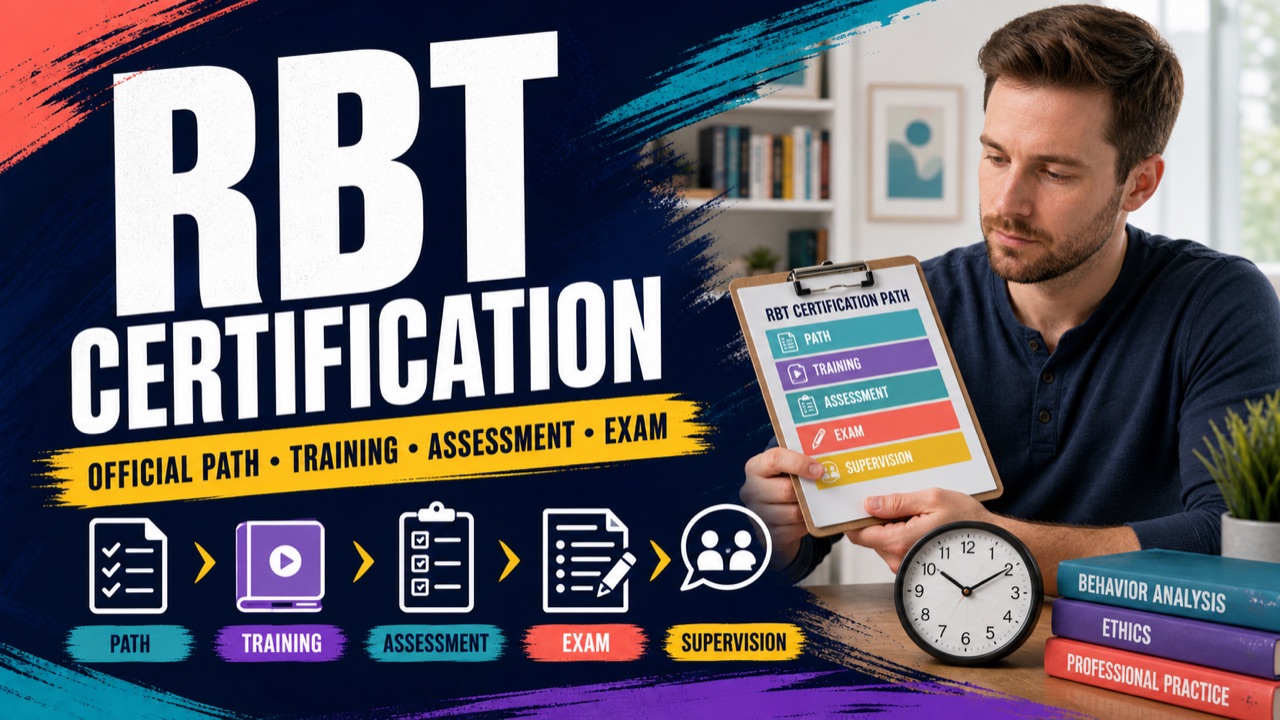
RBT certification is a BACB credentialing process with several separate steps. Candidates generally need the required education, background checks, 40-hour training, initial competency assessment, application, and examination steps described in the current BACB materials. A study page can help you organize preparation, but it cannot issue the credential, perform an assessment, approve an application, or guarantee an examination result.
Table of Contents
- What RBT certification means
- RBT certification pathway at a glance
- Check eligibility before you train
- Understand the 40-hour training step
- Separate training from the competency assessment
- Prepare for the RBT examination
- Use independent study materials honestly
- Build an application document checklist
- Maintain the credential after certification
- Common RBT certification mistakes
- Frequently Asked Questions
- References
This distinction matters because “training,” “competency assessment,” “exam,” and “certification” are often used as if they were interchangeable. They are not. The current BACB Handbook and RBT pages are the authority for requirements that can change. This article is an independent orientation guide, not a BACB page, not a certification program, and not a substitute for the current official documents.
RBT Training is not affiliated with, operated by, or endorsed by the Behavior Analyst Certification Board (BACB). The examples and checklists here are for independent study and planning. They are not official, recalled, leaked, or BACB-endorsed exam questions, and no preparation resource can guarantee certification or a passing result.
What RBT certification means
RBT certification is the BACB credential for a Registered Behavior Technician. An RBT works under ongoing supervision and implements behavior-analytic services as assigned within the role. The credential does not mean that an RBT independently designs treatment, changes a behavior plan, diagnoses a client, or replaces a supervisor’s clinical direction.
The credential also does not make every training course or quiz an official BACB product. A provider may offer a 40-hour course, an exam-prep resource, or a practice test, while the BACB controls its own application, assessment, examination, and certification requirements. Always ask which organization controls the step you are trying to complete.
For example: completing an independent mock exam may show that you need more practice with measurement or documentation. It does not prove that you completed the official initial competency assessment, and it does not authorize you to apply or use the RBT designation.
RBT certification pathway at a glance
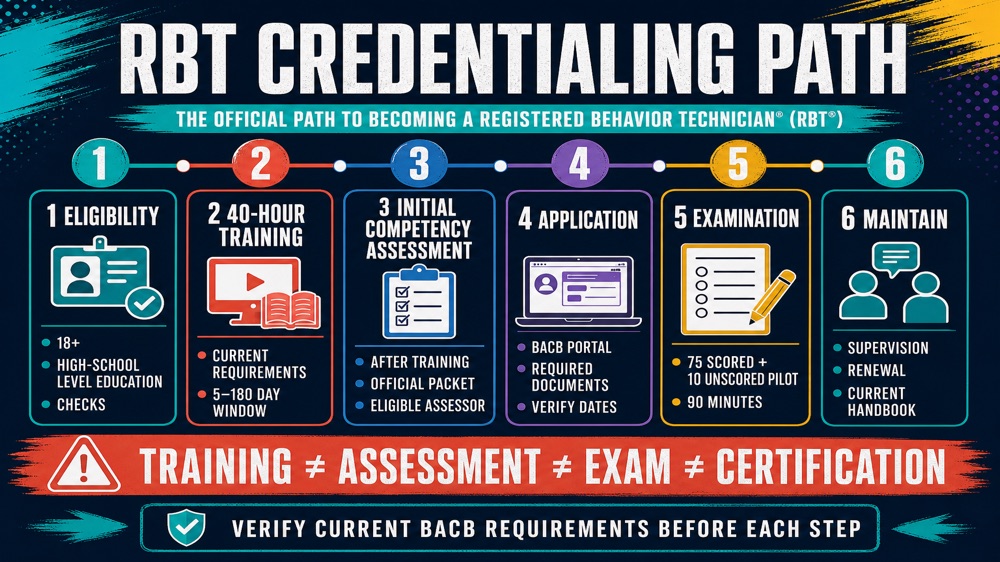
Use this sequence as a planning map, then verify every timing rule in the current BACB Handbook before you act:
- Confirm the current requirements: start with the BACB RBT page and Handbook, not a dated social post.
- Check basic eligibility: review age, education, background-check, and registry-check requirements.
- Complete the required training: use a current 40-hour training that meets the stated delivery and timing rules.
- Complete the initial competency assessment: use the current official packet and an eligible assessor within the applicable window.
- Prepare and submit the application: use your own BACB account and the required attestations and documents.
- Schedule and take the examination if approved: follow the current approval, scheduling, and identification instructions.
- Maintain the credential: follow the current supervision, renewal, ethics, and continuing requirements.
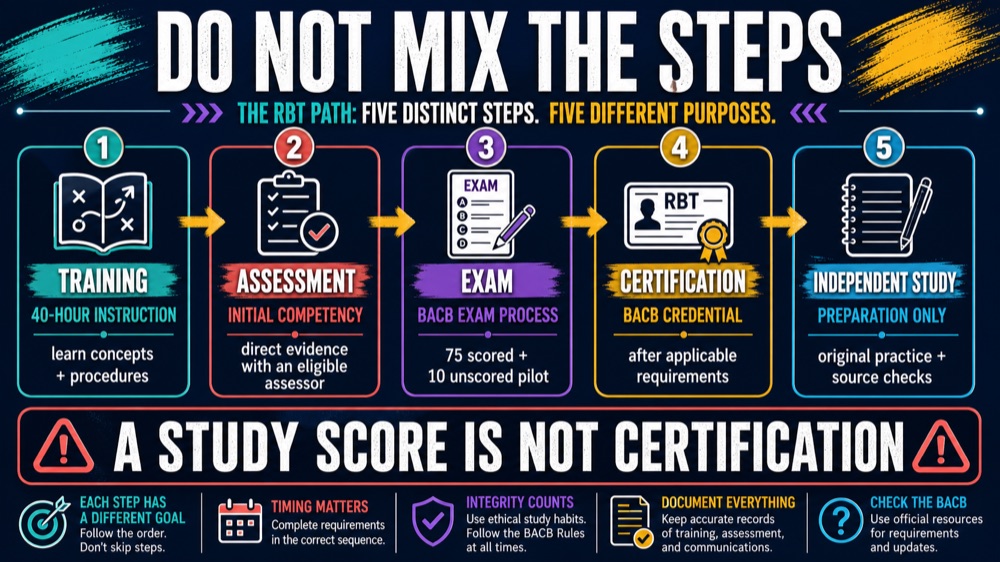
The order is important. An exam-prep product may help with the examination step, but it cannot replace training or direct competency evidence. A training certificate may document a course, but it is not the same as certification. A passed examination is one part of the pathway, not permission to ignore maintenance rules.
Check eligibility before you train
The current Handbook describes baseline eligibility requirements that include being at least 18 years old, having a high-school-level education or equivalent, and completing the required criminal background and abuse registry checks. The Handbook also states that the checks must fall within the applicable period before the application and payment step. Because requirements and forms may change, treat the current Handbook as the controlling source.
Make a personal checklist with four columns: requirement, evidence, date completed, and source checked. Keep copies of your own documents in a secure location. Do not upload identifying client information to an exam-prep website, and do not assume that an employer’s internal screening automatically satisfies every BACB application requirement.
| Planning question | What to verify | Where to verify it |
|---|---|---|
| Do I meet the age and education threshold? | Current eligibility wording and acceptable evidence. | Current BACB Handbook. |
| Are my checks recent enough? | Criminal background and abuse registry timing. | Current Handbook and application instructions. |
| Is my training current? | Provider, hours, delivery window, and certificate details. | Current Handbook and training documentation. |
| Who can assess me? | Assessor eligibility and official packet requirements. | Current initial competency assessment materials. |
Understand the 40-hour training step
The current 2026 Handbook describes a 40-hour training requirement and includes timing and delivery conditions. It states that the training must be completed in no less than five days and no more than 180 days. Do not use an old course description or a search snippet as proof that a provider’s current course meets every requirement. Check the certificate, dates, instructor information, and current BACB wording.
Training is where a candidate learns concepts, procedures, data systems, teaching and reduction principles, documentation, and ethics. It is not the final certification decision. A high course quiz score cannot replace the required competency assessment or application steps. During training, keep a running list of terms that you can define but cannot yet apply to a scenario.
When comparing courses, ask whether the provider clearly states the edition and current requirements it follows. A course that advertises a legacy task list without explaining the current exam transition deserves careful verification. Independent study notes can supplement training, but they should not silently override the trainer’s written instruction or the current official source.
Separate training from the competency assessment
The initial competency assessment is a separate checkpoint from the 40-hour training. The current Handbook describes it as occurring after the required training and within the applicable timing window before the application. The current official packet sets the assessment evidence and process. An assessor observes or evaluates the applicable performance; an online article cannot perform that function.
| Step | What it is for | What an independent website can do |
|---|---|---|
| 40-hour training | Structured instruction and learning activities. | Explain concepts, offer study notes, or link to materials. |
| Initial competency assessment | Official competency evidence under the applicable process. | Help you rehearse questions; it cannot assess or sign for you. |
| Application | Submitting the required information and documents to the BACB. | Provide a personal checklist; it cannot approve the application. |
| Examination | Testing under the current BACB examination process. | Provide original practice; it cannot provide secure exam content. |
| Certification | The credential after the applicable requirements are satisfied. | Explain the pathway; it cannot issue the credential. |
If an assessor or supervisor gives a client-specific direction, follow that direction and ask for clarification when needed. A practice explanation may illustrate a general concept, but it cannot authorize a procedure for a real client.
Prepare for the RBT examination
The current RBT Test Content Outline, 3rd edition, maps 43 tasks across six domains. The examination blueprint describes 75 scored questions and 10 unscored pilot questions; the Handbook describes a 90-minute examination with four answer choices. All questions are not presented as six separate subtests, so a practice score by domain should be treated as a study signal rather than an official result.
| Domain | Tasks / share | Review question |
|---|---|---|
| A. Data Collection and Graphing | 13 / 17% | What is observable, and which measurement unit fits? |
| B. Behavior Assessment | 8 / 11% | Which assigned procedure and report format apply? |
| C. Behavior Acquisition | 19 / 25% | Which teaching, prompt, reinforcement, or generalization step is written? |
| D. Behavior Reduction | 14 / 19% | What does the plan require, and what protects safety? |
| E. Documentation and Reporting | 10 / 13% | What objective information should be recorded and communicated? |
| F. Ethics | 11 / 15% | How do competence, privacy, supervision, and boundaries affect the action? |
Use a three-pass study cycle: read the current source, answer an original scenario without searching, and explain why the best option fits the facts and role. Then change one fact and solve again. Do not copy retired examples or present any practice item as an official BACB question.
Use independent study materials honestly
Independent RBT certification study materials can organize a learner’s notes, provide original examples, and make it easier to find weak topics. They should state their limits clearly. Look for the current TCO version, official-source links, an independent-content disclaimer, concrete explanations, and a correction process instead of only a score.
Be skeptical of any page that promises certification, implies that a practice score is a BACB decision, sells “real” or “leaked” questions, or claims affiliation without evidence. A polished design does not make a resource official. The safest routine is to use the primary source for requirements and the independent resource for rehearsal and organization.
Build an application document checklist
Before applying, create a private checklist and compare it with the current portal instructions:
- one BACB account using your legal name and personal email;
- the required attestation or application information;
- the current 40-hour training certificate;
- the initial competency assessment documentation from the applicable official process;
- current background and registry-check evidence where required;
- dates that fit the Handbook’s timing windows;
- a secure way to store copies without exposing personal or client information.
The Handbook describes applications as active for a limited period and explains that approval does not mean you can wait indefinitely to schedule the examination. Record the application date, processing messages, approval date, and scheduling deadline in your own calendar. If the portal or Handbook conflicts with an older blog, follow the current official instruction and contact the BACB for clarification.
Maintain the credential after certification
RBT certification is not a one-time quiz result. After certification, an RBT must continue to follow the current supervision, ethics, renewal, and documentation requirements. The details and forms may change, so review the Handbook and BACB notices rather than relying on a static checklist. Keep your own renewal dates and supervision records organized, and report questions through the appropriate professional or BACB channel.
In real work, stay within competence and the written plan. Document objectively, protect confidentiality, communicate concerns promptly, and ask before changing a procedure. A credential supports a supervised role; it does not eliminate supervision or authorize independent clinical decisions.
Common RBT certification mistakes
- Calling training certification: a course certificate documents training; it is not the BACB credential.
- Skipping the official assessment: independent practice cannot replace direct competency evidence.
- Using outdated requirements: check the current Handbook, RBT page, and applicable packet.
- Assuming a mock score is approval: a practice percentage is not an application or certification decision.
- Ignoring role boundaries: an RBT implements under supervision and should not improvise clinical changes.
- Sharing private information: keep applications and study notes separate from identifying client details.
Bottom line: RBT certification is an official BACB pathway with distinct eligibility, training, assessment, application, examination, and maintenance steps. Use the current official sources for requirements and use independent RBT study materials only to prepare, organize, and rehearse.
Ready to practice the RBT concepts you just reviewed?
Try an independent, original RBT practice resource with exam-style questions, scoring, and answer explanations.
References
- Behavior Analyst Certification Board. RBT Test Content Outline, 3rd edition.
- Behavior Analyst Certification Board. RBT Handbook.
- Behavior Analyst Certification Board. RBT Ethics Code.