
The phrase RBT code of ethics points to a current professional standard, not a list of personal preferences. For exam study, you need to recognize the source version, identify the client-protection principle in a scenario, and choose an action that respects supervision, competence, confidentiality, and applicable requirements.
Table of Contents
- What the RBT Code of Ethics is
- Check the current version first
- Four core principles for RBT decisions
- Protect client dignity and welfare
- Stay within competence and supervision
- Protect confidentiality and privacy
- Handle boundaries, gifts, and public statements
- Respond to an ethical concern
- Read RBT code of ethics scenarios
- Common RBT ethics study mistakes
- Frequently Asked Questions
- References
This guide uses the BACB’s current RBT Ethics Code (2.0) as the primary source, then turns its themes into original study decisions. It explains what to do when a question involves privacy, boundaries, gifts, public statements, unclear instructions, or a possible violation. It is educational exam preparation, not legal advice and not a substitute for the current code, workplace policy, supervisor direction, or local law.
RBT Training is an independent educational resource. It is not affiliated with, operated by, or endorsed by the Behavior Analyst Certification Board (BACB). The examples and practice prompts below are newly written for independent study; they are not official, recalled, leaked, or BACB-endorsed questions. No ethics study guide or practice score guarantees a passing result.
What the RBT Code of Ethics is
The RBT code of ethics is the BACB’s professional standard for RBT applicants and certificants. The current BACB resource is titled RBT Ethics Code (2.0). The BACB ethics page states that it went into effect January 1, 2022, and the current linked document identifies an August 2024 update. Always open the official page or current document when a requirement matters; do not assume that an old PDF, quiz, or screenshot is still authoritative.
The current code applies to RBT behavior-technician activities across settings and modalities. That scope matters because ethical responsibilities do not disappear when the service occurs at home, in a clinic, in a community setting, by phone, through email, in a video conference, or through another approved modality. The code is not a complete substitute for law, employer policy, payer requirements, or supervisor direction. When sources differ, use the applicable law and current requirements, protect the client, and seek qualified support.
Keep ethics scope separate from exam-format facts. The current RBT exam context used in this workflow includes 75 scored questions and 10 unscored pilot questions. Those numbers help organize exam preparation; they are not sections of the RBT Ethics Code and do not change the code’s professional responsibilities.
The current RBT Test Content Outline, 3rd edition describes 43 tasks across six domains. Ethics is most directly represented in Domain F, but privacy, accurate reporting, supervision, and client welfare can also shape the best answer in other domains.
| Source | What it controls | Study use |
|---|---|---|
| RBT Ethics Code (2.0) | Ethical standards for RBT applicants and certificants. | Identify principles and responsibilities in a scenario. |
| RBT Handbook | Certification, supervision, reporting, and process requirements. | Verify time-sensitive administrative rules. |
| RBT Test Content Outline, 3rd edition | Exam content and task scope. | Map ethics study to Domain F and related domains. |
| Law and workplace policy | Additional obligations for the setting or jurisdiction. | Do not treat an exam summary as a legal answer. |
A common exam trap is choosing the answer that sounds kind but ignores the source hierarchy. Ethics questions usually reward an action that protects the client, follows the written requirement, respects the RBT role, documents objective facts, and uses the supervisor or designated authority when direction is needed.
Check the current version first
Before making flashcards for the RBT code of ethics, write a version note at the top of your study file:
- Document title: RBT Ethics Code (2.0).
- Primary source: the current BACB ethics page and its linked code.
- Effective date: January 1, 2022, as identified by the BACB ethics page.
- Document update: check the current file; the linked document shows an August 2024 update in the current source record.
- Review date: record when you last opened the official source.
Do not mix the RBT Code with the Ethics Code for Behavior Analysts as if they were one document. RBTs should be familiar with both in the situations described by the BACB, but the documents address different roles. A competitor page may use “BACB ethics” as a broad label; your notes should name which code or requirement supports the decision.
Version checking is especially important for reporting, supervision, self-reporting, public statements, and cultural responsiveness. If a study card gives a precise deadline or enforcement outcome, verify it in the current primary source rather than copying a secondary summary.
Four core principles for RBT decisions
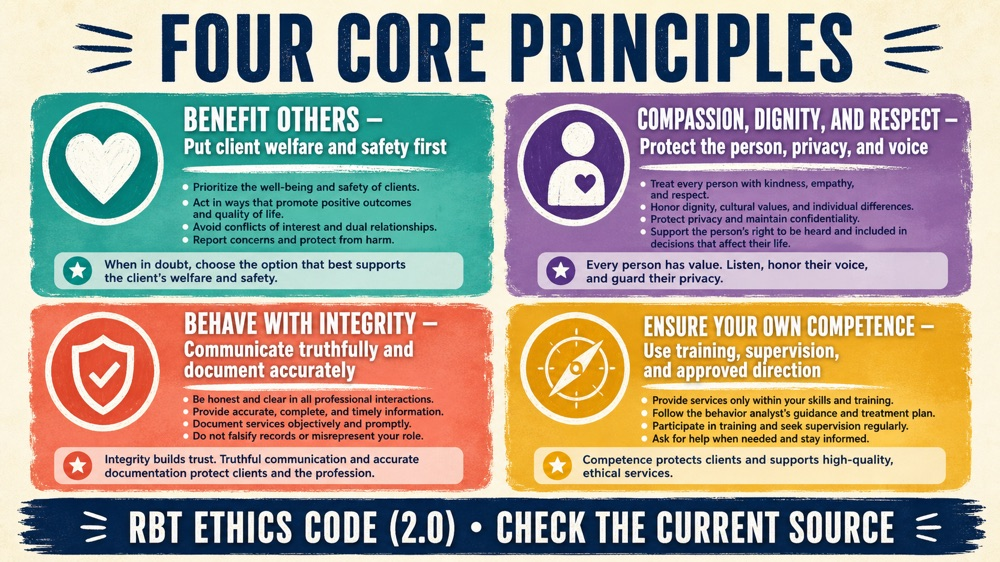
The current BACB RBT Ethics Code introduction identifies four core principles that underlie the ethics standards:
| Core principle | What it asks you to notice | Scenario clue |
|---|---|---|
| Benefit others | Does the action support client welfare and reduce avoidable risk? | An option prioritizes convenience over an assigned safety or service need. |
| Compassion, dignity, and respect | Does the action treat the person as a person, with appropriate voice and privacy? | An option uses humiliation, public disclosure, or coercive language. |
| Behave with integrity | Is the information accurate, complete, and honestly communicated? | An option hides a missed session, changes data, or exaggerates credentials. |
| Ensure your own competence | Do you have the training, instruction, and supervision needed for the task? | An option asks the RBT to improvise a procedure they have not been trained to implement. |
These principles do not replace the code’s specific standards. They help you recognize which standard may control when a question uses everyday language instead of quoting a heading. If two options seem helpful, choose the one that also protects dignity, maintains accuracy, stays within competence, and uses the correct supervision route.
Protect client dignity and welfare
Client welfare is not limited to physical safety. Ethical study decisions also include respectful communication, privacy, assent or cooperation where relevant to the setting, culturally responsive interaction, and avoiding unnecessary embarrassment. An RBT implements assigned services under supervision; the RBT should not use a client as a demonstration prop, share a story for entertainment, or continue an approach that creates a concern without communicating it.
| Scenario | Weak answer | Stronger decision pattern |
|---|---|---|
| A visitor asks why a client receives services. | Explain the diagnosis so the visitor understands. | Protect privacy and use an approved response or communication route. |
| A learner shows distress during a programmed task. | Ignore it because the session target must be completed. | Follow the safety and treatment instructions, observe objectively, and communicate the concern through supervision. |
| A family asks for a public success story. | Post a photo because the story is positive. | Follow current authorization, privacy, workplace, and code requirements; do not make a public statement casually. |
| A material does not fit the learner’s communication or culture. | Insist that the learner adapt without documenting the issue. | Record the observable concern and seek appropriate direction or adaptation through the responsible team. |
Exam questions may hide the ethical issue inside a normal-sounding request. Look for the person affected, the information disclosed, the professional role, and whether the option protects the client or mainly protects the staff member from an uncomfortable conversation.
Stay within competence and supervision
The current RBT code states that RBTs practice under the direction and close supervision of an RBT Supervisor and/or RBT Requirements Coordinator who is responsible for their work. That is a central distinction in RBT ethics study. Certification does not turn an RBT into an independent clinician, supervisor, diagnostician, or treatment-plan author.
- Implement what is assigned: use the written teaching, measurement, reduction, or safety procedure as instructed.
- Recognize limits: do not perform a task without the training, competence, or direction required for it.
- Ask when unclear: document the question or observable problem and use the designated supervisor route.
- Report accurately: do not hide an error, change a data point, or claim a procedure was completed when it was not.
- Keep supervision real: supervision is not a signature-only formality; use it for feedback, clarification, and competency support.
For example, if a caregiver asks the RBT to add a new consequence because the current intervention is inconvenient, the role-safe answer is not to test the new idea. Follow the existing direction, record what occurred, and contact the responsible supervisor. If there is an immediate safety issue, follow the applicable safety protocol and emergency route first.
Protect confidentiality and privacy
Confidentiality questions test more than whether you can keep a paper in a locked cabinet. Think across verbal, written, electronic, visual, and social communication. A recognizable story, screenshot, schedule, voice recording, name, school detail, or casual confirmation can reveal protected information even if a full name is omitted.
| Communication moment | Check before responding |
|---|---|
| Text message | Is the channel approved, the recipient authorized, and the content necessary? |
| Social media | Could a reasonable person identify the client, family, setting, or service relationship? |
| Team discussion | Is the listener part of the authorized service or reporting team, and is the disclosure relevant? |
| Public space | Can others overhear a name, diagnosis, schedule, behavior, or service detail? |
| Study material | Are the examples fictional and free of identifying client information? |
When a question asks whether an RBT should confirm that a person is a client, the safest study pattern is to protect confidentiality rather than satisfy curiosity. When communication is needed for service delivery, use the authorized channel and share only the relevant information. If law or workplace policy adds a requirement, follow that requirement and seek qualified support.
Handle boundaries, gifts, and public statements
Boundary questions often contain a social pressure cue: “It is just a small favor,” “Everyone knows us,” or “The family wants to thank you.” Do not decide from the size of a gift or the friendliness of a request alone. Check the current code, employer policy, applicable law, the risk of a conflict or multiple relationship, and supervisor guidance.
- Gifts: do not accept or decline automatically based on a memorized dollar amount. Identify the potential effect, conflict, policy, and required consultation.
- Extra services: a request for babysitting, tutoring, private transportation, or another paid service may create a boundary or conflict issue. Seek direction before agreeing.
- Social media: do not connect with clients or families casually when the connection could expose private information or change the professional relationship.
- Public statements: represent credentials, role, training, and results accurately. Do not speak as if an independent article or practice product is BACB-approved.
- Personal benefit: notice whether an option mainly benefits the RBT, creates pressure on the client, or risks using the professional relationship for private gain.
The best exam answer may be “consult the supervisor” rather than a confident yes or no when the facts are incomplete. Consultation is not avoidance; it is the correct use of the supervision structure when a conflict, policy, or risk needs interpretation.
Respond to an ethical concern
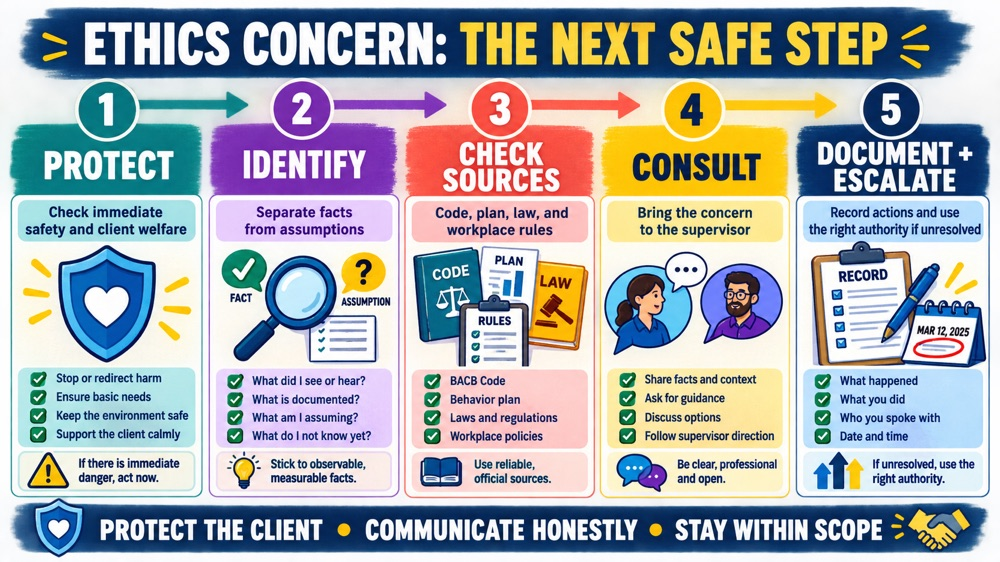
The current BACB source explains that RBTs should seek support from their supervisor and other appropriate workplace individuals when interpreting or applying the code. When an RBT suspects a violation, the study sequence should be concrete:
- Protect immediate safety and client welfare. Follow applicable emergency, safety, and workplace instructions.
- Identify the concern. Separate direct observations from assumptions, labels, or rumors.
- Check the controlling sources. Review the current code, handbook, written plan, law, and workplace process as relevant.
- Bring it to the supervisor. State what happened, when, who was involved, and what support is needed.
- Document actions. Keep an objective record of the concern, steps taken, dates, and outcomes using the approved system.
- Escalate if unresolved. Use the appropriate authority identified by the workplace, law, licensing body, or BACB process when the concern cannot be resolved through the initial route.
Do not treat a public accusation, a social-media post, or a copied template as the first response to every uncomfortable event. At the same time, do not allow a supervisor’s convenience to erase a serious concern. The correct path depends on the facts and applicable requirements; document and seek qualified support.
Read RBT code of ethics scenarios
Use this six-part method for original practice questions about the RBT code of ethics:
- Person: whose welfare, privacy, or dignity is at stake?
- Fact: what did the RBT directly see, hear, record, or receive?
- Role: is the option within the RBT’s training and assigned responsibility?
- Source: which code, plan, law, policy, or supervisor instruction controls?
- Action: does the response implement, document, consult, report, or escalate?
- Boundary: does the option avoid confidentiality breaches, conflicts, false statements, and unauthorized changes?
Try these newly written study prompts:
- A coworker asks whether a recognizable child is receiving services. The clue is confidentiality, not the coworker’s curiosity.
- A parent offers the RBT a paid weekend tutoring job for a sibling. The clue is a possible multiple relationship or conflict, not the size of the payment.
- The written plan does not say what to do after a safety-related event. The clue is the need to follow the safety route, document facts, and seek supervisor direction.
- An RBT realizes a session note contains an inaccurate time. The clue is integrity and accurate documentation; silently leaving it is not a correction.
- A public post says an RBT practice quiz is “BACB-approved.” The clue is truthful public communication and independent-content labeling.
After each item, write why the nearest distractor fails. A distractor may sound helpful but violate privacy, exceed competence, hide information, or skip supervision. That explanation is the part that transfers to a new scenario.
Common RBT ethics study mistakes
- Studying a random PDF as current: open the BACB source and record the version and update date.
- Mixing the RBT Code with the Behavior Analyst Code: name the document that supports each rule.
- Choosing “ask the supervisor” without facts: state what happened and what decision needs support.
- Assuming small gifts are automatically safe: check the context, conflict, policy, and current code.
- Sharing a de-identified story casually: consider whether the setting and details still identify the client.
- Confusing kindness with ethics: a helpful-sounding action may still violate privacy, competence, or boundaries.
- Treating the code as legal advice: consult the applicable authority when law or workplace rules are involved.
- Memorizing answer patterns: use the person, fact, role, source, action, and boundary checklist.
Bottom line: use the current RBT code of ethics as the primary source, then practice recognizing the client-protection principle, role boundary, confidentiality risk, and correct supervision path in each scenario. Document facts, communicate honestly, protect dignity, and verify time-sensitive requirements instead of relying on a recycled summary.
Ready to practice the ethics distinctions?
Use independent RBT questions, identify the controlling principle, and write the role-safe next action.
Try Free RBT Practice Questions →
Frequently Asked Questions
What is the current RBT code of ethics?
The current BACB resource is the RBT Ethics Code (2.0). Open the official BACB ethics page and linked document for the current version, update information, and enforcement resources.
Does the RBT code of ethics apply outside a clinic?
It applies to RBT behavior-technician activities across settings and modalities. Use the current code together with applicable law, workplace requirements, and supervisor direction.
What should an RBT do when an ethics concern is unclear?
Protect immediate welfare, identify objective facts, review the controlling sources, seek supervisor support, document actions, and use the appropriate escalation route if the concern remains unresolved.
Can an RBT make an independent clinical decision?
RBTs work under direction and close supervision. Implement assigned procedures and seek qualified direction rather than independently diagnosing, changing a plan, or creating a new intervention.
Are RBT ethics practice questions official BACB questions?
No. Independent study examples are not official, recalled, leaked, or BACB-endorsed exam questions.
References
- Behavior Analyst Certification Board. Ethics Codes.
- Behavior Analyst Certification Board. RBT Ethics Code (2.0).
- Behavior Analyst Certification Board. RBT ethics resources.
- Behavior Analyst Certification Board. RBT Test Content Outline, 3rd edition.
- Behavior Analyst Certification Board. RBT Handbook, updated June 2026.
- RBT ethics study resource. Reviewed for competitor research; not an endorsement.
- RBT ethics guide. Reviewed for competitor research; not an endorsement.