
An RBT competency assessment study guide should do more than list vocabulary. It should connect observable behavior, written procedures, supervision, documentation, and ethics to the decisions an RBT must explain. The guide below is designed for independent review before a supervised assessment conversation; it is not the official assessment itself.
Table of Contents
- What this RBT competency assessment study guide covers
- Use a source hierarchy
- Six-domain study map
- Study data and observation decisions
- Study teaching and behavior reduction
- Study documentation and ethics
- Build a weekly review loop
- Original study scenarios
- Prepare for the official pathway
- Common RBT competency assessment study guide mistakes
- Frequently Asked Questions
- References
The current BACB RBT Test Content Outline, 3rd edition, maps 43 tasks across six domains. The current RBT examination blueprint describes 75 scored questions and 10 unscored pilot questions. These facts help organize exam preparation, but they do not define an independent study provider as official. The examples here are newly written for study and are not official, recalled, leaked, or BACB-endorsed questions. RBT Training is an independent study-material site, not a BACB certification program, and studying here cannot guarantee certification or a passing result.
Keep the process boundary clear: the current BACB Handbook and RBT Initial Competency Assessment Packet control the official requirements, timing, documentation, and assessment pathway. A study guide can help you find gaps and prepare questions for your supervisor or assessor, but it cannot perform direct observation or decide competency.
What this RBT competency assessment study guide covers
This RBT competency assessment study guide uses a decision-first structure. For every concept, ask:
- What is observable? Name the response, context, and measurement instead of an inferred motive.
- What does the written plan say? Identify the instruction, prompt, criterion, reinforcement, safety step, or documentation rule.
- What is the RBT role? Decide whether to implement, record, report, or request direction.
- What evidence supports the answer? Remove options that invent facts or change a procedure without authorization.
A definition is a starting point. A usable study note adds one example, one non-example, one data decision, and one role boundary. If you cannot explain what you would record or what you would ask a supervisor, the term is not ready to leave the flashcard.
For example: if a study scenario says a learner begins responding 4 seconds after an instruction, do not automatically call that duration. First identify whether the question asks for latency, confirm the stated start and end events, and choose the measurement that matches those events.
This guide is intentionally independent. It does not reproduce secure exam or assessment items, and it does not represent any question as official. Use the source documents linked at the end for requirements that may change.
Use a source hierarchy
When two study notes conflict, use a clear order of authority:
| Source | Use it for | Study action |
|---|---|---|
| Current BACB Handbook | Application, examination, maintenance, and process requirements. | Check the date and verify the current version. |
| Current RBT TCO | Exam content scope, domains, task map, and blueprint. | Tag each review question to a domain. |
| Official competency packet | Applicable assessment procedures and documentation. | Use it with the eligible assessor, not as a quiz bank. |
| Written treatment plan and supervisor direction | Client-specific implementation and safety instructions. | Follow the plan; ask before changing it. |
| Independent study resource | Practice explanations and memory supports. | Use it to generate questions, not to override primary sources. |
The hierarchy prevents a common error: treating a confident commercial explanation as stronger than the current official document or the written plan for the case. Keep source dates in your notes and escalate an unresolved conflict.
Six-domain study map
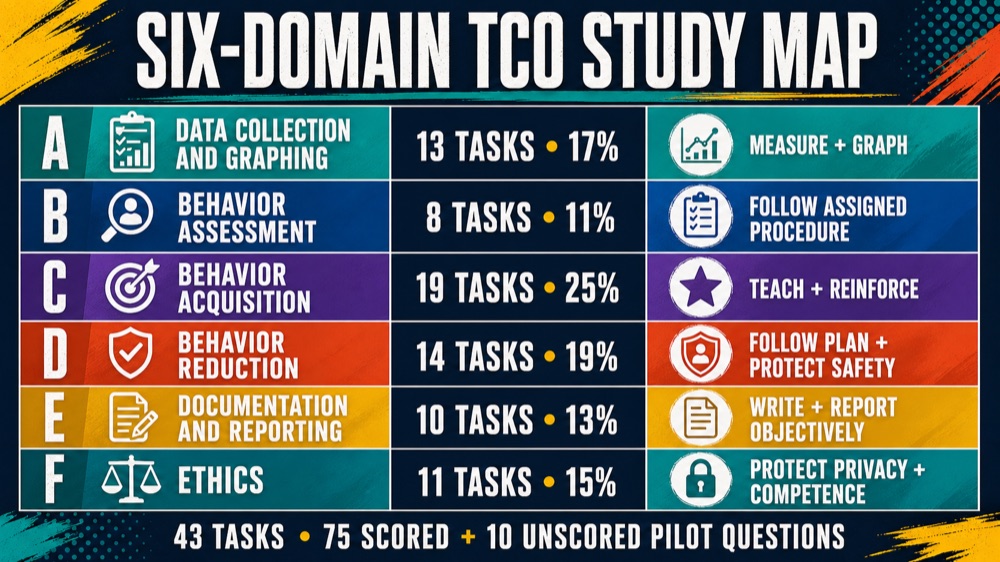
Use the current TCO as a map for broad review. The task counts and percentages below are the current examination blueprint; they are not instructions to make every independent study set the same length.
| Domain | Tasks / share | Ask yourself |
|---|---|---|
| A. Data Collection and Graphing | 13 / 17% | What is measured, with which unit, and how is the data described? |
| B. Behavior Assessment | 8 / 11% | What assigned procedure is being followed and what is reported? |
| C. Behavior Acquisition | 19 / 25% | Which teaching step, prompt, reinforcement, or generalization decision applies? |
| D. Behavior Reduction | 14 / 19% | What does the plan require, and what protects safety and fidelity? |
| E. Documentation and Reporting | 10 / 13% | What objective information belongs in the note or report? |
| F. Ethics | 11 / 15% | How do competence, supervision, privacy, and boundaries affect the action? |
The map contains 43 tasks across six domains. The exam blueprint describes 75 scored questions and 10 unscored pilot questions. Do not turn those facts into a promise about a third-party score, and do not assume that an assessment packet is identical to the exam blueprint.
Study data and observation decisions
Start with the response definition. “Refusal,” “aggression,” or “off task” may be useful shorthand in a plan, but the study question should tell you what can be seen, heard, counted, timed, or recorded. Then match the measurement to the question:
- Count: how many times did the defined response occur?
- Rate: how often did it occur relative to a stated time unit?
- Duration: how long did the response last?
- Latency: how long from the instruction or event to the response?
- Interval recording: what happened during the specified observation intervals?
Do not choose a measurement because its name sounds technical. Read the target, observation window, and requested unit. If the time frame changes, recalculate or restate the decision rather than carrying the old answer forward.
Study teaching and behavior reduction
For acquisition questions, identify the skill target, instruction, prompt, learner response, consequence, criterion, and opportunity for maintenance or generalization. The RBT implements the written procedure under supervision; the learner’s momentary performance is not permission to redesign the teaching plan.
For reduction questions, identify the observable behavior, antecedent context, replacement response, consequence, data requirement, and safety direction stated in the plan. Do not infer function from one event or add an intervention that was not authorized. If the plan is incomplete or a new safety concern appears, the correct study action is often to follow available safety instructions and contact the responsible professional.
Study documentation and ethics
Documentation questions reward accuracy, not drama. Write what happened, when it happened, what procedure was used, the response observed, and what was communicated. Avoid labels that hide the observation, claims about intention, or omissions designed to make a session look easier.
Ethics questions often appear as ordinary workplace requests:
- a family asks for a photo or story that could identify a client;
- a coworker asks you to perform a procedure outside your training;
- a supervisor is unavailable and the written plan does not cover a new risk;
- a friend asks for a client detail for a social post;
- a note is requested that leaves out an inconvenient event.
Use the Ethics Code, current Handbook, written plan, and supervision channel. Protect privacy, practice within competence, report accurately, and ask rather than improvise when the facts or instructions are insufficient.
Build a weekly review loop
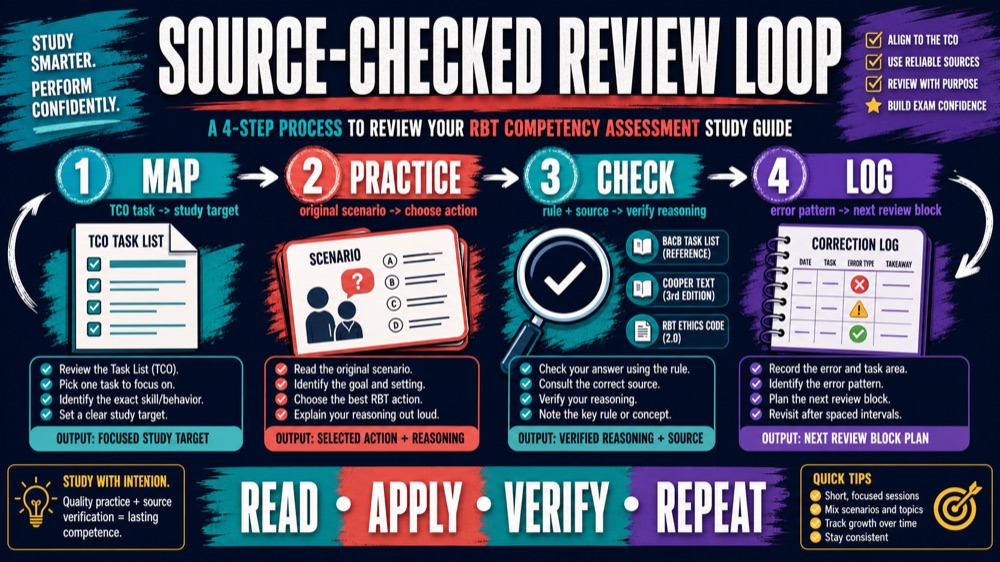
A study guide works best as a loop rather than a one-time reading:
- Map: select one TCO domain and one narrow decision point.
- Read: check the relevant official source or written instruction.
- Practice: answer a newly written scenario without searching.
- Explain: write the fact, procedure, role, and evidence.
- Discuss: take unresolved questions to supervision or the assessor.
- Transfer: solve a changed scenario after a delay.
Keep a confidence mark beside each answer. A correct answer with low confidence is a review target. A wrong answer with a clear correction rule is progress. A wrong answer that leads you to invent a new procedure is a prompt to consult the responsible professional.
Original study scenarios
These are newly written examples for study and are not official, recalled, leaked, or BACB-endorsed questions:
- Data: a learner responds 10 times during a 25-minute observation, and the question asks for a time-based comparison. Identify the requested unit before selecting count or rate.
- Assessment: a supervisor assigns a preference procedure with a written sequence. Follow the sequence, record choices, and report any ambiguity instead of adding a step.
- Acquisition: the plan specifies a model, a wait, and reinforcement for an independent response. Preserve the order and record what occurred.
- Reduction: a new safety concern appears while a behavior plan gives no direction for that event. Follow available safety instructions and ask the appropriate professional.
- Documentation: a caregiver describes a difficult event using a label. Translate the report into observable language and identify what still needs verification.
- Ethics: a colleague asks for a recognizable client detail. Decline the disclosure and use the proper supervisory route for a legitimate case discussion.
After each example, change one fact: the time frame, prompt, setting, or role. If the answer changes, explain why. That one sentence is more useful than memorizing the original wording.
Prepare for the official pathway
The BACB Handbook explains the credentialing pathway and may change over time. Verify the current requirements at the time you apply and at the time you schedule or take the examination. The Handbook describes the initial competency assessment as a separate step after the required 40-hour training and within the applicable timing window before application. Use the current official packet and eligible assessor for the assessment itself.
Before the supervised conversation, bring a short question list:
- Which task or procedure should I demonstrate next?
- What observable evidence shows that I followed the written step?
- Which data system and documentation format should I use?
- What safety direction applies when the plan is silent?
- Which official source controls the requirement I am studying?
Do not treat this guide, a flashcard set, or a practice score as application approval, assessment completion, examination authorization, or certification status.
Common RBT competency assessment study guide mistakes
- Reading without deciding: convert every concept into an observable scenario.
- Using one source for everything: match Handbook, TCO, packet, plan, and Ethics Code to their proper jobs.
- Confusing assessment and exam: they are related parts of preparation but not the same process.
- Changing the plan in your head: follow written direction and ask before modifying a procedure.
- Writing labels instead of data: describe what happened and what was recorded.
- Skipping transfer: repeat with a changed fact after a delay.
Bottom line: a useful RBT competency assessment study guide links the current TCO to observable decisions while respecting the official Handbook, assessment packet, supervision, and Ethics Code. It helps you prepare; the official process determines its own requirements and evidence.
Ready to practice the RBT concepts you just reviewed?
Try an independent, original RBT practice resource with exam-style questions, scoring, and answer explanations.
References
- Behavior Analyst Certification Board. RBT Test Content Outline, 3rd edition.
- Behavior Analyst Certification Board. RBT Handbook.
- Behavior Analyst Certification Board. RBT Ethics Code.