
An RBT competency assessment is a demonstration of performance, not just a vocabulary quiz. The applicant or certificant must show that they can carry out behavior-technician tasks, explain relevant decisions, follow written procedures, and recognize when supervision or clinical direction is needed. That makes preparation different from memorizing practice-test answer letters.
Table of Contents
- What an RBT competency assessment measures
- How the official Initial and Recertification packets differ
- Prepare for an RBT competency assessment by task group
- Practice an RBT competency assessment under supervision
- Use feedback from an RBT competency assessment
- Common competency-assessment mistakes
- Build an RBT competency assessment prep loop
- Frequently Asked Questions
- References
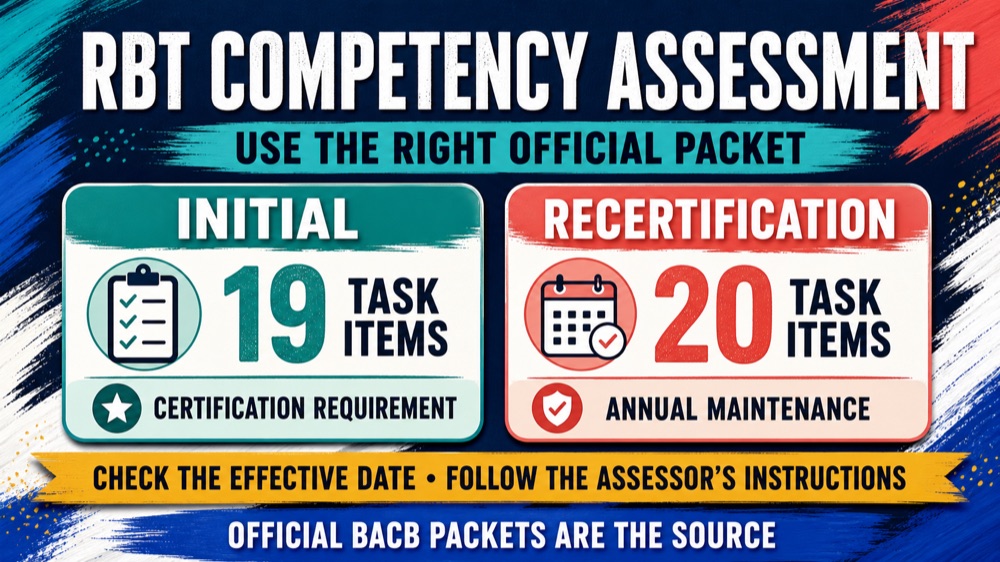
The official BACB materials distinguish an Initial Competency Assessment from a Recertification Competency Assessment. The Initial packet effective January 1, 2026 states that all task items 1–19 must be completed as part of the certification requirements. The Recertification packet describes task items 1–20 as part of the annual maintenance requirements. These official packets are the authority for their requirements; the 3rd-edition TCO separately maps 43 tasks across six domains, including 75 scored questions and 10 unscored pilot questions for the examination. These are not official, recalled, leaked, or BACB-endorsed questions, and this article is an independent study guide, not an assessment form or a substitute for a qualified assessor. Nothing here guarantees a successful result.
Use this guide to understand the boundaries, prepare observable demonstrations, practice explanations, and turn assessor feedback into a next step.
What an RBT competency assessment measures
A competency assessment asks whether you can perform and describe critical tasks in context. A strong preparation plan therefore has four layers:
- Performance: you carry out the task as instructed, using the materials and procedure available in the setting.
- Accuracy: your measurement, recording, prompting, reinforcement, or response matches the target and the written plan.
- Communication: you can explain what you are doing in plain language without inventing a new intervention.
- Professional judgment: you know when the situation requires documentation, supervisor direction, or a safety response.
This is why a definition-only flashcard deck is not enough. You may know what a rate is and still record the wrong unit. You may define prompting and still deliver an unclear instruction or fail to follow the prescribed prompt sequence. Preparation should move from term, to demonstration, to explanation, to feedback.
How the official Initial and Recertification packets differ
Start with the official packet that matches your situation. Do not blend the initial-certification requirements with annual recertification maintenance requirements.
| Packet | Official purpose | Key preparation boundary |
|---|---|---|
| Initial Competency Assessment | Part of the requirements to qualify for initial RBT certification. | The 2026 packet states that the assessment follows completion of the 40-hour training and cannot be completed more than 90 days before submitting an RBT certification application. |
| Recertification Competency Assessment | Annual requirement for RBT certificants to demonstrate ongoing proficiency. | Prepare for the current maintenance packet and its assessor requirements; do not assume the initial packet is interchangeable. |
The 2026 Initial packet also describes a responsible assessor, relationship expectations, record maintenance, and the possibility of conducting the assessment across one or more sessions, in person, live online, or through recordings created specifically for the assessment. Confirm the current packet and your assessor’s instructions rather than relying on a commercial summary.
Search results sometimes promise a guaranteed pass or sell a package as if it were the official assessment. Treat that language as a warning. A course or checklist can support preparation, but only the applicable BACB materials and qualified assessor determine the assessment process.
Prepare for an RBT competency assessment by task group
Organize practice by observable task group rather than by a long list of terms. The current RBT scope includes six connected areas:
- Measurement and data: define the target behavior, select or use the specified measurement, record consistently, and describe what the data show without turning interpretation into observation.
- Assessment: follow the assigned preference, skill, or functional-assessment procedure and identify the RBT’s role in the process.
- Skill acquisition: deliver instructions, prompting, reinforcement, shaping, chaining, or generalization steps as written.
- Behavior reduction: implement the approved plan, monitor safety, use the specified differential or extinction procedure, and seek direction when the plan does not cover the situation.
- Documentation and reporting: write objective notes, report changes or irregularities promptly, and protect client information.
- Professional conduct: stay within competence, follow supervision requirements, maintain boundaries, and communicate respectfully.
For each group, make a four-line practice card: the observable target, the exact procedure step, the common error, and the sentence you would say to the assessor. For example, a measurement card might say: “Target: responses; procedure: record count during the stated interval; common error: adding a rate when count was requested; explanation: I used the unit named in the procedure.”
Practice an RBT competency assessment under supervision
Practice should be supervised and role-appropriate. You can rehearse a sequence with a peer or on blank materials, but do not present a private rehearsal as an official assessment and do not use client information outside the approved setting.
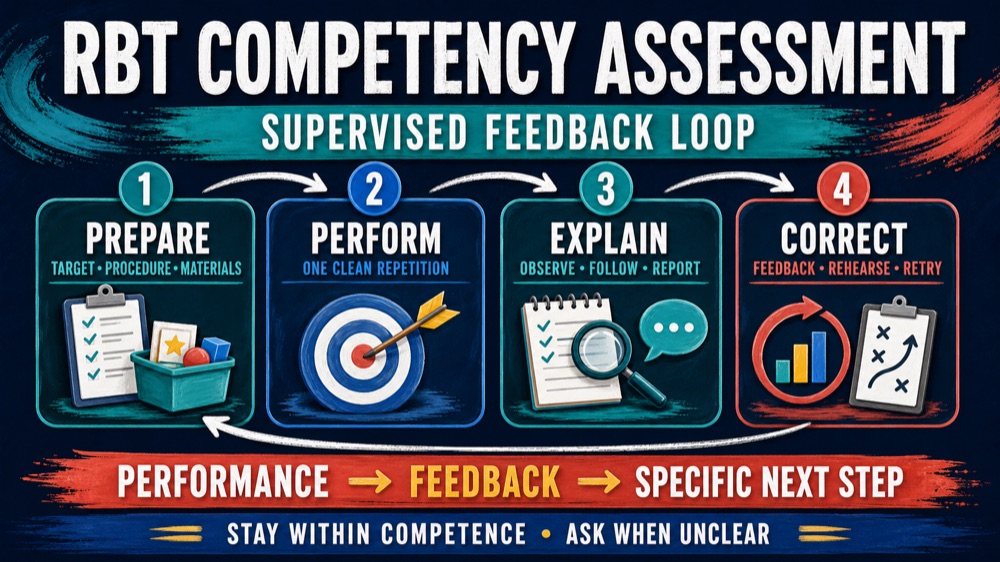
- Prepare the materials. Have the current procedure, data sheet, teaching materials, and safety instructions available as directed.
- State the target. Before starting, identify what you are measuring or teaching and what the learner or client is expected to do.
- Perform one clean repetition. Use the instruction, prompt, reinforcement, data, and documentation steps in the order specified.
- Explain the decision. Say what you observed, what procedure you followed, and what you would do if the plan became unclear.
- Ask for feedback. Treat correction as part of skill development, not as an argument about which answer sounds sophisticated.
Short micro-reps are usually more useful than one exhausting rehearsal. Practice the first instruction, one prompt, one reinforcement delivery, one data entry, and one objective note. Then combine them into a longer sequence. If a task involves a client, follow the responsible assessor’s and organization’s requirements for consent, privacy, safety, and documentation.
Use feedback from an RBT competency assessment
Feedback becomes actionable when you classify it. Add four columns to a correction log:
| Feedback type | Example | Next practice |
|---|---|---|
| Accuracy | Recorded duration when the procedure required count. | Repeat the measurement with two new examples and name the unit before recording. |
| Procedure fidelity | Added an unapproved prompt or skipped a stated step. | Highlight the written sequence and rehearse it slowly before adding speed. |
| Communication | Gave several instructions at once or could not explain the decision. | Practice one clear instruction and one-sentence rationale. |
| Professional boundary | Proposed changing a target instead of asking the supervisor. | Role-play documentation and the request for clinical direction. |
Do not respond to feedback by collecting a new generic study resource immediately. First repair the exact behavior that was observed. If the assessor says the data entry was inconsistent, practice data entry. If the issue is a safety or scope boundary, rehearse the safe escalation path and document the question.
Common competency-assessment mistakes
- Preparing for an exam instead of a demonstration. Vocabulary recall supports performance but cannot replace it.
- Using the wrong official packet. Initial certification and recertification have different purposes and task forms.
- Changing the plan to look expert. Competence includes following the assigned procedure and seeking direction when needed.
- Recording data from memory later. Record according to the procedure and timing in the moment.
- Overprompting or reinforcing late. Rehearse the exact prompt and reinforcement arrangement, not a general idea of encouragement.
- Ignoring documentation and ethics. Objective reporting, confidentiality, supervision, and boundaries are part of competent practice.
- Trusting guaranteed-pass marketing. No independent course can convert preparation into a guaranteed assessment result.
Build an RBT competency assessment prep loop
Use a three-pass loop. Pass One is a packet review: read the applicable official document and mark every task you must demonstrate or discuss. Pass Two is a supervised micro-rehearsal: perform each task in short, observable repetitions. Pass Three is a correction rehearsal: repeat the tasks that drew feedback and explain the role boundary aloud.
For related study, compare the site’s RBT exam-prep materials, use section practice for measurement, assessment, or ethics review, and return to the free RBT mock exam for written-scenario practice. Written practice can support recall and application, but it does not replace the official competency packet, a qualified assessor, or supervised performance.
Use the official RBT Initial Competency Assessment Packet for current initial-certification requirements and the RBT Recertification Competency Assessment Packet for annual maintenance context. These sources are authoritative for their own requirements; this article remains independent educational guidance.
Bottom line: prepare for an RBT competency assessment by making your performance observable, your procedure faithful, your explanation concise, and your next correction specific.
Ready to practice the RBT concepts you just reviewed?
Try an independent, original RBT practice resource with exam-style questions, scoring, and answer explanations.
References
- Behavior Analyst Certification Board. RBT Test Content Outline, 3rd edition.
- Behavior Analyst Certification Board. RBT Handbook.
- Behavior Analyst Certification Board. RBT Ethics Code.