
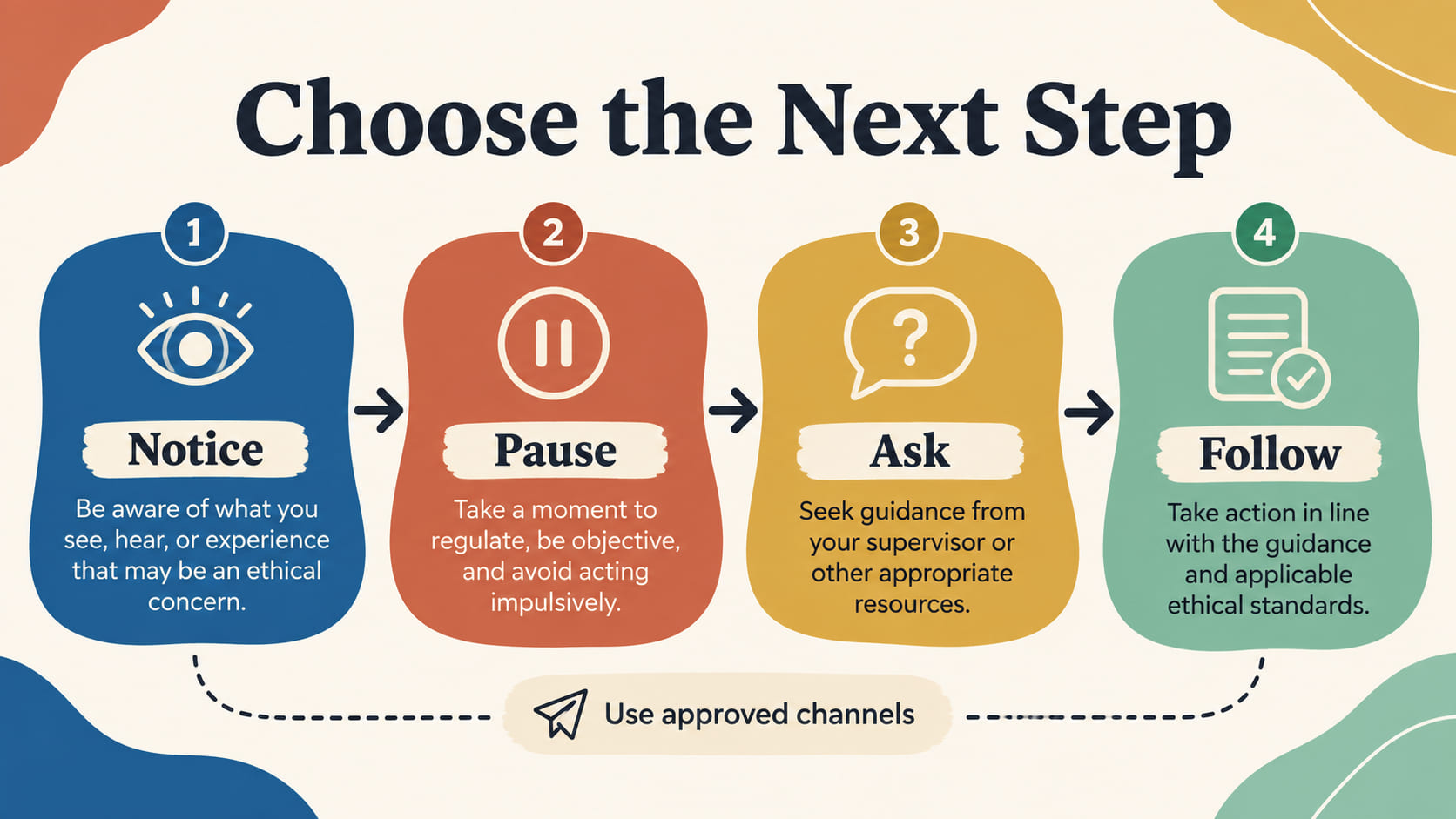
RBT ethics scenarios are easier to handle when you identify the professional issue before choosing a response. Pause, protect the client’s interests and privacy, check the current BACB Ethics Code and employer policy, ask the supervisor through an approved channel, and follow the direction. The goal is not to memorize a clever answer; it is to use a repeatable decision process.
Table of Contents
- RBT ethics scenarios: the short answer
- A repeatable method for scenario questions
- Scenario 1: a boundary or gift request
- Scenario 2: a request for private information
- Scenario 3: a task outside competence
- Scenario 4: unclear or missing supervision
- Scenario 5: a documentation concern
- Frequently asked questions
RBT ethics scenarios, professional judgment, supervision, boundaries, privacy, and records
RBT Ethics Scenarios: A Pause-and-Ask Decision Guide
Practice identifying the issue, protecting the role, asking for direction, and documenting the approved next step.
RBT ethics scenarios are easier to handle when you identify the professional issue before choosing a response. Pause, protect the client’s interests and privacy, check the current BACB Ethics Code and employer policy, ask the supervisor through an approved channel, and follow the direction. The goal is not to memorize a clever answer; it is to use a repeatable decision process.
Scenario practice can build recognition, but a quiz answer is not a substitute for case-specific supervision. Real situations contain details that change the analysis, and the current official sources and organization process should control.
RBT ethics scenarios: the short answer
For most unclear situations, use five moves:
- Notice the issue. Name the possible boundary, privacy, competence, safety, supervision, or documentation concern.
- Pause the commitment. Do not promise, accept, disclose, change, or hide something while the issue is unclear.
- Check the sources. Use the current BACB Ethics Code, employer policy, and assigned plan.
- Ask the right person. Bring the facts to the supervisor or approved escalation contact.
- Follow and record. Use the direction consistently and document through the required channel.
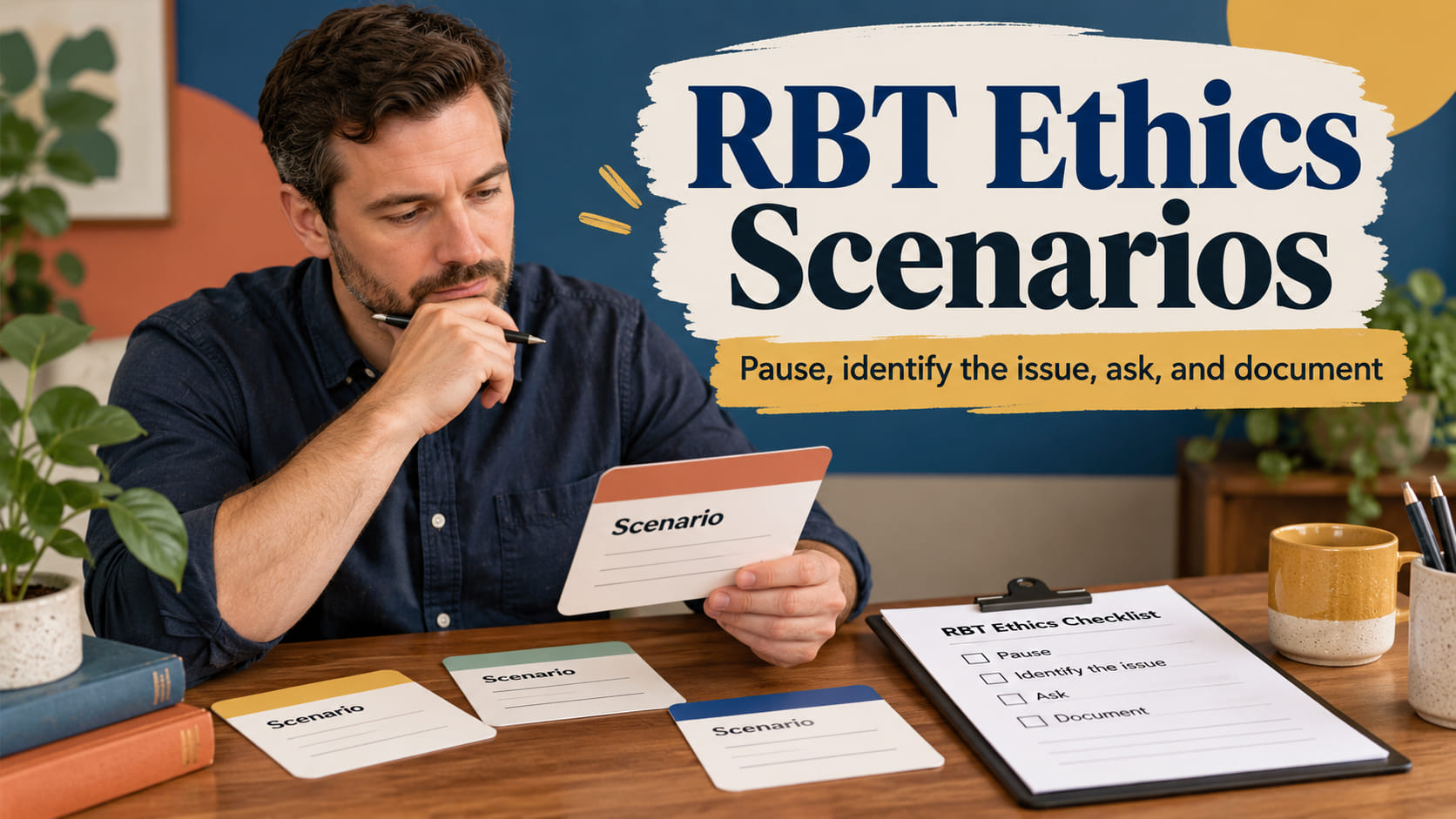
A repeatable method for scenario questions
Ask what could affect the client, the professional relationship, the accuracy of records, or the RBT’s competence. Then separate known facts from assumptions. “The caregiver asked me to keep this private” is a fact. “The caregiver is trying to manipulate the service” is an interpretation that should not be treated as fact without evidence.
Look for urgency and risk. Safety, abuse or neglect concerns, privacy breaches, threats, and missing supervision may require an immediate escalation route. Do not wait for a routine meeting if the organization has a faster process.
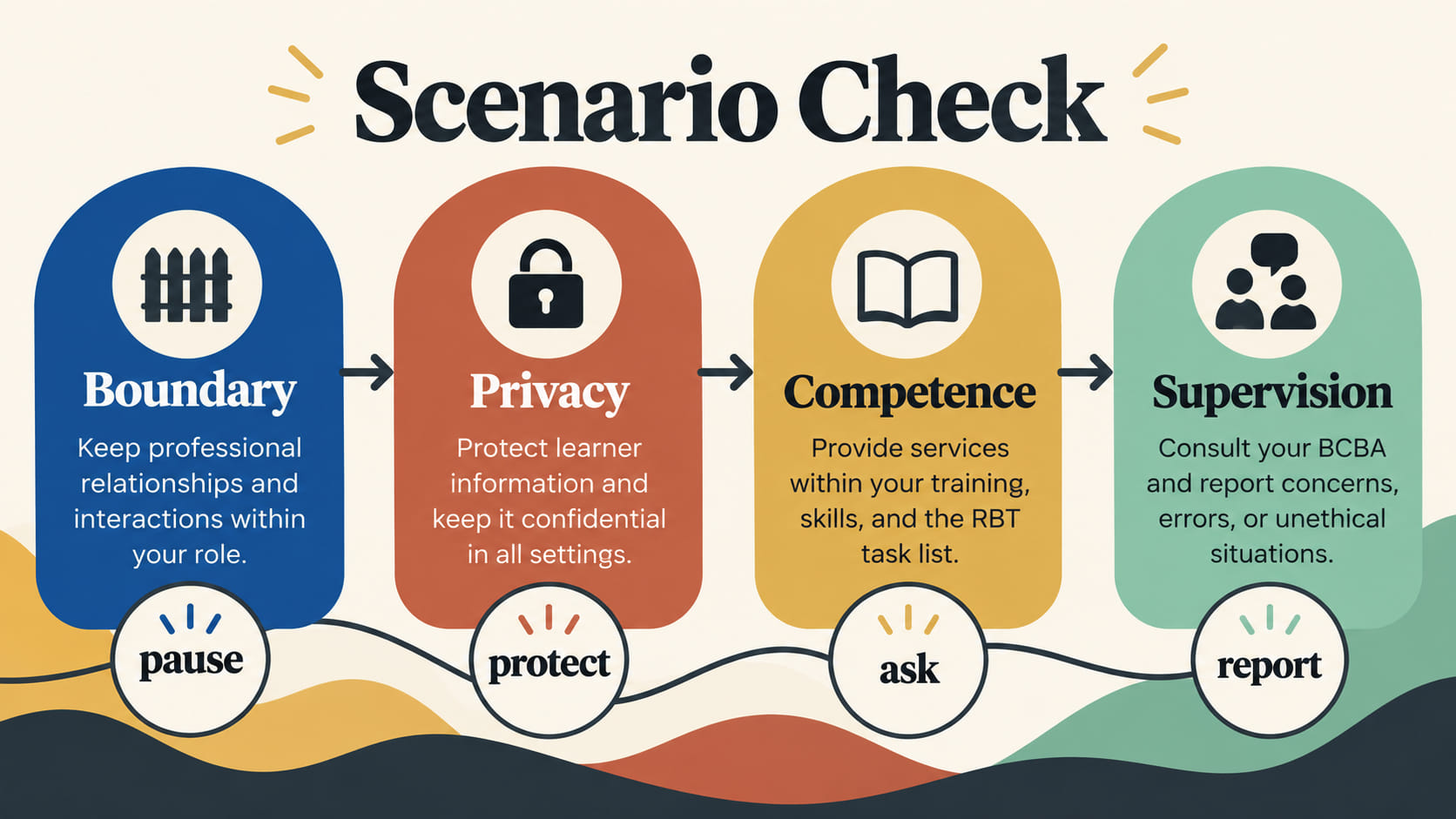
Scenario 1: a boundary or gift request
Situation: A caregiver offers an RBT a gift card and asks the RBT not to tell the supervisor because it is “just appreciation.”
Better next step: Thank the caregiver for the thought without promising acceptance. Pause, check the current policy, and tell the supervisor through the approved channel. Do not accept, use, hide, exchange, or privately document the gift to avoid review.
Why: The issue is not only the amount. It may involve secrecy, a financial benefit, a power relationship, and the appearance of favoritism. A respectful response can protect the relationship without creating a private exception.
Scenario 2: a request for private information
Situation: A family member asks the RBT to send session details through a personal social-media account or tells the RBT to share another client’s progress as a comparison.
Better next step: Do not use an unapproved channel or disclose another person’s information. Explain that communication must follow the organization’s privacy process, and ask the supervisor how to respond.
Why: Convenience does not replace privacy rules. The RBT should use only the information and channels necessary for the assigned work, and should not treat curiosity or a family request as authorization to disclose private records.
Scenario 3: a task outside competence
Situation: Someone asks the RBT to independently diagnose a concern, design a new treatment procedure, or make a plan change because the supervisor is busy.
Better next step: State the role boundary, avoid making the decision, and contact the supervisor or responsible organization contact. Continue only the assigned work that is clear and safe.
Why: Experience and good intentions do not authorize independent clinical decisions. The RBT can report observations and data; the responsible professional must address decisions outside the RBT role.
Scenario 4: unclear or missing supervision
Situation: An RBT’s scheduled supervision is repeatedly missed, the backup person is unknown, and the RBT is asked to implement a procedure that was never explained.
Better next step: Use the organization’s escalation process, describe what was scheduled and what is missing, and ask what work may continue. Do not sign for someone else, borrow informal instructions, or invent a new supervision arrangement.
Why: A workable supervision structure requires access to direction, observation or review, feedback, records, and a route for gaps. Current BACB requirements and employer policy should be checked rather than inferred from a title.
Scenario 5: a documentation concern
Situation: An RBT realizes that a session note contains an inaccurate time, missing data, or a copied statement that does not describe what occurred.
Better next step: Do not quietly overwrite, backdate, delete, or ask another person to sign. Follow the organization’s correction process, notify the supervisor, and record the facts accurately.
Why: A record should support continuity, accountability, and client care. Correcting a mistake through the approved process is safer than hiding it or creating a second unofficial version.
A similar principle applies when a coworker asks for a “quick favor” that would make the record look complete. Do not copy data you did not observe, sign for work you did not perform, or change a note to match what someone wishes had happened. Report the discrepancy and ask how the organization wants it corrected.
In every scenario, separate the immediate action from the later review. You may need to pause a disclosure, stop an unassigned procedure, secure a record, or contact an escalation person right away. The supervisor can then help determine training, documentation, policy review, or follow-up.
A calm, factual report is usually more useful than a dramatic label. State what happened, what you did, what remains uncertain, and what support you need. This keeps the next decision grounded in evidence for the team.
Frequently asked questions
What is the best answer to an RBT ethics scenario?
Identify the issue, protect privacy and safety, pause an unclear commitment, check current sources, ask the supervisor or approved contact, and follow the documented direction. The exact answer still depends on the facts.
Should an RBT always ask a supervisor?
Ask when the situation is unclear, outside the assigned plan or competence, potentially unsafe, privacy-sensitive, or affected by a boundary or conflict. Use the organization’s urgent route when necessary.
Can scenario practice replace supervision?
No. Scenario practice helps recognition and vocabulary, but it cannot replace current official rules, workplace policy, observation, feedback, or case-specific supervision.
What should I document after an ethics concern?
Use the approved process and record the relevant facts, who was notified, the direction received, and the action taken. Avoid unnecessary private detail and never create a hidden record.
Role reminder: This is educational scenario practice, not credentialing, employment, legal, or clinical advice. Verify current BACB materials and ask a supervisor about a specific situation.
Official starting points: the BACB RBT Ethics Code, ethics codes page, RBT Handbook, and supervision and training resources.
Ready to practice the RBT concepts you just reviewed?
Try an independent, original RBT practice resource with exam-style questions, scoring, and answer explanations.
References
- Behavior Analyst Certification Board. RBT Test Content Outline, 3rd edition.
- Behavior Analyst Certification Board. RBT Handbook.
- Behavior Analyst Certification Board. RBT Ethics Code.