

RBT exam prep works best as a system of small decisions, not as an endless pile of flashcards. A useful plan connects the current Test Content Outline to observable examples, written procedures, accurate documentation, and a specific correction for the next study block.
Table of Contents
- What RBT exam prep should do
- Start RBT exam prep with the current TCO
- Build your RBT exam prep materials
- Use a seven-day RBT exam prep plan
- Practice decisions, not definition lists
- Review missed items by error type
- Protect ethics and role boundaries during RBT exam prep
- Prepare for the testing session
- Common RBT exam prep mistakes
- Frequently Asked Questions
- References
The BACB RBT Test Content Outline, 3rd edition, maps 43 tasks across six domains. The current examination blueprint describes 75 scored questions and 10 unscored pilot questions. This page uses those official documents as the scope anchor, but RBT Training is an independent exam-preparation and study-material site. The examples and practice prompts here are not official, recalled, leaked, or BACB-endorsed questions. Preparation material can support study, but it cannot guarantee a passing result, replace required training or supervision, or issue certification.
Use the plan below to decide what to study, how to practice, how to review mistakes, and when to ask an appropriate supervisor or official source for clarification. The exact schedule can be shortened or extended; the sequence is what makes the work measurable.
What RBT exam prep should do
Good preparation should make your reasoning more observable. After a study block, you should be able to show:
- Scope awareness: you can identify the TCO domain and task connected to the decision.
- Discrimination: you can separate directly observable facts from labels, assumptions, or guesses about function.
- Procedure fidelity: you can select the step written in the plan rather than inventing a more complicated intervention.
- Measurement accuracy: you can choose and use a measurement system that matches the target and the question.
- Communication: you can write an objective note, report an irregularity, and ask for direction when the information is incomplete.
A definition list can help you start, but recall alone is not enough. If you know that latency is the time between an instruction and a response, you still need to recognize when a scenario asks for latency rather than duration, count, or rate. That is why each concept should be paired with an observable example and a role-appropriate action.
Keep a simple study record. For every block, write the task, the decision you practiced, your confidence before checking, and the next repeat date. This creates evidence of what to review instead of relying on the feeling that a chapter “looks familiar.”
Start RBT exam prep with the current TCO
The current TCO is the first map for an RBT exam prep schedule. Use its six domains and blueprint shares to balance broad review:
| Domain | Tasks / share | Study question |
|---|---|---|
| A. Data Collection and Graphing | 13 / 17% | Can I define, measure, calculate, graph, and describe data accurately? |
| B. Behavior Assessment | 8 / 11% | Can I follow an assigned assessment procedure and stay within role? |
| C. Behavior Acquisition | 19 / 25% | Can I implement teaching, prompting, reinforcement, maintenance, and generalization steps? |
| D. Behavior Reduction | 14 / 19% | Can I follow a written plan, protect safety, and maintain treatment fidelity? |
| E. Documentation and Reporting | 10 / 13% | Can I write objective notes and report data or concerns on time? |
| F. Ethics | 11 / 15% | Can I recognize supervision, confidentiality, competence, and boundary decisions? |
The percentage is a planning aid, not a promise about the order or wording of items. The 43 tasks define the content scope, while the 75 scored and 10 unscored pilot questions describe the current examination blueprint. Check the live BACB documents whenever a future edition, timing rule, or testing policy could affect your plan.
Mark the tasks you can explain, the tasks you can apply only with answer options, and the tasks you have not yet practiced. Start with the second and third groups. A study schedule should spend less time rereading what is already fluent and more time correcting decisions that fail when the scenario changes.
Build your RBT exam prep materials
Use a small, source-grounded set of materials rather than collecting every resource that appears in search results:
- Current TCO: use it to label the task and check coverage.
- Current Handbook: use it for the application, examination, supervision, and maintenance process.
- Current training materials: use the required training content and the examples provided by your training provider.
- Competency assessment materials: use the current official packet for the assessment process, not a substitute quiz.
- Ethics Code: use it to ground privacy, competence, public statements, supervision, and professional-boundary review.
- Independent practice: use original scenarios to test application and explanation, not to claim access to official items.
For each source, record the edition or update date and the question it answers. This prevents an old blog post from silently becoming your authority for current requirements. Keep personal application documents and portal credentials separate from study notes, and do not paste sensitive client information into a public practice tool.
RBT Training provides independent study support. It does not operate the BACB certification program, approve applications, administer the examination, perform your competency assessment, or decide whether a professional disclosure affects your eligibility.
Use a seven-day RBT exam prep plan
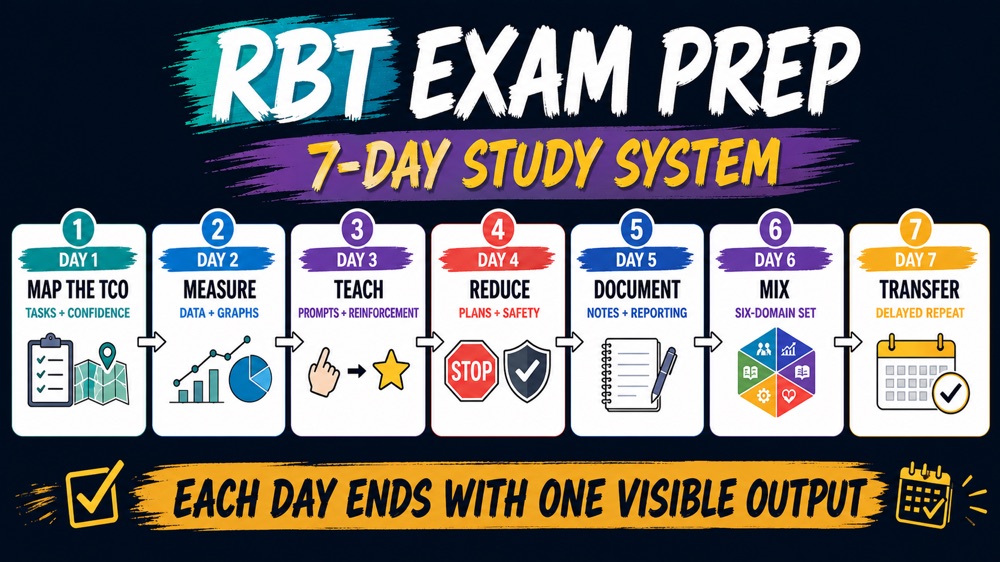
A seven-day plan is a starting template. Adjust the length to your schedule, but keep each day tied to a visible output:
- Day 1 — map: read the current TCO, mark your weakest domains, and create a task list with confidence ratings.
- Day 2 — measure: practice observable definitions, count, rate, duration, latency, interval systems, calculation, and graph interpretation using fresh examples.
- Day 3 — teach: rehearse prompting, fading, reinforcement, shaping, chaining, maintenance, and generalization from written-plan scenarios.
- Day 4 — reduce and protect: identify the plan-based response, safety step, replacement skill, differential reinforcement, or supervisor question in behavior-reduction examples.
- Day 5 — document: write objective notes, report data irregularities, and practice confidentiality, timely communication, and scope boundaries.
- Day 6 — mix: take a short independent set across all six domains, record confidence, and review every missed or uncertain decision.
- Day 7 — transfer: solve changed scenarios for the three largest error groups and schedule a delayed repeat rather than simply retaking the same items.
Each day should end with something you can inspect: a calculation, a graph, a procedure sequence, a corrected note, an error log, or a new scenario explanation. If the output is only “I studied for two hours,” you do not yet know what to repeat.
Practice decisions, not definition lists
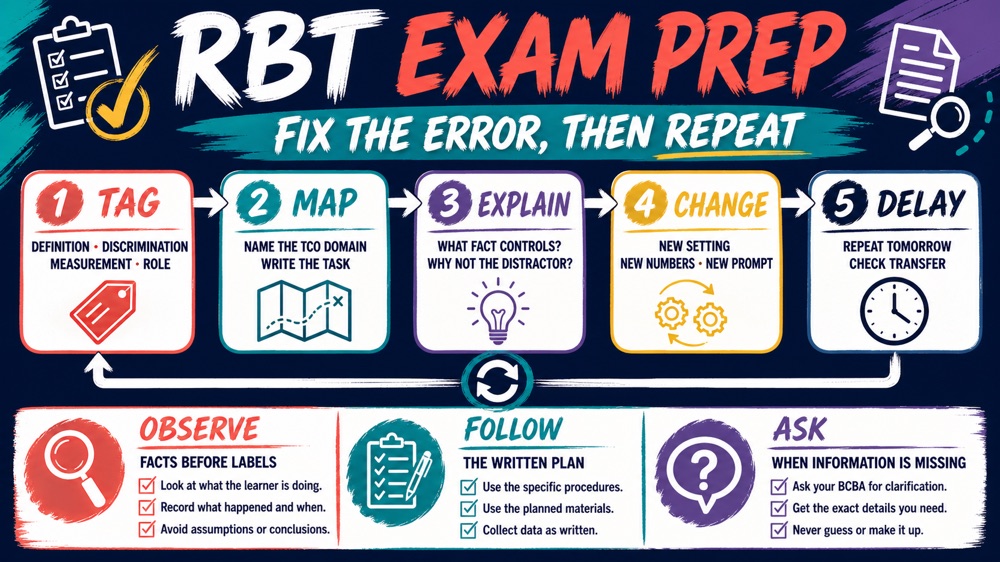
Use a two-pass method for independent questions:
- First pass: identify what happened, what the question asks, and what the written plan says. Choose the best option without searching.
- Second pass: explain the answer, name the TCO task, and reject the strongest distractor using a fact from the stem.
For instance, if a scenario describes 12 responses in 30 minutes and asks for responses per hour, the answer must use the requested time unit. If a note says a learner was “unmotivated,” the correction is to replace the interpretation with observable behavior and report the relevant facts. If a written plan is incomplete at a safety point, the role-appropriate decision is to follow the available safety direction and contact the designated supervisor, not to invent a new procedure.
Change one feature at a time when you create a new example. Change the setting, behavior, timing, prompt, or data values and see whether the same rule still works. This tests transfer and reduces the chance that you are memorizing the surface wording.
Review missed items by error type
Sort mistakes before you choose the next chapter. Use categories such as:
| Error type | What it sounds like | Next correction |
|---|---|---|
| Definition | “I do not know the term.” | Write a plain-language definition and one observable example. |
| Discrimination | “I knew both terms but chose the wrong one.” | List the feature that separates the two in a new scenario. |
| Procedure fidelity | “I selected a reasonable step, but not the written step.” | Underline the plan instruction and rehearse its sequence. |
| Calculation | “The unit or arithmetic was wrong.” | Write the unit before calculating and check the result against the time frame. |
| Role and ethics | “I chose an independent action.” | State what the RBT can implement, document, and escalate. |
Track low-confidence correct answers too. They often show fragile learning. A useful log includes the date, domain, task, confidence, error type, correction rule, and delayed repeat date. When the same error appears twice, reduce the question set and increase explanation quality.
Protect ethics and role boundaries during RBT exam prep
Ethics is not a final page to memorize after the “technical” content. Put it into every practice explanation:
- Do not treat a practice score as an official result or a promise of certification.
- Do not share client-identifying details to make a scenario sound realistic.
- Do not provide clinical advice outside the written plan or your competence.
- Do not describe independent study materials as BACB-approved, affiliated, or endorsed.
- Ask the supervisor or appropriate official channel when the facts do not support a decision.
These boundaries improve reasoning because they force you to distinguish implementation from treatment design, documentation from interpretation, and preparation from certification. They also make your practice notes safer to share with a study partner.
Prepare for the testing session
Use the current Handbook and the instructions in your portal for appointment, identity, accommodations, deadlines, and testing-vendor details. Avoid relying on a generic checklist copied from an old page. The test-session plan should cover:
- the exact identification and appointment instructions shown to you;
- the time and location or online requirements provided by the authorized vendor;
- what to do if a technical, identity, or accommodation question occurs;
- a short sleep, food, and arrival plan that protects attention;
- a final review of concepts and procedures rather than an all-night attempt to memorize more terms.
On practice days, notice whether rushing, changing answers, or losing track of units causes errors. Correct the process before the testing session. The aim is calm, accurate application under the instructions that actually govern your appointment.
Common RBT exam prep mistakes
- Using one score as a verdict: a local score is evidence about one set, not a certification result.
- Studying by search ranking alone: a high-ranking page is not automatically the current primary source.
- Mixing editions: mark legacy notes and compare the current TCO and Handbook before using them.
- Collecting questions without reviewing: volume does not correct a repeated discrimination error.
- Ignoring smaller domains: balance the six-domain map even while spending more time on larger areas.
- Writing explanations that exceed the role: the RBT should implement, document, communicate, and ask—not independently redesign care.
- Calling independent items real or official: preparation content must be labeled honestly.
Bottom line: effective RBT exam prep is a source-grounded loop: map the current TCO, practice an observable decision, explain the procedure and role boundary, correct the error, and repeat it in a changed scenario.
Ready to practice the RBT concepts you just reviewed?
Try an independent, original RBT practice resource with exam-style questions, scoring, and answer explanations.
References
- Behavior Analyst Certification Board. RBT Test Content Outline, 3rd edition.
- Behavior Analyst Certification Board. RBT Handbook.
- Behavior Analyst Certification Board. RBT Ethics Code.