

When you take an RBT mock exam, the most useful result is not the score by itself. A score can tell you where to look, but the missed question, the decisive clue, and the reason you chose an option show you what to study next. A strong mock-exam session therefore has three parts: simulate the task, diagnose the mistake, and transfer the corrected rule to a new situation.
Table of Contents
- What an RBT mock exam should simulate
- How to set up an RBT mock exam session
- Use an RBT mock exam score as a diagnostic
- Review the decision behind each answer
- Compare the six RBT domains before your next attempt
- Common mock-exam mistakes
- Build a two-cycle review plan
- Frequently Asked Questions
- References
The current BACB RBT Test Content Outline, 3rd edition, is the academic map used in this guide. It lists 43 tasks across six domains and describes an examination with 75 scored questions plus 10 unscored pilot questions. The examples in this article are newly written for study. They are not official, recalled, leaked, or BACB-endorsed questions.
What an RBT mock exam should simulate
A useful RBT mock exam should do more than present a long list of vocabulary questions. It should make you read a short situation, identify the relevant RBT task, choose the response that matches the written procedure, and explain why the strongest distractor does not fit. That is the difference between recognizing a familiar term and applying a skill under exam conditions.
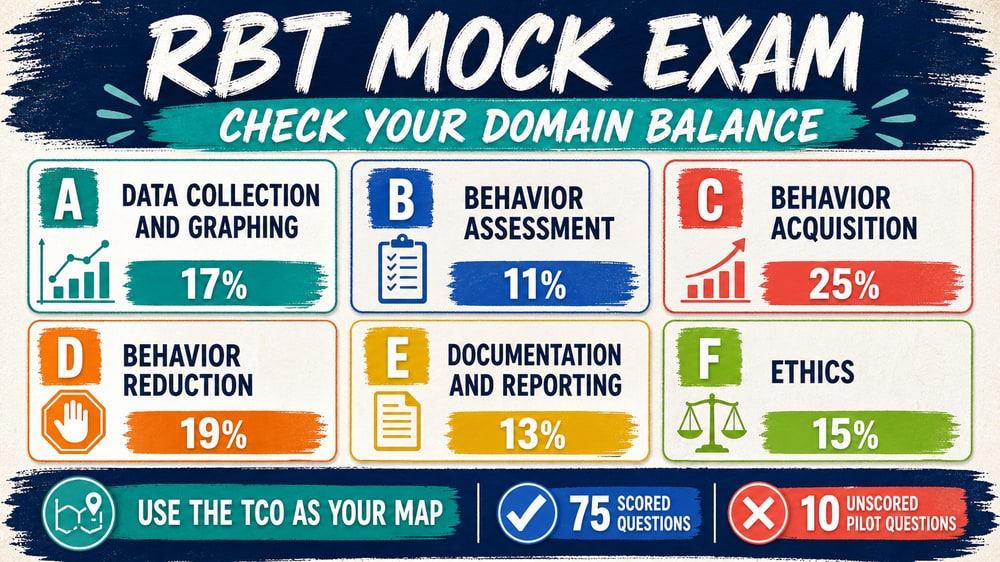
The TCO organizes the scored content into six domains. The percentages below describe the TCO distribution of the 75 scored questions; they are a planning map, not a promise about the order of questions in any independent practice set.
| Domain | TCO share | What to check while reviewing |
|---|---|---|
| A. Data Collection and Graphing | 13 questions / 17% | Can I match the requested measure to its unit, record observable behavior, calculate data, and identify a trend? |
| B. Behavior Assessment | 8 questions / 11% | Can I recognize the purpose of a preference, skill, or functional-assessment procedure and follow the stated steps? |
| C. Behavior Acquisition | 19 questions / 25% | Can I identify reinforcement, teaching, prompting, fading, chaining, discrimination, maintenance, or generalization? |
| D. Behavior Reduction | 14 questions / 19% | Can I identify the function or assigned procedure without inventing a new intervention? |
| E. Documentation and Reporting | 10 questions / 13% | Can I communicate objective facts, data irregularities, client variables, and concerns in a timely way? |
| F. Ethics | 11 questions / 15% | Can I protect confidentiality, work within demonstrated competence, accept supervision, and represent the role accurately? |
Because the TCO includes 10 unscored pilot questions in addition to the 75 scored questions, do not treat a practice provider’s total item count as proof that it reproduces the official examination. Ask what the resource covers, how it explains answers, and whether it clearly labels itself as independent practice.
How to set up an RBT mock exam session
Use the conditions that the practice resource actually states. If it offers a timed full-length simulation, follow that timer; if it offers a shorter set, treat it as a targeted drill rather than calling it a full exam replica. The goal is honest information about your current reasoning, not a dramatic number produced by pausing, searching, or checking every answer immediately.
- Choose the set deliberately. Use a mixed set when you want to test transfer across domains. Use a section set when you are repairing one known weakness. Record the date, item count, and whether the set was timed.
- Remove answer support. Put notes, answer keys, and searchable tabs away. You may keep a blank page for flagging an item, but do not write a definition while the test is in progress.
- Read for the decision point. Underline mentally what the stem actually asks: a measure, a procedure, a documentation step, a supervision response, or an ethics boundary.
- Mark uncertainty without stopping the set. If two options seem plausible, choose the best-supported one, place a small uncertainty mark in your review log, and continue.
- Save the evidence. Keep the question number, chosen option, confidence level, and topic. A score without this record is difficult to use for targeted review.
A realistic session is not a performance of endurance alone. It is a controlled sample of your ability to notice the evidence in a scenario and apply a rule without adding facts that the stem did not provide.
Use an RBT mock exam score as a diagnostic
After an RBT mock exam, sort every item into four groups instead of reviewing only the wrong answers:
- Incorrect and low confidence: the concept or procedure needs direct study. Write the rule in plain language and find a new example.
- Incorrect but high confidence: look for a specific misconception. These errors are especially important because a confident wrong rule can repeat across many questions.
- Correct but low confidence: treat the item as a warning, not as proof of mastery. Explain why the answer fits before you move it into the secure group.
- Correct and well explained: test the same rule with different names, settings, numbers, or distractors so you know it transfers.
For each uncertain or missed item, write four short notes: the topic, the decisive clue, the rule you used, and the rule that should replace it. For example, a question giving six responses during 30 minutes asks for different information depending on whether it requests frequency or rate. Six is the count; six divided by 30 is 0.2 responses per minute. The time unit changes the answer.

Do not let a practice score become a pass guarantee. A score is a study signal from one set of questions. Readiness is stronger when you can explain both the correct choice and the mismatch in the most tempting alternative across several new scenarios.
Review the decision behind each answer
Exam-style reasoning becomes portable when you review the evidence in a repeatable order. Start with the observable facts, identify the task or procedure, check the RBT’s role, and then choose the next action that fits the written plan and supervision structure.
Measurement and assessment distinctions
If the stem asks how often a behavior occurred, frequency is a count. If it asks how long a response lasted, duration is the relevant measure. If it asks for responses per unit of time, rate includes the time unit. If it asks for correct responses out of opportunities, percentage requires a denominator. The wording is not decoration; it identifies the measure.
For assessment questions, distinguish a preference assessment from a skill assessment and from a functional assessment procedure. The best answer should match the purpose and the steps described. Do not select a more elaborate assessment merely because it sounds more clinical.
Acquisition and behavior-reduction distinctions
When a teaching program specifies a prompt sequence, reinforcement arrangement, or task-analysis procedure, the RBT’s job is to implement the written procedure accurately, collect relevant data, and communicate concerns to the supervisor. A question may include a distractor that asks the RBT to change the target, replace the reinforcement schedule, or design a new intervention. That option exceeds the described implementation role unless the stem provides appropriate authorization.
For behavior-reduction items, identify what the stem says about the behavior and the assigned plan before choosing a consequence. Do not infer a function as fact from one brief description. Do not treat extinction, punishment, differential reinforcement, or an antecedent intervention as interchangeable labels. The procedure and the evidence must match.
Documentation, supervision, and ethics distinctions
If data look unusual, a client variable changes, or a caregiver raises a concern, the safer answer usually includes objective documentation and timely clinical direction. The RBT should not hide a data irregularity, improvise outside the plan, or delay a concern because the next session might look different.
Ethics questions often test boundaries that sound ordinary until the stem adds a detail: an unauthorized request for client information, an inaccurate public statement, a task outside demonstrated competence, a gift or multiple relationship, or a supervision problem. Look for the answer that protects the client, represents the RBT role accurately, follows workplace requirements, and seeks supervision when the situation is unclear.
Compare the six RBT domains before your next attempt
Use your error log to decide whether the next set should be mixed or targeted. A practical domain check looks like this:
| If your misses cluster around | Review question | Transfer task |
|---|---|---|
| Data collection and graphing | Did I identify the unit and describe only what is observable? | Calculate or classify a new example with different numbers. |
| Behavior assessment | Did I match the assessment purpose and follow the stated procedure? | Compare two assessment formats and name the decision each supports. |
| Behavior acquisition | Did I identify the teaching step, prompt, reinforcement, or generalization cue? | Explain what changes when the learner responds independently. |
| Behavior reduction | Did I distinguish the assigned plan from an unsupervised redesign? | Identify the evidence and the appropriate supervisor question. |
| Documentation and reporting | Did I record objective facts and escalate a concern in time? | Rewrite an interpretation as an observable session note. |
| Ethics | Did I protect information, competence, supervision, and accurate representation? | Choose the boundary that controls a new workplace scenario. |
This map keeps the review anchored to the TCO rather than to the wording of one commercial question bank. It also prevents a common study mistake: spending all of your time on the most familiar domain because it produces the fastest score improvement.
Common mock-exam mistakes
- Calling independent content official. An original simulation can be useful without being a BACB exam or recalled content.
- Using a score as a guarantee. One result cannot establish readiness or predict an official outcome.
- Practicing only definitions. RBT tasks require application to observable situations, procedures, data, documentation, and supervision.
- Changing the answer because it sounds more advanced. The best choice is the one supported by the evidence and within the described role.
- Ignoring correct guesses. Low-confidence correct answers belong in the review log until you can explain them.
- Reviewing only the topic label. Write the distinction that separated the correct answer from the distractor.
Build a two-cycle review plan
Use two different cycles rather than repeating the same set until the score feels comfortable. In cycle one, complete a mixed RBT mock exam under honest conditions, classify every item, and repair the highest-impact rules. In cycle two, take a fresh mixed set or a targeted section set with new scenarios. Compare the error types, not just the percentages.
A simple weekly record can include the date, set type, item count, domain, confidence, decisive clue, corrected rule, and retest result. If a topic remains weak, return to the official TCO task wording, your approved training materials, and supervisor guidance where the question involves a procedure or boundary that cannot be decided from a definition alone.
For additional independent practice, review the site’s RBT exam-prep materials, use the section practice to isolate a domain, and try the free RBT mock exam when you want a broader check. Those resources support preparation; they are not official BACB content.
Bottom line: a mock exam earns its place in your study plan when it shows the decision you can make, the distinction you still confuse, and the next rule you need to transfer.
Ready to practice the RBT concepts you just reviewed?
Try an independent, original RBT practice resource with exam-style questions, scoring, and answer explanations.
References
- Behavior Analyst Certification Board. RBT Test Content Outline, 3rd edition.
- Behavior Analyst Certification Board. RBT Handbook.
- Behavior Analyst Certification Board. RBT Ethics Code.