
RBT practice exam questions are most useful when a timed attempt is followed by an equally deliberate review. Take the set under clear conditions, mark confidence, identify the decision behind each missed item, and schedule a changed scenario for the second attempt.
Table of Contents
- What RBT practice exam questions can tell you
- Check the current TCO before using practice exam questions
- Set up a timed RBT practice exam
- Use a three-pass answer strategy
- Review RBT practice exam questions after the clock
- Six original practice decisions
- Build the second attempt
- Common RBT practice-exam mistakes
- Frequently Asked Questions
- References
The current BACB RBT Test Content Outline, 3rd edition, maps 43 tasks across six domains. The current examination blueprint describes 75 scored questions and 10 unscored pilot questions. Independent practice exam questions can use another length, order, or interface. The examples in this article are newly written for study and are not official, recalled, leaked, or BACB-endorsed questions. A practice score cannot guarantee certification or a passing result.
Use this guide to prepare a short timed set, manage the first pass, review the second pass, and convert errors into a targeted next block. It supports preparation; it does not replace the current BACB Handbook, TCO, training, competency assessment, supervision, or official testing instructions.
What RBT practice exam questions can tell you
A timed set gives local evidence about a study process. It can show whether you:
- read the action word before reacting to a familiar term;
- separate observable facts from labels or inferred motives;
- match the measurement unit to the question and time frame;
- follow the written plan instead of inventing a new step;
- recognize when the RBT should implement, document, communicate, or ask.
It cannot establish clinical competence, replace direct observation or a competency assessment, or predict the exact experience of an official examination. Treat the score as a signal about this set under these conditions. The explanations and error tags are more valuable than the percentage alone.
For example, a learner may answer 18 of 20 items correctly but miss every question that asks for the requested measurement unit. That score looks strong while the error pattern points to a precise correction.
Check the current TCO before using practice exam questions
Use the current TCO to decide whether your set is broad or focused:
| Domain | Tasks / share | Timed-set signal |
|---|---|---|
| A. Data Collection and Graphing | 13 / 17% | Measurement, calculations, graphing, definitions, and data quality. |
| B. Behavior Assessment | 8 / 11% | Assessment purpose, assigned procedures, and role boundaries. |
| C. Behavior Acquisition | 19 / 25% | Teaching, prompts, fading, reinforcement, maintenance, and generalization. |
| D. Behavior Reduction | 14 / 19% | Written plans, safety, function-informed procedures, and fidelity. |
| E. Documentation and Reporting | 10 / 13% | Objective notes, timely communication, irregularities, and privacy. |
| F. Ethics | 11 / 15% | Competence, supervision, boundaries, public statements, and confidentiality. |
The 43 tasks are the scope map. The 75 scored and 10 unscored pilot questions describe the current blueprint. Neither number authorizes a third-party practice set to call itself an official form. Label your set as broad, domain-focused, or correction-focused before you begin.
Set up a timed RBT practice exam
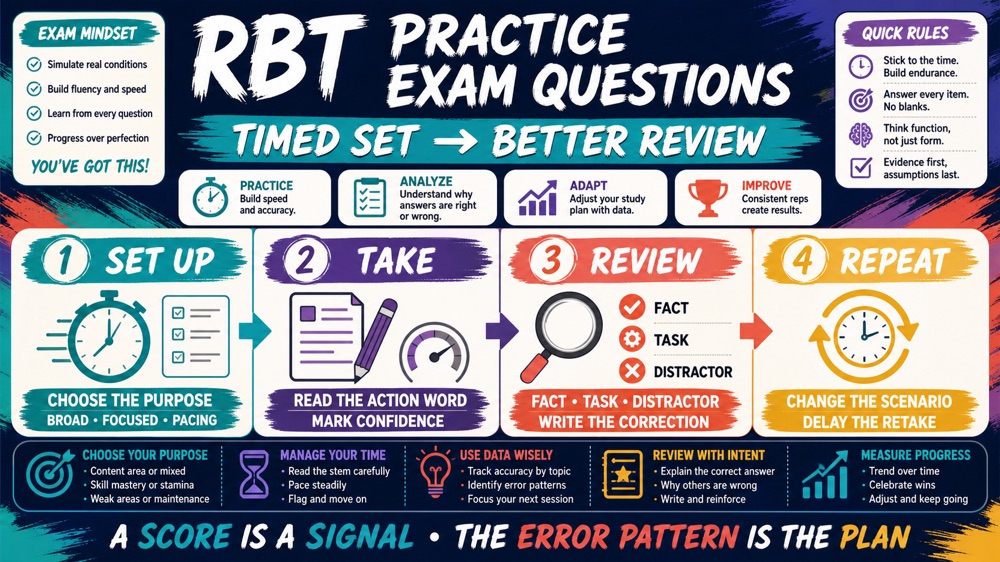
A useful setup reduces noise without pretending to reproduce official testing conditions:
- Choose the purpose: broad sample, weak-domain correction, or pacing practice.
- Choose the set length: use a manageable block and record that it is independent.
- Prepare a confidence mark: high, medium, or low beside every answer.
- Remove answer cues: do not read explanations or search terms during the first pass.
- Plan the review window: reserve at least as much attention for explanations as for the attempt.
Use the current official Handbook and portal instructions for actual examination timing, identity, accommodations, and testing-vendor rules. A third-party timer is a study tool, not an official appointment instruction.
Use a three-pass answer strategy
- Pass 1 — answer: read the stem, identify the action requested, choose the best-supported option, and mark confidence.
- Pass 2 — flag: return to low-confidence items, compare the two strongest options, and use the facts in the stem rather than technical-sounding language.
- Pass 3 — review: after time ends, explain missed and uncertain decisions using the TCO task, written procedure, and role boundary.
Do not spend the entire block rescuing one difficult item. If the stem does not provide enough information, the role-appropriate answer may involve following the stated direction and asking a supervisor or designated professional. Mark the uncertainty and continue.
For example, if a written teaching plan specifies a verbal model before an independent response, an option that replaces the sequence is not better merely because it sounds more advanced. The plan instruction controls the decision.
Review RBT practice exam questions after the clock
Use an error table after the timed attempt:
| Review line | Question | Example |
|---|---|---|
| Observable fact | What was directly seen, heard, counted, or timed? | “12 responses in 30 minutes.” |
| Action word | What did the stem ask me to do? | “Calculate responses per hour.” |
| TCO task | Which domain or task fits? | “A measurement calculation decision.” |
| Distractor | Why did the tempting option fail? | “Count alone omits the requested time unit.” |
| Next repeat | What will change in the new scenario? | “Different setting and observation length.” |
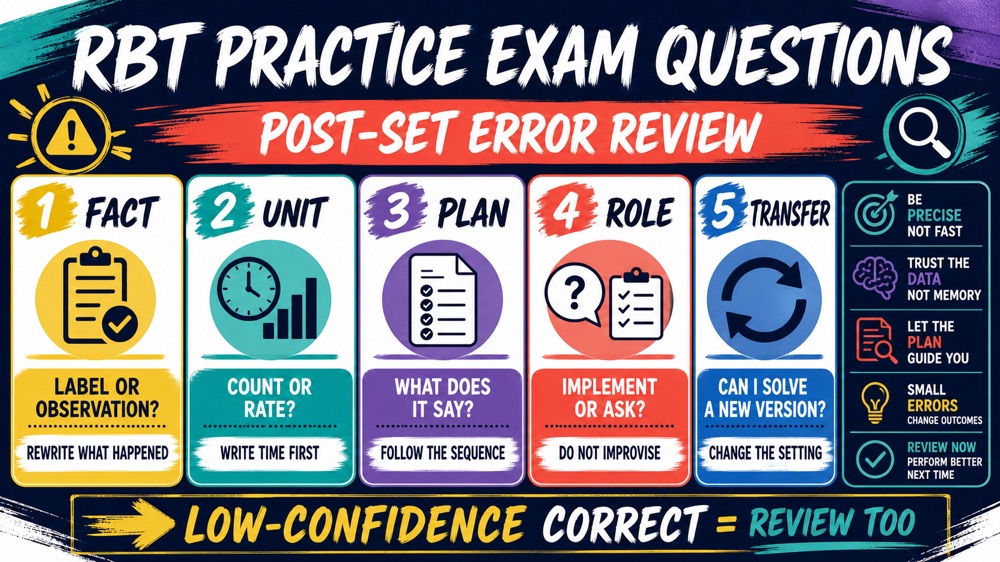
Review low-confidence correct answers as well as wrong answers. A lucky selection may need the same correction. Write one short rule, close the answer key, and solve a changed example later.
Six original practice decisions
The following are newly written study prompts, not official, recalled, leaked, or BACB-endorsed questions:
- Measurement: 12 responses occur during 30 minutes and the procedure requests responses per hour. Convert to the requested time unit rather than reporting count alone.
- Documentation: a learner leaves the table for 40 seconds after an instruction. Record the observable action and duration; do not write a motive or label.
- Prompting: the plan names a verbal model before an independent response. Follow and record that step instead of inventing a new hierarchy.
- Assessment: a supervisor assigns a preference procedure. Prepare, follow the sequence, record choices, and report questions; do not redesign the assessment.
- Behavior reduction: a safety detail is missing from the plan. Follow available safety direction and contact the supervisor or designated professional rather than improvising.
- Ethics: someone asks for a recognizable client photo for a public success post. Follow privacy requirements and ask the supervisor before sharing.
Use the same explanation structure for all six: fact, task, action, distractor, and next repeat. This is how a timed set becomes a learning loop.
Build the second attempt
The second attempt should not be a copy of the first. Choose the largest error group and change one surface feature:
- change the time frame while keeping the measurement question;
- change the setting while keeping the written prompt sequence;
- change the behavior while keeping the objective-documentation rule;
- change the missing information while keeping the escalation boundary;
- change the distractor wording while keeping the same best-fit decision.
Delay the repeat by at least one study block. Immediate retakes can measure recognition of the answer page rather than transfer. Compare confidence with accuracy and update the next TCO task.
Common RBT practice-exam mistakes
- Calling a third-party set real or official: independent questions need honest labels.
- Using score as a promise: a local score cannot guarantee certification or a passing result.
- Ignoring the error pattern: the missed decision matters more than the raw percentage.
- Changing the plan in an answer: the RBT should implement, document, communicate, and ask within role.
- Skipping low-confidence correct answers: uncertainty belongs in the review log.
- Repeating the same items immediately: change the scenario and delay the repeat.
Bottom line: effective RBT practice exam questions combine a clear purpose, current TCO coverage, a calm first pass, precise rationale review, and a changed second attempt.
Ready to practice the RBT concepts you just reviewed?
Try an independent, original RBT practice resource with exam-style questions, scoring, and answer explanations.
References
- Behavior Analyst Certification Board. RBT Test Content Outline, 3rd edition.
- Behavior Analyst Certification Board. RBT Handbook.
- Behavior Analyst Certification Board. RBT Ethics Code.