
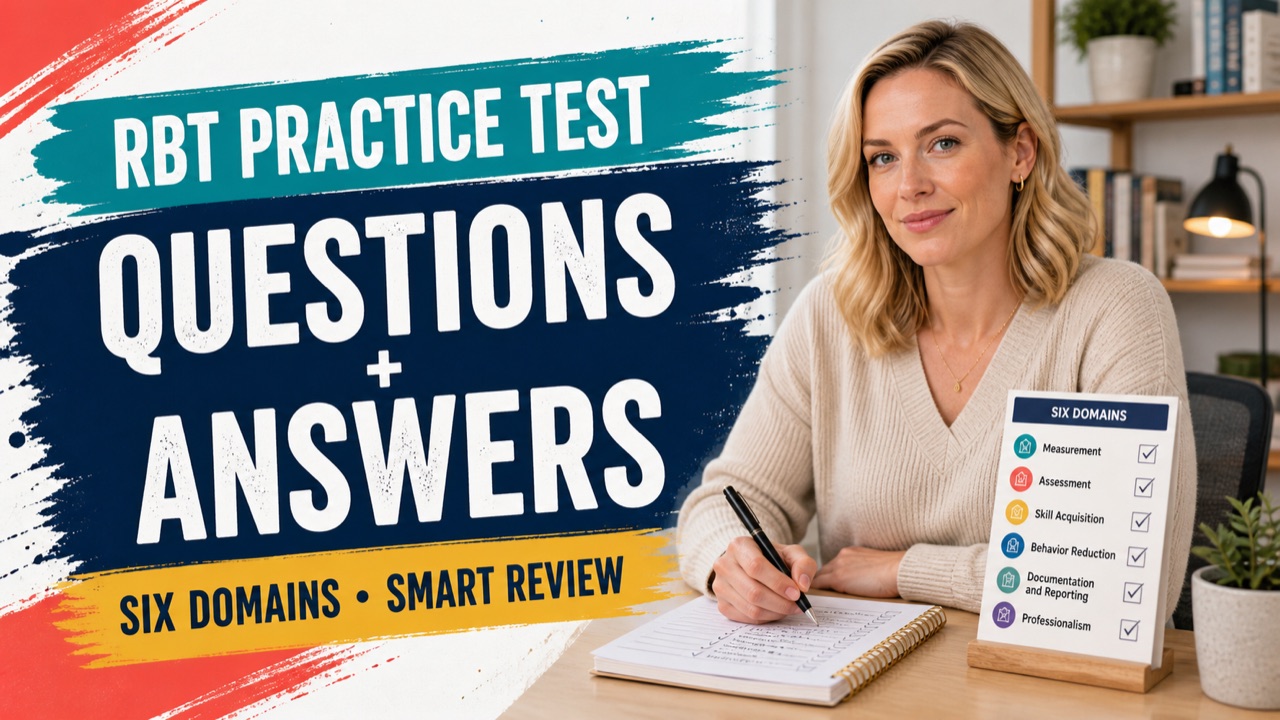
When people search for an RBT practice test, they may want a quick score, a full simulation, or a way to decide what to study next. Those are different uses. A useful practice test should help you apply the current RBT content outline to short scenarios, explain why an option fits, and show which rule needs more work. It should not be presented as the BACB examination or as a source of official, recalled, leaked, or BACB-endorsed questions.
Table of Contents
- What an RBT practice test should measure
- How to choose an RBT practice test aligned with the current TCO
- Set up an RBT practice test like a diagnostic
- Read an RBT practice test score by domain
- Review each RBT practice test question using the written procedure
- Common RBT practice test mistakes to avoid
- A two-pass RBT practice test study plan
- Frequently Asked Questions
- References
This guide uses the Behavior Analyst Certification Board’s RBT Test Content Outline, 3rd edition, as the academic map. The TCO lists 43 tasks across six domains, with 75 scored questions and 10 unscored pilot questions described for the examination. A practice provider can use a different number, order, timer, and score scale. A practice result is therefore an independent study signal, not a BACB passing score or a prediction of an official result, and it cannot guarantee a passing result.
The goal is simple: take an independent set under consistent conditions, sort the evidence behind each answer, and turn the pattern into a focused review plan.
What an RBT practice test should measure
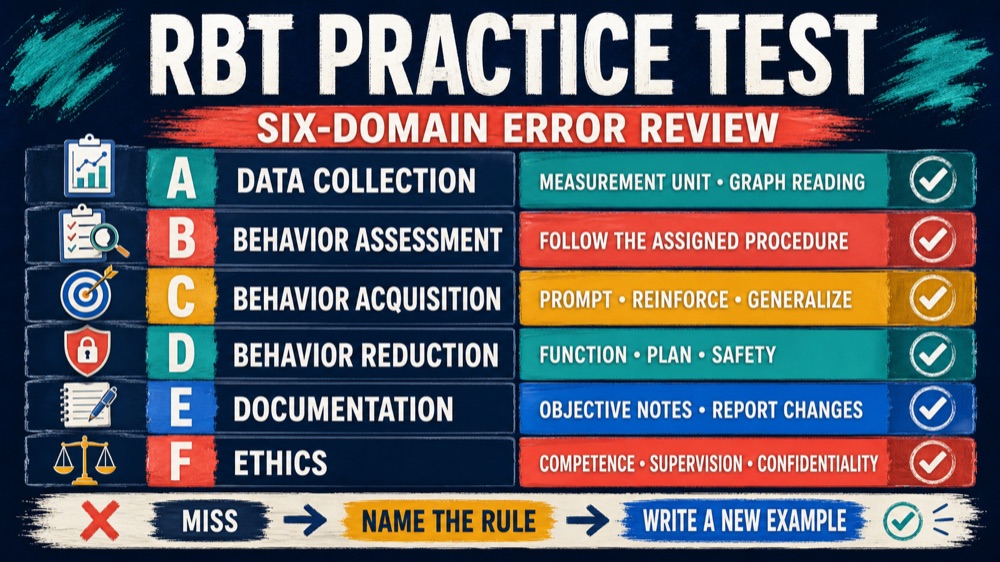
A strong practice set samples more than vocabulary. It asks you to identify what is observable, match a measurement system to the behavior, follow a written teaching or behavior-reduction procedure, communicate accurately, and recognize when supervisor direction is required. These decisions connect directly to the six domains in the current TCO.
| TCO domain | Scored share | Practice decision to rehearse |
|---|---|---|
| A. Data Collection and Graphing | 13 / 17% | Choose the correct measurement, calculate or record it accurately, and read a graph without adding an interpretation as if it were data. |
| B. Behavior Assessment | 8 / 11% | Follow the assigned preference, skill, or functional-assessment procedure and identify the RBT’s role in the process. |
| C. Behavior Acquisition | 19 / 25% | Apply reinforcement, prompting and fading, shaping, chaining, discrimination, maintenance, and generalization as written. |
| D. Behavior Reduction | 14 / 19% | Connect observable behavior to the plan, use approved procedures, and respond safely when a crisis or escalation procedure applies. |
| E. Documentation and Reporting | 10 / 13% | Describe events objectively, protect records, report variables and irregularities, and seek direction when the plan is unclear. |
| F. Ethics | 11 / 15% | Respect competence, supervision, confidentiality, professional boundaries, public statements, gifts, and cultural humility. |
The percentages are a planning map for the 75 scored questions in the TCO. They are not a promise that an independent set will reproduce those exact proportions. A good RBT practice test makes its scope visible so you can tell whether a low result reflects one neglected domain or a broader application problem.
How to choose an RBT practice test aligned with the current TCO
Search results for practice tests often emphasize free access, 85-question simulations, instant scores, or large question banks. Those features may be convenient, but they do not establish academic quality. Before you start an RBT practice test, check the resource itself against the following questions.
- Does it name the edition? The page should identify the current TCO or clearly state how its categories were mapped. Topic labels copied from an older outline can create gaps.
- Does it cover all six domains? Measurement and skill acquisition are important, but documentation, reporting, and ethics also belong in the study map.
- Are the items scenario-based? A definition-only quiz may help with recall. Application items should include a setting, an observable event, a written procedure, or a role boundary that changes the best answer.
- Are explanations more than answer letters? A useful explanation identifies the decisive clue, states the applicable rule, and rejects the strongest distractor.
- Is the source boundary honest? The provider should not claim to reproduce official or recalled BACB questions. Independent content should be labeled as independent.
- Is the scoring language careful? A percentage from one provider is not an official passing standard. Be cautious with claims that a score predicts certification or guarantees success.
If you use a free quiz, save the URL, access date, number of items, and whether explanations were available. If you use a paid bank, record the same information. That small record lets you compare resources without confusing a different format with a change in your actual skill.
Set up an RBT practice test like a diagnostic
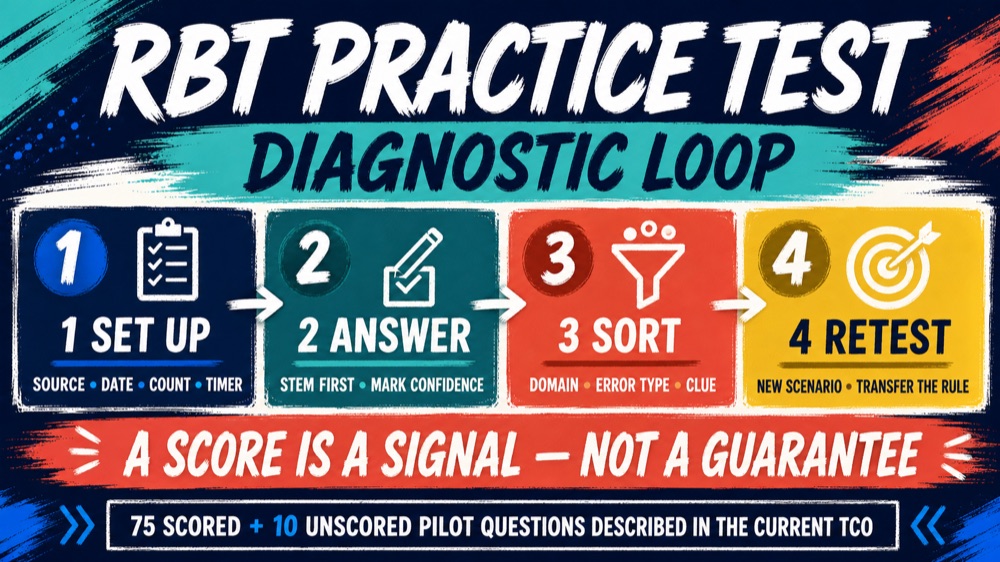
A practice score becomes more useful when the conditions are predictable. You do not need to make every study session stressful, but you should decide what the result is meant to tell you. A diagnostic set can be open-book and untimed; a simulation set can restrict help and use a timer. Do not mix the interpretations.
- Write the setup. Record the source, date, item count, timer, whether the set is mixed or domain-specific, and what help is allowed.
- Answer from the stem first. Select the best-supported option before looking up a definition. If you need to check a term, mark the item as low confidence.
- Track confidence. Label each response high, medium, or low confidence. A correct low-confidence answer belongs in the review log because it may be a lucky selection.
- Mark the decision point. Note whether the item turned on a measurement unit, a procedure step, a supervisor response, a safety concern, or an ethics boundary.
- Keep the misses. Save the item number, domain, error type, and corrected rule. A total score without this record cannot tell you what to review.
Do not change the meaning of a provider’s score by silently adding the TCO’s 10 unscored pilot questions. The TCO describes 75 scored questions and 10 unscored pilot questions for the examination. An independent resource should be described using its own count, not relabeled to sound official.
Read an RBT practice test score by domain
Once the set is complete, calculate the overall percentage if the provider supplies a transparent rule. Then go deeper. Sort incorrect and low-confidence responses by TCO domain and by the type of decision you missed.
| Error pattern | What it may mean | Next review action |
|---|---|---|
| Knowledge gap | You did not recognize a concept, term, or task. | Read the relevant TCO task and write a plain-language definition with one example. |
| Application gap | You knew the term but selected the wrong action in the scenario. | Underline the observable clue and explain how it changes the procedure. |
| Measurement gap | You confused count, duration, rate, latency, percentage, or another unit. | Rewrite the requested unit and calculate a new example with different numbers. |
| Role-boundary gap | You chose an option that asks the RBT to redesign a plan or act beyond competence. | Mark where the written plan, supervisor, or demonstrated competence controls the next step. |
| Reading or pacing error | You knew the rule but missed a qualifier, time unit, or exception. | Practice identifying the exact question before comparing answer choices. |
For a simple measurement example, imagine six responses in 30 minutes. If the question asks for count, the answer is six responses. If it asks for rate, time belongs in the answer: 0.2 responses per minute. The numbers are not the difficult part; matching the requested unit is. A strong explanation should make that distinction visible instead of merely marking one answer letter correct.
Look for clusters, not isolated drama. Three mistakes in one measurement distinction may deserve an immediate measurement review. One missed ethics item should still be understood, but it does not automatically mean the entire ethics domain is weak. Your next action should be proportional to the evidence.
Review each RBT practice test question using the written procedure
The review phase is where an RBT practice test becomes a learning tool. For each incorrect or low-confidence item, use four short passes.
Start with observable evidence
Separate what was seen, heard, counted, timed, or recorded from a hypothesis about why it happened. A function hypothesis may guide discussion, but it is not automatically an observable fact. The distinction matters in data collection, graphing, documentation, and behavior-reduction items.
Identify the assigned procedure
Ask whether the stem names a preference assessment, skill assessment, teaching program, prompt sequence, reinforcement arrangement, behavior-reduction plan, or crisis procedure. Select the answer that follows the written procedure. Do not choose an unapproved intervention merely because it sounds more advanced.
Check the next safe action
If data are unusual, a client variable changes, a caregiver raises a concern, or the plan is unclear, accurate documentation and timely supervisor direction are usually central. The RBT should not conceal the irregularity, improvise outside the plan, or delay a question to protect a score.
Reject the strongest distractor precisely
Write one sentence explaining why the best distractor fails. It may use the wrong measurement unit, confuse acquisition with maintenance, treat extinction and punishment as synonyms, ignore confidentiality, or ask the RBT to change a target without authorization. Naming the mismatch transfers better than memorizing an answer letter.
Common RBT practice test mistakes to avoid
- Confusing a provider’s count with the official structure. A practice bank may use 20, 75, or 85 items. Check what the resource actually measures.
- Calling independent content official. A polished interface or a large question bank is not BACB endorsement.
- Studying only the biggest domain. The TCO distribution helps prioritize, but ethics and documentation errors can still change the safest answer.
- Ignoring low-confidence correct answers. A guess that happened to be correct is evidence for review, not proof of mastery.
- Changing the procedure in the name of creativity. RBT application questions often reward following the written plan and seeking direction when it does not cover the situation.
- Using answer explanations as a script. Rewrite the rule in your own words and apply it to a new scenario.
A two-pass RBT practice test study plan
Use the first pass to repair the highest-impact distinctions. Select one error cluster from each domain represented in your misses, read the related TCO task, rewrite the rule, and create a fresh example. Use the second pass to test transfer with new names, numbers, settings, or distractors. If you remember the old answer letter but cannot explain the rule, the item is not repaired yet.
- Pass one: diagnose. Sort every miss and low-confidence answer by domain and error pattern.
- Pass two: transfer. Complete a new mixed set or a different section set without copying the original wording.
- Close the loop. Compare the new error pattern with the first one and schedule the next review from evidence, not anxiety.
For additional practice, compare the site’s RBT exam-prep materials, use section practice for a focused domain, and return to the free RBT mock exam for broader rehearsal. Use the official RBT Test Content Outline as the map and the RBT Handbook for current certification-process context. These study resources are independent and should not be confused with the official examination.
Bottom line: the best RBT practice test is not the one that gives the most comforting percentage. It is the one that shows which decision rule you can apply, which distinction you still confuse, and what you should study next.
Ready to practice the RBT concepts you just reviewed?
Try an independent, original RBT practice resource with exam-style questions, scoring, and answer explanations.
References
- Behavior Analyst Certification Board. RBT Test Content Outline, 3rd edition.
- Behavior Analyst Certification Board. RBT Handbook.
- Behavior Analyst Certification Board. RBT Ethics Code.