
A registered behavior technician practice exam can be a useful study tool when you know exactly what it measures. Use an independent set to rehearse observable decisions, follow written procedures, mark uncertainty, and identify the correction for your next study block.
Table of Contents
- What a registered behavior technician practice exam can measure
- Map the registered behavior technician practice exam to the current TCO
- Prepare the practice session
- Read each question by fact, plan, and role
- Review errors after a registered behavior technician practice exam
- Original independent practice decisions
- Separate preparation from certification
- Common registered behavior technician practice-exam mistakes
- Frequently Asked Questions
- References
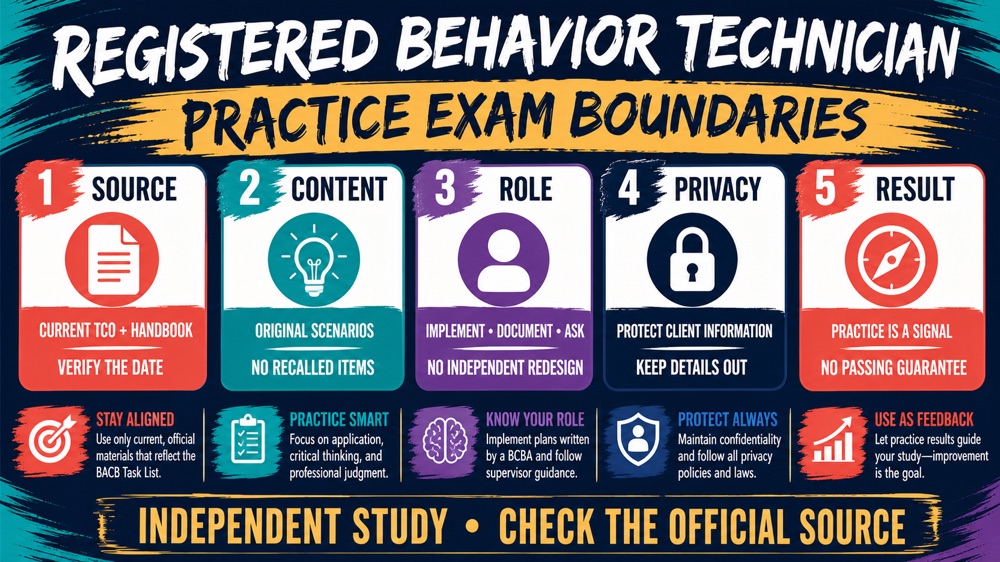
The current BACB RBT Test Content Outline, 3rd edition, maps 43 tasks across six domains. The current examination blueprint describes 75 scored questions and 10 unscored pilot questions. A third-party practice exam may use a different length or interface. The examples below are newly written for study and are not official, recalled, leaked, or BACB-endorsed questions. RBT Training is an independent study-material site, not a BACB certification program, and practice cannot guarantee certification or a passing result.
This guide explains how to check scope, take a practice set, review answers, and protect the difference between preparation and the actual RBT certification process. Use the current BACB Handbook, TCO, training materials, competency packet, and Ethics Code as primary sources for their own requirements.
What a registered behavior technician practice exam can measure
An independent set can give you local evidence about whether you can:
- identify an observable target instead of a label or inferred motive;
- match count, rate, duration, latency, or interval recording to the scenario;
- follow the written teaching or behavior-reduction procedure;
- recognize what an RBT can implement, document, communicate, or escalate;
- explain why the strongest distractor is not supported by the facts.
It cannot establish clinical competence by itself. It does not replace a competency assessment, direct observation, supervision, required training, or official application and testing instructions. A score is a snapshot from one independent set and should be read with its error pattern.
For example, a learner can score well overall and still repeatedly confuse count with rate. The useful conclusion is not “I am ready” or “I am not ready.” It is “I need a measurement-unit correction and a delayed repeat with a changed time frame.”
Map the registered behavior technician practice exam to the current TCO
| Domain | Tasks / share | Practice decision |
|---|---|---|
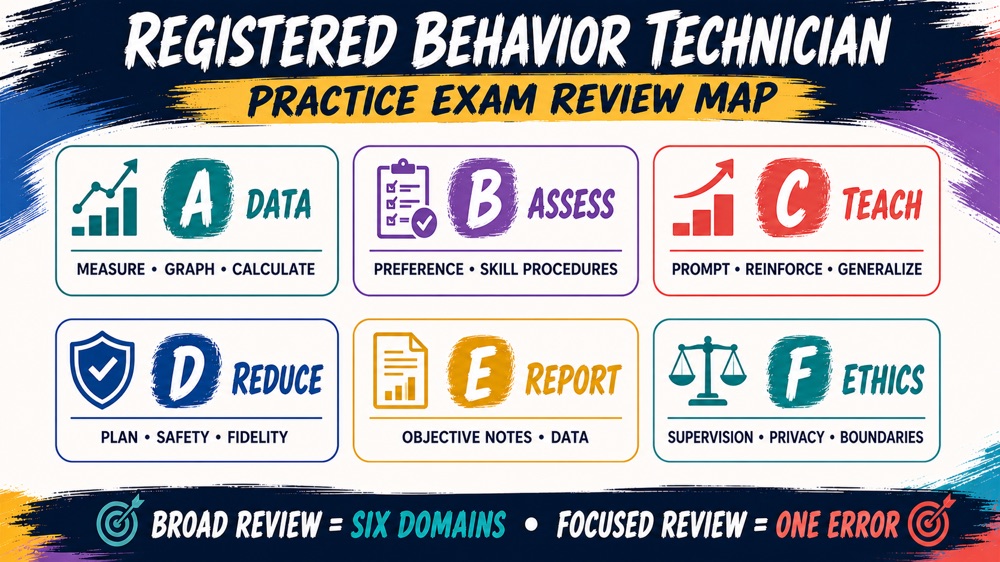
| A. Data Collection and Graphing | 13 / 17% | Define, measure, calculate, graph, and describe data. |
| B. Behavior Assessment | 8 / 11% | Follow assigned assessment procedures and role boundaries. |
| C. Behavior Acquisition | 19 / 25% | Implement prompts, reinforcement, teaching, maintenance, and generalization. |
| D. Behavior Reduction | 14 / 19% | Follow plans, protect safety, and maintain fidelity. |
| E. Documentation and Reporting | 10 / 13% | Write objective notes and report concerns accurately. |
| F. Ethics | 11 / 15% | Protect competence, supervision, boundaries, and privacy. |
The 43 tasks define the scope map. The 75 scored and 10 unscored pilot questions describe the current examination blueprint. These facts do not make a third-party set official. Use the map to label a broad set, a focused correction set, or a pacing block before you begin.
Prepare the practice session
- Choose the goal: broad coverage, a weak domain, decision discrimination, or pacing.
- Choose the length: a short set is useful when every item receives a review note.
- Mark confidence: use high, medium, or low before checking the key.
- Protect the first pass: do not search every term or read explanations between items.
- Reserve review time: plan the correction before starting the timer.
Use current official instructions for the actual examination appointment, timing, identity, accommodations, and testing vendor. A practice timer is a study aid, not a substitute for those instructions.
Read each question by fact, plan, and role
Read each item in four steps:
- Action: what does the stem ask you to measure, record, implement, report, or identify?
- Fact: what was directly observed or explicitly written?
- Plan: what procedure, prompt, criterion, or safety direction is stated?
- Role: should the RBT implement, document, communicate, or ask for direction?
Eliminate options that invent a motive, change a plan without direction, skip documentation, or exceed the RBT role. Technical language is not evidence. The best answer is the option that fits the exact facts.
For example, if a plan specifies a verbal model before an independent response, do not select an option that replaces the sequence with a new prompt hierarchy. If a safety direction is missing, do not improvise a consequence; follow available instructions and contact the appropriate supervisor or professional.
Review errors after a registered behavior technician practice exam
Use five lines for every missed or low-confidence item:
| Line | Question | Example |
|---|---|---|
| Fact | What happened? | “12 responses occurred in 30 minutes.” |
| Task | What TCO decision is this? | “Measurement and time-unit selection.” |
| Plan | What does the written procedure say? | “Report responses per hour.” |
| Distractor | Why is the tempting option wrong? | “Count omits the requested time unit.” |
| Repeat | What changes next time? | “New setting and observation length.” |
Review low-confidence correct answers too. A correct letter without a stable explanation is a review signal. Close the answer key, write one correction rule, and solve a changed scenario after a delay.
Original independent practice decisions
These newly written examples are not official, recalled, leaked, or BACB-endorsed questions:
- Measurement: 12 responses occur in 30 minutes and the requested unit is per hour. Use the time conversion rather than count alone.
- Documentation: a learner leaves the table for 40 seconds. Write the observable action and duration, not “defiant” or an assumed motive.
- Teaching: the plan specifies a verbal model before an independent response. Follow and record the written step.
- Assessment: a supervisor assigns a preference procedure. Prepare, follow the sequence, record choices, and report questions.
- Reduction: a plan does not specify a safety response. Follow available safety instructions and ask rather than inventing a consequence.
- Ethics: a family requests a recognizable public client photo. Follow privacy requirements and consult the supervisor before sharing.
The goal is to practice the decision rule, not to imitate a remembered item. Change the setting, data, or wording and solve again later.
Separate preparation from certification
RBT Training provides independent study support. It does not operate the BACB certification program, approve applications, administer the official examination, perform a competency assessment, or decide certification status. A practice exam does not replace:
- the current BACB Handbook and application instructions;
- the applicable 40-hour training and competency assessment materials;
- supervision and direction from the responsible professional;
- the official examination authorization and testing instructions;
- the Ethics Code and current maintenance requirements.
Keep source dates in your study notes and verify changes through the official BACB channel. Do not store sensitive client or portal information in a public question bank.
Common registered behavior technician practice-exam mistakes
- Using a score as a guarantee: one independent set cannot predict certification.
- Calling third-party content official: practice questions need honest labels.
- Ignoring the task map: a narrow set does not show broad coverage.
- Choosing a plausible but unwritten procedure: follow the plan and ask when it is incomplete.
- Skipping uncertainty: low-confidence correct answers belong in the correction log.
- Repeating immediately: delay and change the scenario to test transfer.
Bottom line: a strong registered behavior technician practice exam is an independent rehearsal that uses the current TCO, observable facts, written procedures, honest role boundaries, and a specific delayed correction.
Ready to practice the RBT concepts you just reviewed?
Try an independent, original RBT practice resource with exam-style questions, scoring, and answer explanations.
References
- Behavior Analyst Certification Board. RBT Test Content Outline, 3rd edition.
- Behavior Analyst Certification Board. RBT Handbook.
- Behavior Analyst Certification Board. RBT Ethics Code.