
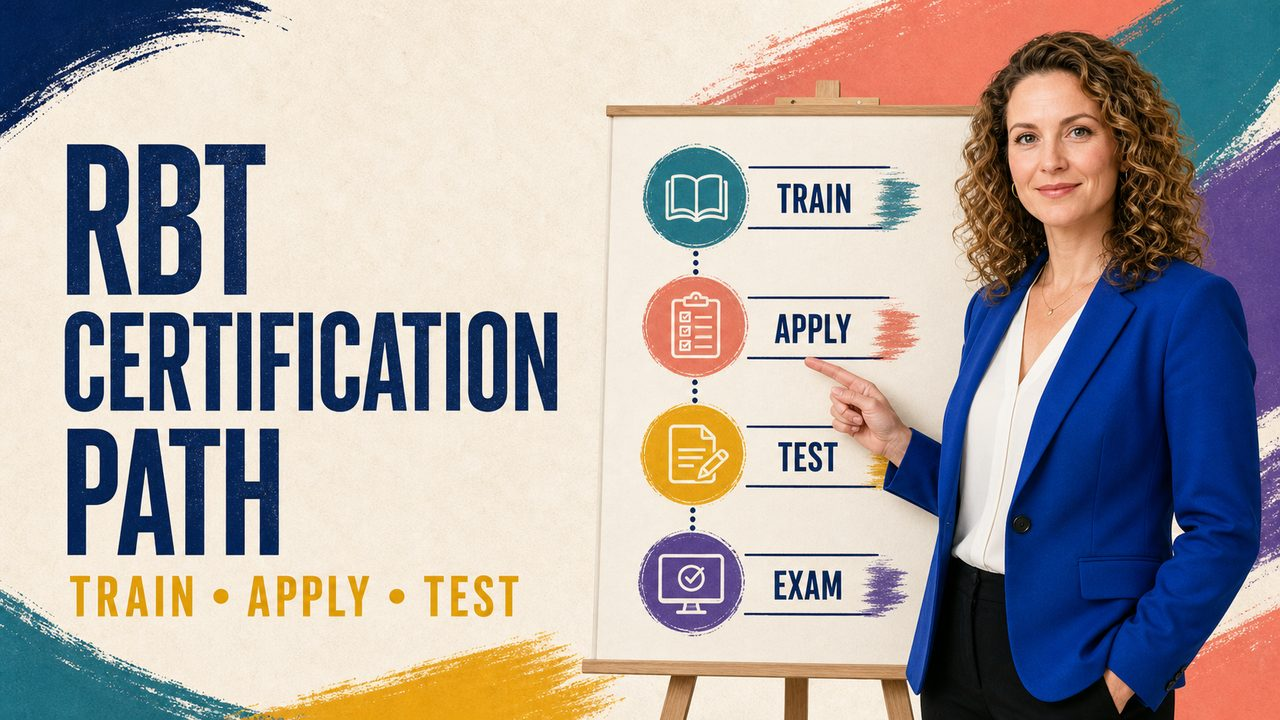
If you search for registered behavior technician RBT certification, start with one important distinction: the Behavior Analyst Certification Board (BACB) grants the RBT credential. A course, employer, study website, or training provider can help you meet a requirement or prepare for the exam, but it does not issue BACB certification.
Table of Contents
- Registered behavior technician RBT certification: what it means
- The current 2026 registered behavior technician RBT certification checklist
- How the 40-hour training document fits the RBT path
- How the Initial Competency Assessment fits
- Application, attestation, and the Pearson VUE examination
- Who does what in registered behavior technician RBT certification?
- A document audit before you submit
- What happens after you earn the RBT credential?
- Common certification mistakes
- Frequently Asked Questions
- References
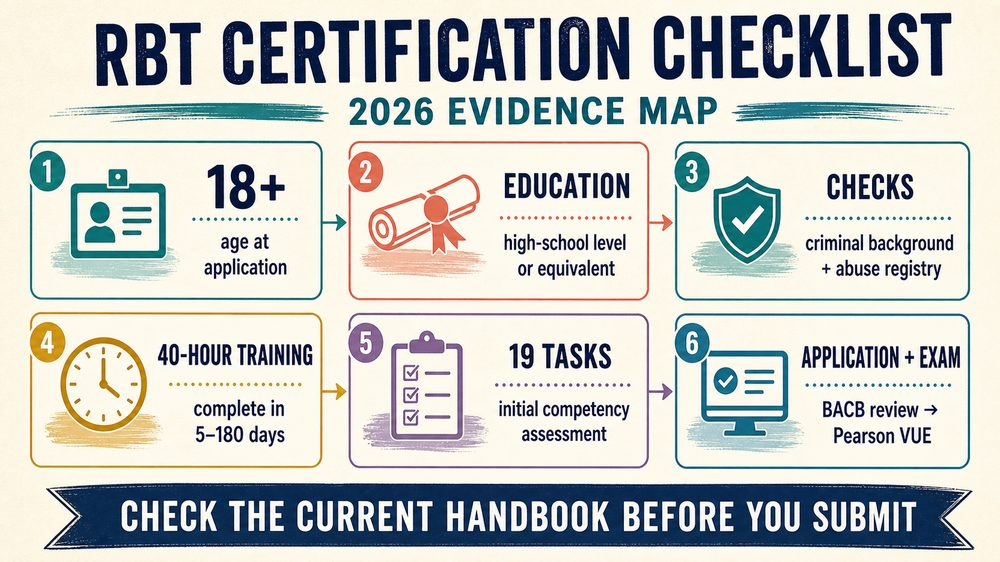
For applications submitted under the current 2026 rules, candidates generally need to document age, education, background checks, qualifying 40-hour training, an Initial Competency Assessment, an attestation, and the RBT examination. The exact evidence and deadlines belong to the current RBT Handbook and linked BACB forms, so read those documents before paying an application fee.
The formal exam is a separate checkpoint: 85 multiple-choice questions in 90 minutes, with 75 scored questions and 10 unscored questions. The current RBT Test Content Outline (3rd ed.) contains 43 tasks across six domains. RBT Training’s practice explanations are independent study content, not official, recalled, leaked, or BACB-endorsed questions.
This guide is an evidence map, not a promise of approval, certification, employment, or passing. Employers, payers, and jurisdictions may impose additional requirements. Verify the live BACB documents when your application timing or personal situation is unusual.
Registered behavior technician RBT certification: what it means
An RBT is a paraprofessional credential issued through the BACB. The credential recognizes entry-level behavior-analytic service delivery under ongoing supervision and within a defined scope. It is not the same as a state professional license, a university degree, a 40-hour course certificate, or a job title created by an employer.
| Document or event | What it proves | Who controls it |
|---|---|---|
| 40-hour training certificate | You completed a qualifying training program and its required approval statement. | Training provider and qualified trainer, subject to BACB requirements. |
| Initial Competency Assessment | You demonstrated the required practical tasks to a qualified assessor. | Responsible assessor, using the current BACB packet. |
| Certification application and attestation | Your application evidence and required declarations were submitted. | BACB portal and qualified attesting certificant. |
| RBT examination | You completed the formal computer-based certification exam. | BACB examination program and Pearson VUE. |
| RBT credential | BACB certification after the application and examination requirements are satisfied. | BACB. |
For example: finishing a 40-hour course may give you a certificate, but it does not by itself make you an RBT. You still need the current competency assessment, application evidence, approval, and examination steps described by BACB. A study website can help you review concepts, but it cannot sign your clinical assessment or approve your application.
The current 2026 registered behavior technician RBT certification checklist
The current Handbook describes eligibility requirements for applicants applying on or after January 1, 2026. Use the checklist as a planning aid and open the current official document for the exact attestation language and evidence dates.
- Age: be at least 18 when you submit the RBT certification application.
- Education: have at least a high-school-level education or equivalent when you apply.
- Criminal background check: complete and pass the required check within the current eligibility window before paying the application fee.
- Abuse registry check: complete and pass the required check within the current eligibility window.
- 40-hour training: complete training that meets the current 2026 RBT training requirements and curriculum outline.
- Initial Competency Assessment: demonstrate the current task items after the qualifying training and within the application timing window.
- Application attestation: have the required qualified certificant attest to the application information and submit the current evidence through the BACB process.
- Examination: after approval, schedule and complete the RBT examination through the official Pearson VUE flow.
“Eligible” does not mean “automatically approved.” BACB may request clarification or additional documentation, and the application forms control the final evidence. Keep copies of certificates, assessment forms, checks, signatures, and submission confirmations.
How the 40-hour training document fits the RBT path
The training requirement is not simply “watch 40 hours of videos.” The program must meet the current RBT 2026 40-Hour Training Requirements and Curriculum Outline, be delivered under the required trainer qualifications, and provide a certificate with the current approval statement. The BACB’s 2026 transition guidance says the current statement indicates that the program is designed to meet the 2026 training eligibility requirement and is offered independent of the BACB.
| Training check | Why it matters |
|---|---|
| Current curriculum | Confirm the program follows the current 2026 outline rather than relying only on an old Task List 2nd-edition description. |
| Time window | The current Handbook describes completion in no fewer than 5 days and no more than 180 days. |
| Trainer qualification | Check the BACB role requirements; current guidance identifies BCBA or BCaBA trainers with the required 8-hour supervision training, with permitted assistant roles under oversight. |
| Certificate language | Make sure the certificate includes the current approval statement required for the application timing that applies to you. |
| Provider status | Remember that the training is offered independent of the BACB unless an official BACB page says otherwise; a provider cannot promise certification. |
Do not purchase a program solely because its page says “BACB certified course.” Ask for the actual current certificate wording, curriculum version, trainer qualifications, and a clear explanation of how the competency assessment is arranged. Those questions protect you from confusing marketing language with application evidence.
How the Initial Competency Assessment fits
The Initial Competency Assessment is the practical checkpoint after qualifying training and before the application. The current packet is effective January 1, 2026 and requires all 19 task items to be completed. Three tasks from the Skill Acquisition and Behavior Reduction group, tasks 6–14, must be demonstrated with a client. The packet permits in-person, live-internet, or qualifying recorded-video methods, as well as role-play and interview formats where allowed by the task.
The responsible assessor must meet the current BACB requirements. The official packet identifies an active BCaBA or BCBA with the required 8-hour supervision training, a proper organizational or contractual relationship, and responsibility for overseeing and signing the assessment. Portions may be delegated to a qualified assistant assessor under the responsible assessor’s oversight. A course completion screen is not a substitute for that assessment.
- Measurement: continuous measurement, discontinuous measurement, and data or graphs.
- Assessment: preference assessments and ABC data.
- Skill acquisition and behavior reduction: DTT, naturalistic teaching, chaining, shaping, discrimination, prompting, token systems, crisis or emergency procedures, and a specified intervention or differential-reinforcement task.
- Professionalism and requirements: objective session notes, client dignity, professional boundaries, supervision requirements, and clinical direction.
The assessment must be completed after the 40-hour training and no more than 90 days before the certification application under the current packet. If competence is not demonstrated, the assessor may give corrective feedback and reassess on another day under the packet’s rules. Keep the completed form and related records; do not upload a blank, outdated, or unofficial substitute.
Application, attestation, and the Pearson VUE examination
Once the evidence is ready, follow the BACB application instructions rather than sending documents to a training provider for “approval.” The application process may require uploaded certificates, checks, assessment evidence, attestation, and payment. Use the current Handbook’s deadlines, file rules, acceptable signatures, and portal instructions.
- Audit your evidence: compare names, dates, signatures, certification numbers, and document versions.
- Submit through the BACB portal: upload the current documents in the required sections and retain confirmation.
- Respond to questions: if BACB requests clarification, answer through the official channel and keep the correspondence.
- Wait for approval: do not schedule the Pearson VUE examination based only on course completion.
- Schedule the exam: after authorization, use Pearson VUE for the official RBT appointment.
- Complete the exam: the current format is 85 multiple-choice questions in 90 minutes, with 75 scored and 10 unscored questions.
The current TCO has 43 tasks across six domains, but the 85 presented exam questions are not a promise that every task receives one question or that you can predict a personal pass threshold from a practice score. Use the TCO to organize study and the current Handbook for official exam rules.
Who does what in registered behavior technician RBT certification?
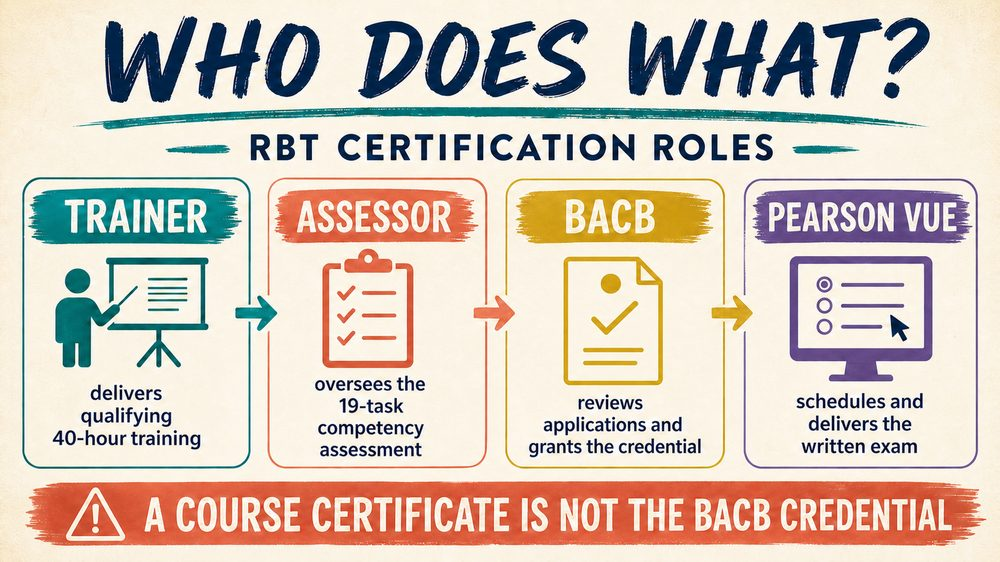
Many application mistakes come from assigning one person every responsibility. The roles are related but not interchangeable.
| Role | Primary responsibility | What the role does not prove |
|---|---|---|
| Training provider | Offers a qualifying training program and issues its certificate. | It does not grant BACB certification or guarantee application approval. |
| Trainer | Delivers the required training under the current qualifications and outline. | Training attendance alone does not prove practical competence. |
| Responsible assessor | Oversees and signs the Initial Competency Assessment. | An assessor’s sign-off is not a Pearson exam result. |
| Attesting certificant | Confirms the required application information under the current attestation form. | Attestation is not a substitute for every uploaded document. |
| BACB | Sets certification requirements, reviews applications, and grants the credential. | The BACB does not endorse ordinary commercial study claims. |
| Pearson VUE | Schedules and delivers the authorized computer-based examination. | Pearson does not replace BACB application approval. |
| Employer or supervisor | May add hiring, supervision, payer, or local practice requirements. | Employer onboarding is not automatically BACB certification. |
A document audit before you submit
Use a one-page evidence audit to catch preventable delays. Write the document name in one column, the version or completion date in another, and the person or organization responsible for it in a third.
- Identity and eligibility: age, education, background check, abuse-registry check.
- Training: 2026 outline, date range, trainer details, and required certificate statement.
- Competency: current 19-task packet, task initials, assessment methods, dates, signatures, and assessor certification information.
- Application: portal fields, uploads, payment, attestation, and confirmation.
- Exam: approval or authorization email, Pearson account, appointment confirmation, ID name match, and test-center plan.
For example: a candidate may have a valid 40-hour certificate but an Initial Competency Assessment completed six months ago. The training document can be correct while the assessment falls outside the current application window. An evidence audit catches that timing mismatch before the candidate relies on an outdated packet.
What happens after you earn the RBT credential?
Certification is not the end of the compliance path. RBTs work under ongoing supervision and must follow the current RBT Handbook, Ethics Code, employer procedures, and applicable law. The 2026 transition materials describe a move to a two-year recertification cycle with professional-development requirements for the applicable maintenance period. Open the current Handbook and recertification instructions for the cycle that applies to your certificate.
- Maintain supervision: know who is responsible for your ongoing supervision and how contacts are documented.
- Stay within scope: implement written plans and seek clinical direction rather than independently changing assessment or treatment decisions.
- Protect client information: use objective notes, appropriate boundaries, and approved communication channels.
- Track development: save professional-development records and use the current BACB maintenance rules.
- Check status: monitor the BACB portal and renewal deadlines instead of assuming an employer reminder is the official record.
A credential can be active while a particular employer, payer, or state still requires additional onboarding or supervision documentation. Treat the BACB credential and local practice requirements as separate checks.
Common certification mistakes
- Calling a course the certification: a training certificate is evidence of training, not a BACB credential.
- Using an old form: the current 2026 packet and Handbook control the application you submit now.
- Skipping the competency assessment: completing training does not replace practical demonstration.
- Scheduling too early: Pearson VUE scheduling follows application approval and authorization.
- Ignoring evidence dates: checks, training, competency, and attestation each have timing rules.
- Assuming BACB endorsement: commercial training and study sites should be described as independent unless BACB explicitly states otherwise.
- Confusing certification with licensure: review local employer, payer, and jurisdiction rules separately.
Bottom line: registered behavior technician RBT certification is a BACB credential earned through a current eligibility, training, competency, application, attestation, and examination path. Start with the live RBT Handbook, keep each document tied to its responsible signer, and use practice content only to strengthen exam reasoning. A training provider can support preparation, but only the official BACB process determines certification.
Prepare for the certification checkpoints.
Review current RBT concepts with original scenarios and explanations while you verify the official training, assessment, application, and examination documents.
Review the RBT study materials →
Frequently Asked Questions
Who grants registered behavior technician RBT certification?
The Behavior Analyst Certification Board grants the RBT credential. Training providers and employers may support the required steps, but they do not issue BACB certification.
What are the 2026 RBT certification requirements?
The current path includes age and education requirements, background and abuse-registry checks, qualifying 40-hour training, the Initial Competency Assessment, application evidence and attestation, and the RBT examination. Read the current Handbook for exact documentation and timing.
How long is the RBT 40-hour training?
The requirement is 40 hours, and the current Handbook describes completing it in no fewer than 5 days and no more than 180 days. The program must meet the current RBT 2026 training outline and certificate statement.
Is the RBT competency assessment the same as the RBT exam?
No. The competency assessment is a practical demonstration using the current BACB packet. The written certification examination is a separate Pearson VUE step with 85 questions in 90 minutes.
Can a study website certify me as an RBT?
No. A study website can provide independent preparation content, but BACB controls the certification decision. Do not treat marketing language as proof of BACB endorsement or credential issuance.
How many questions are on the RBT certification exam?
The current exam presents 85 multiple-choice questions, including 75 scored and 10 unscored questions, across the current 3rd-edition blueprint. Candidates cannot identify the unscored items.
References
- Behavior Analyst Certification Board. Registered Behavior Technician Handbook.
- Behavior Analyst Certification Board. RBT application resources.
- Behavior Analyst Certification Board. Guidance for Meeting RBT Requirements During the 2026 Transition.
- Behavior Analyst Certification Board. RBT 2026 40-Hour Training Requirements and Curriculum Outline.
- Behavior Analyst Certification Board. Supervision, Assessment, Training, and Oversight.
- Behavior Analyst Certification Board. RBT Initial Competency Assessment Packet: Effective January 1, 2026.
- Behavior Analyst Certification Board. RBT Test Content Outline, 3rd edition.
- ABA Degree RBT certification guide. Reviewed for competitor research; not an official source.
- LegalClarity RBT certification overview. Reviewed for competitor research; not an official source.
- Counseling Psychology RBT guide. Reviewed for competitor research; not an official source.