
If you search for a registered behavior technician task list, the current official exam document has an important name: the BACB publishes the RBT Test Content Outline (3rd ed.). Candidates still use “task list” as everyday shorthand, but the current outline is the document to open when you study for an examination beginning in 2026.
Table of Contents
- Registered behavior technician task list: what the current document is
- The 43-task registered behavior technician task list map
- How the task-list weights help you plan study time
- How to audit every task on the current outline
- Read the task verbs as performance directions
- How to handle old and current domain names
- How to combine the outline with other RBT documents
- Common registered behavior technician task list study mistakes
- Frequently Asked Questions
- References
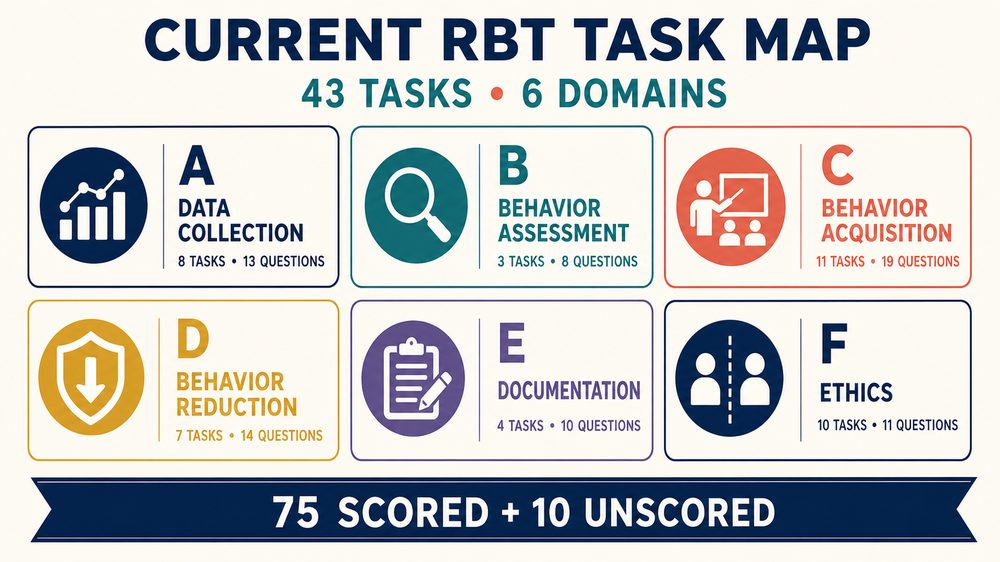
The outline contains 43 tasks organized into six domains. It also publishes the scored-question distribution for the 75 scored questions; the current examination presents 85 questions in 90 minutes, including 10 unscored pilot questions. The outline is a study map, not a collection of official practice questions.
The best way to use it is to turn every task into evidence: what would you observe, what procedure would you implement, what result would you document, and when would you contact the supervisor? RBT Training’s examples are independent study content, not official, recalled, leaked, or BACB-endorsed questions.
This guide explains how to read and audit the current outline. It does not replace the BACB document, guarantee a score, or certify practical competence.
Registered behavior technician task list: what the current document is
The phrase “RBT Task List” is still common in search results and older study materials. For current exam preparation, open the BACB’s RBT Test Content Outline (3rd ed.). The document describes the knowledge, skills, and abilities identified for entry-level behavior technicians and the content that appears on the RBT certification examination beginning in 2026.
| Search phrase or document | How to use it |
|---|---|
| RBT task list | Useful shorthand for finding study content, but check which edition and official source the page means. |
| RBT Test Content Outline (3rd ed.) | Current BACB exam-content authority for the 2026 examination. |
| RBT Handbook | Use for eligibility, application, exam administration, and maintenance requirements. |
| Initial Competency Assessment Packet | Use for practical competency evidence; it is not the written exam outline. |
For example: a study page can call itself a “3rd-edition task list” while showing an approximate item count. Compare its domain names and task statements with the official TCO before using it as your primary checklist. A current page with a stale count is not corrected by a colorful layout.
The 43-task registered behavior technician task list map
The official TCO organizes 43 tasks into six domains. The domain labels and task counts below are a compact orientation map; use the official outline for the exact task statements and examples.
| Domain | Task count | What the domain asks you to reason about |
|---|---|---|
| A. Data Collection and Graphing | 8 | Define behavior, choose measurement, collect data, and summarize or interpret graphs. |
| B. Behavior Assessment | 3 | Participate in preference or other assessment procedures within the written plan and role. |
| C. Behavior Acquisition | 11 | Implement reinforcement, prompting, teaching, generalization, maintenance, shaping, and token procedures. |
| D. Behavior Reduction | 7 | Implement antecedent and consequence-based procedures, differential reinforcement, extinction, and safety steps as written. |
| E. Documentation and Reporting | 4 | Write objective notes, report progress, and communicate changes or concerns through the proper channel. |
| F. Ethics | 10 | Protect confidentiality, dignity, boundaries, supervision, and scope of practice. |
The current exam blueprint assigns the six domains 13, 8, 19, 14, 10, and 11 scored questions respectively, for 75 scored questions total. Those numbers help you allocate study time; they do not tell you the exact order or wording of the questions you will see.
How the task-list weights help you plan study time
Do not read the task count as the same thing as examination weight. Domain C has 11 tasks and 19 scored questions, while Domain F has 10 tasks and 11 scored questions. Task length, decision complexity, and question weighting can differ.
| Domain | Scored questions | Approximate share | Planning implication |
|---|---|---|---|
| A. Data Collection and Graphing | 13 | 17% | Practice choosing the measurement that matches the behavior and reading the data display. |
| B. Behavior Assessment | 8 | 11% | Review preference assessment, ABC data, and the RBT’s implementation boundary. |
| C. Behavior Acquisition | 19 | 25% | Build applied fluency with teaching procedures rather than memorizing labels alone. |
| D. Behavior Reduction | 14 | 19% | Match the written plan, differential reinforcement, antecedent strategies, and safety response. |
| E. Documentation and Reporting | 10 | 13% | Practice objective notes, progress communication, and session-variable reporting. |
| F. Ethics | 11 | 15% | Review confidentiality, supervision, boundaries, and scope decisions in context. |
The 10 unscored pilot questions are mixed into the 85 presented questions and are not identified. A practice plan should therefore answer every item and review the reasoning for every uncertain choice.
How to audit every task on the current outline
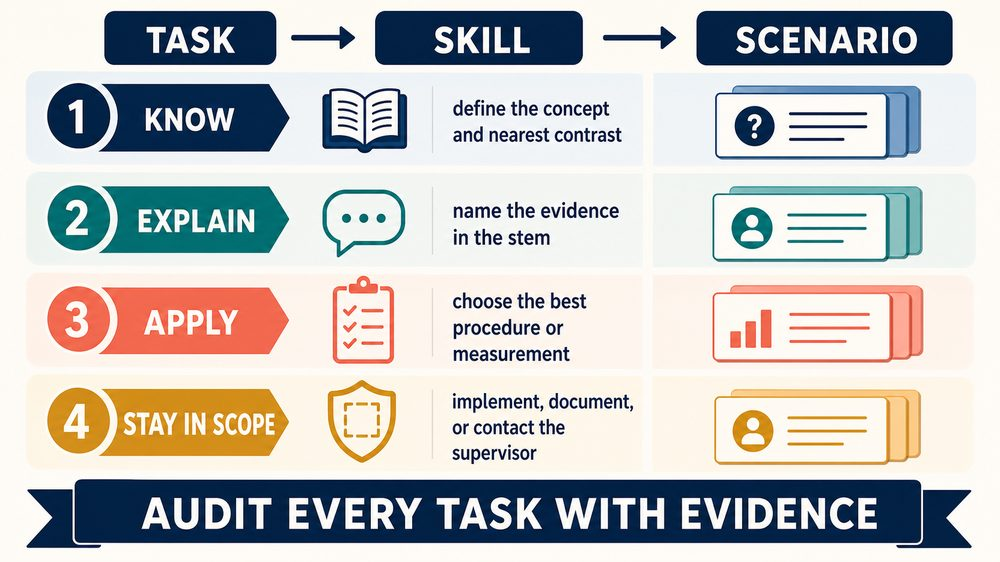
Instead of highlighting a task and calling it “studied,” use four evidence columns. This creates a mastery check that is more useful than a vocabulary list.
- Know: write a plain-language definition and the key distinction from its nearest distractor.
- Explain: describe why the procedure fits a short scenario and what result you would expect to observe.
- Apply: complete an original scenario, choose the best response, and identify the data or action that supports it.
- Stay in scope: write what you would implement, document, or report and what requires supervisor direction.
| Task-audit prompt | Example evidence |
|---|---|
| What is observable? | A behavior definition uses an action and clear conditions instead of “becomes upset.” |
| What is measured? | You can explain why duration, latency, rate, or interval recording fits the stated question. |
| What is implemented? | You can follow the written teaching or reduction procedure without adding an unapproved clinical change. |
| What is reported? | You can write an objective note and identify a change that needs timely communication. |
| What is escalated? | You can recognize uncertainty, risk, or a scope boundary and contact the supervisor. |
Use new names and settings in your practice examples. Reusing one scenario until it feels familiar can create false confidence. Transfer the same task to a home, school, clinic, or community context only when the written plan and supervision structure make that context appropriate.
Read the task verbs as performance directions
The verbs in the outline tell you what kind of preparation is needed. “Distinguish” calls for comparison. “Implement” calls for procedure selection and faithful steps. “Calculate” calls for a worked data example. “Document” calls for objective writing. “Report” calls for communication and timing.
- Distinguish: make a side-by-side contrast and list the cue that separates the options.
- Implement: write the sequence, materials, prompt or reinforcement decision, and fidelity check.
- Calculate or summarize: solve a small original data example and explain the unit.
- Identify: locate the relevant feature in the scenario before selecting the answer.
- Document or report: practice objective language and the proper escalation path.
A definition-only flashcard may be useful for the first pass, but it cannot show whether you can implement, distinguish, calculate, document, or report. Add at least one scenario or worked example to each task group.
How to handle old and current domain names
Some study resources retain familiar labels while the current TCO uses current domain names. A naming bridge can help you find older explanations, but do not let the bridge hide the document version.
| Familiar label in older materials | Current TCO label | Study caution |
|---|---|---|
| Measurement | Data Collection and Graphing | Read the current task statements, not only the heading. |
| Assessment | Behavior Assessment | Keep the RBT’s participation and scope boundary visible. |
| Skill Acquisition | Behavior Acquisition | Check current examples for teaching, prompting, generalization, and maintenance. |
| Professional Conduct | Ethics | Use the current Ethics Code and supervision rules with the outline. |
| Behavior Reduction, Documentation | Same broad labels in current map | Still confirm task wording and current source version. |
The bridge is for navigation, not a claim that every old study page is current. If a page says the list has 42 tasks or describes the 2nd-edition examination as current, use it only as historical context and return to BACB for the controlling document.
How to combine the outline with other RBT documents
The task list answers “what content is on the exam.” It does not answer every certification question. Keep the documents in separate folders or tabs.
- TCO: exam content, tasks, domains, and scored-question distribution.
- RBT Handbook: eligibility, application, examination administration, supervision, ethics, and maintenance.
- 40-hour training outline: requirements for the qualifying training program.
- Initial Competency Assessment: practical performance evidence after training.
- Ethics Code: professional conduct and reporting boundaries.
Separating these documents prevents a common mistake: treating a task-list summary as a certification application checklist or treating a practice question bank as official exam content.
Common registered behavior technician task list study mistakes
- Using the wrong edition: confirm that the resource is aligned to the current 3rd-edition TCO for a 2026 examination.
- Counting tasks instead of weighting questions: use both the 43-task map and the 75-question distribution.
- Memorizing headings only: turn each task verb into an observable study action.
- Ignoring scope: choose answers that follow the plan and supervision structure rather than inventing clinical decisions.
- Confusing current and historical names: use the naming bridge but return to the official task statements.
- Calling practice content official: independent questions are not recalled, leaked, or BACB-endorsed exam items.
- Assuming a checklist equals competence: practical competence is assessed through its own current packet and assessor process.
Bottom line: the current registered behavior technician task list search phrase points to the BACB RBT Test Content Outline (3rd ed.): 43 tasks, six domains, and a published 75-question scored distribution for the 2026 examination. Use the outline as a task-by-task evidence audit, pair it with the Handbook and competency documents, and verify current versions before you study or apply.
Turn the outline into a study checklist.
Use original RBT scenarios and explanations to practice the task verbs, domain distinctions, and scope decisions behind the current blueprint.
Review the RBT study materials →
Frequently Asked Questions
What is the current registered behavior technician task list?
The current official exam-content document is the BACB RBT Test Content Outline (3rd ed.). “RBT Task List” remains a common search phrase, but candidates should verify the current official title and version.
How many tasks are in the current RBT outline?
The current TCO includes 43 tasks organized into six domains: Data Collection and Graphing, Behavior Assessment, Behavior Acquisition, Behavior Reduction, Documentation and Reporting, and Ethics.
How many questions are based on the RBT task list?
The examination presents 85 questions, with 75 scored and 10 unscored pilot questions. The TCO publishes the scored-question distribution across the six domains, but it does not reveal an individual exam’s order or wording.
Is the RBT task list the same as the competency assessment?
No. The TCO describes examination content. The Initial Competency Assessment is a separate practical requirement that uses its own current BACB packet and assessor process.
Can I study from a 2nd-edition task list?
For a 2026 examination, use the current 3rd-edition TCO and treat older materials as historical or supplemental only. Confirm domain names, task statements, and current exam timing with BACB.
Does the task list guarantee that I will pass?
No. The outline identifies exam content, but it cannot guarantee a score or certification. Practice with original scenarios and review reasoning under the current exam conditions.
References
- Behavior Analyst Certification Board. RBT Test Content Outline (3rd ed.).
- Behavior Analyst Certification Board. RBT Test Content Outline (3rd ed.) PDF.
- Behavior Analyst Certification Board. Registered Behavior Technician Handbook.
- RBT Practice Exam study guide. Reviewed for competitor research; not an official source.
- RBT Practice Test task-list guide. Reviewed for competitor research; not an official source.
- RBT Hub study-guide breakdown. Reviewed for competitor research; not an official source.
- RBT Practice Exam task-list explainer. Reviewed for competitor research; not an official source.