
A useful registered behavior technician test study guide should do more than collect definitions. It should help you identify the current exam blueprint, retrieve a concept without looking, apply it to a new scenario, explain why distractors fail, and decide what to review next. If a guide only produces familiar-looking pages or repeated scores, it may be measuring recognition rather than readiness.
Table of Contents
- What makes a registered behavior technician test study guide useful?
- Registered behavior technician test study guide: start with the current blueprint
- The six domains and the skill each study session should build
- A flexible four-week study plan
- Use the retrieve–practice–correct loop
- How to solve RBT scenario questions
- How to use practice exams without fooling yourself
- Readiness without a false pass line
- What to keep in your study folder
- Frequently Asked Questions
- References
For 2026 preparation, begin with the current BACB RBT Test Content Outline (3rd ed.) and Handbook. The outline is the authority for the exam content; independent study guides, worksheets, videos, and practice questions are learning aids. A good guide should show its edition, link primary sources, mark original questions clearly, and avoid promising certification.
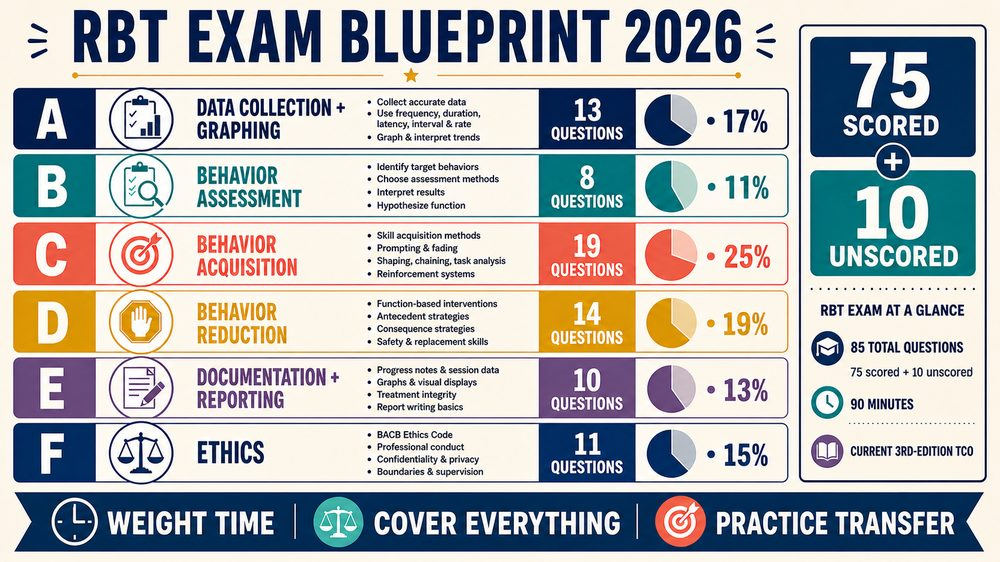
The current outline contains 43 tasks across six domains. The exam includes 75 scored questions and 10 unscored questions, with 85 questions presented in the current exam frame. RBT Training’s examples are independent, newly written study content—not official, recalled, leaked, or BACB-endorsed questions.
This article gives a flexible four-week system, a six-domain map, an error-review loop, and a readiness audit. Adjust the pace to your training, experience, access needs, and supervisor guidance. No study guide, course, practice score, or schedule can guarantee a passing result or certification.
What makes a registered behavior technician test study guide useful?
Use this audit before spending time or money on any guide:
| Guide feature | What to look for | Why it matters |
|---|---|---|
| Current edition | It names the RBT Test Content Outline (3rd ed.) and shows an update date. | Old Task List language can point to the wrong domain structure or weighting. |
| Primary sources | It links the current BACB outline and Handbook. | Requirements and exam facts should be checked against the responsible source. |
| Scenario reasoning | It explains why the best answer fits and why distractors fail. | Rote definitions do not guarantee transfer to a new situation. |
| Original-content boundary | It says questions are independent and not official, recalled, leaked, or endorsed. | Source clarity protects learning quality and exam integrity. |
| Correction loop | It gives you a way to log errors, uncertainty, and next practice. | Review becomes targeted instead of endless rereading. |
A longer PDF is not automatically a better guide. The useful question is whether the guide helps you make a correct decision under a changed scenario and explain the boundary that makes the answer correct.
Registered behavior technician test study guide: start with the current blueprint
Before choosing a chapter order, write the six domains and the current question distribution on one page. The percentages are rounded, and the question counts below refer to the scored exam blueprint:
| Domain | Scored questions | Approx. share | Study job |
|---|---|---|---|
| A. Data Collection and Graphing | 13 | 17% | Match definitions to measurement, calculate, graph, and spot unreliable data. |
| B. Behavior Assessment | 8 | 11% | Distinguish preference, skill, and functional-assessment participation. |
| C. Behavior Acquisition | 19 | 25% | Apply reinforcement, teaching, prompting, chaining, discrimination, shaping, generalization, and maintenance. |
| D. Behavior Reduction | 14 | 19% | Follow written reduction and crisis procedures, identify functions and consequences carefully, and stay within role. |
| E. Documentation and Reporting | 10 | 13% | Communicate objectively, protect confidentiality, and report concerns through the chain of command. |
| F. Ethics | 11 | 15% | Apply dignity, supervision, boundaries, cultural responsiveness, privacy, and ethical decision-making. |
The heaviest domains are not permission to ignore the others. Domain C and D together are a large part of the blueprint, but a missed documentation or ethics decision can expose a reasoning weakness that also appears in mixed questions. Use weighting to allocate time, not to create blind spots.
The six domains and the skill each study session should build
Domain A: Data Collection and Graphing
Practice choosing continuous, discontinuous, and permanent-product procedures; distinguish frequency, rate, duration, latency, and IRT; use observable definitions; calculate or summarize data; update graphs; identify trends; and recognize unreliable data or poor procedural fidelity. The key question is often “What does this procedure actually measure?”
Domain B: Behavior Assessment
Study preference assessments, participation in skill-strength or deficit assessments, and components of functional assessment. Separate observable ABC data from an unsupported conclusion about function. Also review the RBT boundary: participate as written and supervised; do not independently diagnose or interpret beyond the role.
Domain C: Behavior Acquisition
Build comparison tables for reinforcement, conditioned reinforcers, discrete-trial teaching, naturalistic teaching, chaining, discrimination, prompts and fading, generalization, maintenance, shaping, and token economies. Then solve scenarios where one detail—prompt level, immediacy, consequence, or setting—changes the best answer.
Domain D: Behavior Reduction
Review functions, antecedent interventions, differential reinforcement, extinction, punishment-related procedures when included in the written plan, crisis or emergency direction, and safety. Many questions are next-step questions: follow the plan, protect the client, document objectively, and seek supervisor direction when the situation is outside the written procedure.
Domain E: Documentation and Reporting
Practice writing observable session notes, communicating relevant variables, protecting confidentiality, following legal or workplace requirements, and distinguishing direct observation from interpretation. Rewrite labels such as “unmotivated” or “manipulative” into observable events and context.
Domain F: Ethics
Review benefit to others, dignity, competence, supervision, confidentiality, public statements, multiple relationships, gifts, collaboration, feedback, cultural humility, and self-awareness. The stronger answer usually protects the client, stays within competence, and uses the appropriate supervision or reporting path.
A flexible four-week study plan
This is a planning example, not a required BACB schedule. Keep a source file with the current TCO and Handbook, a concept notebook, an error log, and a bank of original practice scenarios.
| Week | Focus | Output to keep |
|---|---|---|
| 1. Map and baseline | Read the current blueprint, take a mixed diagnostic set, and study Domains A and B. | A six-domain map, baseline errors, and a list of terms you can define but cannot yet apply. |
| 2. High-weight application | Study C and D with short scenario sets; compare teaching and reduction procedures. | Decision tables, corrected rationales, and at least one changed scenario per weak concept. |
| 3. Reporting and ethics | Study E and F, then mix them with A–D instead of keeping them isolated. | Objective-note rewrites, scope-boundary examples, and privacy/supervision escalation cues. |
| 4. Mixed retrieval | Use new, timed practice sets; review the error log; return to primary sources for unresolved requirements. | A final gap list and a plan for rest, timing, accommodations, and test-day logistics. |
Short sessions can be effective when each has a clear output. For example, a 45-minute session might include 10 minutes of retrieval, 20 minutes of scenario practice, 10 minutes of correction, and 5 minutes of scheduling the transfer example.
Use the retrieve–practice–correct loop
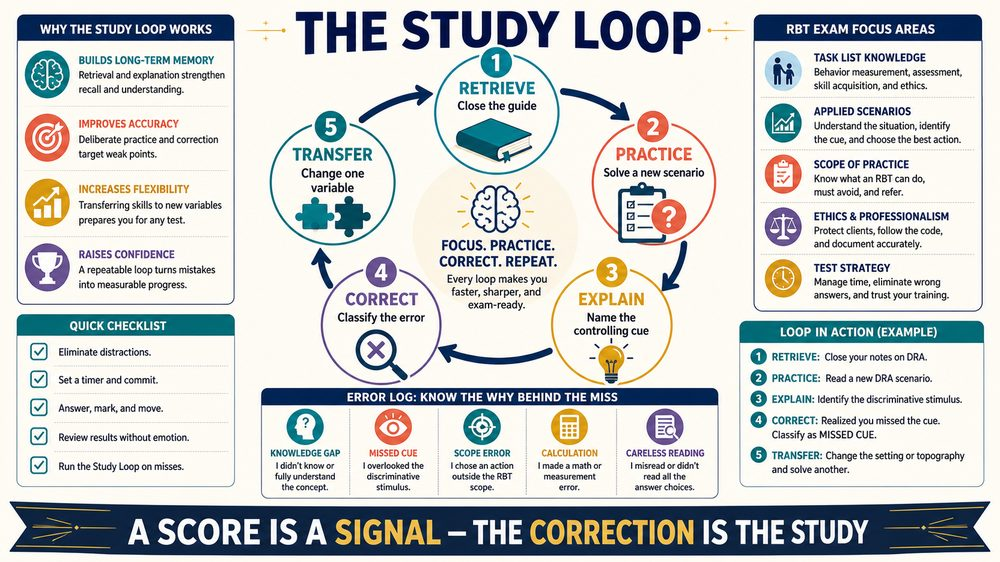
Rereading creates familiarity. A stronger loop requires you to produce an answer before looking at the explanation:
- Retrieve: close the guide and state the definition, procedure, or role boundary from memory.
- Practice: solve an original scenario without checking the answer first.
- Explain: name the fact in the stem that controls the decision.
- Classify the error: mark knowledge gap, cue missed, calculation error, scope error, distractor trap, or careless reading.
- Correct: write why the best answer fits and why the nearest distractor fails.
- Transfer: change one variable—setting, prompt, interval, consequence, or communication route—and solve again later.
Original example: you choose whole-interval recording because the stem mentions a 30-second interval. The error is not “forgot the term”; it is “ignored the scoring rule.” Correct it with a comparison: any time during the interval points to partial interval, entire interval points to whole interval, and the specified check moment points to momentary time sampling.
Do not use only the raw score to decide whether to move on. A correct answer chosen with low confidence belongs in the error log because it may fail under a changed scenario.
How to solve RBT scenario questions
Many exam-style questions ask what the RBT should do next. Use a five-step read:
- Identify the role: Is the stem asking what the RBT implements, documents, reports, or asks a supervisor to decide?
- Find the controlling detail: Look for the written plan, operational definition, prompt rule, timing phrase, safety instruction, or confidentiality issue.
- Reject overreach: Cross out answers that independently diagnose, change a program, conceal data, or improvise outside competence.
- Choose the smallest defensible action: Follow the written procedure, record what happened, and communicate the relevant concern.
- Explain the distractor: Say what assumption makes the weaker answer unsafe, inaccurate, or outside role.
| Stem clue | Likely reasoning task | Study question |
|---|---|---|
| “The data sheet is missing two intervals.” | Data integrity and reporting. | Would you guess, leave blank, document the reason, or ask for the approved correction? |
| “The learner does not respond after the instruction.” | Prompting and written procedure. | What prompt or wait rule is in the plan? |
| “The caregiver asks for a diagnosis.” | Scope and communication. | Who is qualified to answer and how should the RBT route the request? |
| “The client leaves the area during a crisis.” | Safety and protocol. | What does the current emergency procedure require? |
| “A friend asks for a client story online.” | Confidentiality and public statements. | What information must remain protected and what approved route applies? |
How to use practice exams without fooling yourself
Use a practice exam as a measurement tool, not a prophecy. A score can change because of question familiarity, item difficulty, timing, sleep, or repeated exposure. Record more than the percentage:
- domain and task represented;
- confidence before seeing the answer;
- reason the selected option seemed correct;
- fact or cue that controlled the best answer;
- why each serious distractor failed;
- next practice and transfer scenario.
Do not keep retaking the same 85 questions until the score feels comfortable. That can measure memory of the item order. Use a new set, a new context, or a new explanation and see whether the reasoning transfers.
Readiness without a false pass line
No independent study guide can set a BACB passing threshold or guarantee a result. Instead, use a readiness audit:
| Readiness area | Evidence you can collect |
|---|---|
| Coverage | You can map every TCO domain and task to a definition, procedure, example, or source. |
| Retrieval | You can explain a concept without copying the guide’s wording. |
| Application | You can solve a new scenario and identify the controlling detail. |
| Correction | You can explain why a distractor fails instead of only memorizing the correct letter. |
| Timing | You have practiced reading carefully within the current exam frame and have a test-day plan. |
| Boundary | You can distinguish written-exam preparation from the Initial Competency Assessment and supervised practice. |
If one area is weak, use it to choose the next study block. Do not respond to anxiety by downloading more disconnected material. Consolidate the current sources, close gaps, and ask a qualified supervisor or trainer about clinical-scope questions.
What to keep in your study folder
- The current RBT Test Content Outline (3rd ed.) and Handbook.
- Your completed 40-hour training materials and competency-assessment notes.
- A six-domain task map with links or page references to primary sources.
- Original practice sets with explanations and no recalled or leaked content.
- An error log that records cue, distractor, correction, and transfer.
- A short test-day checklist for appointment, identification, timing, accommodations, and rest.
Bottom line: the best registered behavior technician test study guide is current, source-first, six-domain, scenario-based, and honest about its limits. Build a blueprint map, retrieve before rereading, practice the highest-weight concepts without ignoring the rest, correct your reasoning, and test transfer with changed scenarios.
Turn your study plan into deliberate practice.
Use original RBT questions, explanations, and domain review materials to identify gaps and practice the next decision.
Compare RBT exam-prep materials →
Frequently Asked Questions
What should a registered behavior technician test study guide include?
It should be current, aligned with the published RBT Test Content Outline, organized across six domains, linked to primary sources, and built around original scenarios with explanations and error correction.
How long should I study for the RBT exam?
There is no single required schedule. Use the current blueprint, your training background, diagnostic results, and available time to create a plan that includes retrieval, practice, correction, and mixed review.
Should I study the largest RBT domain first?
High-weight domains deserve appropriate time, but do not ignore smaller domains. Use the blueprint to allocate effort and mixed practice to find gaps that domain-only study can hide.
Can a study guide replace the RBT Handbook?
No. Use the current BACB Handbook and Test Content Outline for certification and examination facts. An independent study guide can organize learning but does not control requirements.
Is a mock-exam score a guarantee?
No. Practice scores are signals about the specific items and conditions used. They cannot guarantee a passing result, certification, or readiness under every new scenario.
Is the written exam the same as the Initial Competency Assessment?
No. The written examination uses multiple-choice questions. The Initial Competency Assessment evaluates practical RBT task performance under the current BACB packet and qualified assessor structure.
References
- Behavior Analyst Certification Board. RBT Test Content Outline (3rd ed.).
- Behavior Analyst Certification Board. RBT Handbook.
- Behavior Analyst Certification Board. RBT Initial Competency Assessment Packet.
- RBT Practice Exam six-domain study guide. Reviewed for competitor research; not an official BACB source.
- RBT Practice Test study guide. Reviewed for competitor research; not an official BACB source.
- RBT Exam Practice domain-weighted resource. Reviewed for competitor research.