

If you are asking is RBT certification worth it, the honest answer depends on what you want the credential to do. It can be useful when you want a defined entry point into supervised behavior-analytic services, an employer requires or supports it, or you want structured experience before a later education or career decision. It is a poor fit when the role, supervision, pay structure, schedule, or ethical culture does not work for you.
Table of Contents
- Is RBT certification worth it? Start with fit
- What RBT certification does and does not do
- Potential benefits of RBT certification
- Costs, tradeoffs, and questions people forget
- Evaluate the employer, not just the certification
- RBT certification versus a longer-term career path
- A practical decision checklist
- Original scenarios for the value question
- Frequently Asked Questions
- References
The RBT credential is not a promise of a particular wage, caseload, promotion, graduate-school admission, or clinical outcome. The BACB sets certification requirements and ethical standards; employers and local systems determine many day-to-day conditions. This article is independent information, not a BACB certification program, endorsement, or guarantee.
The current RBT Test Content Outline, 3rd edition, describes 43 tasks across six domains. The current exam frame includes 75 scored questions and 10 unscored pilot questions. Those facts explain the scope of the credential, but they do not answer the personal value question by themselves.
Is RBT certification worth it? Start with fit
RBT certification may be worth it when four conditions line up:
- You want supervised, hands-on work with behavior-analytic programs.
- You can complete and maintain the current requirements without treating them as a shortcut.
- The employer offers clear supervision, training, scheduling, and feedback.
- The experience supports a goal you actually have, whether that is an RBT role itself or informed exploration of a related path.
It may not be worth it if you are being promised easy money, guaranteed advancement, independent clinical authority, or a quick route to becoming a BCBA. A credential cannot repair an unsafe workplace or unclear supervision structure.
If your question is is RBT certification worth it because a job posting requires it, ask whether the employer pays for the training and assessment, how cancellations are handled, and what support exists after certification.
What RBT certification does and does not do
| It can provide | It does not automatically provide |
|---|---|
| A standardized entry credential for a defined technician role. | A guaranteed salary, hours, promotion, or job satisfaction. |
| A framework for training, competency assessment, examination, supervision, and ethics. | Permission to design treatment or change a plan independently. |
| Evidence that current requirements were met at the time of certification. | A permanent credential without renewal, supervision, or compliance responsibilities. |
| A way to compare role expectations across employers. | A substitute for evaluating the actual employer and client population. |
The RBT role is a paraprofessional role performed under the direction and close supervision required by the current BACB structure. A candidate who wants to make independent clinical decisions should investigate a different training and credential pathway rather than expecting the RBT certificate to expand the role.
Potential benefits of RBT certification
1. A structured entry point
The current process gives a candidate a defined sequence: required training, initial competency assessment, application steps, examination, and ongoing responsibilities. That structure can be valuable if you learn best with explicit milestones and supervised practice.
2. Direct implementation experience
RBT work can develop practical skills in measurement, preference assessment, teaching procedures, behavior-reduction plans, documentation, communication, and professional boundaries. Those skills may help you decide whether behavior analysis or a related helping profession is a good fit.
3. A clearer employer comparison
When several organizations use the same credential, you can ask more precise questions about supervision, training, client population, scheduling, travel, documentation, and advancement. The credential does not make employers identical, but it gives you a common role language.
4. A possible next step, not a promise
Some people use RBT experience while exploring education in behavior analysis, special education, psychology, or another field. That is an individual decision. RBT certification itself does not guarantee admission, supervised fieldwork eligibility, or success in a future credential.
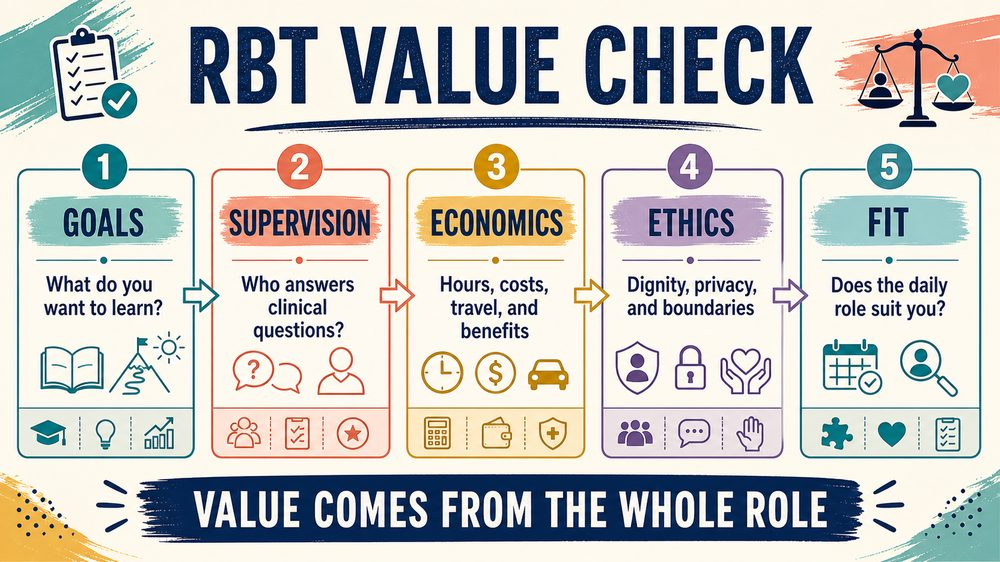
Costs, tradeoffs, and questions people forget
| Question | Why it matters | What to verify |
|---|---|---|
| Who pays for training and assessment? | Up-front cost and repayment rules can change the value. | Written offer, fees, deadlines, and whether payment is contingent on employment. |
| Are hours stable? | Client cancellations, school calendars, travel, and part-time status affect income. | Typical weekly hours, cancellation policy, paid nonbillable work, and travel time. |
| How is supervision delivered? | Certification is not useful if you cannot receive meaningful direction and feedback. | Supervisor availability, observation schedule, feedback process, and escalation route. |
| What is the emotional and physical demand? | Direct service can involve repetition, crisis protocols, caregiver communication, and changing needs. | Client population, safety training, breaks, team support, and realistic job preview. |
| What are the documentation expectations? | Notes, data, privacy, and compliance are part of the role. | Systems used, protected information rules, correction process, and training. |
Do not calculate value using a headline hourly rate alone. Compare the full arrangement: paid training, predictable hours, commute, benefits, supervision quality, cancellation exposure, required materials, and the time needed to maintain the credential.
For example: an offer may advertise paid training but provide unpredictable part-time hours and a long unpaid commute. Another offer may have a lower headline rate but clearer supervision, paid preparation time, and steadier scheduling. Compare the complete arrangement before deciding which credential opportunity is worth your time.
Evaluate the employer, not just the certification
Two RBT jobs can share a title while offering very different experiences. Before committing, ask:
- Who is the responsible supervisor, and how do RBTs contact that person?
- How are new procedures introduced and competency-checked?
- What happens when the written plan is unclear or a safety concern occurs?
- How are missed sessions, cancellations, travel, and indirect tasks handled?
- What does feedback look like after an error?
- How are client dignity, privacy, communication, and family requests handled?
- What support is available for the RBT’s own questions and professional development?
A useful warning sign is a recruiter who focuses on certification speed but cannot explain supervision, client safety, data systems, or role boundaries. A good sign is a concrete explanation of who observes performance, who provides clinical direction, and how uncertainty is escalated.
RBT certification versus a longer-term career path
Use a two-column plan instead of assuming the credential must determine your future.
| If your goal is… | Use the RBT decision to ask… |
|---|---|
| Work directly in supervised services | Does the organization provide ethical, stable, well-supported technician work? |
| Explore behavior analysis | Will the job expose you to the actual work, supervision, data, and client communication—not only marketing? |
| Become a BCBA later | What degree, coursework, fieldwork, and current certification rules would still be required? |
| Work in education or another helping field | Which RBT skills transfer, and which credentials are required for the target role? |
RBT certification can be a useful experiment when it is financially and ethically workable. It should not be treated as a test of your worth or as the only way to enter a helping profession.
A practical decision checklist
Give each item a clear answer before paying for a course or accepting an offer:
- Role fit: I understand that the RBT implements assigned programs under supervision.
- Requirement fit: I can complete current training, competency, exam, renewal, and supervision responsibilities.
- Schedule fit: I know the realistic hours, cancellation exposure, commute, and availability expectations.
- Support fit: I know who answers clinical and safety questions.
- Ethics fit: The organization can explain privacy, dignity, boundaries, documentation, and self-reporting.
- Financial fit: I have written information about costs, pay, benefits, and repayment obligations.
- Learning fit: I am willing to receive feedback and practice observable skills rather than only memorize terms.
Score the checklist as “clear,” “unclear,” or “not acceptable.” Unclear is not a yes. It is a question to resolve before you make a commitment.
Original scenarios for the value question
Scenario 1—training cost: a company offers free training but asks for a large repayment if you leave. Request the written terms and compare them with the expected schedule, support, and alternatives before deciding.
Scenario 2—unclear supervision: a recruiter says “a BCBA is available” but cannot describe observations or response time. Ask for the actual supervision process; do not infer quality from the title alone.
Scenario 3—career exploration: a candidate wants to know whether behavior analysis is a fit. A supervised RBT role may provide information, but the candidate should still research the education and fieldwork required for later credentials.
Scenario 4—ethical mismatch: a workplace asks staff to change data so a session looks successful. That is a reason to pause, document through authorized channels, seek direction, and reconsider the organization—not a reason to hide the concern because certification feels valuable.
These are newly written independent examples, not official, recalled, leaked, or BACB-endorsed questions.
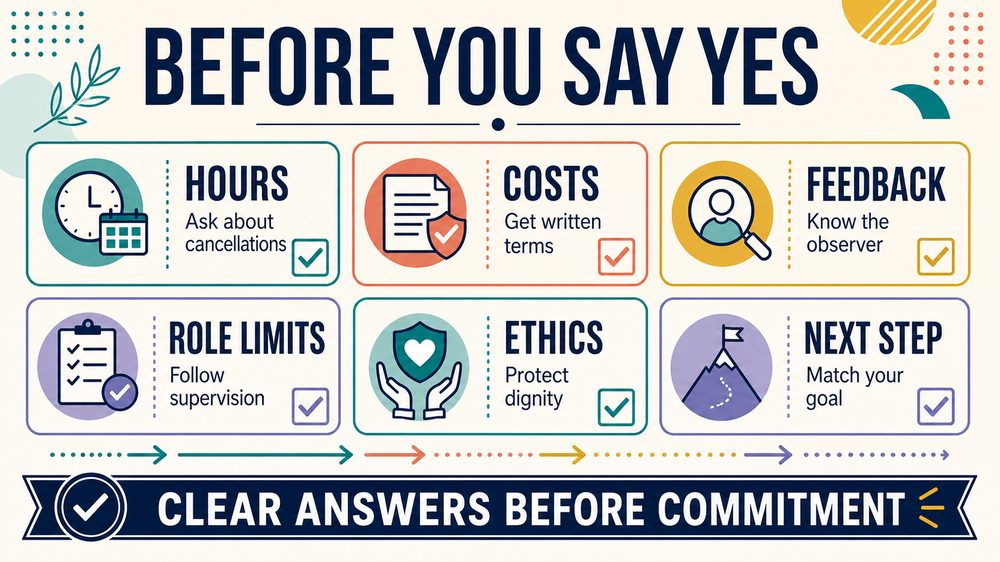
Bottom line: is RBT certification worth it is a fit-and-context question. It can be worthwhile when the role, supervision, economics, ethics, and personal goal align. Verify the current BACB requirements and the employer’s written conditions before treating the credential as your next step.
Explore the RBT role with realistic practice.
Use original scenarios to compare exam concepts, ethical decisions, and supervised role expectations.
Review RBT study materials →
Frequently Asked Questions
Is RBT certification worth it for everyone?
No. Value depends on role fit, supervision, schedule, costs, workplace culture, and goals. A credential is not automatically a good deal.
Does RBT certification guarantee a higher salary?
No. Pay, hours, benefits, and advancement vary by employer and location. Verify written terms rather than relying on a universal claim.
Does an RBT work independently?
RBTs implement behavior-analytic services under the direction and close supervision required by the current role structure. Certification is not permission to design treatment independently.
Can RBT experience help with a future career?
It may provide supervised experience and information about the work, but future credentials have their own education, fieldwork, and examination requirements.
Is this article affiliated with BACB?
No. RBT Training is not a BACB certification program and this article is independent informational content.
References
- Behavior Analyst Certification Board. RBT certification information.
- Behavior Analyst Certification Board. RBT Handbook.
- Behavior Analyst Certification Board. RBT Test Content Outline (3rd ed.).
- Behavior Analyst Certification Board. Ethics Codes and RBT Ethics Code (2.0).
- RBT career guide. Reviewed for competitor research; not an endorsement.