
Registered behavior therapist certification is usually a search phrase for the BACB’s Registered Behavior Technician (RBT) certification. The title matters because an RBT is a paraprofessional behavior-analysis credential, not a general license that authorizes independent clinical practice. Candidates should use the current BACB Handbook and their own portal instructions as the authority for requirements, dates, fees, and application decisions.
Table of Contents
- What this certification phrase means
- 2026 eligibility: build a document checklist
- How the RBT application sequence works
- What happens after the application is approved
- A scenario: correcting an application mistake
- How to study registered behavior therapist certification
- Exam map for registered behavior therapist certification
- Mistakes that delay candidates
- A final certification study checklist
- Frequently Asked Questions
- References
Quick answer: Treat registered behavior therapist certification as a current-source study topic. Identify the official credential or document, follow the applicable procedure, practice an original scenario, and keep the RBT’s supervision boundary visible.
Study boundary: This independent guide is educational content. It is not a BACB policy, certification decision, legal opinion, answer key, or guarantee of examination success. Examples are original and are not official, recalled, leaked, or BACB-endorsed questions.
What this certification phrase means
The phrase can create two separate questions: what credential is being discussed, and what work does that credential permit? The BACB uses the name Registered Behavior Technician, or RBT. An RBT assists with behavior-analytic services under the direction and close supervision of an RBT Supervisor and/or RBT Requirements Coordinator. The credential shows that the applicant met the certification board’s requirements; it does not turn an entry-level technician into a BCBA, an independent assessor, or an owner of a treatment plan.
That distinction is useful for both searchers and exam candidates. A page, employer, or training provider may use the informal phrase registered behavior therapist, but the applicant should verify the exact credential name in the BACB portal and handbook. Do not rely on a course title alone. Check who issues the credential, which jurisdiction accepts the application, what documents are required, and whether the information applies to the current year.
2026 eligibility: build a document checklist
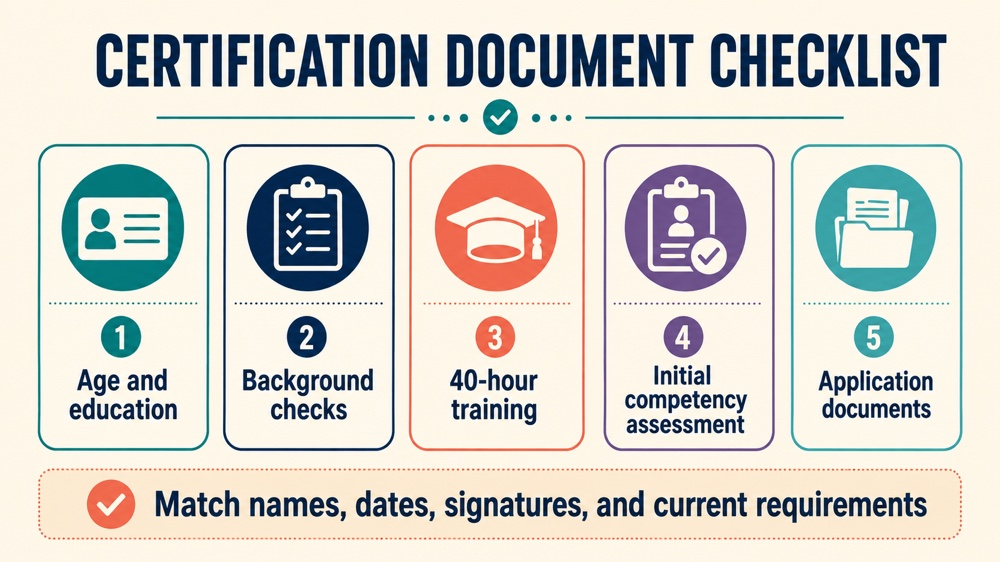
Before applying, organize the requirements as evidence rather than as a list of promises. The current handbook describes age, education, background and abuse-registry checks, 40-hour training, and an initial competency assessment. The attesting certificant and assessor also have eligibility rules, so a candidate should confirm that the people signing or completing the documents are allowed to do so.
- Confirm that you are at least 18 when the application is submitted.
- Confirm high-school-level education or an equivalent credential.
- Complete the required criminal background and abuse-registry checks within the applicable window.
- Complete a qualifying 40-hour training program and keep the certificate.
- Complete the current initial competency assessment within its application window.
- Check that names, dates, signatures, and uploaded files match the BACB portal record.
The BACB does not provide the 40-hour training certificate or recommend a particular training provider. A course can be useful, but the candidate remains responsible for checking whether the course meets the current requirements. Save the certificate, assessment, and attestation in a secure location before starting the application.
How the RBT application sequence works
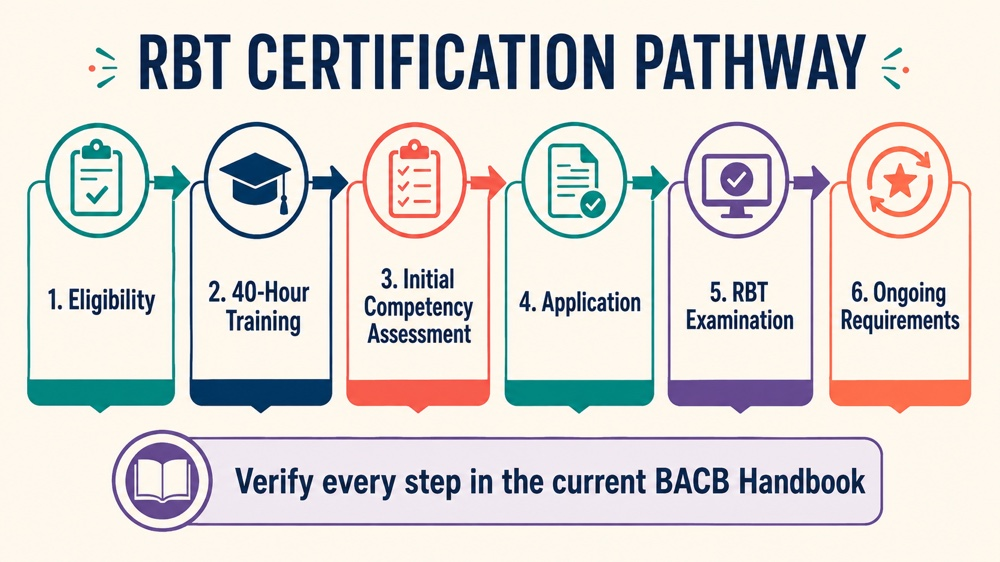
A practical sequence is: create or access one BACB portal account, complete the eligibility documents, submit the certification application, pay the application fee, wait for the determination, and schedule the examination only after receiving authorization. The current handbook says applications are active for a limited period and that incomplete or unresolved applications may require a new application and fee. Read the portal’s action items instead of guessing what a status means.
Use a personal email address that you will retain. The handbook advises candidates to use their legal name exactly as it appears on government identification and to keep contact information current. A mismatch can delay examination access. If a document is unreadable or incomplete, uploading it again without understanding the problem may waste time; first identify the requested correction and then submit a clean replacement.
Processing estimates, examination availability, and fees can change. Treat the current BACB handbook and portal as the source of truth, not an old social post or a third-party checklist.
What happens after the application is approved
An approved application is not the same as certification. It gives the candidate instructions for scheduling the examination. The examination tests entry-level knowledge and skills described by the current RBT Test Content Outline. After passing, the candidate still has ongoing responsibilities such as supervision, ethical conduct, accurate documentation, and timely recertification or professional development requirements that apply to the certification cycle.
For study purposes, make a timeline with three columns: documents, authorization, and maintenance. Documents answer whether you are eligible to apply. Authorization answers whether you may schedule the examination. Maintenance answers what you must do after certification. Mixing those columns is a common reason candidates misunderstand a training certificate or assume that passing an exam removes the need for supervision.
A scenario: correcting an application mistake
Imagine that a candidate notices that the name on a 40-hour certificate omits a middle name that appears in the BACB portal. The best next step is not to edit the certificate or submit a note claiming the documents are close enough. The candidate should review the application instructions, ask the training provider or BACB through the appropriate channel what correction is needed, and upload accurate documentation. The candidate should keep a record of the question and response.
This scenario illustrates a broader exam principle: certification work rewards accurate, traceable documentation. A confident-sounding explanation is not a substitute for an official decision. If the issue affects eligibility, jurisdiction, an attestation, a background check, or an assessment signature, stop and obtain direction before paying or submitting.
How to study registered behavior therapist certification
Use the certification pathway as a study map, then connect each step to an observable professional behavior. For example, an application question tests whether you can identify the correct document and timing. A role-boundary question tests whether you know that an RBT implements assigned services under supervision rather than independently changing goals or procedures. An ethics question may test whether you protect account information or confidential client information.
A useful study note has four lines: requirement, evidence, decision owner, and candidate action. For a clinical procedure, replace decision owner with supervisor and candidate action with the trained implementation step. This structure helps you avoid a frequent error: choosing an answer because it sounds helpful when the actual correct answer is to pause, document, and seek direction.
Exam map for registered behavior therapist certification
The current TCO organizes the RBT examination into six domains: Data Collection and Graphing, Behavior Assessment, Behavior Acquisition, Behavior Reduction, Documentation and Reporting, and Ethics. Administrative certification questions still depend on the current handbook, but these domains help you connect eligibility and role questions to the skills expected of an entry-level technician. The current outline describes 43 tasks; the examination includes 75 scored questions and 10 unscored pilot questions, four answer choices, and a 90-minute testing period.
Practice with original scenarios, not copied or protected questions. When reviewing an answer, explain which document, task, or role boundary controls the decision. If you cannot name the evidence, mark the topic for review instead of memorizing a pattern.
Mistakes that delay candidates
- Treating an informal job title as the official BACB credential name.
- Using a training provider’s old checklist without comparing it with the current handbook.
- Submitting documents with mismatched names, dates, signatures, or unreadable scans.
- Assuming application approval, examination authorization, and certification are the same status.
- Changing a document or making an eligibility decision without asking the responsible authority.
- Using recalled or leaked exam material instead of the current outline and original practice.
A final certification study checklist
- Can I state what RBT certification is and what it does not authorize?
- Can I list the current eligibility evidence without relying on an outdated date window?
- Can I explain the order from portal account to application, approval, examination, and maintenance?
- Can I identify which questions belong to the BACB, an assessor, a training provider, an employer, or a supervisor?
- Can I use the TCO to plan study time across all six domains?
- Can I recognize when a document or clinical question requires clarification rather than improvisation?
Practice the concept
Review registered behavior therapist certification with original RBT scenarios, current-source reminders, and clear role boundaries.
Try the RBT practice resource →
Frequently Asked Questions
Is registered behavior therapist certification the official credential name?
The BACB credential is Registered Behavior Technician, or RBT. Searchers may use other wording, but candidates should verify the exact credential and current requirements in BACB materials.
Does an RBT certification allow independent practice?
No. RBTs assist with behavior-analytic services under direction and close supervision. Certification does not authorize independent diagnosis, assessment design, or treatment-plan changes.
Where should candidates check current requirements?
Use the current BACB RBT Handbook, the BACB RBT page, and the candidate’s portal instructions. Requirements, fees, and transition dates can change.
Are the examples on this page official exam questions?
No. The examples are original study scenarios and are not official, recalled, leaked, or BACB-endorsed questions.
References
- Behavior Analyst Certification Board: Registered Behavior Technician Handbook, updated June 2026.
- Behavior Analyst Certification Board: RBT Test Content Outline (3rd ed.).
- Behavior Analyst Certification Board: RBT resources.
- RBT Training: independent RBT practice questions.