
BACB Registered Behavior Technician usually refers to the RBT credential administered by the Behavior Analyst Certification Board. The BACB describes an RBT as a paraprofessional in behavior analysis who assists with behavior-analytic services under the direction and close supervision of an RBT Supervisor and/or RBT Requirements Coordinator. This guide explains the credential pathway and study implications while leaving current eligibility and administrative decisions to the BACB’s official materials.
Table of Contents
- What the BACB does and what an RBT does
- The current certification pathway
- How the 2026 examination is organized
- A source-checking scenario
- Supervision is part of the credential
- Maintenance and BACB registered behavior technician identity
- What to do when a procedure is unclear
- Common mistakes on BACB RBT topics
- BACB registered behavior technician review checklist
- Frequently Asked Questions
- References
Quick answer: Treat bacb registered behavior technician as a current-source study topic. Identify the official credential or document, follow the applicable procedure, practice an original scenario, and keep the RBT’s supervision boundary visible.
Study boundary: This independent guide is educational content. It is not a BACB policy, certification decision, legal opinion, answer key, or guarantee of examination success. Examples are original and are not official, recalled, leaked, or BACB-endorsed questions.
What the BACB does and what an RBT does
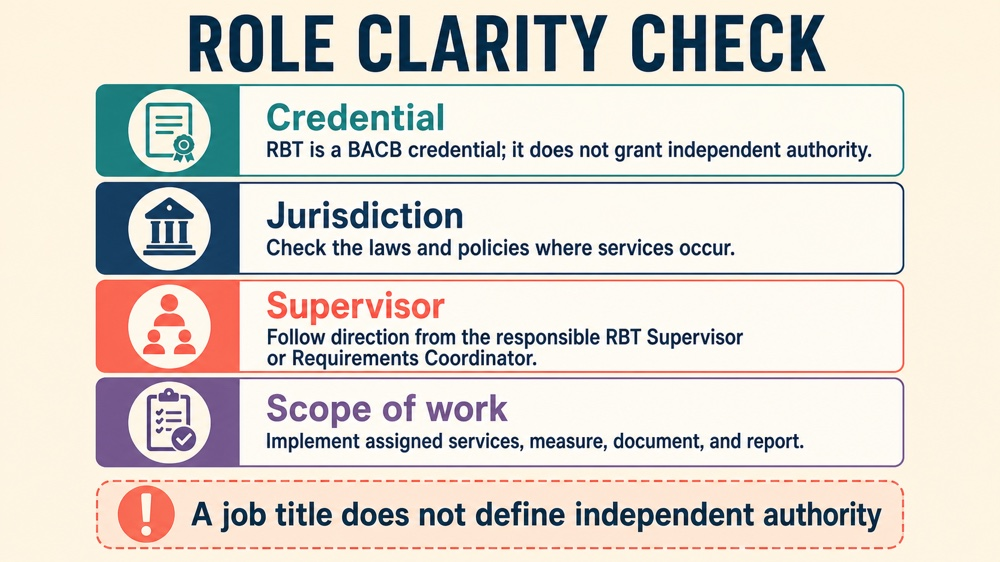
The BACB establishes certification standards, administers examinations, and publishes requirements for its certification programs. An RBT is not the same role as a BCBA or BCaBA. The RBT credential is designed for an entry-level technician who implements assigned services, collects data, documents sessions, and communicates with the supervising team within demonstrated competence.
A helpful mental model is responsibility rather than prestige. The BACB sets the credential requirements; the supervisor directs clinical work; the RBT implements and reports; the employer manages workplace operations. A single person may hold more than one relationship to a service, but an RBT should still know which decision belongs to which role.
The current certification pathway
The current handbook describes a sequence that includes meeting eligibility requirements, creating a BACB portal account, completing the required documents, submitting an RBT certification application, receiving a determination, scheduling the examination after approval, and maintaining the certification after passing. The exact requirements and transition rules are time-sensitive, so use the version of the handbook that applies when you apply.
- Review the current handbook and confirm jurisdiction.
- Complete the applicable age, education, background, training, and competency requirements.
- Prepare the attestation, training certificate, competency assessment, and other requested documents.
- Submit the application accurately through the BACB portal and monitor action items.
- Schedule the authorized examination through the instructed testing provider.
- After certification, follow supervision, ethics, documentation, and recertification requirements.
Do not treat a 40-hour training certificate as the RBT credential itself. Training is one part of the pathway; certification depends on the full application and examination process.
How the 2026 examination is organized
The current BACB handbook and TCO describe an examination with 75 scored questions and 10 unscored pilot questions. The 43 tasks are organized into six areas: Data Collection and Graphing, Behavior Assessment, Behavior Acquisition, Behavior Reduction, Documentation and Reporting, and Ethics. The handbook also describes four answer options, one correct answer, and a 90-minute testing period.
Study by behavior, not by acronym alone. For a measurement task, practice applying start and stop rules. For an acquisition task, practice identifying the programmed prompt and reinforcement step. For an ethics task, practice confidentiality, competence, supervision, and accurate public statements. Each domain should end with a short explanation of why the tempting alternatives exceed the RBT role.
A source-checking scenario
A candidate sees a social post claiming that every BACB RBT applicant may skip the competency assessment if an employer signs a letter. The candidate should not forward the claim or build a study plan around it. The correct process is to open the current handbook, compare the eligibility section, check the date and jurisdiction, and contact the BACB if the documents remain unclear.
The same rule applies to exam scores, fees, renewal cycles, and testing locations. Search snippets and course advertisements can be useful leads, but they are not the final authority. For exam preparation, link each administrative note to an official source and write the date you last checked it.
Supervision is part of the credential
The RBT credential is connected to supervision before and after certification. Supervision is not merely a meeting where a technician receives a signature; it supports competence, feedback, observation, and responsible service delivery. An RBT should be able to identify who provides direction, how concerns are escalated, how training is documented, and what to do when a task exceeds demonstrated competence.
In a session, a data irregularity, safety concern, missing material, or unclear instruction should be communicated through the appropriate process. The technician can describe what happened and preserve the data. The technician should not independently redesign the intervention to make the session look successful.
Maintenance and BACB registered behavior technician identity
Passing the examination is a beginning, not the end of the credential pathway. The current handbook describes ongoing requirements related to supervision, ethics, and recertification or professional development depending on the applicable certification cycle. Keep the portal account secure, monitor official notices, and update personal information when it changes.
Ethical identity also includes how an RBT describes work publicly. Do not imply that you are a BCBA, that you can guarantee an outcome, or that an employer title changes the scope of an RBT certification. Protect confidential information, accept feedback, and use culturally responsive communication. These are not decorative statements; they affect trust and service quality.
Maintenance questions are often practical rather than dramatic. A technician may need to recognize that a supervision record is incomplete, a required notice was missed, or a public profile uses an inaccurate credential description. The correct response is to review the current requirement, notify the appropriate person, correct the record honestly, and keep evidence of the follow-up. Never solve a maintenance problem by backdating a signature or hiding a gap in service.
What to do when a procedure is unclear
Use a three-step response: pause at the decision point, record the observable condition, and ask the responsible supervisor for direction. If safety requires an emergency procedure, follow the trained crisis or emergency plan and then report what occurred. Do not conceal a deviation, backfill data from memory, or label a learner’s behavior with an unsupported motive.
For example, if the written prompt hierarchy does not state what to do when the learner responds during the delay, the RBT should follow the trained rule if one exists, record the prompt level and response, and ask for clarification before the next opportunity. The professional answer is precise because it separates implementation from plan design.
Common mistakes on BACB RBT topics
- Using an old handbook or outline without checking the current version.
- Confusing the RBT credential with a BCBA, BCaBA, state license, or training certificate.
- Treating an employer, instructor, or social-media post as the certification board.
- Assuming supervision is optional after passing the examination.
- Reporting a hypothesis as though it were an observed fact.
- Studying recalled or leaked material instead of original practice and official sources.
BACB registered behavior technician review checklist
- Can I explain the BACB’s certification role and the RBT’s supervised service role?
- Can I outline the current application pathway without promising a result?
- Can I name the six exam domains and connect them to observable technician actions?
- Can I identify when to document and seek direction?
- Can I protect credentials, client information, and public statements?
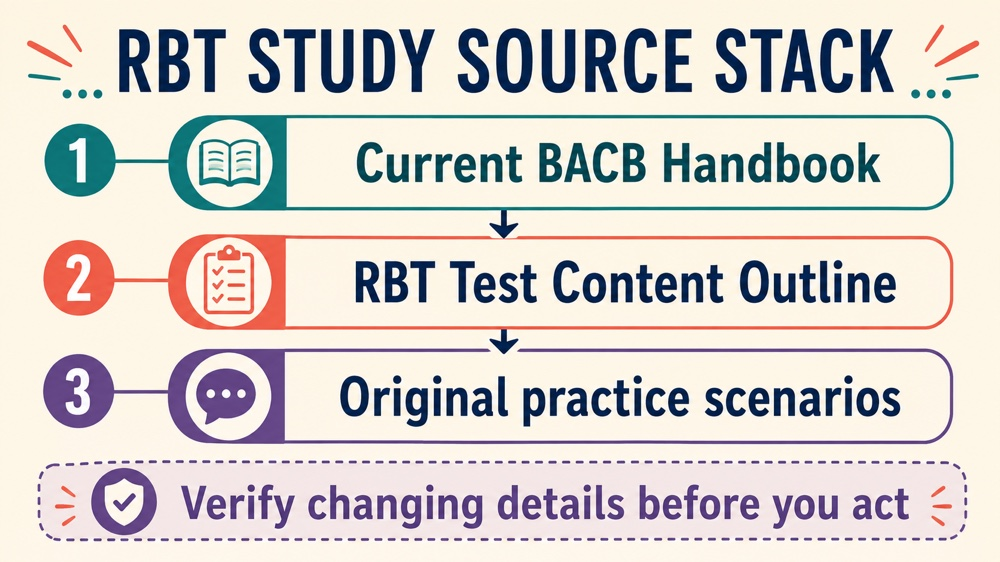
- Can I find the current handbook and TCO instead of relying on an undated summary?
End each study session by writing one “source action” and one “session action.” The source action says where you would verify a changing administrative detail. The session action says what you would do with an assigned learner when the written plan is clear. Keeping those actions separate helps prevent an administrative answer from being applied as an unapproved clinical decision. This two-part review also makes it easier to notice when a question is administrative rather than clinical. Keep the date of your source check beside the note.
Use the exact phrase BACB registered behavior technician when you label the source note, then write the shorter RBT action beneath it. This keeps the search term visible without turning the article into repetitive keyword text.
Practice the concept
Review bacb registered behavior technician with original RBT scenarios, current-source reminders, and clear role boundaries.
Try the RBT practice resource →
Frequently Asked Questions
What does BACB RBT mean?
It refers to the Registered Behavior Technician credential administered by the Behavior Analyst Certification Board.
Is the RBT an independent behavior analyst?
No. An RBT is an entry-level paraprofessional who assists with behavior-analytic services under required supervision and within demonstrated competence.
What should I use to prepare for the RBT examination?
Start with the current RBT Test Content Outline, your qualifying training materials, competency-assessment materials, and the current BACB Handbook.
Are the study scenarios official BACB questions?
No. They are original explanations for independent study and are not official, recalled, leaked, or BACB-endorsed questions.
References
- Behavior Analyst Certification Board: Registered Behavior Technician Handbook, updated June 2026.
- Behavior Analyst Certification Board: RBT Test Content Outline (3rd ed.).
- Behavior Analyst Certification Board: RBT resources.
- RBT Training: independent RBT practice questions.