
People searching for a licensed behavior technician may be trying to understand a job title, a state rule, or the BACB’s RBT certification. Those are not automatically the same thing. The safest answer starts by separating the credential issuer, the jurisdiction, the employer’s title, and the work being performed. In many study contexts the relevant BACB credential is Registered Behavior Technician (RBT), a paraprofessional certification practiced under supervision.
Table of Contents
- Certification, licensure, and a job title are different
- How to verify what an employer means
- What an RBT may do under supervision
- An original job-posting scenario
- Connect the role to the RBT examination
- Local rules and licensed behavior technician source checking
- Ethics and communication in a technician role
- Common confusion points
- Licensed behavior technician study checklist
- Frequently Asked Questions
- References
Quick answer: Treat licensed behavior technician as a current-source study topic. Identify the official credential or document, follow the applicable procedure, practice an original scenario, and keep the RBT’s supervision boundary visible.
Study boundary: This independent guide is educational content. It is not a BACB policy, certification decision, legal opinion, answer key, or guarantee of examination success. Examples are original and are not official, recalled, leaked, or BACB-endorsed questions.
Certification, licensure, and a job title are different
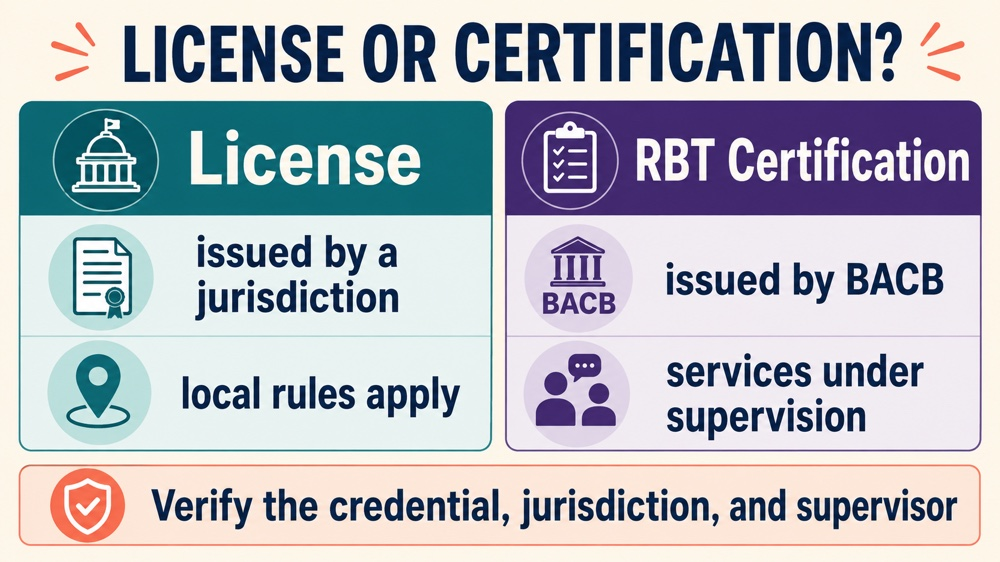
A license is generally a government-issued authorization created by a jurisdiction. A certification is a credential issued by a professional or certifying organization. A job title is what an employer chooses to put in a posting or schedule. These categories can overlap in everyday language, but they should not be treated as interchangeable when a person is deciding whether they may provide services.
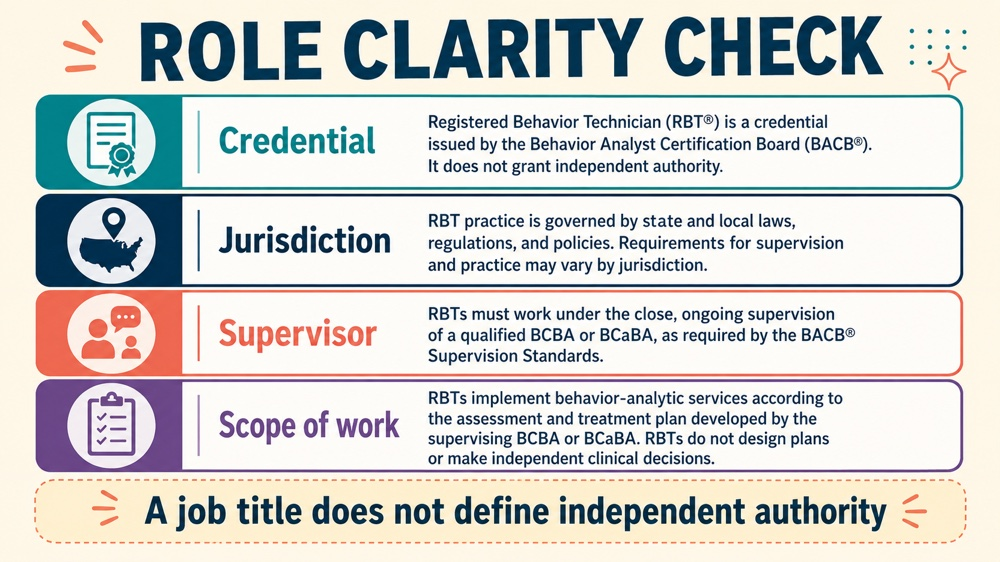
For an RBT candidate, the practical question is: who authorizes this work, under which rules, and who is responsible for supervision? The BACB describes RBTs as paraprofessionals who assist in delivering behavior-analytic services under the direction and close supervision of an RBT Supervisor and/or RBT Requirements Coordinator. Local law, payer rules, employer policy, and the current BACB handbook may add requirements.
How to verify what an employer means
Job postings sometimes use broad phrases such as behavior technician, licensed behavior technician, registered behavior technician, or behavioral health technician. Before accepting the phrase as a credential, read the posting for the issuing body, required application, supervision arrangement, and scope of work. Ask whether the employer expects an active RBT certification, a state license, a background check, or an internal training certificate.
- Identify the exact credential name and issuing organization.
- Ask which jurisdiction’s rules apply at the service location.
- Confirm who provides ongoing supervision and how it is documented.
- Check whether the role includes only assigned implementation or also an independently licensed function.
- Verify what happens if the credential is pending, inactive, or expires.
What an RBT may do under supervision
An RBT may implement assigned teaching or behavior-reduction procedures after demonstrating competence, collect and enter data, document observable session events, communicate concerns, and receive feedback. The exact service setting and plan determine the procedure. The technician’s responsibility is faithful implementation, accurate measurement, privacy, and timely communication.
An RBT should not independently diagnose, conduct an assessment outside the trained assignment, rewrite treatment goals, change mastery criteria, select a new intervention, or promise an outcome. If the written plan conflicts with the immediate situation, the professional response is to follow safety directions, preserve observable information, and seek clinical direction through the chain of command.
An original job-posting scenario
A posting says “licensed behavior technician” and asks the new hire to design goals after a two-week orientation. The applicant should not assume that the title makes the request appropriate. The applicant can ask which license or certification is required, who signs the plan, how competency is assessed, and how supervision is provided. If the role expects independent clinical decisions from an entry-level RBT, that mismatch is a serious boundary question.
A second posting may use the same title but clearly state that the technician implements BCBA-designed programs, records data, attends supervision, and reports variables affecting progress. The title alone cannot distinguish the two roles; the supervision and decision responsibilities do.
Connect the role to the RBT examination
The current RBT Test Content Outline includes tasks for measurement, assessment participation, acquisition, behavior reduction, documentation, and ethics. It describes 43 tasks, while the examination includes 75 scored questions and 10 unscored pilot questions. The outline is useful because it describes technician actions, not a license to practice independently. A question that asks what to do when data are irregular may be testing documentation and supervisor communication. A question that asks who changes a goal may be testing role boundaries and ethics.
Use a three-column study note: “I implement,” “I document or report,” and “I ask a qualified supervisor to decide.” Place measurement procedures, prompting steps, and programmed reinforcement in the first column only when trained and assigned. Place new goals, diagnostic conclusions, and treatment-plan changes in the third column.
Local rules and licensed behavior technician source checking
Credential and title rules can vary by state, province, payer, and employer. A web page written for another jurisdiction may be accurate there and still be wrong for the reader. Check the current BACB RBT page and handbook for certification requirements, then check the relevant local authority or employer for additional rules. Do not present RBT Training as a BACB certification program or as a government licensing agency; this site provides independent study material only.
When a source uses the word licensed, look for the statute, board, or regulation behind the claim. When it uses the word certified, look for the issuer and credential number process. When it uses the word trained, look for the competency and supervision requirements. This simple source check prevents many search-driven misunderstandings.
A good candidate keeps a small source log: the title of the document, the issuing organization, the date checked, and the question it answers. Add a separate note for what remains uncertain. That habit is more reliable than saving several screenshots with no context, especially when a rule changes between application years. If an employer’s policy is stricter than the certification minimum, follow the applicable workplace rule and ask who can explain the difference.
Ethics and communication in a technician role
Role clarity is an ethics issue because unclear titles can lead clients, families, or coworkers to expect services the technician is not authorized or competent to provide. Use accurate professional descriptions, protect confidential information, and avoid public claims that imply independent expertise. If a family asks whether you can add a new goal, explain that the request must go to the responsible supervisor rather than promising an answer.
- Use the credential name accurately in resumes and public profiles.
- Do not imply that an employer title is a state license or BACB certification.
- Share client information only through approved channels and for appropriate purposes.
- Accept feedback, document errors, and seek direction when training is incomplete.
- Report pressure to work outside competence through the appropriate workplace process.
Common confusion points
- Assuming every behavior technician title means the same credential.
- Treating RBT certification as permission to practice without ongoing supervision.
- Using a state-specific licensing article as a universal rule.
- Calling an internal onboarding course a professional certification.
- Letting a title hide a request to diagnose, assess, or redesign treatment.
- Failing to explain the difference when speaking with a learner’s family.
Licensed behavior technician study checklist
- Can I distinguish a license, a certification, a job title, and a training certificate?
- Can I explain what an RBT does under supervision?
- Can I identify a task that belongs to a supervisor rather than an RBT?
- Can I verify the jurisdiction and issuing authority behind a credential claim?
- Can I describe the role accurately without overstating independence?
- Can I use current BACB and local sources when requirements may change?
If you are studying for an interview, practice one respectful question about supervision and one about the exact credential. Those questions help you protect clients and yourself without sounding adversarial. A clear employer should be able to explain who provides direction, how competence is evaluated, and what decisions remain outside the technician role. Keep the answer tied to the actual posting rather than assuming that a familiar title has one universal meaning.
Practice the concept
Review licensed behavior technician with original RBT scenarios, current-source reminders, and clear role boundaries.
Try the RBT practice resource →
Frequently Asked Questions
Is a licensed behavior technician the same as an RBT?
Not automatically. The phrase may describe a local license, an employer title, or informal wording. Verify the issuing authority and current jurisdictional requirements.
Can an RBT work without supervision?
RBT services are provided under direction and close or ongoing supervision as required by current BACB rules and the service arrangement.
Can an RBT change a treatment goal?
An RBT should not independently change goals or treatment procedures. Document the concern and seek direction from the responsible supervisor.
Is RBT Training affiliated with BACB?
No. RBT Training provides independent study content and is not a BACB certification program or BACB-endorsed provider.
References
- Behavior Analyst Certification Board: Registered Behavior Technician Handbook, updated June 2026.
- Behavior Analyst Certification Board: RBT Test Content Outline (3rd ed.).
- Behavior Analyst Certification Board: RBT resources.
- RBT Training: independent RBT practice questions.