

RBT exam application is a search phrase for the administrative path that connects eligibility evidence, a certification application, an approval decision, and examination scheduling. The application is not the examination itself and a training certificate is not the same as certification. Candidates should use the current BACB RBT Handbook and the action items in their own portal for dates, fees, document rules, and decisions.
Table of Contents
- What the RBT exam application actually does
- Before starting the RBT exam application
- A step-by-step application workflow
- Names, documents, and identity matching
- What happens after submission
- A realistic application scenario
- Application errors that create avoidable delays
- How to study for RBT exam application questions
- The application and the RBT role boundary
- RBT exam application final checklist
- Frequently Asked Questions
- References
Quick answer: Treat rbt exam application as a current-source study topic. Define the term, follow the written procedure, practice an original scenario, and keep the RBT’s supervision boundary visible.
Study boundary: This independent guide is educational content. It is not a BACB policy, certification decision, legal opinion, answer key, or guarantee of examination success. Examples are original and are not official, recalled, leaked, or BACB-endorsed questions.
Current exam context: The current BACB RBT Test Content Outline describes 43 tasks across six domains; the examination includes 75 scored questions and 10 unscored pilot questions in a 90-minute testing period. Verify the current handbook and outline before relying on a time-sensitive detail.
What the RBT exam application actually does
An RBT exam application gives the certification board the information needed to determine whether a candidate may proceed in the credential pathway. It is an administrative record, not a substitute for the 40-hour training, initial competency assessment, background checks, or other applicable evidence. Once an application is approved, the candidate receives instructions about the examination and testing process.
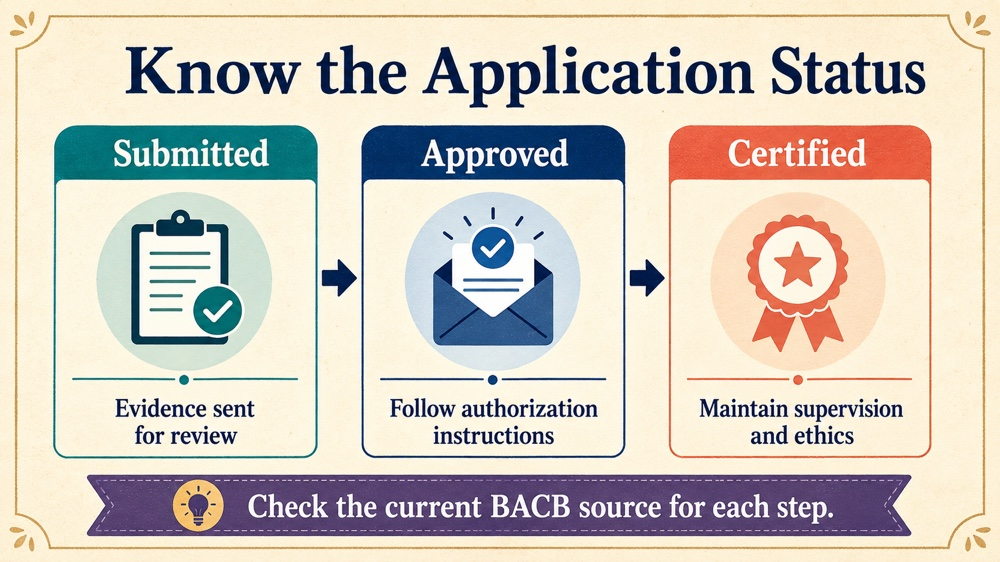
This distinction helps answer common study and planning questions. A candidate may be ready to take a course but not ready to submit an application. A submitted application may be under review but not yet authorize an examination. A passed examination may not remove ongoing supervision or ethical responsibilities. Keep those statuses in separate columns in a personal checklist.
Before starting the RBT exam application
Begin with the current handbook and make a document inventory. Check your legal name, date of birth, education evidence, training certificate, competency assessment, background-check timing, abuse-registry requirements where applicable, and the identity of the people who must attest or assess. The exact rules and transition provisions can change, so do not copy dates from an old course handout.
- Create or access one BACB portal account using a durable personal email.
- Confirm that your name matches the government identification used for testing.
- Save clean copies of certificates, assessments, and required supporting records.
- Mark the completion date and expiration or validity window for time-sensitive evidence.
- Ask the appropriate source about an ambiguity before submitting or paying.
A step-by-step application workflow
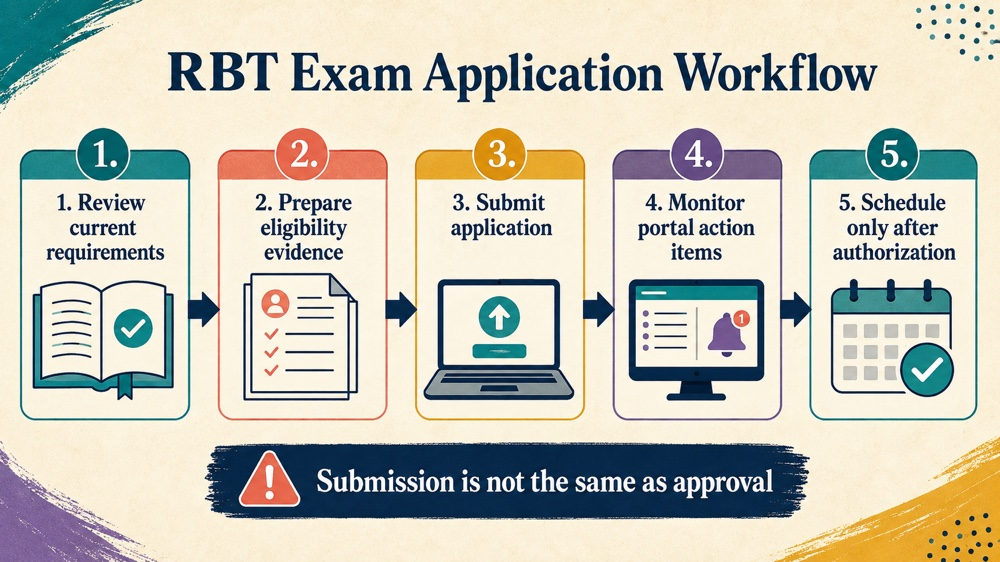
A practical workflow is to review the current requirements, complete the training and competency steps, assemble the documents, submit the application, pay the applicable fee, monitor the portal, respond to action items, and schedule the examination only after receiving authorization. Each step creates a different kind of evidence. The portal confirmation shows submission; it does not prove approval.
Use a simple status table with four labels: not started, evidence ready, submitted, and decision received. Save the date of each change and a copy of any message that explains the next action. If the board requests a correction, read the request literally. Re-uploading a file without fixing a mismatch may prolong the review.
Names, documents, and identity matching
Identity mismatches are a preventable source of delay. The name in the portal, training record, competency assessment, and examination identification should be handled consistently according to the current instructions. A missing middle name or a different surname may require clarification; do not edit an official record yourself or assume that a note in the upload will resolve it.
A candidate who notices a mismatch should identify which organization issued the document, ask what correction is needed, and retain the response. The same careful approach applies to an unreadable scan, a missing signature, a date outside the allowed window, or a form completed by someone who may not meet the applicable eligibility rules. Accurate records are part of professional practice, not just administrative paperwork.
What happens after submission
After submission, monitor the portal and the email address associated with the account. A request for more information is not automatically a rejection, but it is also not something to ignore. Read the exact action item, check the applicable section of the current handbook, and respond within the stated time. Keep a private log of what was sent and when.
If the application is approved, follow the testing instructions and verify the name and identification requirements before scheduling. If the application is returned or denied, read the reason and the available next step. Do not submit multiple conflicting applications simply because a status is unfamiliar. When a decision is unclear, use the official channel rather than relying on a social-media interpretation.
A realistic application scenario
Suppose a candidate completed a 40-hour training course, but the certificate uses a nickname while the portal uses the candidate’s legal name. The candidate should not assume that the course is invalid, and should not alter the certificate. The next step is to compare the current application instructions, contact the training provider or BACB as appropriate, and obtain accurate documentation or direction before submitting.
Now change the scenario: the candidate has an application confirmation but no examination authorization. The correct conclusion is that the file was submitted, not that the candidate may schedule. This is the kind of distinction that appears in good study questions because it tests status reading rather than memorization of a course advertisement.
Application errors that create avoidable delays
- Using an old eligibility checklist without checking the current handbook.
- Submitting an unreadable file, missing signature, or inconsistent legal name.
- Treating a training completion certificate as proof of RBT certification.
- Scheduling before the application or examination authorization is received.
- Ignoring a portal action item because the original submission was successful.
- Creating duplicate accounts or applications to solve an unclear status.
- Assuming fees, processing windows, or testing rules stay the same every year.
How to study for RBT exam application questions
Turn the application into a decision map. For each requirement, write who controls it, what evidence demonstrates it, when it must be completed, and what a candidate should do if it is missing. Then practice scenarios involving a submitted-but-not-approved application, a corrected document, a changed name, a portal message, and an examination scheduling instruction.
Administrative questions reward careful reading. Circle verbs such as submit, verify, monitor, schedule, maintain, and report. Ask whether the scenario describes a candidate action, a BACB decision, a training-provider responsibility, or a supervising-team responsibility. When a question involves a changing rule, the safest study answer is to check the current source rather than invent a date.
The application and the RBT role boundary
The application process and service delivery are connected by the same professional habit: do not claim more authority than the evidence supports. An RBT candidate should not sign as a supervisor, change a clinical plan to compensate for a missing document, or represent a pending application as an active credential. Once certified, an RBT still works under direction and close supervision within demonstrated competence.
Keep administrative records separate from client records, protect account credentials, and use only the communication channels authorized by the relevant organization. A polished application does not authorize independent assessment, diagnosis, treatment-plan design, or public claims about certification. This boundary is useful both for the exam and for real workplace decisions.
RBT exam application final checklist
- Have I read the current RBT Handbook that applies to my application date?
- Are my portal name, identification, certificates, and assessment records consistent?
- Can I explain the difference between training, application submission, approval, authorization, and certification?
- Do I know how to monitor and respond to a portal action item?
- Will I verify current fees, dates, testing rules, and validity windows instead of using an old post?
- Can I identify which question belongs to the BACB, the training provider, the assessor, or the supervisor?
- Have I saved confirmation records without exposing private account information?
Use this checklist as a preparation tool, not as a replacement for the current BACB instructions. The official source controls when a requirement, transition rule, or portal instruction changes.
Practice the concept
Review rbt exam application with original RBT scenarios, current-source reminders, and clear role boundaries.
Review the RBT study resource →
Frequently Asked Questions
Is the RBT exam application the same as the RBT certification?
No. The application is part of the pathway used to determine eligibility and examination access. Certification depends on completing the applicable requirements and passing the examination.
Can I schedule the exam right after submitting the application?
Only follow the current authorization and scheduling instructions. Submission confirmation is not necessarily examination authorization.
What should I do if a document has a name mismatch?
Review the current instructions, contact the document issuer or BACB through the appropriate channel, and obtain accurate direction before altering or resubmitting records.
Is this page affiliated with BACB?
No. RBT Training provides independent study content and is not a BACB certification program or BACB-endorsed provider.
References
- Behavior Analyst Certification Board: Registered Behavior Technician Handbook, updated June 2026.
- Behavior Analyst Certification Board: RBT Test Content Outline (3rd ed.).
- Behavior Analyst Certification Board: RBT resources.
- Behavior Analyst Certification Board: ethics resources.
- Behavior Analyst Certification Board: RBT Ethics Code (2.0).